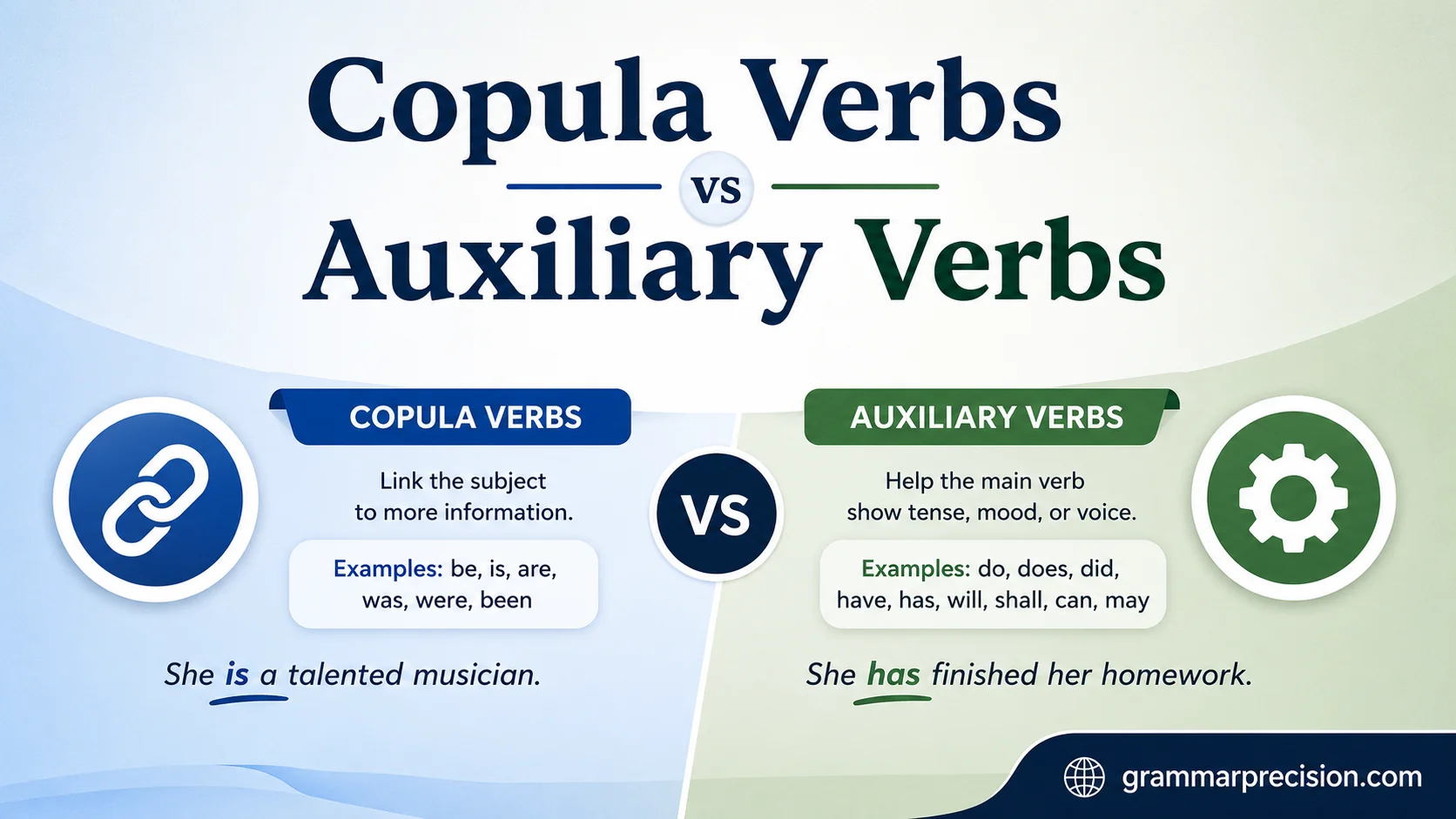
Copula Verbs vs Auxiliary Verbs is an important grammar topic that helps learners understand verb functions, sentence meaning, and language structure, making communication clearer, stronger, and more effective overall.
In English grammar, copula verbs act as linking verbs that connect a subject to a complement, expressing state, identity, or condition. Verbs such as is, am, are, was, and were help describe meaning clearly. Understanding their function improves writing, comprehension, and overall communication, giving learners greater confidence in sentence construction.
Unlike copula verbs, auxiliary verbs support the formation of tenses, moods, and aspects. Words like have, has, had, will, can, and must help express actions, questions, and emphasis. Through practice, examples, and careful usage, learners develop semantic accuracy, strengthen speaking skill, and improve communication effectiveness in professional and everyday contexts.
Quick Answer: Copula Verbs vs Auxiliary Verbs
If you’re looking for the short answer, here it is.
A copula verb connects the subject to information that describes or identifies it.
Example:
The sky is blue.
The verb is links sky to blue.
An auxiliary verb helps another verb express tense, mood, voice, or aspect.
Example:
The sky is becoming darker.
The verb is helps the main verb becoming.
Quick Comparison Table
| Feature | Copula Verb | Auxiliary Verb |
| Main Function | Connects subject to complement | Helps main verb |
| Can Stand Alone? | Yes | Usually no |
| Expresses Action? | No | Supports action |
| Examples | is, am, are, seem, become | is, have, do, can, will |
| Requires Main Verb? | No | Yes |
| Example Sentence | She is happy. | She is working. |
At first glance, the distinction looks simple.
However, English grammar contains many exceptions and overlaps. That’s where deeper understanding becomes valuable.
Understanding the Foundation of English Verbs
Before exploring the difference between copula verbs and auxiliary verbs, you need a solid grasp of how verbs function in English.
Think of a sentence as a machine.
Every component has a specific job.
Some verbs carry meaning directly. Others support those verbs behind the scenes.
Main Verbs
A main verb expresses the primary action or state.
Examples:
- run
- jump
- write
- sing
- think
Sentence examples:
- Maria writes novels.
- The dog runs quickly.
- They play soccer.
The main verb provides the sentence’s central meaning.
Helping Verbs
Helping verbs support main verbs.
Examples:
- is
- are
- have
- do
- can
- may
- will
Sentence examples:
- She is running.
- They have finished.
- We will travel tomorrow.
These helping verbs create grammatical meaning rather than lexical meaning.
What Is a Copula Verb?
A copula verb links the subject to a subject complement.
Rather than showing action, it creates a relationship.
The word copula comes from Latin and means:
“link” or “connection.”
That’s exactly what these verbs do.
They connect information.
Copula Formula
Subject + Copula Verb + Complement
Example:
Sarah + is + intelligent
The verb does not describe an action.
Instead, it connects Sarah with a description.
The Core Function of Copula Verbs
Copula verbs answer questions such as:
- What is it?
- Who is it?
- What is it like?
- What did it become?
Examples:
| Sentence | Copula Verb | Complement |
| John is a teacher. | is | a teacher |
| The soup smells delicious. | smells | delicious |
| The weather became cold. | became | cold |
| She seems tired. | seems | tired |
Notice something interesting.
None of these verbs express physical action.
Instead, they connect the subject to additional information.
Common Copula Verbs
Although forms of be are the most common copula verbs, several others can serve the same purpose.
Forms of Be
- am
- is
- are
- was
- were
- be
- being
- been
Examples:
- She is happy.
- They were excited.
- I am ready.
Other Common Copula Verbs
- seem
- appear
- become
- remain
- stay
- feel
- look
- sound
- smell
- taste
Examples:
- The cake looks delicious.
- He became angry.
- The room feels warm.
- The plan seems reasonable.
These verbs link rather than act.
Also Read This: No Problem vs. Not a Problem
What Is an Auxiliary Verb?
An auxiliary verb, often called a helping verb, supports another verb.
It helps create:
- tense
- aspect
- voice
- mood
- questions
- negatives
Without auxiliary verbs, English would struggle to express many complex meanings.
Auxiliary Verb Formula
Subject + Auxiliary Verb + Main Verb
Example:
Sarah + is + studying
The word studying contains the primary meaning.
The word is supports it.
Why Auxiliary Verbs Matter
Imagine trying to communicate without helping verbs.
Instead of saying:
She is studying.
You might only say:
She study.
The meaning becomes unclear.
Auxiliary verbs add crucial information.
They tell readers and listeners:
- When something happens
- Whether it is complete
- Whether it is possible
- Whether it is required
Primary Auxiliary Verbs
English has three primary auxiliary verbs:
| Auxiliary | Function |
| Be | Progressive and passive forms |
| Have | Perfect tenses |
| Do | Questions and negatives |
Examples:
Be
- She is working.
- They were laughing.
Have
- I have finished.
- We had arrived earlier.
Do
- Do you agree?
- She does not know.
Modal Auxiliary Verbs
Modal verbs express possibility, necessity, permission, ability, or prediction.
Examples include:
- can
- could
- may
- might
- shall
- should
- will
- would
- must
Examples:
- You can swim.
- We must leave.
- She might arrive soon.
- They will travel tomorrow.
Modal auxiliaries never function as copulas.
They always support another verb.
Copula Verbs vs Auxiliary Verbs: Side by Side Comparison
Now let’s compare them directly.
| Feature | Copula Verb | Auxiliary Verb |
| Purpose | Connects subject and complement | Supports main verb |
| Main Meaning | Relationship or state | Grammatical meaning |
| Needs Another Verb | No | Yes |
| Expresses Description | Yes | No |
| Expresses Tense | Sometimes | Frequently |
| Example | She is happy. | She is singing. |
This distinction forms the foundation of the entire topic.
The Special Case of the Verb “Be”
Here’s where things become interesting.
The verb be wears multiple hats.
Sometimes it behaves as a copula.
Sometimes it functions as an auxiliary.
Sometimes it acts as both historically and structurally.
This flexibility creates most learner confusion.
When “Be” Functions as a Copula
In these examples, be links the subject to a complement.
Examples:
- She is smart.
- They are tired.
- The sky was blue.
- The meeting is tomorrow.
Notice something important.
Nothing follows the verb except descriptive information.
The verb creates a connection.
When “Be” Functions as an Auxiliary
Now look at these examples:
- She is studying.
- They are running.
- The car was repaired.
- We were waiting.
The verb be supports another verb.
The main meaning comes from:
- studying
- running
- repaired
- waiting
This makes be an auxiliary.
A Simple Trick to Identify the Difference
Ask yourself:
Does the verb connect the subject to information?
If yes, it’s likely a copula.
Or ask:
Does the verb help another verb?
If yes, it’s likely an auxiliary.
Examples:
She is happy.
Connection? Yes.
Answer: Copula.
She is dancing.
Helping another verb? Yes.
Answer: Auxiliary.
Sentence Structure Diagrams
Visual learners often grasp grammar faster through patterns.
Copula Structure
Subject
↓
Copula Verb
↓
Complement
Example:
The flower → is → beautiful
Auxiliary Structure
Subject
↓
Auxiliary Verb
↓
Main Verb
Example:
The flower → is → growing
The structures look similar.
The functions differ dramatically.
Subject Complements: The Key to Identifying Copula Verbs
A subject complement completes the meaning of the subject.
It follows a copula verb.
Two common types exist:
Predicate Nouns
These rename the subject.
Examples:
- Sarah is a doctor.
- Tom became a manager.
- My brother remains a student.
Predicate Adjectives
These describe the subject.
Examples:
- Sarah is intelligent.
- The coffee smells wonderful.
- The water feels cold.
Whenever you spot a subject complement, you’re usually dealing with a copula verb.
Why English Learners Struggle with Copula Verbs and Auxiliary Verbs
Many languages don’t separate these concepts in the same way English does.
As a result, learners often assume:
Every form of “be” is the same.
Unfortunately, that shortcut creates mistakes.
Consider these sentences:
- She is beautiful.
- She is singing.
The same word appears.
The grammatical role changes completely.
Understanding function rather than memorizing words solves this problem.
FAQs:
What are copula verbs?
Copula verbs are linking verbs that connect a subject to a word or phrase that describes it. Common examples include is, am, are, was, and were. They help express state, identity, or condition rather than action.
What are auxiliary verbs?
Auxiliary verbs, also called helping verbs, support the main verb in a sentence. Words such as have, has, had, will, can, and must help form tenses, moods, and aspects while adding important grammatical meaning.
How can I identify the difference between copula and auxiliary verbs?
A copula verb links the subject to a description or identity, while an auxiliary verb helps another verb express time, possibility, necessity, or completion. Looking at the verb’s function in the sentence is the easiest way to identify it.
Why are copula verbs important in English grammar?
Copula verbs improve clarity and help speakers describe people, places, objects, and conditions accurately. They are essential for building meaningful sentences and expressing ideas clearly in both speaking and writing.
Why should learners master auxiliary verbs?
Mastering auxiliary verbs helps learners use correct sentence structure, form different tenses, and communicate with greater accuracy. They are important for asking questions, making negatives, and expressing different shades of meaning.
Conclusion:
Understanding Copula Verbs vs Auxiliary Verbs is essential for improving English grammar, writing, and speaking skills. While copula verbs connect a subject to its description or identity, auxiliary verbs support the main verb and help form different grammatical structures.
Learning their functions, usage, and differences strengthens communication effectiveness, improves semantic accuracy, and builds confidence in both academic and everyday communication.