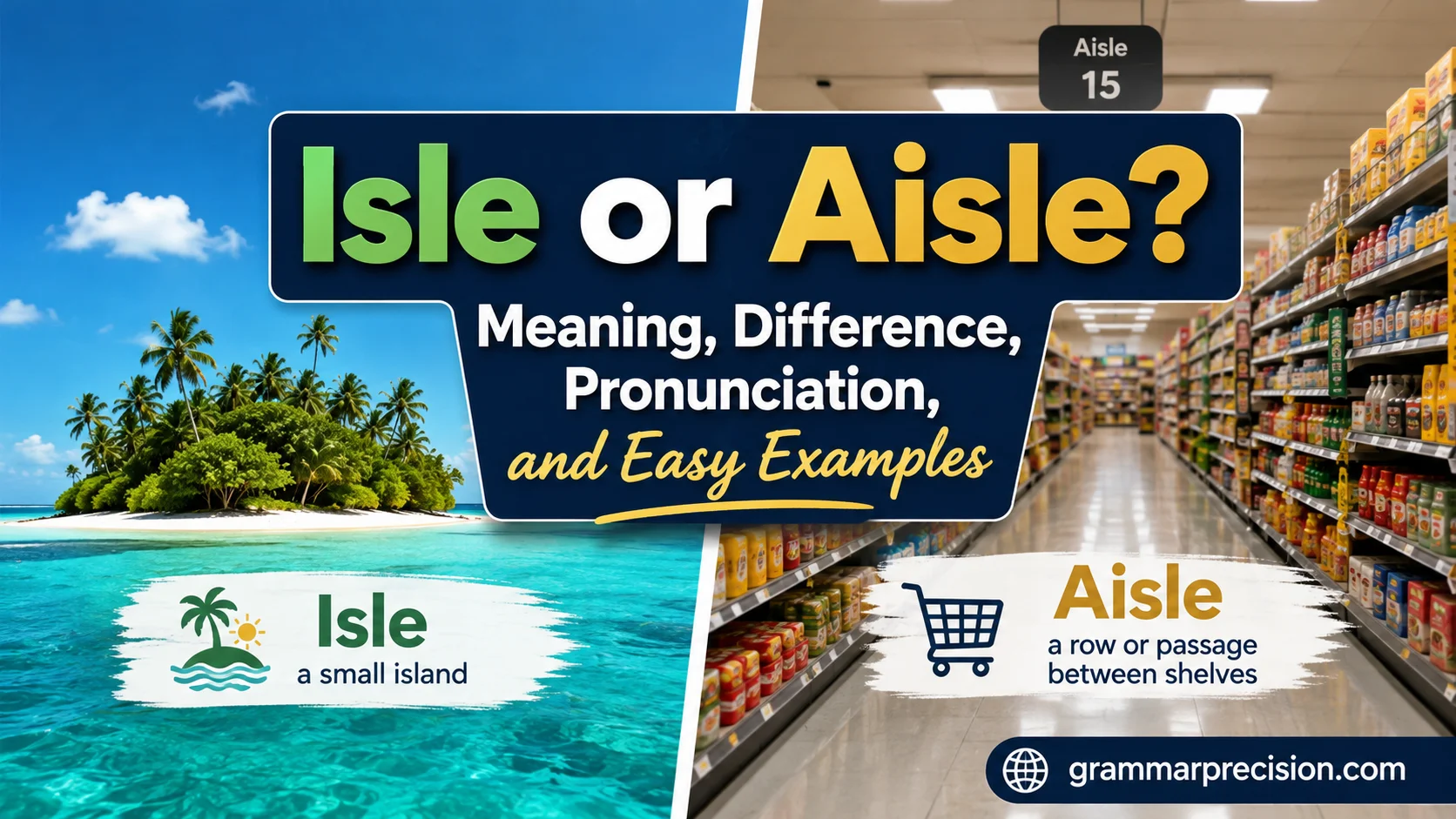
Isle or Aisle? These commonly confused words have the same pronunciation, but their spelling, meaning, and usage are different. Understanding this distinction improves clear communication.
An aisle refers to a passageway between rows of seats in a building, theater, or supermarket. You may also find an aisle between sections and shelves in stores. Think of grocery shopping or walking through a store when remembering this word. Its meaning depends on context.
An isle refers to a small island or peninsula, usually in a geographic location. Although aisle and isle are homophones, their meanings differ. Remember isle when thinking about travel, a tropical vacation, or an island. This simple connection makes the correct word choice easier to understand and use.
Isle or Aisle: The Quick Answer
The easiest way to remember the difference is simple:
| Word | Meaning | Common Examples |
| Aisle | A passage or walkway between rows or sections | grocery aisle, airplane aisle, wedding aisle |
| Isle | An island, especially a small one | tropical isle, remote isle, Isle of Man |
Both words are pronounced /aɪl/, which sounds like “I’ll.” That makes them homophones. Homophones have the same pronunciation but different meanings and spellings.
Aisle Means a Passage
Use aisle when you mean a space people walk through. You’ll see this word in stores, airplanes, churches, theaters, libraries, and other places arranged in rows.
Examples:
- Please meet me in the cereal aisle.
- She chose an aisle seat on the flight.
- The bride walked down the aisle.
- Keep the center aisle clear.
Isle Means an Island
Use isle when you mean a piece of land surrounded by water. The word often appears in geographical names, travel writing, and literary descriptions.
Examples:
- They spent a week on a remote isle.
- The ship passed a tiny isle at sunset.
- The Isle of Man lies in the Irish Sea.
- The writer described a peaceful tropical isle.
What Does “Aisle” Mean?
An aisle is a passage that separates rows of seats, shelves, or other objects. Its main purpose is movement. If people need a clear path between sections, that space can be called an aisle.
You’ll encounter the word constantly in everyday American English. Think about a supermarket: shelves line both sides while shoppers move through the open space in the middle. That open path is an aisle.
The same idea works in many settings.
Aisle in a Grocery Store
A grocery store can have dozens of aisles. Each one usually contains a particular group of products.
You might hear:
- “The pasta is in aisle six.”
- “I’ll meet you in the frozen-food aisle.”
- “Which aisle has the cleaning supplies?”
The spelling aisle matters here. Writing “grocery isle” is a common mistake.
A quick test can help: Can people walk through the space? If yes, aisle is probably the word you need.
Aisle on an Airplane
An airplane has seats arranged in rows with a walking path between them. That path is the aisle.
This creates several familiar expressions:
- aisle seat
- aisle seat preference
- aisle side
- walk down the aisle
- stand in the aisle
For example:
I prefer an aisle seat because I can get up easily.
An aisle seat gives you direct access to the aisle. A window seat, naturally, places you beside the aircraft window.
Aisle at a Wedding or Church
One of the most recognizable uses appears in weddings.
A bride or groom may walk down the aisle toward the person conducting the ceremony. In this expression, aisle refers to the passage between rows of seats.
That phrase also appears figuratively. If someone says a couple is “walking down the aisle,” they usually mean the couple is getting married.
The spelling still stays aisle.
Aisle in a Theater or Auditorium
Theaters, cinemas, schools, and auditoriums often arrange seats in blocks. Narrow passages separate those blocks so people can enter and leave.
Those passages are aisles.
For example:
- Please don’t leave bags in the aisle.
- The usher stood near the center aisle.
- We sat beside the aisle.
In buildings, aisles also serve an important practical purpose. They provide access, guide movement, and help people reach exits.
“Across the Aisle” as a Figurative Expression
Aisle has a second life in political language.
The expression “across the aisle” describes cooperation or disagreement between opposing political groups. It comes from legislative chambers where different groups sit on opposite sides of a central aisle.
For example:
- The lawmakers worked across the aisle to pass the bill.
- Both parties found common ground across the aisle.
Here, the word still comes from the idea of a physical passage. English often turns ordinary physical spaces into useful metaphors.
What Does “Isle” Mean?
An isle is an island. More specifically, it often suggests a relatively small island.
However, you shouldn’t treat “isle” as a strict scientific measurement. English doesn’t provide a universal rule saying an island becomes an isle at a particular number of acres or square miles.
Instead, isle often carries a particular tone. It can sound geographical, traditional, poetic, or literary.
For example, “small island” is completely ordinary. “Remote isle” feels more evocative. It may make you picture cliffs, blue water, sea birds, and a distant horizon.
Isle vs. Island
The words isle and island overlap strongly in meaning. In many sentences, you could use either one.
Consider these examples:
- They discovered a small island.
- They discovered a small isle.
Both sentences work. The second may sound more descriptive or literary.
There is also an important naming tradition. Many official place names contain Isle, even when people commonly describe those locations as islands.
The key point is this: isle does not simply mean “a very tiny island.” Usage, history, and naming conventions also influence the choice.
Famous Names Containing “Isle”
The word appears in several well-known geographical names.
Examples include:
- Isle of Man
- Isle of Wight
- Isles of Scilly
- Emerald Isle, a nickname for Ireland
These names show why you shouldn’t replace isle with aisle simply because the words sound identical.
Is an Isle Always Small?
Not necessarily.
Traditional English usage often associates isle with a small island, but the distinction isn’t a precise scientific category. A dictionary-style definition and a geographic classification aren’t always the same thing.
For everyday writing, you can think of isle as an island word with a slightly more picturesque or formal flavor.
Isle vs. Aisle: Side-by-Side Comparison
The fastest way to understand isle vs. aisle is to compare their jobs in a sentence.
| Feature | Aisle | Isle |
| Meaning | Passage or walkway | Island |
| Pronunciation | /aɪl/ | /aɪl/ |
| Part of speech | Noun | Noun |
| Common setting | Stores, planes, churches, theaters | Geography and travel |
| Typical phrase | aisle seat | tropical isle |
| Can you walk through it? | Yes | Not normally |
| Can it be surrounded by water? | No | Yes |
| Common mistake | “grocery isle” | “tropical aisle” |
Notice how one spelling points to movement while the other points to geography.
That contrast gives you a reliable shortcut.
Why Are “Isle” and “Aisle” Pronounced the Same?
Isle and aisle are homophones. They share pronunciation even though their spellings and meanings differ.
The silent letters make the confusion worse.
In aisle, the letters do not tell you much about how the word sounds. In isle, the final e is silent. Both words ultimately produce the same spoken sound: /aɪl/.
This is one reason English spelling can feel unpredictable. English has absorbed vocabulary from several languages over centuries. Spellings often preserve historical clues that modern pronunciation no longer reveals.
Isle, Aisle, and “I’ll”
There is another word to add to the pronunciation puzzle: I’ll.
These three forms are pronounced alike in standard American English:
- isle — island
- aisle — passageway
- I’ll — contraction of “I will”
Their meanings are completely different.
Compare:
- The boat reached the isle.
- Walk down the aisle.
- I’ll call you tonight.
Context tells you which word belongs on the page.
How to Pronounce Isle and Aisle
Both isle and aisle are normally pronounced like “I’ll.”
The pronunciation can be represented as /aɪl/.
Break it into two parts:
- /aɪ/ — the vowel sound in “eye”
- /l/ — the final sound in “light”
So you can think:
eye + l = isle / aisle
Don’t pronounce the letters individually. The spelling doesn’t work that way.
Isle vs. Aisle Memory Tricks That Actually Work
You don’t need to memorize a complicated rule. A simple mental image works better.
Remember “Isle” With “Island”
The word isle begins with the same sound and letters as island.
Think:
ISLE → ISLAND
If your sentence describes land surrounded by water, choose isle.
Remember “Aisle” With “Access”
Think of an aisle as a route that gives you access.
AISLE → ACCESS → WALKWAY
If people walk through it, aisle is your answer.
Use the Sentence Test
When you’re unsure, replace the word with walkway or island.
If walkway makes sense, use aisle.
The boxes are blocking the walkway.
The boxes are blocking the aisle. ✓
If island makes sense, use isle.
They sailed toward the island.
They sailed toward the isle. ✓
This tiny substitution test can prevent most spelling errors.
Common Isle and Aisle Mistakes
Because the words sound identical, people often spell them according to context incorrectly.
“Grocery Isle” vs. “Grocery Aisle”
Incorrect: I found the cereal in the grocery isle.
Correct: I found the cereal in the grocery aisle.
A grocery store has passages, not islands.
“Aisle Seat” vs. “Isle Seat”
Incorrect: I booked an isle seat.
Correct: I booked an aisle seat.
You’re sitting beside a passageway, not a piece of land.
“Walk Down the Isle” vs. “Walk Down the Aisle”
Incorrect: She walked down the isle at the wedding.
Correct: She walked down the aisle at the wedding.
Unless the wedding takes place on an island and the person is literally crossing it, aisle is the correct choice.
“Tropical Aisle” vs. “Tropical Isle”
Incorrect in the usual geographical sense: They stayed on a tropical aisle.
Correct: They stayed on a tropical isle.
A tropical isle is an island. A tropical aisle would be a very unusual walkway.
Also Read This: Fit or Fitted: Meaning, Grammar Rules & Differences
Common Phrases With “Aisle”
Learning common phrases can make the spelling almost automatic.
- aisle seat
- center aisle
- main aisle
- grocery aisle
- store aisle
- church aisle
- wedding aisle
- airplane aisle
- theater aisle
- across the aisle
- walk down the aisle
Each phrase connects aisle with movement, rows, access, or figurative division.
Common Phrases With “Isle”
Isle appears less often in everyday conversation. Still, several phrases and names are familiar.
- tropical isle
- remote isle
- deserted isle
- beautiful isle
- isle of paradise
- Isle of Man
- Isle of Wight
- Emerald Isle
The word often creates a more scenic image than the plain word island.
Compare:
They rented a house on a small island.
with:
They rented a house on a quiet isle.
Both are correct. The second simply has a more evocative tone.
Isle vs. Island vs. Islet
These three words are related, but they aren’t interchangeable in every context.
| Word | General Meaning | Typical Feel |
| Island | Land surrounded by water | Neutral and common |
| Isle | Island, often a small or named one | Literary, geographic, or traditional |
| Islet | A very small island | More specifically small |
Island is by far the most general choice.
Isle often appears in names and descriptive writing.
Islet emphasizes small size.
For example:
- We visited an island during our vacation.
- The ship passed a distant isle.
- Birds nested on a rocky islet.
Isle or Aisle Examples in Real Sentences
Here are practical examples across several contexts:
Shopping
- The bread is in the fourth aisle.
- Don’t leave your cart in the aisle.
- We couldn’t find the product in any aisle.
Travel
- I always request an aisle seat.
- The boat sailed past a rocky isle.
- They photographed a distant isle from the deck.
Weddings
- The bride walked slowly down the aisle.
- Guests stood beside the aisle as the ceremony began.
Geography
- The tiny isle was surrounded by clear water.
- Several isles appeared on the horizon.
Politics
- Lawmakers from both sides of the aisle supported the proposal.
- The senator called for cooperation across the aisle.
Isle or Aisle: Practice Quiz
Choose isle, aisle, or I’ll.
- The snacks are in the next ______.
- They sailed toward a distant ______.
- ______ see you after dinner.
- She prefers an ______ seat.
- The bride walked down the ______.
- The fishermen reached a rocky ______.
- Please don’t block the ______.
- ______ send the documents tomorrow.
- The two groups worked across the ______.
- They spent their honeymoon on a quiet ______.
Answers
- aisle
- isle
- I’ll
- aisle
- aisle
- isle
- aisle
- I’ll
- aisle
- isle
The pattern becomes easier once you stop listening for the sound and start checking the meaning.
FAQs:
What is the difference between aisle and isle?
An aisle is a passageway between rows, seats, or shelves, while an isle means a small island. Their meanings and spellings are different.
How do you use aisle in a sentence?
You use aisle when talking about a passage in a theater, supermarket, airplane, church, or store. For example, “She walked down the aisle to find the cereal.”
How do you use isle in a sentence?
Use isle when referring to an island, especially in a geographical or travel context. For example, “They spent their vacation on a beautiful isle.”
Are aisle and isle pronounced the same?
Yes. Aisle and isle are homophones, meaning they have the same pronunciation but different spellings and meanings.
How can I remember aisle vs. isle?
Remember that aisle contains “ai,” which you can associate with a store aisle or a passageway. Isle is connected with an island, making it easier to remember.
Conclusion:
Understanding aisle and isle becomes simple when you focus on their meanings and contexts. An aisle describes a passageway, while an isle refers to an island. Although they share the same pronunciation, their spelling and usage differ. Remember these basic distinctions, and you’ll make the right word choice in everyday writing, speaking, travel, shopping, and other situations.