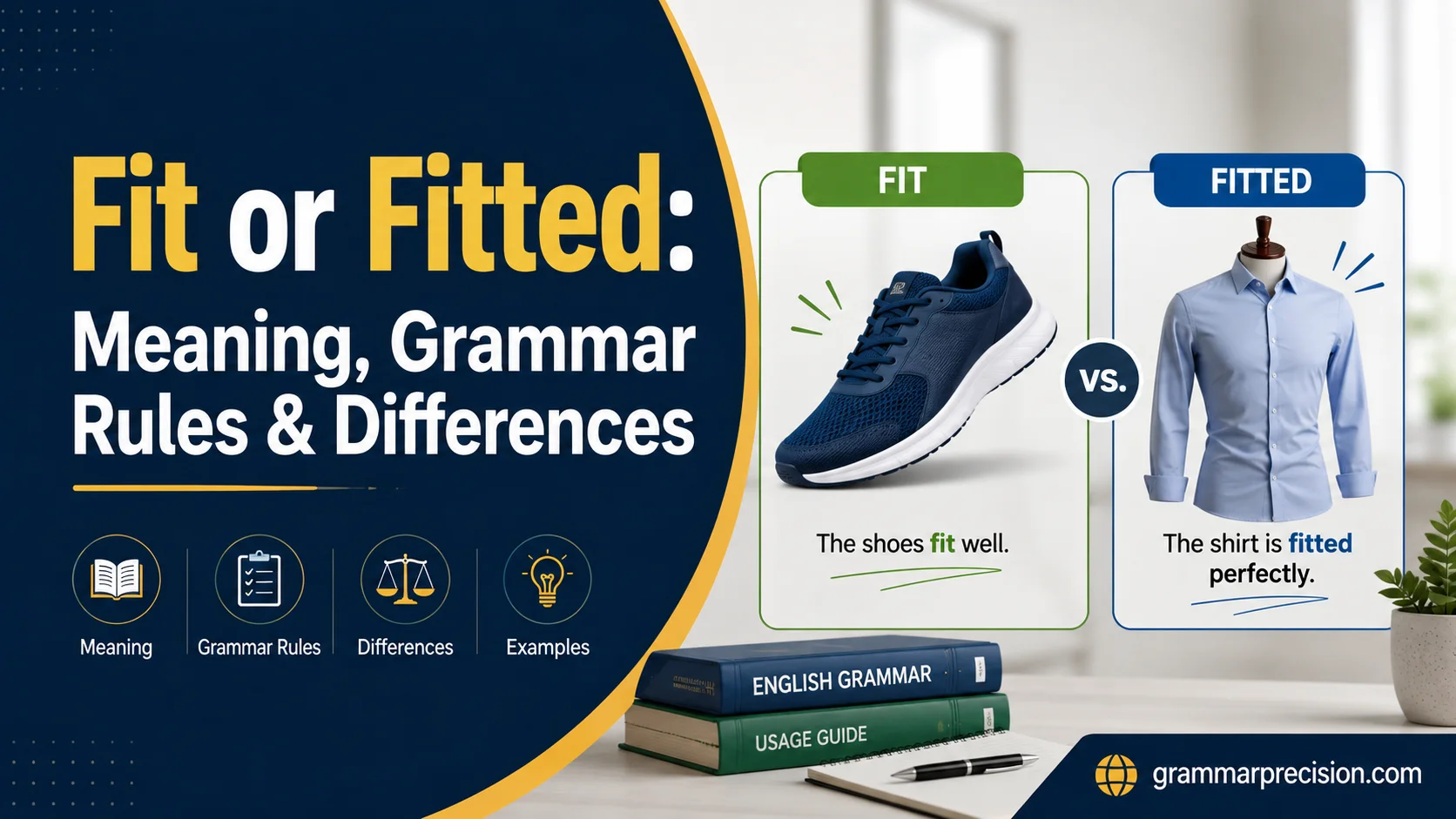
Fit or Fitted can confuse English learners because both forms are correct. American English often uses fit, while British English commonly prefers fitted in certain verb forms and contexts.
When used as adjectives, fit and fitted have different meanings. Fit means healthy or appropriate, while fitted means designed to fit. Understanding this distinction helps you choose the correct word when discussing grammar, clothing, or whether something suits a particular purpose or situation.
In clothing, regular fit and fitted styles can affect your body shape, comfort, and overall look. The right fit should help you feel confident and comfortable. Choosing suitable clothes matters because different styles can emphasize your shape, provide easier movement, and help you find clothing that truly works right for you.
Fit or Fitted: What’s the Correct Word?
Both fit and fitted are correct words. The right choice depends on what you mean and how the word functions in the sentence.
Use fit when you mean that something is the right size, shape, amount, or suitability. In US English, fit is also commonly used as the simple past tense of fit.
Use fitted when you’re describing something that was installed, adjusted, or made to fit, or when you need a past form in a context where fitted is the intended verb form.
Consider these examples:
- These jeans fit me perfectly.
- These jeans fit me last year.
- The technician fitted a new screen to the device.
- She wore a fitted jacket.
The first two sentences focus on size. The third describes an action involving installation. The fourth uses fitted as an adjective describing style.
Fit vs. Fitted at a Glance
| Word | Common function | Main idea | Example |
| fit | Verb | Be the right size or suitable | The shoes fit well. |
| fit | Past verb in US English | Was the right size or suitable | The shoes fit last week. |
| fit | Adjective | Healthy or suitable | He stays fit. |
| fitted | Verb | Installed or adjusted | They fitted a new lock. |
| fitted | Adjective | Designed or shaped closely | She wore a fitted dress. |
| fitting | Noun/adjective | Adjustment, installation, or suitable | We scheduled a fitting. |
The biggest trap is assuming that fitted simply replaces fit whenever you talk about the past. In American English, that assumption often produces unnatural sentences.
What Does “Fit” Mean?
The verb fit has several closely related meanings. At its simplest, it means that one thing has the right size or shape for another.
Example:
The key fits the lock.
Here, the key has the correct shape and dimensions to work with the lock.
Fit can also describe clothing:
- This shirt fits me well.
- The shoes don’t fit anymore.
- Does this jacket fit you?
Another important meaning involves suitability.
Example:
She fits the role perfectly.
Here, fit means that her skills, personality, or qualities suit the role.
The word also works as an adjective:
He’s very fit.
In that sentence, fit means physically healthy or in good condition.
What Does “Fitted” Mean?
Fitted is the past tense and past participle form used when fit is treated as a regular verb in certain contexts, especially when the meaning involves installing or adjusting something.
For example:
The mechanic fitted new tires to the car.
The mechanic performed an action. The tires didn’t simply happen to be the correct size. Someone installed or attached them.
Fitted also commonly works as an adjective. In this use, it describes something designed to follow a particular shape or sit closely against something.
- a fitted shirt
- a fitted jacket
- fitted cabinets
- fitted sheets
- fitted furniture
Notice how the meaning changes with the noun.
A fitted shirt is designed to follow the body more closely than a loose shirt. Fitted cabinets are designed or installed to occupy a particular space.
Is “Fit” the Past Tense of “Fit”?
Yes. In American English, fit is commonly used as both the present and simple past form.
Compare:
- Present: The shoe fits me.
- Past: The shoe fit me yesterday.
- Present perfect: The shoe has fit me well for years.
This is why “The dress fit perfectly” is completely natural in US English.
However, English usage varies by region and context. Fitted can appear as a past-tense form, particularly in British English or when the speaker emphasizes the act of adjusting or installing something.
The safest approach for a US-English article is simple: use fit for ordinary past situations involving size or suitability.
“The Shirt Fit Me” vs. “The Shirt Fitted Me”
These sentences aren’t equally natural in US English.
The shirt fit me.
This is the normal choice when you mean the shirt was the right size.
The shirt fitted me.
This can be grammatical in some varieties of English, but it sounds less natural to many American readers when the meaning is simply “was the right size.”
The distinction becomes clearer when you introduce an agent:
The tailor fitted the shirt to me.
Now fitted describes an adjustment made by the tailor. The tailor changed or arranged the garment so it would suit the wearer.
A useful rule is:
Fit usually describes the result. Fitted often highlights the process of installation or adjustment.
That isn’t an absolute rule, but it’s a helpful guide.
“The Shirt Fits Me” vs. “The Shirt Is Fitted”
These sentences describe completely different ideas.
The shirt fits me means the shirt is the correct size for your body.
The shirt is fitted means the shirt has a close or shaped design.
A shirt can be fitted yet not fit you.
For example, imagine a slim-cut shirt designed to hug the body. If the shirt is two sizes too small, it may still be a fitted shirt, but it doesn’t fit you.
That distinction is useful far beyond clothing.
- The cabinet fits the space. → It has the correct dimensions.
- The cabinet is fitted. → It is designed or installed as part of a fitted setup.
In short, fit often answers “Does it work with this size or space?” while fitted can answer “Was it designed, adjusted, or installed for this purpose?”
Fit or Fitted for Clothing?
Clothing creates some of the most common confusion.
When you’re talking about size, use fit:
- These pants fit me.
- That coat doesn’t fit anymore.
- The sleeves fit perfectly.
- Did the dress fit you?
When you’re describing the style or cut, fitted works naturally:
- She bought a fitted blazer.
- He prefers fitted shirts.
- The dress has a fitted waist.
When a professional adjusts clothing, fitted can describe the process:
- The suit was fitted by a tailor.
- The tailor fitted the jacket to his measurements.
Here’s a practical clothing test: ask whether you’re describing size, style, or adjustment.
| Meaning | Best choice | Example |
| Correct size | fit | The jeans fit me. |
| Close clothing style | fitted | She wore a fitted blouse. |
| Tailoring or adjustment | fitted | The tailor fitted the suit. |
| Past size judgment in US English | fit | The suit fit last year. |
Fit or Fitted for Objects and Equipment
The difference becomes even clearer with physical objects.
Suppose you buy a replacement battery. You might say:
The battery fits my laptop.
You’re talking about compatibility, size, or physical placement.
Now suppose a technician installs it:
The technician fitted the new battery.
The first sentence describes the result or compatibility. The second describes the action.
The same pattern appears with:
- doors
- windows
- lights
- locks
- machine parts
- kitchen units
- plumbing fixtures
- vehicle components
- electronic components
For example:
The new door fits the frame.
The contractor fitted the new door.
Those sentences work together beautifully because they describe two sides of the same event. One focuses on whether the door is suitable. The other focuses on the person who installed it.
Fit or Fitted When Talking About People?
With people, fit has more than one meaning.
You can use it to describe physical health:
She exercises regularly to stay fit.
You can also use it to describe suitability:
He’s a good fit for the position.
You might even describe social compatibility:
They fit well into the new team.
In clothing contexts, however, the meaning changes:
The jacket fits him.
That means the jacket has the right size.
The jacket is fitted.
That describes the jacket’s cut or design.
The same word can therefore carry different meanings depending on what follows it. Context is the compass.
Fit as a Verb: Major Meanings Explained
The verb fit is more flexible than many learners realize.
Fit Means “Be the Right Size”
This ring fits my finger.
The ring has the appropriate size.
Fit Means “Have Enough Space”
Can all these bags fit in the car?
Here, the question concerns available space.
Fit Means “Be Suitable”
She fits the requirements for the position.
The person meets the needed conditions.
Fit Means “Place Something Somewhere”
Can you fit another chair in the room?
This means there’s enough space to put another chair there.
Fit Means “Suit”
That role fits his personality.
Here, the role matches his qualities.
A useful detail is that fit also appears in several fixed expressions. For example, “fit in” means to belong or find a place, while “fit into” can describe entering a space or situation. These expressions follow their own patterns, so don’t assume every use of fit concerns physical size.
Also Read This: Nobody vs. No One: What’s the Difference?
Fitted as a Verb and Adjective
Fitted has two especially useful roles.
As a verb, it can describe installation or adjustment:
They fitted new shelves in the office.
As an adjective, it can describe something designed to follow a particular shape:
The bedroom has fitted wardrobes.
Clothing gives another familiar example:
She chose a fitted dress for the event.
The adjective doesn’t mean the dress was merely the correct size. It describes its cut and shape.
That’s why replacing fitted with fit can completely change the sentence.
Fit or Fitted in American English
For American readers, the simplest guideline is this:
Use “fit” as the past tense when you mean something was the right size or suitable.
Examples:
- The shoes fit me last summer.
- The box fit under the bed.
- The old desk fit perfectly in the corner.
- That job fit her skills.
Use fitted when you’re talking about installation, adjustment, or a descriptive form:
- The technician fitted the new part.
- The tailor fitted the suit.
- They installed fitted cabinets.
- He wore a fitted shirt.
This distinction makes your writing sound natural without forcing you to memorize dozens of isolated rules.
Fit or Fitted in British English
British English allows some usage patterns that differ from common American practice.
In British usage, fitted can appear more readily as the past tense of fit, particularly in certain contexts. American English generally favors fit for ordinary past-tense situations involving size.
That means a learner may encounter:
The jacket fitted perfectly.
and later see:
The jacket fit perfectly.
Neither should automatically be treated as a spelling error. English has regional variation, and dictionaries often record more than one accepted pattern.
For US English writing, however, The jacket fit perfectly is usually the cleaner choice when you’re describing past size or suitability.
Fit, Fitted, Fitting, and Fitment: What’s the Difference?
These related forms can look confusing, especially in technical writing.
Fit is the base verb and can also function as an adjective.
Fitted commonly describes something installed, adjusted, or shaped closely.
Fitting can describe an adjustment session, a component, or something appropriate.
Examples:
- The shoes fit.
- The cabinets are fitted.
- I have a fitting tomorrow.
- That comment was fitting.
Fitment is less common in everyday conversation. It appears more often in technical, manufacturing, automotive, and commercial contexts. It generally refers to the suitability or compatibility of a part or component.
Common “Fit or Fitted” Mistakes
Mistake: Using “fitted” for every past situation
Incorrect or unnatural for many US-English contexts:
The shoes fitted me yesterday.
Better:
The shoes fit me yesterday.
Mistake: Confusing size with style
The dress fits me.
This describes size.
The dress is fitted.
This describes design.
Mistake: Ignoring the installation meaning
The technician fit the new lock.
In US English, this can sound less natural when the intended meaning is that the technician installed the lock. Fitted clearly signals the installation action.
Mistake: Treating regional variation as an absolute error
English isn’t a perfectly uniform system. A form that sounds unusual in American English may be normal elsewhere. Always consider the intended variety of English.
Fit vs. Fitted: Correct and Incorrect Examples
| Less suitable choice | Better US-English choice | Why |
| The shirt fitted me yesterday. | The shirt fit me yesterday. | Past size |
| The shirt is fit. | The shirt is fitted. | Clothing style |
| The tailor fit the suit to him. | The tailor fitted the suit to him. | Adjustment |
| The box fitted under the desk. | The box fit under the desk. | Past space |
| She wore a fit jacket. | She wore a fitted jacket. | Close-cut style |
Not every sentence containing fit or fitted follows the same pattern. Meaning comes first.
Real-Life Case Study: Buying a Suit
Imagine you’re buying a suit for an important event.
First, you try on the jacket and say:
The jacket fits me well.
You’re describing its size.
Next, the salesperson explains:
This is a fitted jacket.
Now the focus shifts to the jacket’s cut.
Finally, the tailor adjusts the sleeves:
The tailor fitted the jacket to my measurements.
Three sentences. Three slightly different meanings.
A Simple Memory Trick for Fit or Fitted
Think of three questions:
Is it the right size? → fit
Is it a close or shaped design? → fitted
Did someone install or adjust it? → fitted
For past-tense size statements in US English, keep fit:
It fit perfectly.
Fit or Fitted: Quick Cheat Sheet
- It fits me. → Present size
- It fit me. → Past size in common US English
- It is fitted. → Designed or shaped closely
- They fitted it. → Installed or adjusted it
- He is fit. → Physically healthy
- She’s a good fit for the job. → Suitable for the role
- The shelves fit the room. → Correct size or arrangement
- They fitted the shelves. → Installed the shelves
When you’re unsure, don’t ask only, “Is this past tense?” Ask, “What exactly am I trying to describe?” That question usually reveals the answer.
FAQs:
What is the difference between fit and fitted?
Fit and fitted can both describe something that suits or matches. As adjectives, fit often means healthy or suitable, while fitted usually means designed to fit a particular shape or purpose.
Is fit or fitted correct in American English?
In American English, fit is commonly used as the past tense and past participle of the verb fit. For example, “The shoes fit me yesterday” is standard American usage.
Is fitted more common in British English?
Yes. British English often uses fitted as the past tense and past participle of fit. For example, “The new shelves were fitted yesterday.” However, fit can also be used in British English.
What does fitted mean when talking about clothing?
When discussing clothing, fitted usually means that something is designed to follow the shape of your body. Fitted clothes generally have a closer shape than regular-fit or loose clothing.
Which should I use: fit or fitted?
Choose the word based on its meaning and grammatical role. Use fit when describing suitability, health, or common American past-tense usage. Use fitted when referring to something designed to fit or when following common British usage.
Conclusion:
Understanding fit or fitted becomes easier when you focus on grammar, meaning, and context. Fit commonly describes something suitable or healthy, while fitted can describe something designed to match a particular shape. In American English, fit is often used for past forms, whereas British English frequently prefers fitted. Choosing the correct form will make your writing clearer and more natural.