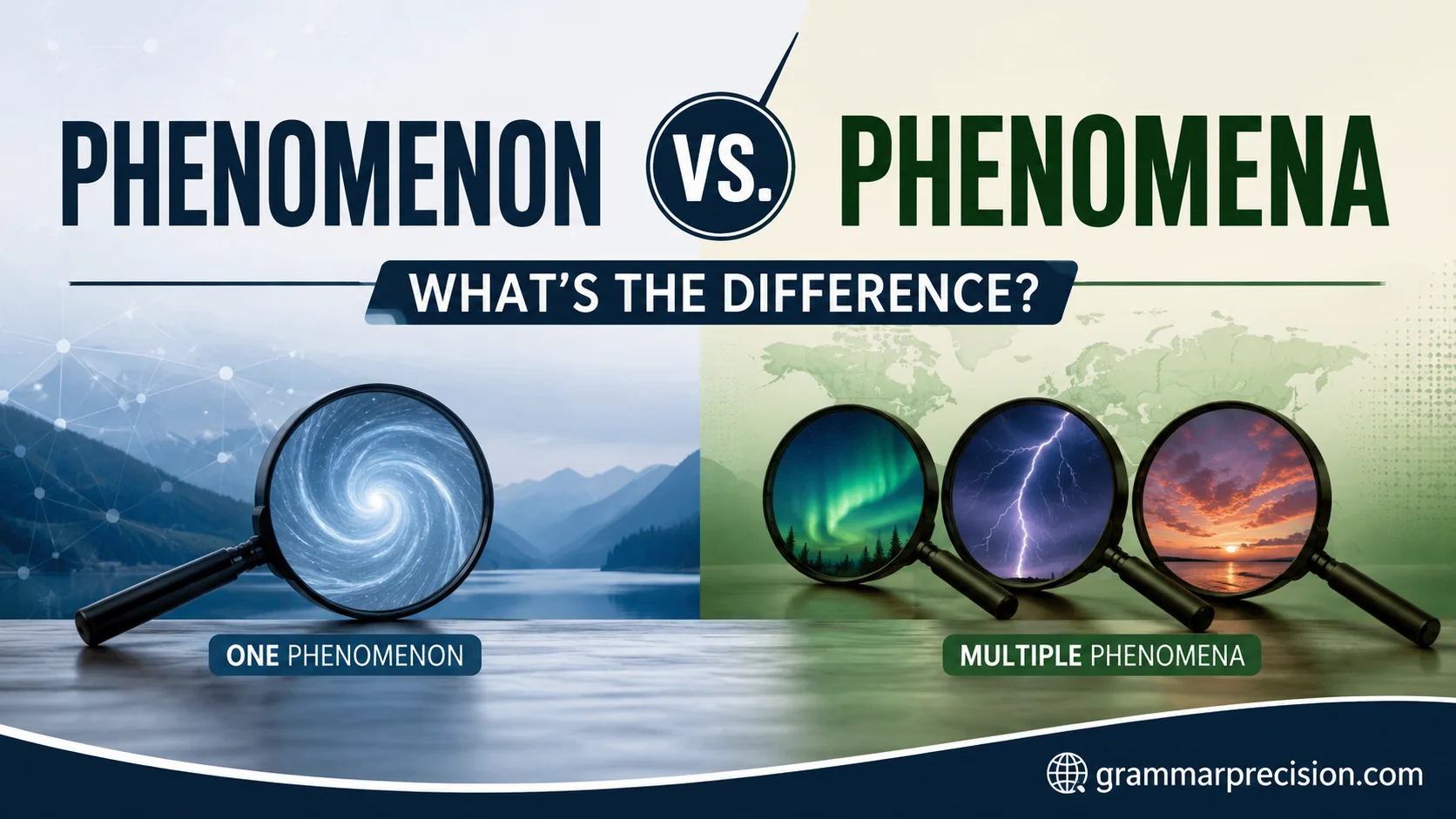
Phenomenon vs. Phenomena can seem confusing, but the difference is simple. Phenomenon refers to one event or thing, while phenomena refers to more than one. Understanding their singular and plural forms makes these words much easier to use correctly in everyday English.
The word phenomenon has Greek origins and works as a singular noun. Its plural form is phenomena, not usually “phenomenons.” This follows an older English grammar pattern involving words borrowed from other languages. Although the forms may look unusual, learning their meanings and usage helps you avoid common mistakes.
For example, a star athlete who performs exceptionally well may become known as a rookie phenomenon. If several players achieve remarkable results, they can be described as phenomena. Remember this simple rule: use phenomenon for one, and use phenomena for more than one. This distinction keeps your writing clear.
Phenomenon vs. Phenomena: Quick Answer
Phenomenon refers to one observable event, fact, occurrence, or situation. Phenomena refers to two or more such events, facts, occurrences, or situations.
| Word | Number | Basic meaning | Example |
| Phenomenon | Singular | One event or occurrence | A rainbow is a natural phenomenon. |
| Phenomena | Plural | Multiple events or occurrences | Rainbows are natural phenomena. |
A useful memory trick is simple:
One phenomenon, many phenomena.
Think of phenomenon as the singular form and phenomena as its traditional plural. The spelling changes because the word comes from Greek rather than following the ordinary English -s pattern.
Is Phenomenon Singular or Plural?
Phenomenon is singular.
You can use a, an, this, or one before it:
- a phenomenon
- an unusual phenomenon
- this phenomenon
- one phenomenon
Its singular status also affects the verb:
- The phenomenon is difficult to explain.
- This phenomenon occurs every winter.
- A strange phenomenon was reported yesterday.
Is Phenomena Singular or Plural?
Phenomena is plural.
It normally works with words such as these, those, many, several, and various:
- these phenomena
- several phenomena
- many phenomena
- various phenomena
The verb should also be plural:
- The phenomena are difficult to explain.
- These phenomena occur naturally.
- Several strange phenomena were reported.
That subject-verb agreement gives you another quick way to check your choice.
Phenomenon Meaning: What Does It Actually Mean?
A phenomenon is something that can be observed, experienced, measured, or recognized as an occurrence. The word often describes something noteworthy, unusual, or worthy of explanation.
However, it doesn’t always mean something mysterious. A phenomenon can be perfectly ordinary.
For example, rainfall is a natural phenomenon. So are eclipses, tides, lightning, and volcanic eruptions. In science, the word often refers to an observable event or process that researchers can study.
The word also appears outside science.
A sudden rise in online shopping can become a social phenomenon. A viral song can become a cultural phenomenon. A new technology can create a global phenomenon.
Common Meanings of Phenomenon
Depending on context, phenomenon can describe:
- A natural event
- A scientific observation
- A social trend
- A cultural development
- A psychological experience
- A remarkable or unusual occurrence
- Something that attracts widespread attention
Consider these examples:
The northern lights are a spectacular natural phenomenon.
The rapid growth of short-form video became a major cultural phenomenon.
Scientists are studying the phenomenon of animal migration.
Notice the pattern. Each sentence discusses one phenomenon, even when that phenomenon affects many people or includes many individual events.
Phenomena Meaning: What Does It Mean?
Phenomena is the plural of phenomenon. It refers to multiple observable events, processes, experiences, or occurrences.
The plural form becomes especially useful when you compare several examples or discuss a broad category.
For instance:
Scientists study atmospheric phenomena such as lightning and auroras.
Here, the sentence refers to multiple types of observable events. Therefore, phenomena fits.
The word is common in academic, scientific, philosophical, and formal writing. You’ll often see it when authors group several related observations under one larger idea.
Examples of Phenomena in Different Contexts
Science:
Scientists recorded several unusual atmospheric phenomena.
Psychology:
Researchers examined psychological phenomena associated with memory.
Society:
Social phenomena can spread rapidly through connected communities.
Culture:
Several cultural phenomena shaped the decade.
Technology:
Digital phenomena can change how people communicate.
The meaning stays connected across these fields. The number changes because you’re discussing more than one observable occurrence or process.
Why Is the Plural “Phenomena” Instead of “Phenomenons”?
This is where English gets a little quirky.
Phenomenon comes from Greek phainomenon, meaning something that appears or is observed. English borrowed the term through the history of Greek and Latin learning, especially in scientific and philosophical writing.
Because of that history, the traditional plural follows a Greek-derived pattern: phenomenon → phenomena.
English contains many words with inherited plural forms that don’t simply take -s. For example:
| Singular | Plural |
| criterion | criteria |
| analysis | analyses |
| crisis | crises |
| thesis | theses |
| phenomenon | phenomena |
These forms can feel strange because modern English usually forms plurals by adding -s or -es. Yet borrowed words sometimes retain older patterns.
Is “Phenomenons” a Word?
Phenomenons does appear occasionally, especially when speakers treat phenomenon like an ordinary English noun. However, phenomena is the established traditional plural and the safest choice in formal writing.
If you’re writing an essay, report, article, academic paper, or professional document, use phenomena when you mean more than one.
The practical rule is easy:
Use “phenomena” for the plural unless you have a specific reason to follow a modernized usage.
For most readers, phenomena will look natural and expected.
Phenomenon vs. Phenomena in Different Fields
One reason these words appear so often is their flexibility. They can describe events in almost any field where observation and explanation matter.
Scientific Phenomena
Science frequently uses phenomenon to identify something researchers can observe.
Examples include:
- Solar eclipses
- Gravitational effects
- Chemical reactions
- Magnetism
- Animal migration
- Light refraction
If you discuss one process, write:
The experiment demonstrated an unusual physical phenomenon.
If you discuss several processes, write:
The experiment revealed several physical phenomena.
The difference is grammatical rather than scientific. The subject determines whether you need the singular or plural form.
Social and Cultural Phenomena
The word has a broader life outside laboratories.
A social phenomenon can describe a pattern or occurrence that develops within a society. A cultural phenomenon can describe something that gains significant attention or influence within a culture.
For example:
The rapid spread of remote work became a social phenomenon.
If you compare several developments:
Remote work, viral marketing, and online communities are modern social phenomena.
Psychological Phenomena
Psychologists also use the term for observable experiences, behaviors, or mental processes.
Examples might include:
- Memory distortions
- Cognitive biases
- Perceptual illusions
- Group behavior
- Emotional responses
One example is a psychological phenomenon. Several examples are psychological phenomena.
Phenomenon vs. Phenomena: Common Grammar Mistakes
Most errors happen because writers recognize the meaning but overlook the number.
Mistake: “A phenomena”
Incorrect:
A strange phenomena occurred last night.
Correct:
A strange phenomenon occurred last night.
Why? The article a signals a singular noun.
Mistake: “Several phenomenon”
Incorrect:
Several unusual phenomenon were observed.
Correct:
Several unusual phenomena were observed.
The word several requires a plural noun.
Mistake: “These phenomenon”
Incorrect:
These phenomenon are difficult to explain.
Correct:
These phenomena are difficult to explain.
The demonstrative these points to more than one thing.
Mistake: “The phenomena is”
Incorrect:
The phenomena is fascinating.
Correct:
The phenomena are fascinating.
Because phenomena is plural, it normally takes a plural verb.
Mistake: “Two phenomenons”
Incorrect in standard formal usage:
Two strange phenomenons appeared.
Better:
Two strange phenomena appeared.
Again, the traditional plural is phenomena.
Phenomenon vs. Phenomena Examples
Seeing the words side by side makes the distinction much clearer.
| Singular: Phenomenon | Plural: Phenomena |
| This phenomenon is rare. | These phenomena are rare. |
| A natural phenomenon occurred. | Several natural phenomena occurred. |
| The phenomenon affects sleep. | The phenomena affect sleep. |
| One social phenomenon gained attention. | Several social phenomena gained attention. |
| Scientists observed a strange phenomenon. | Scientists observed strange phenomena. |
| This cultural phenomenon spread quickly. | These cultural phenomena spread quickly. |
Here’s another useful comparison:
One:
The eclipse is a remarkable phenomenon.
More than one:
Eclipses are remarkable phenomena.
The sentence doesn’t become more complicated. You simply switch the noun form and make sure the rest of the sentence agrees.
Also Read This: Tinder vs Tender: The Ultimate Difference Explained With Examples
Common Phrases With Phenomenon
You’ll frequently encounter phenomenon in established combinations.
Some useful examples include:
- natural phenomenon
- scientific phenomenon
- social phenomenon
- cultural phenomenon
- global phenomenon
- rare phenomenon
- strange phenomenon
- psychological phenomenon
- physical phenomenon
- economic phenomenon
For example:
The sudden trend became a global phenomenon.
Here, phenomenon describes one broad development, even though millions of people may participate in it.
Common Phrases With Phenomena
When the focus shifts from one occurrence to multiple occurrences, the plural appears:
- natural phenomena
- scientific phenomena
- social phenomena
- cultural phenomena
- strange phenomena
- psychological phenomena
- physical phenomena
- economic phenomena
- atmospheric phenomena
- modern phenomena
For example:
Researchers are investigating several atmospheric phenomena.
The adjective doesn’t determine the noun form. The number of phenomena does.
Phenomenon vs. Phenomena vs. Phenomenal
These three words look related because they are.
Phenomenon is a noun. It names an observable occurrence or event.
Phenomena is the plural noun. It names multiple occurrences.
Phenomenal is an adjective. It describes something extraordinary, impressive, or remarkable.
Compare them:
The aurora is a natural phenomenon.
Scientists study atmospheric phenomena.
The view from the mountain was phenomenal.
That distinction prevents another common mix-up. You can describe a phenomenon as phenomenal, but the two words don’t perform the same grammatical role.
How to Choose the Right Word Instantly
You don’t need to memorize complicated grammar rules. Use the one-versus-many test.
Step 1: Ask how many
Are you discussing one occurrence?
Use phenomenon.
Are you discussing two or more?
Use phenomena.
Step 2: Check the word before it
Words such as a, an, one, and this usually point toward singular phenomenon.
Words such as these, those, several, many, and various point toward plural phenomena.
Step 3: Check the verb
If the noun is singular:
The phenomenon is unusual.
If the noun is plural:
The phenomena are unusual.
This three-step check catches most mistakes in seconds.
A Quick Case Study: One Topic, Two Forms
Imagine a researcher studying unusual weather events.
At first, she observes one unusual storm pattern. She might write:
This weather pattern represents an unusual atmospheric phenomenon.
Later, she identifies unusual pressure changes, lightning patterns, and cloud formations. Now she writes:
These atmospheric phenomena require further study.
The subject hasn’t changed dramatically. The number of occurrences has.
That’s the heart of the distinction.
Practice: Phenomenon or Phenomena?
Choose the correct word in each sentence.
- A rare natural ___ was recorded.
- Scientists observed several unusual ___.
- This social ___ changed public behavior.
- These psychological ___ deserve further research.
- One unexplained ___ remains.
- Various cultural ___ influenced the movement.
Answers:
- phenomenon
- phenomena
- phenomenon
- phenomena
- phenomenon
- phenomena
If you got all six right, you’ve mastered the basic rule.
The Grammar Behind Phenomenon and Phenomena
There’s a useful grammatical detail hiding beneath the spelling. Phenomenon behaves as a countable noun when you mean a distinct occurrence. You can count individual examples: one phenomenon, two phenomena, three phenomena.
You can modify it with adjectives, too:
- an unusual phenomenon
- a recurring phenomenon
- several unusual phenomena
Compare:
An unusual phenomenon was discovered.
Several unusual phenomena were discovered.
The first sentence identifies one occurrence. The second groups multiple occurrences under the same category.
Why “Phenomena” Often Sounds More Academic
You may notice phenomena more often in textbooks, research papers, news analysis, and formal essays. Academic subjects frequently examine multiple observable patterns.
A researcher might investigate several related phenomena. A historian might discuss social phenomena across different periods. A psychologist might compare several cognitive phenomena.
In everyday conversation, people often choose simpler words such as events, effects, trends, or occurrences. That can make the sentence feel more natural.
Neither choice is automatically better. The right word depends on your audience and subject.
A Useful Editing Test for Writers
When proofreading your work, don’t look only at the spelling. Check the entire noun phrase.
Suppose you write:
These strange phenomenon is difficult to explain.
Three clues tell you something has gone wrong. These signals plural, phenomenon is singular, and is is singular.
The corrected version is:
These strange phenomena are difficult to explain.
This is why proofreading by pattern works better than memorizing isolated words. Look at the determiner + noun + verb combination.
A quick editing checklist:
- Does a/an/one/this appear before the noun? Choose phenomenon.
- Does these/those/many/several/various appear before it? Choose phenomena.
- Does the verb agree with the noun?
- Are you writing formal content where phenomena is the safer plural?
Key Facts to Remember
If you have seconds before publishing, remember these facts:
- Phenomenon is singular.
- Phenomena is plural.
- Phenomenons is not the preferred plural in standard formal writing.
- Singular subjects take singular verbs: the phenomenon is.
- Plural subjects take plural verbs: the phenomena are.
- The easiest test is one versus many.
Final Verdict: Phenomenon or Phenomena?
The difference between phenomenon vs. phenomena comes down to number.
Use phenomenon when you mean one observable event, occurrence, process, or experience. Use phenomena when you mean more than one.
Remember the pattern:
One phenomenon → two or more phenomena
Then check the surrounding words. A phenomenon is correct. Several phenomena are correct.
Once you recognize that structure, the spelling stops looking mysterious. What initially seems like an awkward exception becomes a simple singular-plural pair.
FAQs:
What is the difference between phenomenon and phenomena?
Phenomenon is the singular form, meaning one remarkable event, thing, or occurrence. Phenomena is the plural form, meaning two or more events, things, or occurrences.
Is phenomena the plural of phenomenon?
Yes, phenomena is the traditional plural form of phenomenon. These words come from Greek, which explains why their plural form doesn’t simply take -s like many English nouns.
Can I use phenomenons instead of phenomena?
In standard English, phenomena is the preferred plural form. Although phenomenons may occasionally appear, especially when referring to different types of phenomena, phenomena is the safer and more widely accepted choice.
How can I remember phenomenon and phenomena?
Use phenomenon when talking about one occurrence and phenomena when talking about more than one. A simple memory trick is to connect the ending -on with singular and -a with plural.
Which is correct: a phenomenon or a phenomena?
The correct phrase is a phenomenon because a refers to one thing. For example, “The athlete is a phenomenon.” You should use phenomena when discussing multiple events, people, or unusual occurrences.
Conclusion:
Understanding phenomenon vs. phenomena becomes simple once you remember their number. Use phenomenon for one event, occurrence, or remarkable thing, and use phenomena for two or more. Their Greek origins explain the unusual plural form. By practicing these words in context, you’ll avoid common grammar mistakes and make your writing more accurate, natural, and confident.