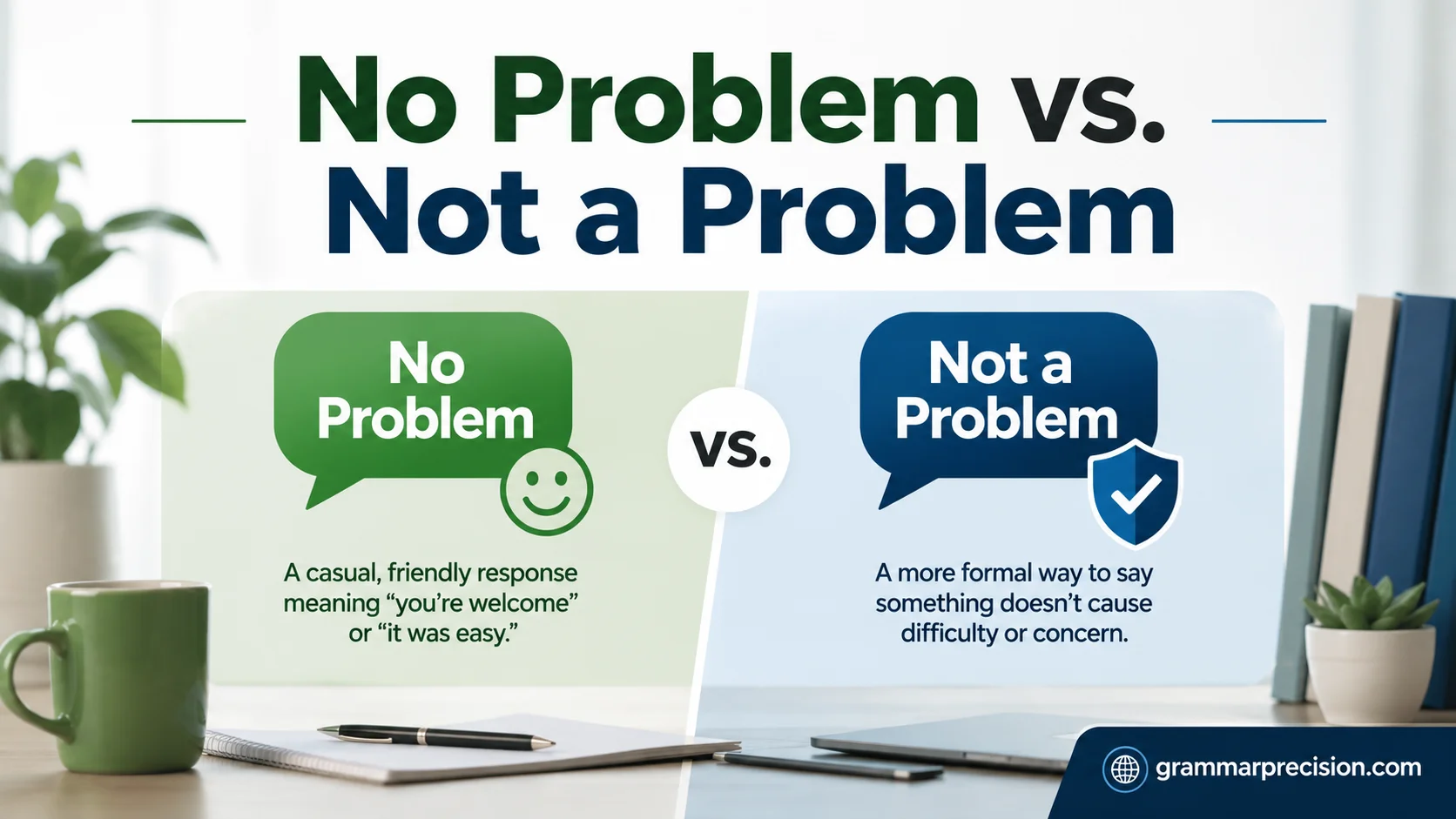
No Problem vs. Not a Problem highlights small differences in everyday communication. Both phrases sound polite, but context, tone, and purpose influence how people understand and respond to them naturally.
In everyday conversation, many English speakers use both phrases as quick responses to thanks, requests, and apologies. Although they seem interchangeable, subtle differences in tone, politeness, and context can affect communication. A professional setting may require more careful wording, while casual interactions often make either phrase sound natural, friendly, and appropriate.
From personal experience, I have noticed that listeners often react differently based on delivery rather than words alone. Eye contact, gratitude, and a sincere response can create positive impressions. Understanding these nuances helps people communicate clearly, build professionalism, offer reassurance, and choose the best expression for different social and workplace situations effectively.
Quick Answer: No Problem vs. Not a Problem
Both “No problem” and “Not a problem” are grammatically correct.
Both expressions mean:
“The request, favor, or task caused no inconvenience.”
In everyday conversation, native English speakers often use them interchangeably.
However:
- No problem sounds slightly more casual and conversational.
- Not a problem often sounds a bit more deliberate and professional.
- Neither phrase is inherently rude.
- The best choice depends on the situation and audience.
If you’re talking to friends, either expression works naturally.
If you’re communicating with clients, executives, or customers, “Not a problem” may sound slightly more polished.
Understanding the Meaning Behind Both Expressions
Before comparing the two phrases, it helps to understand what they actually communicate.
Imagine someone says:
“Thanks for helping me move.”
You reply:
“No problem.”
What you’re really saying is:
“Helping you wasn’t difficult.”
“I didn’t mind helping.”
“I’m happy to do it.”
Now consider:
“Not a problem.”
The message remains almost identical.
The distinction lies mainly in tone rather than meaning.
The Shared Message
Both phrases communicate:
- Cooperation
- Willingness
- Friendliness
- Reassurance
- Lack of inconvenience
The listener receives essentially the same message.
That’s why many native speakers use the expressions interchangeably without even noticing.
Quick Comparison Table
| Feature | No Problem | Not a Problem |
| Grammar | Correct | Correct |
| Formality | Casual to semi formal | Semi formal to professional |
| Common in conversation | Very common | Common |
| Common in business | Sometimes | Frequently |
| Tone | Relaxed and friendly | Polished and reassuring |
| Customer service use | Varies by company | Often preferred |
| Natural in speech | Extremely natural | Natural |
| Email suitability | Moderate | Strong |
Is One More Grammatically Correct?
A common misconception is that one phrase is grammatically superior.
That is not true.
Why “No Problem” Is Correct
“No problem” functions as an idiomatic expression.
English contains many similar constructions:
- No worries
- No chance
- No doubt
- No way
- No issue
In these expressions, the word “no” directly modifies the noun.
For example:
- No problem
- No concern
- No difficulty
The structure is completely acceptable in modern English.
Why “Not a Problem” Is Also Correct
“Not a problem” follows a more traditional grammatical structure.
It contains:
- The negative word “not”
- The article “a”
- The noun “problem”
This structure forms a complete noun phrase.
Because it sounds slightly more explicit, many speakers perceive it as more formal.
The Reality
Neither expression is more grammatically correct.
Both are standard English.
The choice depends almost entirely on style and context.
The Evolution of “No Problem”
Language changes constantly.
Several decades ago, people overwhelmingly responded to gratitude with:
- You’re welcome
- My pleasure
- Glad to help
Over time, younger generations began favoring:
- No problem
- No worries
- Anytime
These phrases emphasize ease and friendliness.
Instead of highlighting the gratitude itself, they focus on reassuring the other person.
Traditional Perspective
Older speakers sometimes interpret “No problem” differently.
They may hear:
“It wasn’t a problem.”
and wonder:
“Who said it was a problem?”
Because of this interpretation, some people view “You’re welcome” as more courteous.
Modern Perspective
Younger speakers usually hear something entirely different:
“Happy to help.”
“Don’t worry about it.”
“I’m glad I could assist.”
Neither perspective is wrong.
They simply reflect different language habits.
When to Use “No Problem”
“No problem” shines in casual communication.
It sounds natural, effortless, and friendly.
Everyday Conversations
Examples:
- “Thanks for driving me home.”
- “No problem.”
- “Thanks for lending me your charger.”
- “No problem.”
- “Thanks for watching my dog.”
- “No problem.”
The phrase feels relaxed and approachable.
Among Friends
Friends rarely analyze linguistic nuances.
They simply hear goodwill.
For this reason, “No problem” remains one of the most common responses in social situations.
Team Collaboration
Within informal workplaces, “No problem” often works well.
Example:
“Thanks for updating the spreadsheet.”
“No problem.”
The exchange feels efficient and friendly.
Text Messages and Chat
Digital communication favors brevity.
“No problem” fits perfectly.
Examples:
- NP
- No prob
- No problem!
- No worries
These responses feel natural in messaging platforms.
Also Read This: Informational vs Informative
When to Use “Not a Problem”
“Not a problem” often works better when professionalism matters.
It sounds slightly more intentional.
Business Emails
Example:
Thank you for sending the updated contract.
Response:
Not a problem. Let me know if you need anything else.
This sounds polished without feeling overly formal.
Client Communication
Clients often expect reassurance.
“Not a problem” delivers exactly that.
Example:
Thank you for making those revisions.
Response:
Not a problem. We were happy to make the changes.
Professional Meetings
In workplace discussions, “Not a problem” can sound more refined.
Example:
Thanks for preparing the presentation on short notice.
Response:
Not a problem. I had everything ready.
Customer Support
Many customer service teams prefer:
- Not a problem
- Happy to help
- Glad to assist
These options create a stronger service oriented impression.
Tone Matters More Than Grammar
Here’s where many articles miss the bigger picture.
The true difference between these expressions lies in tone.
Friendly Tone
“No problem” often feels:
- Casual
- Relaxed
- Approachable
- Conversational
Reassuring Tone
“Not a problem” often feels:
- Professional
- Thoughtful
- Service oriented
- Polished
Potential Misinterpretation
Occasionally, listeners may perceive “No problem” as implying:
“There could have been a problem, but there wasn’t.”
While this interpretation isn’t usually intended, awareness of audience expectations helps.
Real Life Examples: No Problem vs. Not a Problem
Scenario: Friend Asking a Favor
Friend:
Thanks for helping me move.
Best Response:
No problem.
Reason:
The setting is informal.
Scenario: Client Communication
Client:
Thank you for the quick turnaround.
Best Response:
Not a problem.
Reason:
Professional tone matters.
Scenario: Restaurant Guest
Customer:
Thanks for bringing that extra napkin.
Best Response:
Not a problem.
Reason:
Hospitality environments often favor polished language.
Scenario: Text Message
Friend:
Thanks for the ride.
Best Response:
No problem!
Reason:
Short and natural.
Scenario: Executive Email
Manager:
Thank you for handling the report.
Best Response:
Not a problem. Happy to help.
Reason:
Professional and respectful.
Professional Communication Guide
Many professionals wonder which phrase works best at work.
The answer depends on who you’re talking to.
Internal Team Communication
Good options:
- No problem
- Not a problem
- Happy to help
All three work well.
Client Communication
Better options:
- Not a problem
- My pleasure
- Happy to help
- Glad to assist
These phrases project stronger professionalism.
Customer Service
Top choices include:
- Happy to help
- My pleasure
- Not a problem
- Absolutely
These responses focus on service rather than convenience.
Executive Communication
When communicating upward, professionalism matters.
Recommended responses:
- Happy to help
- My pleasure
- Glad I could assist
- Not a problem
The Professionalism Scale
The following chart shows how native speakers often perceive these expressions.
| Phrase | Formality Level |
| No worries | Very casual |
| No problem | Casual |
| Not a problem | Semi formal |
| Happy to help | Professional |
| Glad to assist | Professional |
| My pleasure | Highly professional |
| You’re welcome | Traditional and professional |
Regional Differences Around the English Speaking World
English varies dramatically across countries.
What sounds natural in one region may sound unusual elsewhere.
United States
Americans frequently use:
- No problem
- You’re welcome
- Happy to help
“No problem” has become extremely common.
Canada
Canadians often favor:
- No problem
- No worries
- You’re welcome
The expressions are generally viewed positively.
United Kingdom
British speakers often use:
- No problem
- That’s alright
- Not at all
- You’re welcome
Tone tends to matter more than exact wording.
Australia
Australians commonly say:
- No worries
- No problem
- All good
“No worries” may actually be more common than either phrase.
Alternatives That May Work Better
Sometimes neither expression is ideal.
Choosing the right alternative can strengthen communication.
You’re Welcome
Best for:
- Formal situations
- Traditional etiquette
- Professional interactions
My Pleasure
Best for:
- Hospitality
- Customer service
- High end service environments
Happy to Help
Best for:
- Business settings
- Clients
- Colleagues
Glad to Assist
Best for:
- Professional communication
- Corporate environments
Anytime
Best for:
- Friends
- Casual interactions
Absolutely
Best for:
- Service focused environments
- Positive customer experiences
Alternative Comparison Table
| Phrase | Tone | Formality | Best Use |
| No Problem | Friendly | Casual | Friends and coworkers |
| Not a Problem | Professional | Semi formal | Clients and business |
| You’re Welcome | Traditional | Professional | General use |
| My Pleasure | Service oriented | High | Hospitality |
| Happy to Help | Positive | Professional | Workplace |
| Anytime | Relaxed | Casual | Friends |
| Glad to Assist | Corporate | Professional | Business communication |
Common Mistakes to Avoid
Assuming “No Problem” Is Rude
This myth persists.
In reality, millions of native speakers use it daily.
Context matters far more than the phrase itself.
Using Extremely Casual Language With Clients
Client communication deserves more care.
Instead of:
No worries!
Consider:
Happy to help.
or
Not a problem.
Ignoring Audience Expectations
Language isn’t only about grammar.
It’s about perception.
A phrase that sounds perfect to one audience may sound less appropriate to another.
Overthinking Small Differences
Most native speakers won’t analyze these phrases deeply.
Choose the expression that best fits your audience and situation.
Mini Case Study: Customer Service Language
Imagine two hotel employees responding to guest gratitude.
Employee A
Guest:
Thanks for getting extra towels.
Response:
No problem.
Employee B
Guest:
Thanks for getting extra towels.
Response:
My pleasure. Let us know if you need anything else.
Both responses are polite.
However, the second response creates a stronger service experience.
This illustrates why many hospitality brands train employees to use alternatives beyond “No problem.”
The issue isn’t correctness.
The issue is customer perception.
What English Experts Generally Agree On
Most language experts agree on several key points:
- Both expressions are grammatically correct.
- Both are widely accepted.
- Neither phrase is inherently rude.
- Context determines appropriateness.
- Professional settings may favor more polished alternatives.
- Everyday conversations comfortably support both expressions.
In other words:
The debate is far more about style than grammar.
FAQs:
Is “No Problem” the same as “Not a Problem”?
Both phrases have a similar meaning, but they can create slightly different impressions. No Problem often sounds more casual, while Not a Problem may feel a bit more neutral and professional depending on the situation.
When should I use “No Problem”?
You can use No Problem in casual conversations with friends, family, or colleagues. It is a common response to thanks, requests, and small favors, especially in relaxed settings.
Is “Not a Problem” more professional?
In many workplace and customer facing environments, Not a Problem can sound more polished and professional. However, the best choice still depends on your tone, audience, and communication style.
Why do some people dislike the phrase “No Problem”?
Some people feel that No Problem implies there could have been a problem in the first place. Because of this interpretation, they may prefer traditional responses such as You’re welcome.
How can I choose the right phrase?
Consider the context, your relationship with the listener, and the level of politeness you want to convey. Paying attention to these factors helps you communicate clearly and make a positive impression.
Conclusion:
Understanding No Problem and Not a Problem can improve your communication and help you choose words more effectively. While both expressions are widely accepted, subtle differences in tone, context, and professionalism can influence how they are received.
By paying attention to these nuances, you can sound more confident, polite, and natural in both personal and professional interactions.