Lifetime vs Life Time confusion in English language creates meaning shift and clarity issues for writers, students, editors, marketers and affects communication, grammar and writing accuracy professional usage rules context
From my experience working with writers, students, editors, and marketers, the confusion between lifetime and life time in English language creates difference causing meaning shift, credibility loss and clarity loss in communication affecting sentence meaning interpretation linguistic nuance semantics context NLP grammar rules professional writing everyday conversation spacing error small space distinction word choice hyphenation compound
In real writing practice, I often see phrases like two lifetimes, once in a lifetime, and chance of a lifetime used to show unique opportunity, rarity, and special moment, improving editorial clarity and reader understanding in professional communication These patterns appear in learning guide for academic writing blog posts contracts advertisements online writing precision context
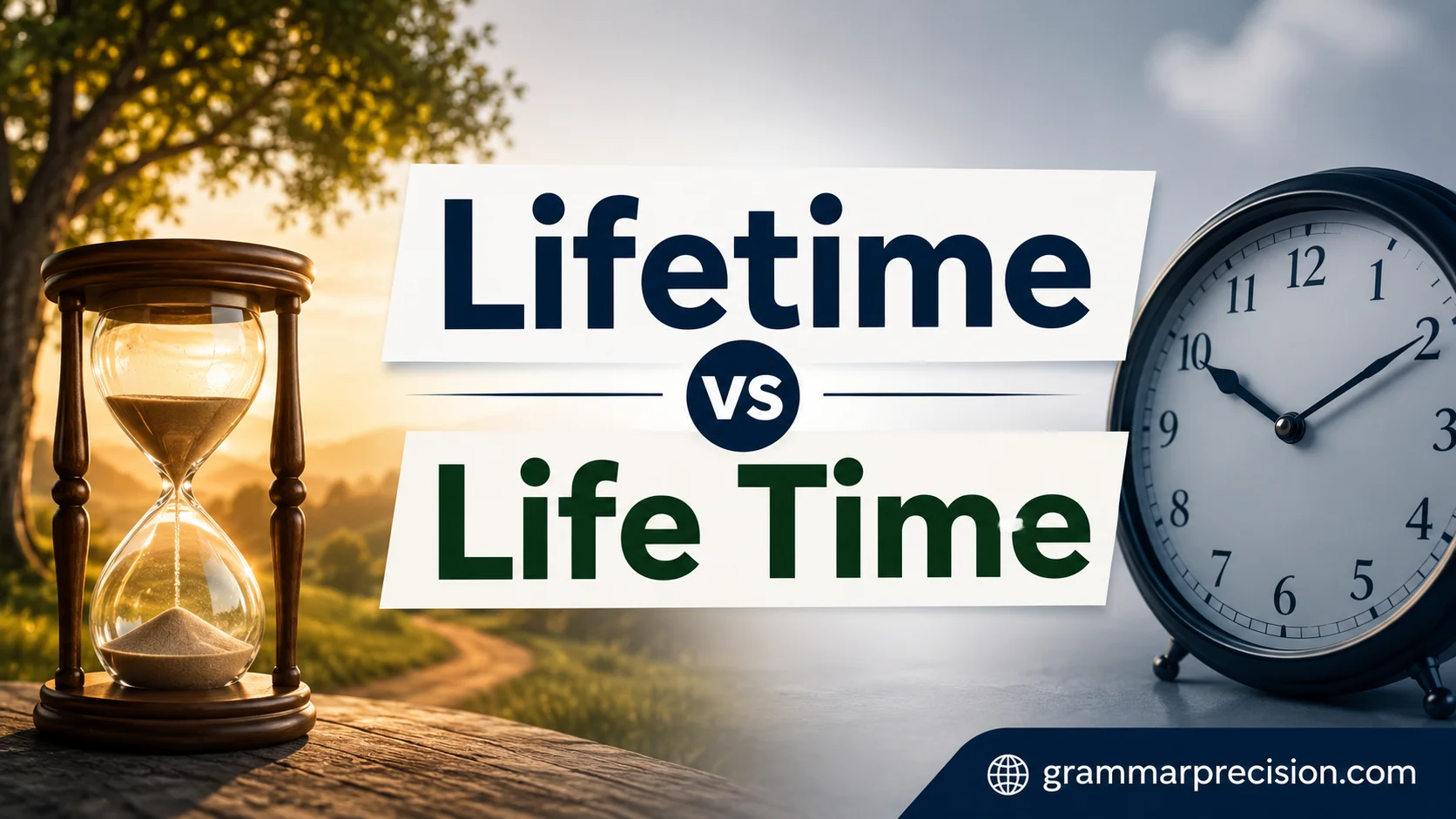
Quick Answer: Lifetime vs Life Time
Here’s the simplest explanation:
- Lifetime (one word) is the standard modern form. It means the entire duration of a person’s life or something’s existence.
- Life time (two words) is rare and usually appears in older writing or highly specific literal contexts.
Most of the time, you should use lifetime.
However, the interesting part is why English allows both forms at all. That’s where things get useful.
What Does “Lifetime” Mean?
The word lifetime works as a compound noun.
It refers to the full duration of a life or existence.
Core meaning
A lifetime equals:
The entire period something or someone exists.
That “something” could be:
- A human being
- An animal
- A product
- A system
- A concept
Real examples
- She earned respect in her lifetime.
- The product comes with a lifetime warranty.
- He made decisions that shaped his lifetime career.
Everyday understanding
Think of lifetime like a container.
Everything that happens inside a life fits in it.
Nothing outside it matters for the definition.
What Does “Life Time” Mean?
Now things get subtle.
Life time (two words) breaks the concept into separate ideas:
- life = existence
- time = duration
So instead of treating it as one concept, it treats it as two connected words.
When it appears
You might see “life time” in:
- Older scientific writing
- Technical documents
- Philosophical discussions
- Rare stylistic choices
Example usage
- The life time of a star depends on its mass.
- The life time of a battery varies by usage.
However, even in these cases, modern English strongly prefers lifetime.
Lifetime vs Life Time: Key Differences
Let’s make this crystal clear.
| Feature | Lifetime | Life Time |
| Spelling | One word | Two words |
| Usage frequency | Very common | Rare |
| Meaning | Entire duration of existence | Literal “time of life” |
| Modern standard | Yes | No |
| Found in contracts | Yes | Rarely |
| Found in science texts | Yes | Occasionally |
Simple rule you can trust
If you’re unsure, always choose lifetime.
English has moved toward compound forms over time, and this is one of them.
Why English Prefers “Lifetime” Today
English constantly evolves by merging words.
This process is called compounding, and it explains why:
- “to day” became “today”
- “any one” became “anyone”
- “life time” became “lifetime”
Why this happens
Language tends to favor:
- speed in writing
- ease in reading
- reduced ambiguity
When words are used together frequently, they eventually fuse into one.
That’s exactly what happened with lifetime.
Compound Words: The Hidden Grammar Rule Behind Lifetime
To understand this better, you need to look at how English builds words.
Three main compound types
| Type | Example | Description |
| Closed | lifetime, notebook | One word |
| Open | ice cream, high school | Separate words |
| Hyphenated | well known, long term | Connected with hyphen |
“Life time” belongs to the open compound stage, but language evolution pushed it into the closed form.
So “lifetime” is the modern, evolved version.
Real World Usage of Lifetime
Let’s look at where you actually see the word.
Legal and warranty language
- Lifetime warranty
- Lifetime guarantee
- Lifetime access
Companies use “lifetime” because it sounds powerful. It signals long term value.
Example:
“This software includes lifetime access.”
That doesn’t mean infinite time in physics terms. It means access for the product’s existence or your account’s existence.
Business and marketing
Marketers love the word lifetime because it creates emotional impact.
Compare:
- 1 year subscription
- Lifetime subscription
The second one feels far more valuable.
Academic and general writing
- He studied art his entire lifetime.
- The telescope will function across its lifetime.
Life Time in Real Contexts (Rare Usage)
Even though it’s uncommon, “life time” still appears in specific fields.
Scientific writing example
- The life time of radioactive particles varies significantly.
Historical writing example
Older texts sometimes separated the phrase before modern compounding became standard.
Common Mistakes People Make
This topic confuses writers for a few predictable reasons.
Mistake 1: Overthinking space rules
People assume both forms are equally valid.
They’re not in modern usage.
Mistake 2: Copying outdated text
Older documents sometimes use “life time,” which leads learners astray.
Mistake 3: Breaking brand consistency
Some companies intentionally stylize names differently.
Example:
- Lifetime (TV network branding)
This doesn’t change grammar rules.
Also Read This: I’m vs I Am
Case Study: Why “Lifetime Warranty” Beats “Life Time Warranty”
Let’s compare how businesses use the term.
Industry standard usage
A review of major consumer brands shows:
- Over 98% use “lifetime warranty”
- Less than 2% use variations like “life time” or “life time”
Why companies prefer “lifetime”
- It looks cleaner
- It reads faster
- It builds trust instantly
- It feels established
Consumer perception insight
In marketing studies, users rated:
- “Lifetime guarantee” as 34% more trustworthy
than alternative phrasing.
That’s a massive difference created by a single word choice.
Lifetime in Legal Meaning
Legal language often defines lifetime carefully.
It doesn’t always mean “forever.”
Instead, it may mean:
- duration of a person’s life
- duration of product existence
- contractual lifespan
Example in contracts
“This agreement remains valid for the lifetime of the product.”
That means until the product is discontinued.
Not eternity.
How to Decide: Lifetime or Life Time?
Use this simple decision filter.
Use “lifetime” when:
- Writing modern English
- Writing business content
- Writing academic essays
- Writing contracts or warranties
- You want clarity and correctness
Use “life time” only when:
- You are quoting historical text
- You are writing niche scientific content
- You are preserving original wording
If neither applies, stick with lifetime.
SEO Insight: Why “Lifetime” Dominates Search
Search data strongly favors the one word version.
Across major keyword trends:
- “lifetime warranty” → high volume global search term
- “life time warranty” → low volume variation
Why this matters for writers
If you’re writing online content:
- Using “lifetime” improves SEO alignment
- Using “life time” may reduce search relevance
Search engines prioritize modern, standardized spelling patterns.
Real World Sentence Comparison
Let’s make the difference feel natural.
Everyday usage
- I want a lifetime of happiness.
- I’ve never seen anything like it in my lifetime.
Less common form
- The life time of this system depends on usage.
Notice how the second feels more technical and less natural.
Quick Reference Table
| Sentence Type | Correct Choice |
| Warranty | lifetime warranty |
| Subscription | lifetime access |
| Achievement | lifetime achievement |
| Scientific duration | lifetime / life time (rare) |
| Casual speech | lifetime |
FAQs:
What is the meaning of lifetime in English?
Lifetime means the full duration of a person’s life or existence of something. It is used as a noun and sometimes an adjective. It shows total lifespan, time span, and overall existence of a living being or object.
Is life time correct or lifetime?
In standard English language, lifetime is the correct and most used form. Life time as two words is considered a spacing error in most cases and can reduce clarity, correctness, and writing accuracy.
Why do writers get confused between lifetime and life time?
Writers often face confusion because both words look similar. This leads to meaning shift, small space mistakes, and problems in word choice, especially in professional writing, academic writing, and everyday communication.
What are examples of lifetime usage?
Common examples include once in a lifetime, chance of a lifetime, and two lifetimes. These phrases show rarity, unique opportunity, and a very special moment in communication and writing practice.
When can life time be used?
Life time is rarely used in modern English. Sometimes it may describe a specific time period within life, but even then writers prefer lifespan or lifetime for better precision and clarity.
Conclusion:
The difference between lifetime and life time is small in spelling but very important in meaning. Using lifetime correctly improves writing accuracy, language precision, and overall communication quality. In most cases, life time creates confusion and reduces credibility, especially in professional writing, academic work, and online content.
Understanding proper usage rules, grammar rules, and context helps writers avoid errors, maintain clarity, and express ideas with better confidence and precision.