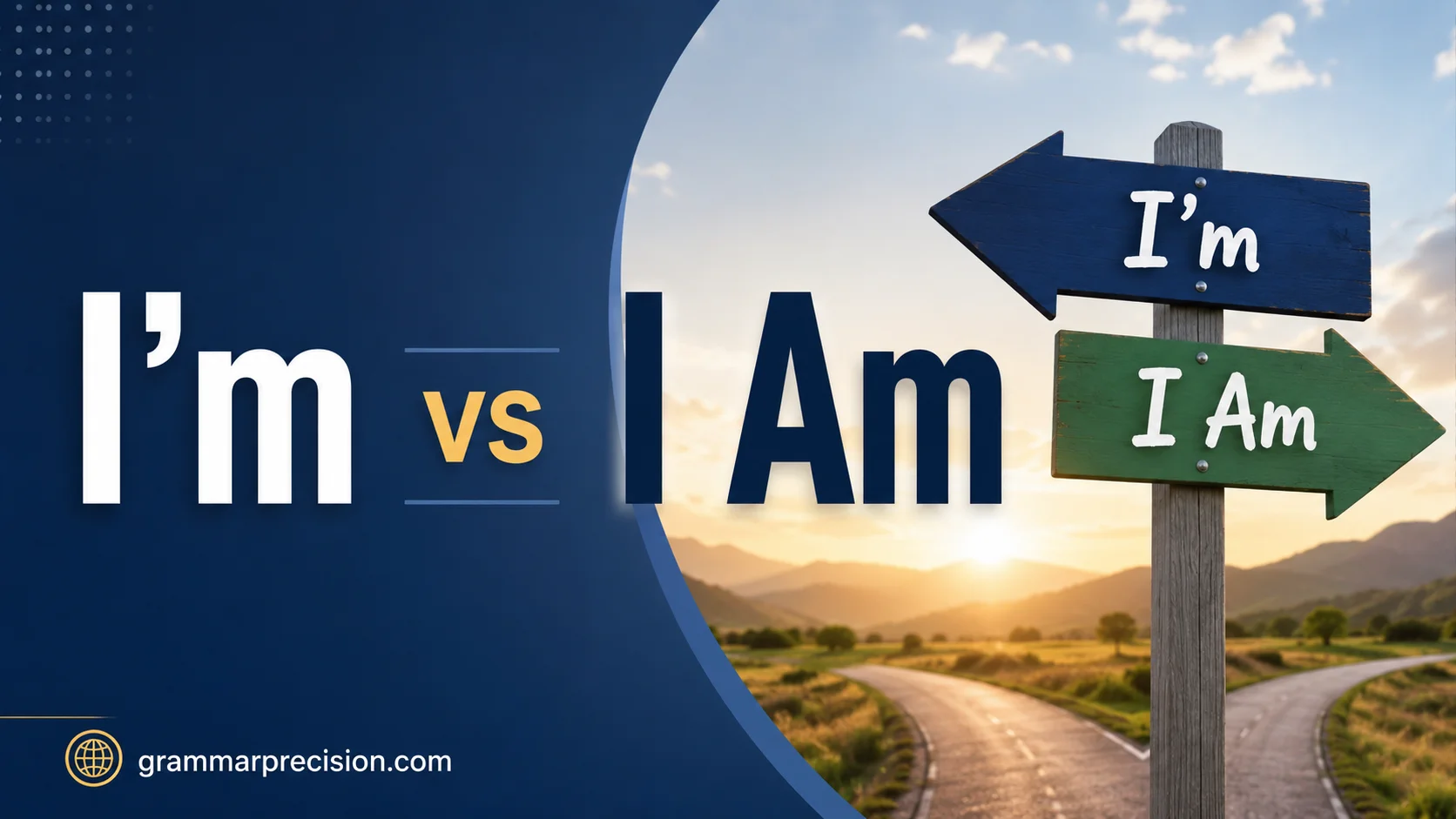
I’m vs I Am is a simple grammar difference where contractions make speech casual and natural, while full forms sound more formal, professional, and depend on context.
In writing, people often ask the question Which Is Correct: I’m or I Am. From experience in English language learning, learners struggle to understand the main difference, especially in job interviews, professional setting, or while talking to a friend, where tone matters and speech changes between casual, friendly, and formal communication styles.
I’m is often preferred in casual phrases, like chatting in a store or everyday writing, because it feels natural and smooth. I Am is used to emphasize something important, like being qualified for a position. The tone, nuances, and meaning affect the impact of a sentence, depending on setting and purpose.
The Quick Answer: I’m vs I Am
Let’s not overcomplicate it.
- I’m = I am (contraction)
- I am = full form
They mean exactly the same thing in grammar.
However, they do not always feel the same in communication.
Here’s the real difference:
- I’m feels natural, conversational, and human.
- I am feels deliberate, formal, or emphatic.
That emotional difference matters more than grammar.
What Is the Difference Between “I’m” and “I Am”?
At the core, this topic belongs to English contractions.
A contraction shortens two words by combining them and removing letters.
Definition of “I’m”
“I’m” is a contraction of:
I + am → I’m
It appears in everyday speech and informal writing.
Examples:
- I’m ready.
- I’m tired.
- I’m happy to help.
Definition of “I Am”
“I am” is the full grammatical form.
It appears in formal writing, emphasis, or structured communication.
Examples:
- I am responsible for this project.
- I am honored to be here.
- I am fully committed to this goal.
Are Both Correct? The Grammar Reality
Yes. Both forms are grammatically correct.
English uses contractions widely because spoken language prefers speed and flow.
In fact, linguists estimate that native English speakers use contractions in over 90% of casual speech.
That means “I’m” is not slang or informal error. It’s standard English.
However, “I am” plays a different role. It adds weight.
Think of it like this:
- “I’m ready” feels like a friend speaking.
- “I am ready” feels like a speaker stepping onto a stage.
Same meaning. Different impact.
Quick Comparison Table: I’m vs I Am
| Feature | I’m | I Am |
| Form | Contraction | Full form |
| Tone | Casual, natural | Formal, deliberate |
| Spoken English | Extremely common | Less common |
| Business writing | Depends on context | Often preferred |
| Academic writing | Rare | Preferred |
| Emotional emphasis | Low | High |
| Example | I’m happy | I am happy |
Why Contractions Like “I’m” Exist in English
English evolved toward efficiency.
When people speak quickly, they naturally shorten phrases.
Instead of saying:
I am going to the store
People say:
I’m going to the store
This shift didn’t happen randomly. It developed over centuries of spoken communication.
A Simple Analogy
Think of contractions like shortcuts on a map.
- Full form = scenic route
- Contraction = express lane
Both get you there. One just feels faster and smoother.
Also Read This: Copula Verbs vs Auxiliary Verbs
When to Use “I’m”
Now we get practical.
You use “I’m” when you want your communication to feel natural and conversational.
Everyday Conversations
Examples:
- I’m on my way.
- I’m busy right now.
- I’m not sure.
Text Messages and Chat
Digital communication heavily favors contractions.
- I’m here.
- I’m fine.
- I’m running late.
Social Media Writing
Posts sound more relatable with contractions.
- I’m grateful for this opportunity.
- I’m excited about this journey.
Friendly Emails
Even in work settings, casual emails often use “I’m.”
- I’m following up on your request.
- I’m happy to help with this.
When to Use “I Am”
“I am” signals control, clarity, or importance.
It slows down the sentence slightly and adds emphasis.
Formal Writing
- I am responsible for this report.
- I am submitting the final draft today.
Academic Writing
Most academic styles prefer full forms.
- I am analyzing the results.
- I am examining the data trends.
Job Interviews
“I am” sounds confident and structured.
- I am interested in this role.
- I am confident in my abilities.
Public Speaking
Speakers often use “I am” for emphasis.
- I am here to change this system.
- I am committed to this mission.
The Psychology Behind “I’m” vs “I Am”
Here’s where things get interesting.
Humans don’t just hear words. They interpret tone.
“I’m” Feels Like:
- Friendly
- Relaxed
- Approachable
- Real time speech
“I am” Feels Like:
- Intentional
- Serious
- Confident
- Formal or powerful
Example Shift in Meaning
- I’m sorry → casual apology
- I am sorry → deeper emotional weight
Same words. Different emotional impact.
Real World Case Study: One Sentence, Two Impressions
Let’s compare how the same idea changes tone.
Sentence 1: “I’m excited to join the team.”
- Sounds friendly
- Feels conversational
- Fits onboarding emails or Slack messages
Sentence 2: “I am excited to join the team.”
- Sounds formal
- Feels deliberate
- Fits interviews or official announcements
What changed?
Not meaning.
Just tone intensity.
How Native Speakers Actually Use Them
Native speakers rarely think about grammar rules.
They follow rhythm and context.
A quick breakdown:
- Casual speech → “I’m” dominates
- Professional speech → mixed usage
- Formal writing → “I am” dominates
Real Usage Pattern (Approximate Distribution)
| Context | “I’m” Usage | “I am” Usage |
| Spoken conversation | 85–95% | 5–15% |
| Text messages | 90% | 10% |
| Business emails | 60% | 40% |
| Academic writing | 10% | 90% |
These aren’t rigid rules, but they reflect real communication behavior.
Common Mistakes Learners Make
English learners often overthink this topic.
Here are the most common errors:
Using “I am” in every sentence
This creates unnatural speech:
I am going to the store. I am buying food. I am coming back.
Native speakers usually contract:
I’m going to the store. I’m buying food. I’m coming back.
Overusing “I’m” in formal writing
This can weaken professionalism in:
- academic essays
- legal writing
- official reports
Ignoring tone entirely
Grammar is correct either way.
But tone mismatch creates awkward communication.
Decision Guide: Should You Use I’m or I Am?
Use this simple filter.
Use “I’m” when:
- You want to sound natural
- You are texting or chatting
- You are writing casually
- You want warmth in tone
Use “I am” when:
- You want emphasis
- You are writing formally
- You are speaking publicly
- You are writing academic or official content
The Emphasis Trick Most People Miss
“I am” is powerful when you want to stress identity or intention.
Compare:
- I’m ready.
- I am ready.
Now imagine a job interview:
I am ready to take on this role.
That sentence carries weight.
It signals confidence.
It feels intentional.
That’s the hidden strength of “I am.”
Advanced Writing Insight: Mixing Both Naturally
Strong writers don’t choose one over the other blindly.
They mix both based on rhythm.
Example:
I’m excited about this project. I am also aware of the challenges ahead.
This combination creates balance:
- “I’m” adds flow
- “I am” adds seriousness
Good writing often plays with contrast like this.
FAQs:
What is the difference between I’m and I Am?
I’m is a contraction of I Am. It is mostly used in casual speech and sounds more natural, while I Am feels more formal and is often used in professional communication or for emphasis.
When should I use I’m?
You should use I’m in everyday writing, casual conversations, and when speaking with friends. It makes your speech sound more friendly, smooth, and natural.
When is I Am more appropriate?
I Am is more appropriate in formal situations, such as job interviews, official statements, or when you want to emphasize something important like your identity or qualification.
Does using I’m or I Am change meaning?
The meaning usually stays the same, but the tone and impact of the sentence can change. I’m feels more relaxed, while I Am feels more serious and polished.
Why is it important to learn both forms?
Learning both forms improves your English communication and helps you choose the right tone based on context. It makes your writing and speaking more clear, natural, and effective.
Conclusion:
Understanding I’m vs I Am is important for better English grammar and communication skills. While I’m is used in casual situations to sound more natural, I Am is preferred in formal contexts for clarity and emphasis.
Knowing when to use each form improves your confidence, writing quality, and overall language accuracy in both spoken and written English.