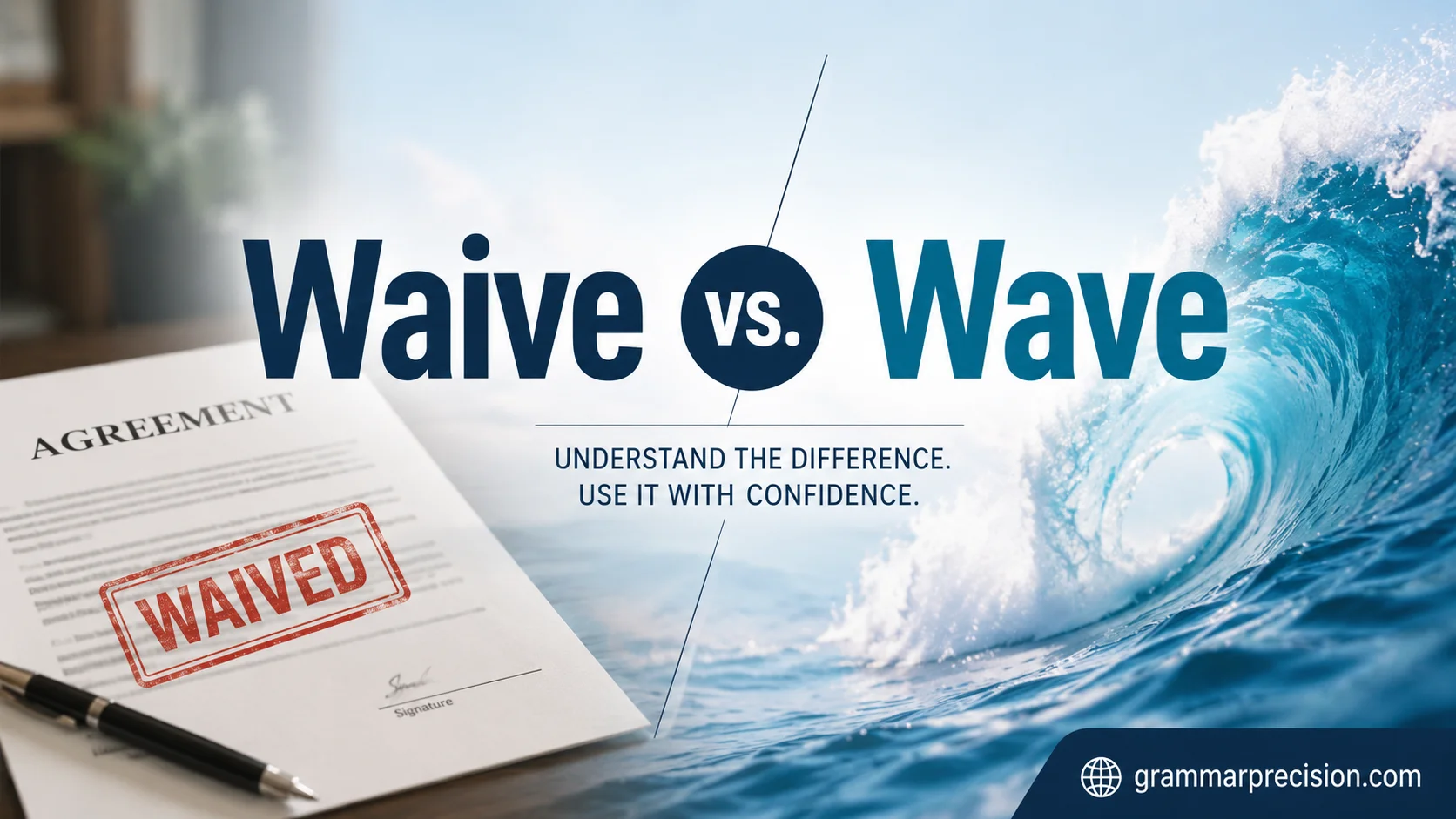
Waive vs. Wave is often confused in writing because wave and waive look and sound similar, but their meanings, usage, and contexts are different in communication.
In the first meaning, waive is used in legal, formal, and bureaucratic settings where a person may relinquish a right, privilege, or sign a waiver during a contract or formal permissions process involving fees, legal rights, and policies in official writing situations.
In the second meaning, wave refers to waving a hand, gestures, and physical movement in everyday motion, where understanding key differences, proper usage, and avoiding confusion helps improve communication skills, writing clarity, and prevents misuse in academic writing, professional emails, and daily conversation.
What Does “Waive” Mean?
The word waive means to voluntarily give something up. Usually, that “something” involves:
- A right
- A rule
- A fee
- A requirement
- A claim
In simple terms, when you waive something, you choose not to enforce or use it.
Simple Definition of Waive
Waive = to give up voluntarily
Think of it this way:
If a university waives your application fee, you no longer need to pay it.
If someone waives their right to a lawyer, they choose not to use that right.
Common Examples of “Waive”
Here are some everyday examples:
- The airline waived the cancellation fee.
- She waived her right to appeal.
- The school waived the admission requirement.
- The company waived late charges during the holiday season.
- He signed a document to waive liability.
Notice the pattern?
Every sentence involves giving something up or removing a requirement.
What Does “Wave” Mean?
The word wave usually refers to movement.
You can:
- Wave your hand
- See ocean waves
- Watch a flag wave in the wind
- Talk about sound waves or radio waves
Unlike waive, this word focuses on motion, signals, or flowing movement.
Simple Definition of Wave
Wave = to move back and forth
That movement can be physical, visual, emotional, or scientific.
Common Examples of “Wave”
- She waved hello from across the street.
- The crowd waved flags during the concert.
- Ocean waves crashed against the shore.
- Heat waves affected several cities.
- He waved at the taxi driver.
Every example involves movement or signaling.
That’s the key difference.
Waive vs. Wave: The Main Difference
Here’s the easiest way to remember it:
WordMeaningCommon ContextExampleWaiveGive something upLegal, financial, formalWaive a feeWaveMove or signalPhysical motion, science, greetingsWave hello
If the sentence involves:
- removing a requirement → use waive
- movement or gestures → use wave
Simple. Clean. Easy to remember.
Why People Confuse Waive and Wave
This mix up happens for three major reasons.
They Sound Exactly the Same
These words are homophones.
Both are pronounced:
/weɪv/
That identical pronunciation tricks even experienced writers.
Spellcheck Often Misses the Error
Grammar tools usually check spelling, not meaning.
For example:
❌ “The hotel waved the fee.”
The sentence contains a real word, so spellcheck may ignore it.
However, the meaning is completely wrong.
Context Changes Everything
The correct word depends entirely on context.
That’s why reading carefully matters more than relying on autocorrect.
The Fastest Memory Trick for Waive vs. Wave
Here’s a trick that works almost instantly.
Waive = Remove
The letter i in waive can remind you of:
- invisible
- ignore
- eliminate
You make something disappear.
Example:
- waive the fee
- waive the rule
- waive the requirement
Wave = Motion
Think about ocean waves or waving your hand.
Movement. Motion. Signals.
Example:
- wave goodbye
- wave at someone
- wave a flag
That mental shortcut sticks surprisingly well.
Real Life Examples That Make the Difference Obvious
Sometimes the fastest way to learn grammar involves seeing mistakes side by side.
Correct vs Incorrect Examples
Incorrect SentenceCorrect SentenceThe bank waved the fee.The bank waived the fee.She waived goodbye.She waved goodbye.They waved the requirement.They waived the requirement.He waived at the crowd.He waved at the crowd.
One wrong letter completely changes the meaning.
Waive vs. Wave in Business Writing
This mistake shows up constantly in professional communication.
Unfortunately, it can make emails look careless.
Example From Customer Service
Incorrect
We are happy to wave your late payment fee.
Correct
We are happy to waive your late payment fee.
The first sentence accidentally sounds like the company physically shook the fee around in the air.
Tiny error. Big difference.
Why It Matters Professionally
Using the wrong word can:
- reduce credibility
- confuse customers
- weaken legal clarity
- make writing look rushed
In contracts and formal communication, precision matters.
A lot.
How Lawyers and Businesses Use “Waive”
The word waive appears frequently in:
- contracts
- court documents
- banking policies
- insurance forms
- college applications
Common Legal Phrases
You’ve probably heard these before:
- waive liability
- waive rights
- waive the fee
- waive penalties
- waive compliance requirements
Example Case Study
College Application Fee Waiver
Many universities offer fee waivers for students with financial hardship.
Instead of paying:
- $50
- $75
- or even $100
the school removes the charge entirely.
That’s a textbook example of “waive.”
How “Wave” Appears in Everyday Life
Unlike waive, the word wave appears everywhere.
You’ll see it in:
- weather reports
- physics classes
- conversations
- sports
- music
- pop culture
Different Meanings of Wave
Type of WaveExampleHand gestureShe waved helloOcean movementMassive waves hit the coastSound wavesMusic travels through sound wavesHeat waveTemperatures reached record highsCrowd movementFans created a wave in the stadium
One word. Many uses.
Funny Mistakes People Make Online
The internet loves grammar mistakes.
And waive vs. wave confusion appears constantly across Reddit, Twitter, forums, and comment sections.
One Reddit discussion joked:
“You can wave it goodbye after you waive it.”
Another thread debated whether referees “wave off” or “waive off” a basketball shot. Most users agreed:
- referees wave off calls with a physical hand motion
- organizations waive rights or requirements
Those examples show how context controls meaning.
Also Read This: Have You Seen vs. Did You See?
Waive Off vs. Wave Off: Which One Is Correct?
This is where things get interesting.
Both phrases appear in English.
However, they don’t mean exactly the same thing.
“Wave Off”
Usually means:
- dismiss with a gesture
- reject physically
- signal cancellation
Example:
- The referee waved off the goal.
“Waive”
Usually means:
- voluntarily give up
- formally remove
Example:
- The university waived the fee.
The Origin of Waive and Wave
Etymology makes the distinction easier to remember.
Origin of “Wave”
The word comes from Old English roots connected to:
- weaving
- movement
- fluttering motion
That explains why the word relates to:
- water
- flags
- gestures
- flowing motion
Origin of “Waive”
The word entered English through Anglo French legal language.
Historically, it referred to:
- abandoning rights
- surrendering claims
- giving something up voluntarily
The legal connection still exists today.
Common Phrases Using “Waive”
Here are phrases native speakers use regularly.
Popular “Waive” Expressions
- waive a fee
- waive rights
- waive interest
- waive penalties
- waive objections
- waive charges
- waive liability
- waive requirements
These almost always sound formal.
Common Phrases Using “Wave”
Now compare those with wave expressions.
Popular “Wave” Expressions
- wave goodbye
- wave hello
- wave a flag
- wave at someone
- heat wave
- sound wave
- tidal wave
- wave your hand
These involve movement, signals, or physical patterns.
The Psychology Behind Homophone Mistakes
English learners aren’t the only people who confuse these words.
Native speakers struggle too.
Why?
Because the human brain often prioritizes:
- sound
- prediction
- familiarity
over spelling precision.
When two words sound identical, the brain sometimes grabs the wrong spelling automatically.
That’s especially common during:
- fast typing
- texting
- casual emails
- social media posting
Linguists call this a homophone substitution error.
Waive vs. Wave Pronunciation Guide
Even though the meanings differ, pronunciation does not.
Pronunciation
WordIPA PronunciationWaive/weɪv/Wave/weɪv/
They sound exactly the same.
That’s why memorizing meaning matters more than memorizing sound.
Synonyms for Waive
Using synonyms helps reinforce meaning.
Alternatives for “Waive”
WordMeaningRelinquishGive up voluntarilyForgoDecide not to takeSurrenderHand overAbandonLeave behindRenounceReject formally
Example:
- The bank waived the penalty.
- The bank forgave the penalty.
Synonyms for Wave
Now compare those with wave related words.
Alternatives for “Wave”
WordMeaningGestureSignal with movementFlutterMove lightlySwingMove back and forthRippleCreate flowing movementUndulateMove in waves
Example:
- She waved at me.
- She gestured at me.
Case Study: One Email Mistake That Changed the Meaning Completely
Imagine receiving this message from your university:
“We are pleased to waive your tuition fee.”
Technically, the sentence contains proper English words.
Yet it sounds strange because “wave” suggests physical movement rather than fee removal.
Now compare it with:
“We are pleased to waive your tuition fee.”
That sentence sounds natural immediately.
One letter changes the entire interpretation.
How to Never Mix Up Waive and Wave Again
Here’s a practical system that actually works.
Step One: Look for Motion
Ask yourself:
Is something physically moving?
If yes, use wave.
Examples:
- wave hello
- ocean wave
- wave a flag
Step Two: Look for Removal
Ask:
Is something being removed, canceled, or given up?
If yes, use waive.
Examples:
- waive the fee
- waive rights
- waive penalties
Step Three: Replace the Word
Try replacing it mentally.
If “remove” fits, choose waive.
If “move” fits, choose a wave.
That trick works almost every time.
Mini Quiz: Can You Choose the Correct Word?
Test yourself.
Questions
- The airline decided to ___ baggage fees.
- She ___ at her friends from the balcony.
- The lawyer asked him to ___ his rights.
- Massive ocean ___ hit the shoreline.
- The company agreed to ___ late charges.
Answers
QuestionCorrect Answer1waive2waved3waive4waves5waive
If you got them right, the difference is already sticking.
The Most Common “Waive vs. Wave” Mistakes
Here are errors people make repeatedly online.
Frequent Errors
Incorrect
- wave the fee
- wave liability
- waive goodbye
- waive hello
Correct
- waive the fee
- waive liability
- wave goodbye
- wave hello
Simple pattern:
- legal/formal = waive
- movement/gesture = wave
Why This Tiny Grammar Difference Actually Matters
At first glance, this might seem like a small grammar issue.
It isn’t.
Clear language affects:
- professionalism
- trust
- communication
- clarity
- credibility
One wrong word can:
- confuse readers
- weaken formal writing
- create unintended humor
- damage authority
That’s why professional editors pay close attention to homophones.
Quick Reference Cheat Sheet
Here’s the easiest summary possible.
If You Mean…Use This WordGive up a rightWaiveRemove a feeWaiveSignal helloWaveOcean movementWavePhysical motionWaveLegal surrenderWaive
Save that table mentally and you’ll avoid the mistake forever.
Expert Tip Most Grammar Guides Miss
Here’s an interesting nuance many articles ignore.
Sometimes English allows overlap between:
- wave aside
- waive aside
- wave off
- waive off
- wave off sounds more natural in everyday English
- waive remains dominant in legal and formal situations
That subtle distinction explains why native speakers occasionally debate these phrases online.
FAQs:
What is the main difference between waive and wave?
The main difference is that waive is used in legal, formal, and bureaucratic settings where someone gives up a right, privilege, or signs a waiver, while wave refers to physical movement, gestures, or waving a hand in everyday motion.
When should I use waive in a sentence?
You should use waive when talking about contracts, fees, legal rights, or when someone is relinquishing a right through a formal act in policies or administrative situations.
Can wave and waive be used interchangeably?
No, wave and waive cannot be used interchangeably because they have different meanings, usage, and contexts, and using them wrongly can cause misunderstandings in writing and communication.
Why do people confuse waive and wave?
People often confuse them because of identical sound, similar spellings, and their nature as homophones, especially in academic writing, professional emails, and among students who struggle with mixing up meanings.
How can I remember the difference easily?
You can remember that waive is related to legal rights, contracts, and fees, while wave is linked to movement, gestures, and physical actions, which helps improve proper usage and clear communication.
Conclusion:
Understanding Waive vs. Wave is important for improving writing clarity and avoiding confusion in both formal and informal communication. The word waive is mainly used in legal, bureaucratic, and contract based contexts where a person gives up a right, privilege, or agrees to a waiver, especially in matters like fees and formal permissions.
On the other hand, wave is used in everyday life to describe gestures, waving a hand, and physical movement in simple communication situations.