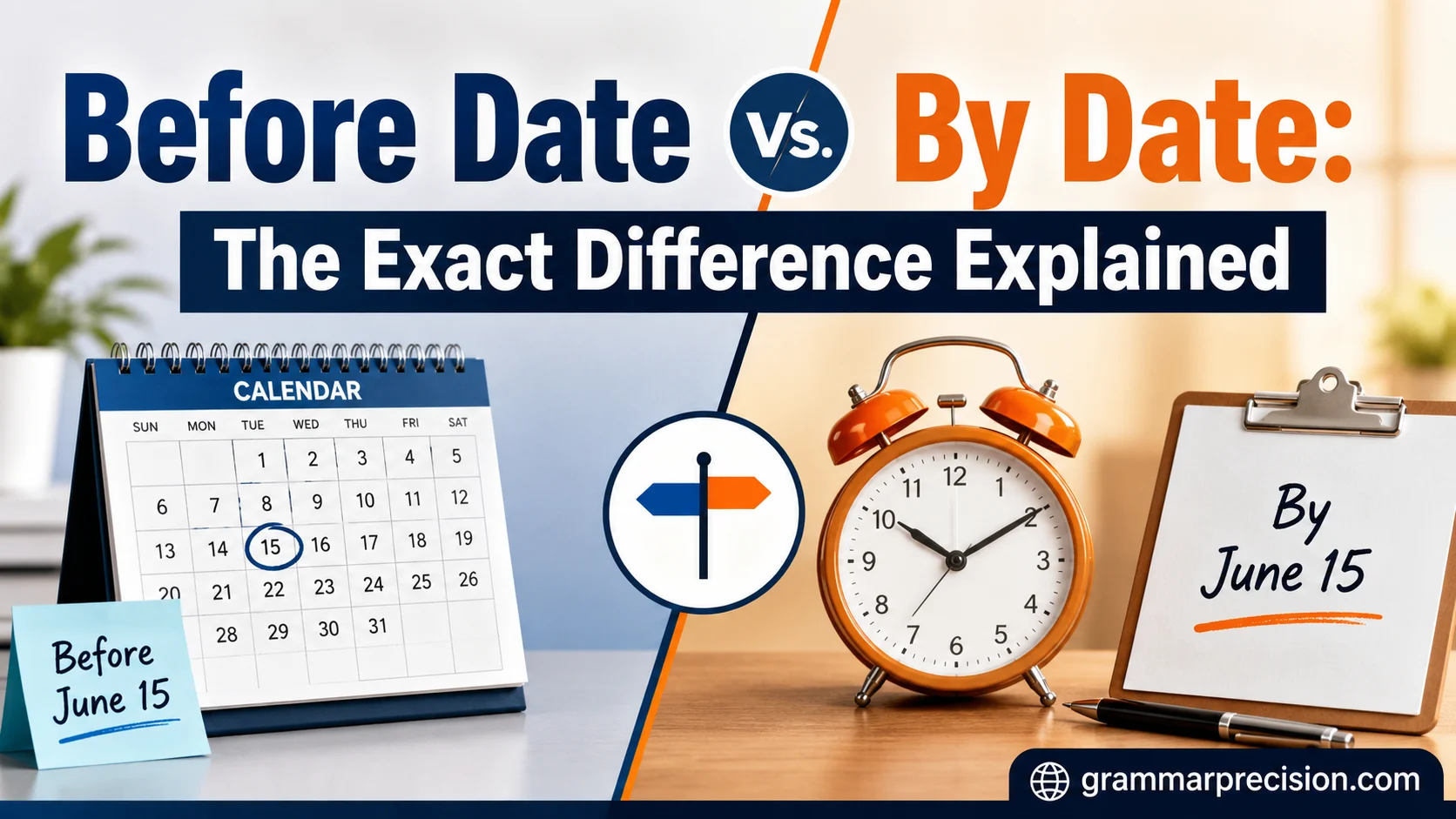
Before Date vs. By Date helps you understand time expressions correctly. Learning the difference between before and by improves grammar, communication, and prevents common writing mistakes every day.
Many learners confuse before and by because both relate to a date. However, before means earlier than the specified day, while by includes the day itself. Understanding this difference improves English grammar, strengthens communication skills, and helps you write clear, accurate sentences with greater confidence.
The easiest way to master these expressions is by paying attention to context, sentence meaning, and the intended deadline. Regular practice with real examples makes Before Date vs. By Date easier to remember. This habit builds stronger language skills, improves writing accuracy, and reduces misunderstandings in everyday communication.
Before Date vs. By Date: The Short Answer
Before date generally means earlier than that date. The stated date normally acts as the boundary that you must not reach.
By date generally means on or before that date. The stated date usually represents the latest acceptable day for completing an action.
Consider these two sentences:
Please send the application before June 15.
This normally means the application should arrive no later than June 14.
Now compare:
Please send the application by June 15.
This normally means the application can arrive on June 15, provided no specific time makes the deadline earlier.
| Phrase | Basic meaning | Does the stated date usually count? | Typical purpose |
| Before June 15 | Earlier than June 15 | No | Establishing an earlier boundary |
| By June 15 | No later than June 15 | Yes | Establishing a deadline |
| On June 15 | During June 15 | Yes | Identifying a specific date |
| On or before June 15 | June 15 or any earlier date | Yes | Removing ambiguity |
The word usually matters here. Real-world deadlines can include special rules. A contract, school policy, government form, or workplace system may define its own deadline.
Imagine You Have a June 15 Deadline
A timeline makes this distinction much easier to see.
June 12 June 13 June 14 June 15 June 16
|————-|————-|————-|————-|
BEFORE JUNE 15 BY JUNE 15
✓ acceptable ✓ acceptable
▲
final date
Suppose your manager says:
“Finish the report before June 15.”
You should aim to finish it on June 14 or earlier. Waiting until June 15 could violate the instruction because before normally excludes the named date.
Now imagine your manager says:
“Finish the report by June 15.”
The expectation changes. June 15 normally remains available because by means the task should be completed no later than that date.
This distinction becomes even clearer with a concrete situation. Imagine you need to pay a registration fee.
- Pay before July 1 → Pay by June 30.
- Pay by July 1 → July 1 is generally still acceptable.
- Pay on July 1 → July 1 is the specified payment date.
- Pay on or before July 1 → July 1 and every earlier date qualify.
Think of before as a gate you must cross earlier. Think of by as a finish line you must reach no later than the stated point.
What “Before Date” Really Means
The preposition before describes something that happens earlier than another point in time.
When you attach it to a date, that date becomes the reference point.
For example:
“The meeting must happen before August 20.”
The meeting needs to happen earlier than August 20. August 19 works. August 18 works. August 20 normally doesn’t.
Earlier Than the Specified Date
The central idea behind before is sequence.
If event A happens before event B, event A occurs first. The same logic applies when the second event is represented by a calendar date.
Consider:
- Submit the form before Monday.
- Arrive before 8:00 a.m.
- Finish the project before December 1.
- Call me before Friday.
Each sentence places a boundary after which the action should not occur.
However, everyday speakers sometimes use before loosely. Someone might say, “Get it to me before Friday,” while informally meaning “by Friday.” That doesn’t make the two expressions grammatically identical. It simply shows why context can matter.
Why the Date Usually Marks the Boundary
The word before has an exclusive sense in ordinary time expressions.
If someone says:
“I arrived before noon.”
The natural interpretation is that the arrival happened earlier than noon. Arriving exactly at noon wouldn’t normally satisfy that statement.
The same pattern applies to dates.
“Complete the task before June 30” normally means the task should be complete earlier than June 30.
That makes before useful when the writer wants to emphasize that something should happen ahead of a particular point.
Examples From Everyday Life
Here are several practical examples:
- Please register before September 1.
- We need to leave before Saturday.
- Submit your documents before the application deadline.
- The package should arrive before December 24.
- Please contact the office before March 10.
Notice that these sentences focus on earlier timing rather than simply identifying a final deadline.
What “By Date” Really Means
The word by works differently. In time expressions, it commonly means at or before a particular time or date.
That makes it especially useful for deadlines.
Consider:
“Please submit your application by June 15.”
The instruction normally permits submission on June 15. It establishes June 15 as the latest acceptable date.
On or Before the Specified Date
A helpful replacement for by is no later than.
For example:
“Submit the report by Friday.”
can usually be understood as:
“Submit the report no later than Friday.”
That means Tuesday works. Wednesday works. Thursday works. Friday generally works too.
Saturday doesn’t.
This is why by appears so frequently in deadline-related instructions.
You might see it in:
- application forms
- school assignments
- payment notices
- work emails
- project plans
- appointment instructions
- registration requirements
- delivery estimates
Why “By” Works Naturally With Deadlines
A deadline answers one basic question:
What is the latest acceptable time?
The word by answers precisely that question.
If your supervisor says:
“Send the figures by 5 p.m.”
the important information isn’t when you send them. You could send them at 2 p.m. or 4:45 p.m. The important boundary is 5 p.m.
The same principle applies to dates.
“Finish the project by October 10” identifies October 10 as the latest expected date unless the surrounding instructions specify another cutoff.
Examples From Everyday Life
Consider these natural examples:
- Please reply by Friday.
- The payment must be made by July 31.
- Finish the assignment by Monday.
- We need the documents by October 5.
- Please complete registration by December 20.
In each case, by naturally introduces a deadline.
Before Date vs. By Date: The Crucial Difference
The simplest distinction is this:
Before = earlier than the date.
By = no later than the date.
That sounds straightforward, yet the difference can matter greatly when the date itself arrives.
| Situation | Before June 15 | By June 15 |
| June 12 | ✓ | ✓ |
| June 13 | ✓ | ✓ |
| June 14 | ✓ | ✓ |
| June 15 | Usually ✗ | Usually ✓ |
| June 16 | ✗ | ✗ |
This table captures the central grammatical distinction.
Suppose you’re submitting a college assignment. Your instructor says:
“Submit the assignment before May 20.”
Submitting it on May 19 is safe. Submitting it on May 20 creates a problem because the instruction normally excludes that date.
If the instructor says:
“Submit the assignment by May 20.”
May 20 generally remains available.
That single word can therefore change your final opportunity by an entire day.
When the Two Phrases Overlap
Although before and by aren’t identical, they can sometimes produce the same practical result.
Imagine someone says:
“Please send the document before Friday.”
You send it Wednesday.
Now imagine they say:
“Please send the document by Friday.”
You also send it Wednesday.
In both situations, the action occurs before Friday. Therefore, both instructions are satisfied.
The difference only becomes important when the action happens on the named date.
That’s the key test.
Ask Yourself One Question
When you’re unsure which phrase to use, ask:
“Does the stated date need to be allowed?”
If the answer is no, before may be appropriate.
If the answer is yes, by is usually better.
For example:
- You don’t want applications arriving on June 30 → before June 30
- You accept applications throughout June 30 → by June 30
This simple test eliminates much of the confusion.
When They Definitely Don’t Mean the Same Thing
Some situations make the difference impossible to ignore.
Application Deadlines
“Apply before October 1.”
This generally means October 1 is too late.
“Apply by October 1.”
This generally allows October 1.
Payments
“Pay before January 10.”
The expected payment date is earlier than January 10.
“Pay by January 10.”
January 10 is generally the final acceptable date.
Work Instructions
“Finish the report before Friday.”
The writer likely wants it completed ahead of Friday.
“Finish the report by Friday.”
The writer establishes Friday as the deadline.
Travel
“Arrive before 6 p.m.”
You need to arrive earlier than 6 p.m.
“Arrive by 6 p.m.”
Arrival at 6 p.m. is generally acceptable unless another instruction says otherwise.
These examples show why the distinction isn’t merely academic. In practical communication, precision prevents disputes.
Also Read This: Phenomenon vs. Phenomena: What’s the Difference?
Before Date vs. By Date in Emails
Workplace emails often create confusion because writers assume everyone interprets deadlines identically.
Consider this message:
“Please send the revised document before Monday.”
The recipient may reasonably interpret Monday as excluded.
If the writer actually means that Monday is acceptable, this version is clearer:
“Please send the revised document by Monday.”
Even better, when precision matters, give the exact time:
“Please send the revised document by Monday at 3 p.m.”
That version leaves less room for interpretation.
Asking Someone to Complete a Task
When assigning work, by is often the cleaner choice.
Please complete the inventory by Thursday.
This establishes a clear latest date.
If the task needs to happen earlier, before communicates that expectation:
Please complete the inventory before Thursday so we have time to review it.
The second sentence does more than establish a deadline. It explains why the earlier timing matters.
Giving Someone a Deadline
For formal deadlines, these expressions can be especially useful:
- by Friday
- by June 15
- no later than June 15
- on or before June 15
- before June 15
However, they don’t all carry exactly the same tone or precision.
By sounds natural and conversational. No later than sounds more explicit. On or before is highly precise and often appears in formal instructions.
Does “Before Date” Include the Date?
Normally, no.
If someone says “before June 15,” the ordinary interpretation is that June 15 itself isn’t included.
The same principle appears with clock times.
“Arrive before 8 a.m.” normally means arriving at 8:00 a.m. isn’t acceptable.
Still, context can modify how people understand an instruction. Informal speakers sometimes use before when they really mean by. That’s why important deadlines should avoid relying on conversational assumptions.
If precision matters, write:
“Please submit the form no later than June 15.”
Or:
“Please submit the form by June 15 at 11:59 p.m.”
Those versions remove most ambiguity.
Does “By Date” Include the Date?
Normally, yes.
When used as a deadline, by June 15 generally means June 15 is included.
The phrase can therefore be replaced with “no later than June 15.”
For example:
Please register by August 31.
means registration should happen on or before August 31.
However, a specific organization can define its own deadline rules. If a website says “by August 31 at 5 p.m. Eastern Time,” then the time and time zone matter. The calendar date alone doesn’t tell the entire story.
Before vs. By With Different Verb Tenses
These prepositions work across several tense structures.
Simple Present
“I finish the report before Friday.”
This can describe a routine or scheduled action.
“I finish the report by Friday.”
This emphasizes completion no later than Friday.
Future Constructions
“I’ll finish the report before Friday.”
The speaker expects completion earlier than Friday.
“I’ll finish the report by Friday.”
The speaker promises completion no later than Friday.
Present Perfect
“I need to have finished it before Friday.”
This emphasizes that completion must occur earlier.
“I need to have finished it by Friday.”
This emphasizes the final completion point.
The tense can change the surrounding meaning, but the core distinction between before and by remains.
Before vs. By in Questions
Questions can reveal the difference particularly well.
“Do I need to submit this before Friday?”
The speaker is asking whether Friday itself is excluded.
“Do I need to submit this by Friday?”
The speaker is asking whether Friday is the final acceptable day.
A useful response might be:
“You can submit it on Friday. The deadline is 5 p.m.”
That answer removes the uncertainty completely.
Before vs. By in Negative Sentences
Negative sentences can become surprisingly tricky.
Consider:
“Don’t submit the application before Friday.”
This means Friday or later is acceptable from the perspective of the stated restriction. The speaker is telling you not to submit early.
Now consider:
“Don’t submit the application by Friday.”
This is much less straightforward. It can imply that submitting by Friday isn’t desired, but the exact intended meaning depends heavily on context.
That’s why negative constructions deserve extra care.
When clarity matters, rewrite the instruction:
- “Wait until Friday to submit the application.”
- “Do not submit the application before Friday.”
- “Submit the application after Friday.”
A few extra words can prevent a major misunderstanding.
Before Date vs. By Date: 12 Side-by-Side Examples
| Before | By | Practical difference |
| Finish before Monday. | Finish by Monday. | Monday is normally excluded in the first sentence. |
| Apply before June 1. | Apply by June 1. | June 1 generally counts with by. |
| Pay before July 10. | Pay by July 10. | The second allows July 10. |
| Arrive before noon. | Arrive by noon. | Noon usually works with by. |
| Call before Friday. | Call by Friday. | Friday is treated differently. |
| Register before August 5. | Register by August 5. | The deadline differs by one day. |
| Send it before Tuesday. | Send it by Tuesday. | Tuesday usually counts only with by. |
| Leave before 9. | Leave by 9. | 9:00 can be acceptable with by. |
| Submit before March 30. | Submit by March 30. | The second creates a final date. |
| Respond before May 12. | Respond by May 12. | May 12 normally counts with by. |
| Complete it before Friday. | Complete it by Friday. | By emphasizes completion. |
| Book before December 1. | Book by December 1. | December 1 generally remains available with by. |
The examples follow the standard interpretation of these expressions. Specific policies can override ordinary language.
How to Make Your Deadline Crystal Clear
If missing a deadline could cause a problem, don’t make the reader decode your sentence.
Instead of:
“Send the paperwork before Friday.”
write:
“Send the paperwork by Thursday, June 14.”
Or, if Friday is acceptable:
“Send the paperwork by Friday, June 15, at 5 p.m.”
For especially formal communication, use:
“Please submit the paperwork no later than June 15 at 5 p.m.”
You can also use on or before:
“Please submit the paperwork on or before June 15.”
These alternatives are useful because they turn an interpretive question into a concrete instruction.
The Best Ways to Express a Deadline
Use:
- by June 15 for natural everyday communication
- no later than June 15 for extra clarity
- on or before June 15 for explicit inclusion
- before June 15 when June 15 should normally be excluded
- by June 15 at 5 p.m. when the exact cutoff matters
A good deadline is like a well-marked road. The reader shouldn’t need a map to figure out where the boundary lies.
A Simple Way to Remember the Difference
Here’s the quickest memory trick:
Before looks backward. By looks toward the finish line.
If someone says before June 15, imagine June 15 standing as a wall. You need to finish on the earlier side of that wall.
If someone says by June 15, imagine June 15 as a finish line. You can reach it at any point before it or directly on it.
So remember:
Before = earlier than.
By = no later than.
That two-line rule handles most everyday situations.
Before Date vs. By Date: Final Verdict
The difference between before date vs. by date comes down to whether the named date normally counts.
Before date means earlier than the specified date. The date itself generally isn’t included.
By date means on or before the specified date. The date itself generally is included.
For ordinary conversation, that distinction is enough.
For important deadlines, however, go one step further. Add the exact date and time whenever the consequences of misunderstanding are significant.
| If you mean… | Use… |
| Earlier than the date | before June 15 |
| The date or any earlier date | by June 15 |
| Explicit inclusion | on or before June 15 |
| Maximum clarity | no later than June 15 at 5 p.m. |
The smartest choice isn’t always the shortest phrase. It’s the phrase that leaves the least room for confusion.
FAQs:
How is before different from by a date?
Before means any time earlier than the specified date, while by means on or before that date. This small difference is important when discussing deadlines, schedules, or instructions.
Does by include the given date?
Yes. By includes the given date unless the context says otherwise. If a task is due by Friday, you can complete it anytime before or on Friday.
Can before and by be used interchangeably?
No. Although they seem similar, they have different meanings. Using the wrong phrase can change the intended message and create confusion in both spoken and written communication.
Why do learners confuse Before Date vs. By Date?
Many learners focus only on the words instead of the context. Understanding the sentence, the deadline, and the intended meaning makes it easier to choose the correct expression.
What is the best way to remember Before Date vs. By Date?
Practice with real-life examples, pay attention to context, and review English grammar rules regularly. Consistent reading and writing will help you use both expressions naturally and accurately.
Conclusion:
Understanding Before Date vs. By Date helps you communicate more clearly and avoid common grammar mistakes. Remember that before means earlier than a specific date, while by includes the date itself. Paying attention to context, meaning, and deadlines will improve your writing, strengthen your communication skills, and make your English more accurate and confident.