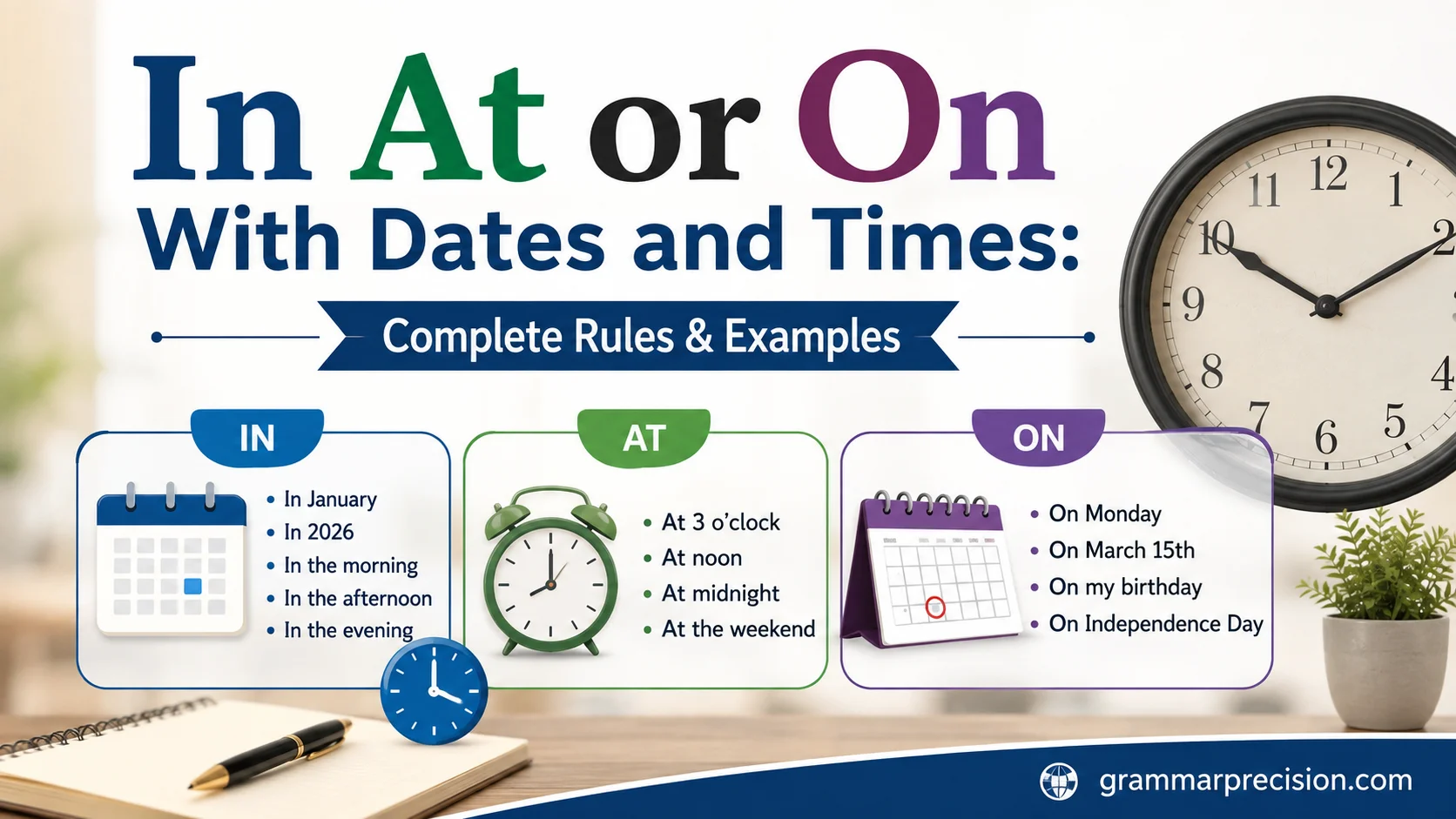
In At or On With Dates and Times helps you understand how to use prepositions for dates and times with confidence while improving your English grammar and writing skills today.
Choosing the correct preposition can make your sentences clearer and more natural in everyday English. Learn how in, on, and at work with different date and time expressions through simple examples. These grammar rules improve your communication skills and help you avoid common mistakes when writing emails, schedules, meetings, or important plans with better accuracy today.
Understanding prepositions of time becomes easier when you practice their usage in real situations. Your English language improves as you follow proper sentence structure and choose the right words for every context. With regular practice, you gain confidence and develop stronger writing habits for daily communication, professional messages, and accurate expressions related to dates and times too.
In, On, or At? The Answer at a Glance
Before diving into the details, look at this quick reference table.
| Time expression | Correct preposition | Example |
| Exact clock time | at | at 8:30 AM |
| Noon | at | at noon |
| Midnight | at | at midnight |
| Night | at | at night |
| Day | on | on Tuesday |
| Specific date | on | on March 15 |
| Birthday | on | on my birthday |
| Month | in | in March |
| Year | in | in 2026 |
| Season | in | in summer |
| Decade | in | in the 1990s |
| Century | in | in the 21st century |
| Morning | in | in the morning |
| Specific morning | on | on Monday morning |
Think of time as becoming broader as you move from at → on → in.
- At = a point
- On = a specific day
- In = a larger period
For example:
The meeting starts at 9:00 AM on Monday in September.
Here, at identifies the exact time, on identifies the day, and in identifies the month.
That single sentence captures the central logic of time prepositions.
When to Use “At” for Time
The preposition at generally describes a precise point on the clock. Imagine placing a tiny pin on a timeline. That pin represents at.
Use “At” With Exact Clock Times
Use at before a specific clock time.
Examples include:
- The train leaves at 6:15 AM.
- The class begins at 9:00.
- Call me at 4:30 PM.
- The store closes at 10 PM.
- Dinner starts at 7:45.
Notice how precise these expressions are. You’re identifying a particular moment rather than describing a whole period.
You can also use at with expressions such as at 5 o’clock, at 10:30, and at 11:59 PM.
Use “At” With Noon and Midnight
Noon and midnight represent precise points in the daily cycle, so they normally take at.
- The appointment is at noon.
- The movie begins at midnight.
- Lunch is served at noon.
- The deadline arrives at midnight.
A useful memory trick is to picture noon and midnight as two dots on a clock.
Use “At” With Night
One of the most important exceptions is at night.
You say:
- I usually read at night.
- The streets become quiet at night.
- We arrived at night.
You generally don’t say in night in standard English.
However, when you specify a particular night, on often becomes appropriate:
- We met on Friday night.
- The power went out on Saturday night.
This difference matters because night can describe a general period or a particular day-linked night.
Common Expressions With “At”
Several established expressions use at naturally:
- at night
- at noon
- at midnight
- at dawn
- at sunrise
- at sunset
- at the moment
- at present
These expressions are worth learning as complete phrases. Trying to build every expression from scratch can lead to awkward choices.
When to Use “On” With Dates
If at points to a time on the clock, on usually points to a specific day on the calendar.
Think of a calendar page. You’re placing your finger on one particular square. That’s the basic idea behind on.
Use “On” With Days of the Week
Use on before a specific day.
- on Monday
- on Tuesday
- on Wednesday
- on Thursday
- on Friday
- on Saturday
- on Sunday
For example:
The interview is on Thursday.
You could also say:
We have a meeting on Monday morning.
The day determines the preposition.
Use “On” With Specific Dates
Specific calendar dates also use on.
- on January 5
- on March 12
- on July 4
- on October 31
- on December 25
Examples:
- The conference begins on March 12.
- Her birthday falls on July 18.
- The office closed on December 25.
When you mention the exact date, on is the natural choice.
Use “On” With Holidays and Special Days
Use on when you’re talking about a holiday as a specific day.
- on Christmas Day
- on New Year’s Day
- on Thanksgiving Day
- on Independence Day
- on my birthday
For example:
We visit our relatives on Christmas Day.
However, holiday expressions become more complicated when you’re referring to the broader holiday period rather than one specific day. Context matters.
Use “On” With Day + Part of Day
This is one of the most useful patterns to remember.
You normally say:
- on Monday morning
- on Tuesday afternoon
- on Wednesday evening
- on Friday night
Why does on appear even though morning, afternoon, and evening usually take in?
Because the phrase identifies a specific day.
Compare these:
- I exercise in the morning.
- I exercise on Monday morning.
The first sentence describes a general part of the day. The second identifies a particular morning.
When to Use “In” for Dates and Time Periods
The preposition in normally describes a broader period. Instead of placing a pin on one moment or day, imagine stepping inside a large container of time.
That container might be a month, year, season, decade, or century.
Use “In” With Months
Months normally take in.
- in January
- in February
- in April
- in August
- in November
Examples:
We moved in August.
The project will finish in November.
You don’t normally say on August when referring to the entire month.
However, add a specific date and the preposition changes:
We moved on August 15.
The difference is simple:
in August = the month
on August 15 = a specific date
Use “In” With Years
Years also use in.
- in 1995
- in 2000
- in 2010
- in 2026
Examples:
- She graduated in 2018.
- The company launched in 2021.
- They met in 2005.
The same pattern works with broad historical periods.
Use “In” With Seasons
Use in with seasons when you’re describing the season generally.
- in spring
- in summer
- in fall
- in winter
Examples:
Flowers usually bloom in spring.
We travel more often in summer.
American English commonly uses in the fall, while in autumn is also perfectly standard.
Use “In” With Decades and Centuries
Larger blocks of historical time also use in.
- in the 1980s
- in the 1990s
- in the 21st century
- in the Middle Ages
For example:
Personal computers became increasingly common in the 1980s.
Technology changed rapidly in the 21st century.
The broader the time period, the more naturally in fits.
The Logic Behind In, On, and At
These prepositions become much easier when you stop memorizing isolated phrases and understand their relationship.
Imagine three different containers.
At is a pinpoint.
at 8:00 AM
On is a calendar square.
on Monday
In is a larger calendar section.
in July
That creates a useful hierarchy:
AT → exact point
ON → specific day/date
IN → broader period
This isn’t a perfect rule for every expression in English, but it handles the vast majority of everyday situations.
A Simple Mental Test
When you’re unsure, ask yourself three questions:
- Am I naming an exact time? → Use at.
- Am I naming a particular day or date? → Use on.
- Am I naming a month, year, season, or longer period? → Use in.
For example:
The appointment is ___ 3 PM ___ Tuesday ___ September.
The answers are:
The appointment is at 3 PM on Tuesday in September.
The structure becomes almost automatic once you identify the size of the time period.
The Most Confusing In, On, and At Combinations
The basic rules are useful, but real sentences often combine several time expressions.
In the Morning vs. On Monday Morning
Use in for a general morning:
I drink coffee in the morning.
Use on when you identify a particular day:
I drink coffee on Monday morning.
The same pattern applies to afternoon and evening:
- in the afternoon
- on Tuesday afternoon
- in the evening
- on Thursday evening
The specific day effectively “controls” the phrase.
At Night vs. On Friday Night
For a general nighttime period, use at night:
I don’t usually work at night.
For a particular night connected to a day, use on:
We watched a movie on Friday night.
This distinction is easy to overlook, yet it’s extremely common in everyday English.
At Christmas vs. On Christmas Day
These expressions can carry slightly different meanings.
On Christmas Day refers specifically to December 25.
We exchanged gifts on Christmas Day.
At Christmas can refer more broadly to the Christmas period or holiday season.
Many businesses close at Christmas.
The same principle appears with other holidays. The exact day and the broader period aren’t always interchangeable.
On the Weekend vs. At the Weekend
American English strongly favors:
on the weekend
For example:
We usually relax on the weekend.
British English commonly uses:
at the weekend
Neither expression should be treated as a universal grammatical error. They reflect regional usage.
For an American English audience, on the weekend is the safer and more natural choice.
In the Weekend
In the weekend is generally not the standard choice when you mean during the weekend.
Use:
I saw her on the weekend.
Instead of:
I saw her in the weekend.
There are some contexts where in may appear in related constructions, but standard everyday American English uses on the weekend for this meaning.
Also Read This: Prophecy vs. Prophesy: Meaning, Pronunciation & Examples
American English vs. British English
Time prepositions sometimes reveal regional differences.
The clearest example is the weekend:
| Meaning | American English | British English |
| During the weekend | on the weekend | at the weekend |
| Every weekend | on weekends | at weekends |
Both varieties follow their own established conventions.
This distinction doesn’t mean one variety is “correct” while the other is wrong. Instead, it shows how English develops slightly different patterns across regions.
If you’re writing for an American audience, especially in business, education, or general web content, on the weekend is the natural choice.
Common Mistakes With In, On, and At
Small prepositions create surprisingly large grammar mistakes.
Here are some common errors and their corrections:
| Incorrect | Correct | Reason |
| at Monday | on Monday | Monday is a day |
| in 8 PM | at 8 PM | 8 PM is an exact time |
| on July | in July | July is a month |
| in 2026 | in 2026 | Already correct |
| on 2026 | in 2026 | A year takes “in” |
| in Friday | on Friday | Friday is a day |
| at January | in January | January is a month |
| in midnight | at midnight | Midnight is a precise point |
| in night | at night | “At night” is the standard expression |
| in Monday morning | on Monday morning | The phrase specifies a day |
One of the best ways to avoid these mistakes is to identify the time unit before choosing the preposition.
Real-Life Examples of In, On, and At
Grammar becomes easier when you see it working naturally.
Consider a workplace schedule:
The team meeting is at 10:00 AM on Monday in September.
Each preposition has a distinct job.
Now consider travel:
We arrived at the airport at 6:30 AM on Saturday.
Here, at 6:30 AM identifies the precise time while on Saturday identifies the day.
Consider a historical sentence:
The company was founded in 1985.
The year is a broad period, so in fits.
Now narrow the date:
The company was founded on June 14, 1985.
The moment becomes more specific, so on introduces the exact date.
A Mini Case Study
Suppose a manager writes this announcement:
The training session will take place in Friday at 9 AM.
Two prepositions are wrong.
The corrected version is:
The training session will take place on Friday at 9 AM.
Why?
- Friday is a specific day → on
- 9 AM is an exact time → at
The correction isn’t about memorizing a random grammar rule. It’s about recognizing what each time expression represents.
A Complete In, On, and At Cheat Sheet
When you need a quick answer, use this guide.
Use “At” For:
- exact clock times
- noon
- midnight
- night
- dawn
- sunrise
- sunset
Examples:
at 6 PM, at noon, at midnight, at night
Use “On” For:
- days
- specific dates
- birthdays
- specific holidays
- day + morning
- day + afternoon
- day + evening
- day + night
Examples:
on Monday, on May 10, on my birthday, on Friday evening
Use “In” For:
- months
- years
- seasons
- decades
- centuries
- general parts of the day
Examples:
in May, in 2026, in summer, in the 1990s, in the morning
Practice Exercise: Choose the Correct Preposition
Test your understanding before checking the answers.
Fill in each blank with in, on, or at.
- The meeting begins ___ 2:30 PM.
- We arrived ___ Monday.
- She was born ___ 1998.
- The event takes place ___ July.
- I usually wake up early ___ the morning.
- They went out ___ Friday night.
- The train arrives ___ midnight.
- We visited them ___ December 25.
- The company expanded rapidly ___ the 1990s.
- I’ll call you ___ noon.
- The exam is ___ Thursday morning.
- They usually travel ___ summer.
Answer Key
- at 2:30 PM
- on Monday
- in 1998
- in July
- in the morning
- on Friday night
- at midnight
- on December 25
- in the 1990s
- at noon
- on Thursday morning
- in summer
If you got most of these right, you’ve already mastered the central pattern.
A Final Trick for Remembering In, On, and At
When grammar rules start blurring together, return to the point-day-period method.
At = point
at 4:00 PM
On = day
on Tuesday
In = period
in August
Then look for exceptions that you’ve learned as fixed expressions:
at night
in the morning
on Monday morning
This method works because you’re not simply memorizing vocabulary. You’re thinking about the size and specificity of the time expression.
English prepositions can be fussy little words. Fortunately, they aren’t completely unpredictable.
Once you understand the underlying pattern, choosing between in, on, and at with dates and times becomes far less intimidating. Use at for precise points, on for specific days and dates, and in for broader periods. When a phrase involves a particular day, watch for combinations such as on Monday morning or on Friday night.
The goal isn’t to memorize hundreds of examples. It’s to recognize the type of time expression in front of you.
When you can identify the difference between a point, a day, and a period, the correct preposition usually falls into place.
FAQs:
What is the difference between in, on, and at with dates and times?
In is used for longer periods like months, years, seasons, and parts of the day. On is used for specific days and dates, such as Monday or July 10. At is used for exact times, like 5:00 PM or midnight. Choosing the right preposition makes your English clearer.
When should I use “in” with time expressions?
You use in when talking about general periods or longer time frames. Examples include in January, in 2026, in the morning, or in a few hours. It shows that something happens within a larger period rather than at a specific moment.
When should I use “on” with dates?
Use on before specific days, dates, or special days. For example, you can say on Monday, on my birthday, or on July 15. The word on connects an event with a particular day or date in the calendar.
When should I use “at” with times?
Use at when referring to an exact time or specific moment. Examples include at 7 PM, at noon, at midnight, and at lunchtime. This preposition helps identify the precise point when an action happens.
Why do people confuse in, on, and at?
Many learners find in, on, and at confusing because these small words have different rules. They are used frequently in English grammar, and choosing the wrong one can change the meaning. Regular practice with examples helps you understand their correct usage.
Conclusion:
Learning in, on, and at with dates and times improves your English communication and writing accuracy. These prepositions may seem difficult at first, but consistent practice makes them easier. By understanding the rules, studying examples, and applying them in daily conversations, you can build stronger grammar skills and communicate more confidently in different situations.