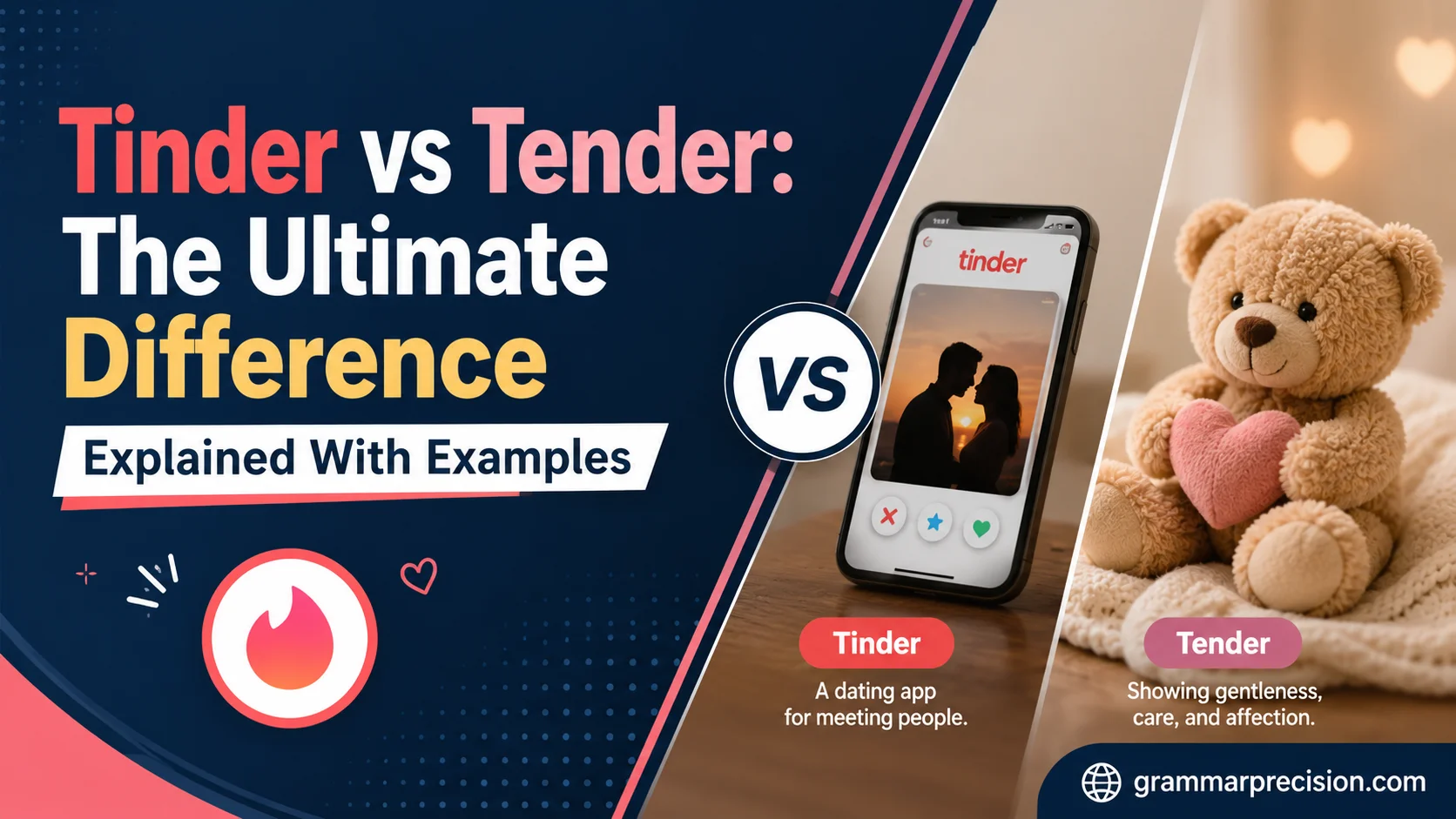
Tinder vs Tender can confuse English learners because these similar-looking words have different meanings, uses, and origins. Knowing the difference helps you choose the correct word and communicate clearly.
Tinder is a flammable substance used to start a fire. It includes paper, fatwood, and bark. Tender, however, can describe kindness, gentleness, softness, or something painful. It can also mean to formally offer something.
In modern English, Tinder also means a popular dating app connected with online dating and social connections. Because both words look similar, spell-check may not catch mistakes. Learning their correct use improves vocabulary, accuracy, and everyday communication.
The 5-Second Difference
The fastest way to separate these words is to connect each one with its strongest everyday meaning.
| Word | Simple meaning | Quick association |
| Tinder | Dry material used to help start a fire | Fire |
| Tender | Soft, gentle, sensitive, or formally offered | Soft / Gentle / Offer |
Think of tinder as the tiny stuff that gets a fire going. Think of tender as something that lacks toughness, shows care, or represents a formal offer.
For example:
- We gathered tinder before lighting the campfire.
- The chicken was surprisingly tender.
- She gave the child a tender smile.
- The contractor submitted a tender for the project.
Notice how one vowel changes the entire meaning. That’s the central lesson in tinder vs tender.
Meet “Tinder”
Tinder Definition
Tinder is primarily a noun. It means dry, easily ignited material used to start a fire.
Common tinder includes dry grass, shredded bark, leaves, wood shavings, paper, and very small dry twigs. The exact material varies, but the purpose stays the same: tinder catches a flame or spark quickly and helps ignite larger fuel.
A useful way to picture the process is a three-step ladder:
Tinder → Kindling → Firewood
Tinder catches first. Kindling burns longer and creates enough heat to ignite larger pieces of wood. Firewood then provides the sustained fuel for the fire.
Tinder as a Fire-Starting Material
Imagine trying to light a thick log directly with a tiny match. The log might burn eventually, but the small flame can’t transfer enough heat quickly.
Tinder solves that problem.
Its fine, dry structure gives a flame plenty of exposed surface area. Once tinder catches, it produces enough heat to ignite kindling. In other words, tinder is the bridge between a spark and a sustainable fire.
Example sentences:
- We collected dry grass to use as tinder.
- The wet campsite had very little usable tinder.
- She placed the tinder beneath the small branches.
- A single spark was enough to ignite the dry tinder.
Tinder in Figurative Language
Although the fire-related meaning is the most familiar, tinder can also appear figuratively.
Writers sometimes use it for something that helps a larger event begin. For instance, a small disagreement might become tinder for a larger conflict. The metaphor works because tinder doesn’t create the entire fire. It helps the fire begin.
Meet “Tender”
Unlike tinder, tender has several common meanings and can work as an adjective, noun, or verb. That’s why it appears in many more situations.
The core meanings revolve around softness, gentleness, sensitivity, or formal offering.
Tender as “Soft”
When tender describes food, it usually means the food is pleasantly soft and easy to chew.
For example:
The slow-cooked beef was incredibly tender.
Here, tender doesn’t mean emotionally kind. It describes texture.
You might describe these foods as tender:
- steak
- chicken
- beef
- vegetables
- meat cooked slowly
- young shoots or leaves
Cooking often makes this meaning especially clear. Slow cooking can break down connective tissue in meat, making it easier to chew. That’s why food writers frequently use tender to describe well-prepared meat.
Tender as “Gentle”
Tender can also describe emotions, behavior, touch, or relationships.
Consider:
He gave his daughter a tender hug.
The word suggests warmth, affection, care, or gentleness. It carries an emotional quality that soft doesn’t always express.
Compare these:
- soft voice → low, gentle sound
- tender voice → affectionate or emotionally warm sound
- soft touch → physically gentle contact
- tender touch → caring or affectionate contact
The meanings overlap, but they aren’t interchangeable in every sentence.
Tender as a Formal Offer
Here’s where tender takes a sharp turn.
As a noun, tender can mean a formal offer to provide goods, services, or work at a stated price. Businesses and government organizations often use the term when inviting companies to compete for contracts.
For example:
Three companies submitted a tender for the construction project.
As a verb, tender can mean to formally offer or present something.
Examples include:
- tender an offer
- tender payment
- tender a resignation
- tender documents
- tender a bid
This meaning is especially common in business, law, finance, and formal administration.
Tinder vs Tender: A Complete Comparison
The clearest way to understand tinder vs tender is to put their major differences side by side.
| Category | Tinder | Tender |
| Main role | Primarily a noun | Noun, verb, and adjective |
| Main meaning | Fire-starting material | Soft, gentle, sensitive, or formal offer |
| Common context | Camping and fire | Food, emotions, business, law |
| Pronunciation | TIN-der | TEN-der |
| Key vowel | Short i sound | Short e sound |
| Related idea | Ignition | Softness, care, offering |
| Example | Dry leaves make good tinder. | The meat is tender. |
The biggest difference isn’t spelling. It’s meaning and context.
If the sentence involves a campfire, sparks, or flammable material, tinder is probably correct.
If it involves softness, affection, sensitivity, or a formal business offer, tender is likely the right choice.
Why One Letter Changes Everything
English contains many word pairs that look nearly identical but mean very different things. Tinder and tender belong to that family of easily confused words.
The crucial spelling difference is the vowel:
tInder → i
tEnder → e
That small change also changes the vowel sound. Tinder begins with the vowel sound heard in words such as “sit,” while tender begins with the vowel sound heard in “bed.”
This is more than a spelling detail. It helps you hear the difference when someone says the words aloud.
A practical proofreading trick is to slow down and identify the intended meaning before checking the spelling. Ask yourself:
Am I talking about fire, or am I talking about softness, gentleness, sensitivity, or an offer?
That question catches many errors immediately.
Also Read This: In At or On With Dates and Times: Complete Rules & Examples
Tinder vs Tender Pronunciation
Pronunciation can make these words easier to distinguish.
- Tinder: /ˈtɪn.dər/
- Tender: /ˈtɛn.dər/
Both words contain two syllables and end with a similar -der sound. The first vowel creates the main difference.
Try saying them slowly:
TIN-der
TEN-der
The vowel in tinder is similar to the vowel in sit. The vowel in tender resembles the vowel in ten.
If you practice that contrast several times, the difference becomes much easier to recognize during conversation.
Real-Life Context Makes the Difference
Sometimes definitions aren’t enough. Context makes a word’s meaning obvious.
Around a Campfire
We need more tinder before we light the fire.
The sentence clearly concerns ignition. Tender would make no sense here.
At the Dinner Table
The roast became wonderfully tender after several hours.
Here, the word describes texture. Tinder would be completely wrong.
In an Emotional Moment
She gave him a tender smile.
The sentence describes affection or warmth.
In Business
The company submitted a tender for the highway project.
Here, tender means a formal bid or offer.
These examples reveal an important pattern: context acts like a compass. It points you toward the correct word before you even analyze the spelling.
Common Errors to Avoid
Because these words differ by just one letter, proofreading errors are easy to make.
Using “Tender” for Fire-Starting Material
Incorrect:
We collected dry leaves as tender.
Correct:
We collected dry leaves as tinder.
The material that helps start a fire is tinder.
Using “Tinder” for Soft Food
Incorrect:
The steak was very tinder.
Correct:
The steak was very tender.
Food can be tender. It can’t be tinder unless you’re discussing it as something intended to burn, which would be a very unusual context.
Confusing “Tender” With “Gentle”
These words sometimes overlap, but tender can carry a stronger emotional or caring sense.
Compare:
She spoke in a gentle voice.
She spoke in a tender voice.
The first focuses on softness or lack of harshness. The second can suggest affection, vulnerability, or emotional warmth.
Forgetting the Business Meaning
Some readers know tender only as an adjective. That’s a mistake worth avoiding.
In formal contexts, tender frequently functions as a noun or verb.
The company issued a tender for the work.
The contractor tendered its proposal.
Knowing this meaning gives you a much broader command of the word.
How to Remember Them Forever
A good memory trick should be fast, visual, and difficult to forget.
Tinder → Fire
Picture a tiny pile of dry grass catching a spark.
Tinder = the beginning of a fire.
You can even remember the phrase:
Tinder triggers the flame.
The repeated T sound creates a useful mental hook.
Tender → Soft
Picture a perfectly cooked piece of meat that cuts easily.
Tender = soft.
Then expand the idea:
Tender → soft, gentle, sensitive, or formally offered.
If you’re still unsure, return to the first question:
Does this sentence involve fire?
If yes, choose tinder. If not, check whether tender fits the meaning.
Tinder, Kindling, and Firewood: Related Fire Terms Explained
These three terms often appear together, yet they describe different stages of building a fire.
Tinder is the easiest material to ignite. It may include dry grass, bark fibers, paper, or fine wood shavings.
Kindling comes next. It consists of small pieces of wood that catch from the tinder and generate more sustained heat.
Firewood provides the main fuel. Larger logs burn longer and keep the fire going.
Think of the sequence like this:
Spark → Tinder → Kindling → Firewood → Sustained Fire
This simple chain makes the vocabulary easier to remember. It also explains why calling a large log “tinder” usually sounds inaccurate.
Tender, Soft, Gentle, and Delicate: Are They Synonyms?
These words overlap, but each has its own flavor.
| Word | Typical idea | Example |
| Tender | Soft, caring, or sensitive | The meat was tender. |
| Soft | Not hard or harsh | The pillow feels soft. |
| Gentle | Mild and not rough | He used a gentle touch. |
| Delicate | Easily damaged or fine | The glass is delicate. |
Tender often carries an emotional or tactile quality. Soft focuses more directly on physical texture. Gentle emphasizes behavior or force. Delicate highlights fragility.
Choosing among them depends on the nuance you want.
Common Grammar Patterns With “Tender”
Because tender has several grammatical roles, its sentence patterns are worth learning.
Tender as an Adjective
Use it before a noun or after a linking verb.
- a tender steak
- a tender moment
- tender skin
- The meat is tender.
Tender as a Noun
Use it when referring to a formal offer or bid.
- The company submitted a tender.
- Several tenders were received.
Tender as a Verb
Use it when someone formally offers or presents something.
- They tendered their resignation.
- The supplier tendered a bid.
- He tendered payment.
The verb often appears in formal writing. Everyday conversation may use simpler alternatives such as offer, submit, or present.
Case Study: Choosing the Right Word in Context
Consider this short paragraph:
Marcus prepared a campfire before sunset. He gathered dry grass and bark for the first stage of the fire. After dinner, everyone complimented the meat because it was easy to cut and chew. Later, Marcus gave his daughter a warm hug before she went to sleep.
Three different meanings appear.
The dry grass and bark are tinder because they help start the fire.
The meat is tender because it has a soft, easy-to-chew texture.
The hug is tender because it expresses affection and warmth.
One small spelling distinction separates these meanings, but context makes each choice clear.
Mini Practice Test: Tinder or Tender?
Choose the correct word in each sentence.
- The dry leaves made excellent ______.
- The slow-cooked beef was incredibly ______.
- She gave her newborn a ______ kiss.
- The company submitted a ______ for the contract.
- Add more ______ before placing the large logs.
- The bruise was still ______ to the touch.
Answers
- tinder
- tender
- tender
- tender
- tinder
- tender
FAQs:
What is the main difference between Tinder and Tender?
Tinder usually refers to a flammable material used to start a fire, while tender has meanings related to kindness, softness, care, or a formal offer. Tinder can also refer to the dating app. Therefore, the two words have completely different meanings and uses.
Are Tinder and Tender homophones?
Yes, tinder and tender are often considered near-homophones because their pronunciation sounds similar, especially in fast speech. However, they are spelled differently and have different meanings. Their similar sound and appearance can make them commonly confused words in English.
How do you use Tinder in a sentence?
You can use tinder when talking about material that helps start a fire. For example: “We collected dry tinder before making the fire.” In modern English, Tinder can also refer to the popular dating app used for online dating.
How do you use Tender in a sentence?
Tender has several uses. It can describe something soft, gentle, or painful, such as “She gave the child a tender touch.” It can also mean to formally offer something, as in “The company decided to tender its proposal.”
Why are Tinder and Tender easy to confuse?
They are easy to confuse because they look similar, sound somewhat alike, and differ by only one letter. Spell-check and autocorrect may not always identify the mistake because both are correctly spelled words. Understanding their meanings and checking the sentence context helps you choose correctly.
Conclusion:
Understanding Tinder vs Tender is important because these similar-looking words have completely different meanings and uses. Tinder relates to fire or a dating app, while tender describes softness, care, or a formal offer. Learning their correct spelling, pronunciation, and context can prevent common mistakes and improve your English vocabulary, writing, and everyday communication with greater confidence and accuracy.