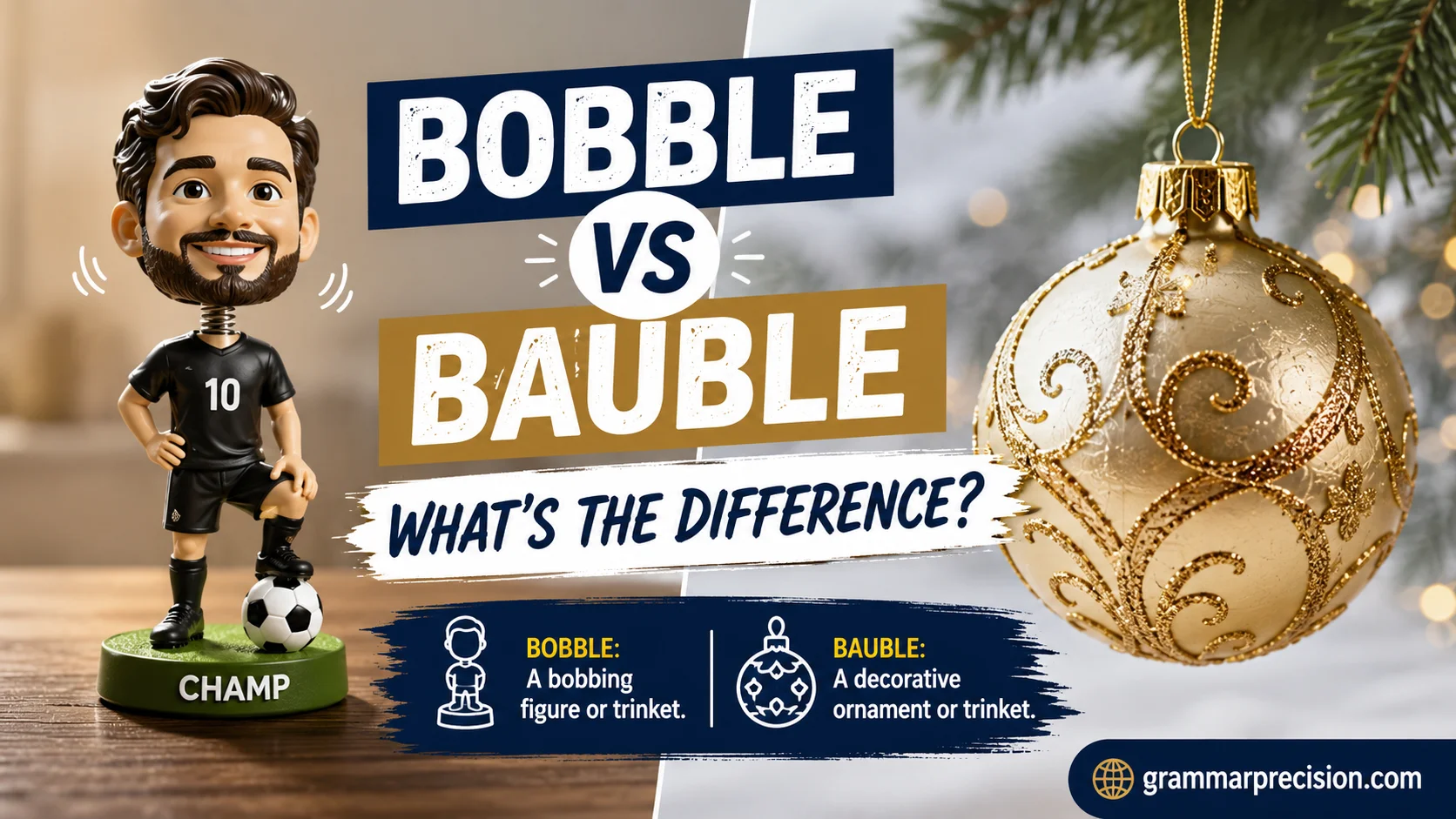
Bobble vs Bauble can be confusing because these words sound alike but have different spellings and meanings. Understanding their uses, origins, and examples makes the difference easier to remember.
Bobble can be a noun meaning a soft ball of wool used to decorate clothing or hats. It can also be a verb meaning to fumble or move with a bouncing motion. A bauble is a small decoration, often brightly colored, gaudy, or inexpensive, especially during Christmas.
A useful memory trick is to connect bobble with a woolly hat and bauble with a Christmas tree decoration. Although their appearance and sound are similar, their uses differ. Remembering these simple examples can help you choose the right word confidently in everyday English conversations and writing.
Quick Answer: Bobble vs Bauble
The simplest distinction is this:
- Bobble usually refers to a small rounded object or an awkward bouncing, wobbling, or fumbling movement.
- Bauble usually refers to a small decorative object, ornament, or trinket.
- Bobble can work as both a noun and a verb.
- Bauble is primarily a noun.
- A bobble often relates to movement or shape.
- A bauble usually relates to decoration or appearance.
Consider these two sentences:
The goalkeeper bobbled the ball.
She placed a silver bauble on the Christmas tree.
The first sentence describes an action. The second describes an object.
That’s the key difference in a nutshell.
Bobble Meaning
Bobble has several related meanings. Its meaning depends heavily on how you use it in a sentence.
As a noun, bobble can describe a small rounded object or decorative feature. As a verb, it can describe handling something awkwardly or causing something to move in an uneven way.
The word appears in sports, clothing, toys, and everyday descriptions.
Bobble as a Verb
When bobble functions as a verb, it commonly describes an awkward movement or a mistake while handling something.
For example:
- The player bobbled the pass.
- I bobbled my keys while trying to unlock the door.
- The ball bobbled across the grass.
- She bobbled the catch before grabbing it.
- The glass bobbled slightly on the uneven table.
In sports, bobble has a particularly clear meaning. A player bobbles a ball when they fail to control it cleanly, usually causing it to bounce, slip, or move unexpectedly.
Imagine a baseball player reaching for a fast-moving ball. The ball hits the glove but doesn’t stay there. It pops loose before the player catches it.
That’s a bobble.
The word can also suggest an unsteady or repeated movement. Something may bob up and down or move awkwardly.
Bobble as a Noun
As a noun, bobble can describe a small ball-shaped decoration.
You might see a bobble attached to:
- A winter hat
- A piece of clothing
- A toy
- A keychain
- A decorative item
- A stuffed animal
For example:
His blue winter hat had a fluffy bobble on top.
Here, bobble doesn’t describe movement. It describes the small rounded object attached to the hat.
The word also appears in bobblehead, which refers to a toy or figurine with an oversized head that moves or wobbles on a spring or flexible connection.
Bauble Meaning
A bauble is generally a small decorative object. It may be attractive, colorful, shiny, or ornamental without necessarily being expensive.
The word is especially familiar in connection with Christmas decorations.
For example:
We bought several red baubles for the Christmas tree.
A bauble can also mean a small piece of jewelry or an inexpensive decorative trinket.
The idea behind the word is simple: a bauble is something decorative rather than something primarily functional.
Bauble as a Decorative Object
You might call something a bauble when it has decorative value but little practical purpose.
Examples include:
- Christmas tree ornaments
- Small decorative jewelry pieces
- Trinkets
- Shiny ornaments
- Decorative glass objects
- Small fashion accessories
For example:
The shop displayed colorful glass baubles near the entrance.
Here, baubles refers to decorative objects.
The word can sometimes carry a slightly dismissive tone. If someone calls jewelry or possessions baubles, they may suggest that those things are pretty but not especially important or valuable.
Bauble in Figurative Language
Bauble can have a figurative meaning too.
Writers sometimes use it to describe something attractive that lacks serious value. The word can therefore suggest frivolity, superficial beauty, or unnecessary decoration.
For example:
He cared more about expensive baubles than practical possessions.
The sentence doesn’t necessarily mean that the objects are worthless. Instead, it emphasizes their decorative or superficial nature.
This figurative sense gives bauble a little more personality than the everyday word ornament.
Bobble vs Bauble: Key Differences
The easiest way to understand bobble vs bauble is to compare their meanings directly.
| Feature | Bobble | Bauble |
| Main meaning | Rounded object or awkward movement | Small decorative object |
| Part of speech | Noun and verb | Mainly noun |
| Common context | Sports, clothing, movement, toys | Christmas, jewelry, ornaments |
| Describes an action? | Yes | Generally no |
| Can describe a decoration? | Yes | Yes |
| Typical example | “He bobbled the ball.” | “She hung a bauble on the tree.” |
| Core idea | Movement or rounded shape | Decoration or trinket |
A useful memory trick is to associate bobble with bouncing.
Both words begin with bo, but bobble has that extra b sound at the end. Think of the repeated b as something bouncing or bobbing around.
For bauble, think beautiful decoration.
It isn’t a perfect linguistic rule, but it’s a handy memory hook.
Is a Christmas Decoration a Bobble or Bauble?
This question causes plenty of confusion.
In many varieties of English, especially British English, a small round Christmas tree decoration can be called a bauble.
For example:
We decorated the tree with gold and red baubles.
In American English, however, ornament is generally the more familiar everyday term.
So you might hear:
We bought new Christmas ornaments.
rather than:
We bought new Christmas baubles.
That doesn’t mean bauble is incorrect in American English. It simply means ornament tends to sound more natural to many American speakers.
Bauble vs Ornament
The two words overlap, but they aren’t perfect synonyms.
Ornament is a broad term for something used to decorate another object or place.
Bauble usually suggests something small, decorative, and often somewhat ornamental or showy.
For example:
- A Christmas ornament could be a wooden angel.
- A Christmas bauble often suggests a small decorative ball.
- A decorative wall piece can be an ornament.
- You wouldn’t normally call a large wall sculpture a bauble.
In other words, bauble is narrower and more specific in flavor.
Is a Pom-Pom a Bobble?
Sometimes.
The words bobble and pom-pom overlap when they describe fluffy, rounded decorations attached to clothing.
For example:
Her winter hat has a large fluffy bobble.
You could also describe a similar object as a pom-pom, especially when referring to a soft ball of yarn or fabric.
However, the terms aren’t always interchangeable.
A pom-pom often consists of yarn, thread, fabric, or similar material gathered into a fluffy ball. A bobble can describe a wider range of small rounded features.
You may therefore see both terms used for similar clothing decorations.
Think of it this way:
Pom-pom emphasizes the construction or fluffy appearance.
Bobble emphasizes the rounded decorative feature.
Bobble vs Bauble Pronunciation
Pronunciation makes this pair even trickier.
The two words are close enough in sound that you may misunderstand one when someone says it quickly.
Bobble is commonly pronounced approximately like BAH-buhl in American English.
Bauble can have regional pronunciation differences. In British English, it is commonly pronounced approximately BAW-buhl.
The vowel distinction may be subtle depending on the speaker’s accent.
That’s why spelling becomes important.
If you’re hearing the word rather than seeing it written, context can reveal the intended meaning.
For example, if someone says:
“I dropped the ball and bobbled it.”
You can immediately infer the movement-related meaning.
If they say:
“We bought new baubles for the tree.”
The Christmas context makes the intended word clear.
Bobble vs Bauble Examples
Seeing the words in realistic sentences makes the distinction much easier.
Examples With Bobble
- The receiver bobbled the football before catching it.
- His winter hat had a bright red bobble.
- The ball bobbled across the muddy field.
- She accidentally bobbled the keys onto the floor.
- The goalkeeper made a difficult save but bobbled the ball.
- The child’s hat had two fluffy bobbles.
- The toy’s head moved like a bobblehead.
- He nearly caught the pass but bobbled it.
- The uneven surface made the object bobble slightly.
- A blue bobble decorated the top of her knitted hat.
Notice the pattern. Bobble frequently connects with movement, handling, shape, or clothing.
Examples With Bauble
- She hung a silver bauble on the Christmas tree.
- The shop sold handmade glass baubles.
- The necklace was decorated with colorful baubles.
- They filled the box with small Christmas baubles.
- The antique shop displayed several unusual baubles.
- He bought a cheap bauble as a souvenir.
- The tree glittered with red and gold baubles.
- She collected decorative baubles from different countries.
- The room was filled with shiny seasonal baubles.
- The critic dismissed the jewelry as expensive baubles.
Here, the focus stays on decoration, ornaments, jewelry, or trinkets.
Also Read This: Before Date vs. By Date: The Exact Difference Explained
Common Spelling Mistakes
Because bobble and bauble look so similar, spelling errors are common.
The most frequent mistake is using one word when the context requires the other.
Mistake: Using “Bauble” for Movement
Incorrect:
The goalkeeper baubled the ball.
Correct:
The goalkeeper bobbled the ball.
A ball that slips or moves awkwardly is associated with bobble, not bauble.
Mistake: Using “Bobble” for a Christmas Ornament
Incorrect:
She placed a red bobble on the Christmas tree.
This isn’t necessarily impossible. A small rounded decoration could technically be called a bobble depending on what it looks like.
However, if you specifically mean a traditional decorative Christmas ball, bauble is the more fitting word in varieties of English where that term is common.
She placed a red bauble on the Christmas tree.
Mistake: Treating Them as Interchangeable
The words aren’t interchangeable simply because they rhyme or look alike.
Compare:
He bobbled the catch.
He bought a bauble.
Changing the words would destroy the intended meaning.
Bobble, Bauble, Bubble, and Pom-Pom: Don’t Mix Them Up
English has several small words that describe rounded shapes or decorative objects. They can blur together when you encounter them quickly.
Bobble vs Bubble
A bubble is a thin sphere filled with air or gas, such as a soap bubble.
A bobble can describe a rounded decoration or awkward movement.
The child blew a bubble.
The player bobbled the ball.
The first involves a floating sphere. The second involves movement or handling.
Bobble vs Pom-Pom
A pom-pom is usually a fluffy ball made from yarn, thread, fabric, or similar material.
A bobble can describe a similar decorative feature, especially on clothing.
She wore a hat with a fluffy pom-pom.
She wore a hat with a fluffy bobble.
Depending on the variety of English and the exact object, both can sound natural.
Bauble vs Trinket
A trinket is a small ornament or piece of jewelry, often inexpensive or of limited practical value.
A bauble has a similar sense but often emphasizes decoration and appearance.
She bought a small trinket while traveling.
The necklace was covered with colorful baubles.
The meanings overlap, but trinket focuses more on the small possession itself.
Bobble vs Bauble in British and American English
Regional English matters here.
In British English, bauble is especially familiar when discussing Christmas decorations. You may commonly hear someone talk about decorating a Christmas tree with baubles.
In American English, Christmas ornament is usually the more familiar expression.
That distinction matters for writers who want their vocabulary to sound natural to a specific audience.
If you’re writing for an American audience, this sentence will generally sound straightforward:
We bought new Christmas ornaments this year.
For a British audience, this may sound equally natural:
We bought new Christmas baubles this year.
Neither usage automatically makes the other incorrect.
Language isn’t a rigid machine. Regional vocabulary often gives the same object different everyday names.
A Simple Rule to Never Confuse Them Again
When you’re stuck between bobble vs bauble, ask yourself one question:
Am I talking about movement or decoration?
If you’re describing movement, fumbling, bouncing, wobbling, or a rounded feature, choose bobble.
If you’re describing a small decorative object, ornament, or trinket, choose bauble.
Use this quick decision guide:
Is something being handled awkwardly?
→ Bobble
Is something moving or bouncing unevenly?
→ Bobble
Is there a small rounded decoration on clothing?
→ Bobble
Is it a Christmas tree decoration?
→ Bauble in common British usage
Is it a small decorative trinket?
→ Bauble
Is it jewelry being described as decorative or frivolous?
→ Bauble
This distinction works in most everyday situations.
Bobble vs Bauble: Which Word Is Correct?
Neither word is simply “more correct.” The context determines the correct choice.
Use bobble when you mean:
- To move awkwardly
- To fumble or mishandle something
- A small rounded feature
- A decoration on a hat or garment
- A bobblehead-style object
Use bauble when you mean:
- A small ornament
- A decorative object
- A Christmas tree decoration
- A trinket
- A showy or relatively insignificant possession
The biggest mistake is focusing only on spelling.
Instead, focus on meaning first.
If the sentence describes what something does, bobble may be the word you need. If it describes a small object valued mainly for its decorative appearance, bauble is more likely.
FAQs:
What is the difference between bobble and bauble?
Bobble usually refers to a small ball of wool or a bouncing movement, while bauble means a small decoration, especially one used on a Christmas tree. Although they sound the same, their meanings, spellings, and uses are different.
Is bobble a noun or a verb?
Bobble can be both a noun and a verb. As a noun, it can describe a soft ball on a hat. As a verb, it can mean to fumble a ball or move with a bouncing motion.
What does bauble mean?
A bauble is a small, usually decorative object. It may be brightly colored, shiny, or somewhat gaudy. The word commonly appears when discussing Christmas decorations, jewellery, ornaments, or other small decorative items.
Are bobble and bauble homophones?
Yes. Bobble and bauble are homophones because they are generally pronounced the same way but have different spellings and meanings. Remembering what each word describes can help you avoid confusing them.
How can I remember bobble vs bauble?
Use a simple memory trick: think of bobble as the soft ball on a woolly hat and bauble as a decoration hanging on a Christmas tree. This connection makes it easier to choose the right word.
Conclusion:
Understanding bobble vs bauble becomes simple when you remember their different meanings and uses. Bobble usually relates to woolly balls, bouncing movements, or fumbled actions, while bauble describes a small decoration or ornament. Although these homophones sound alike, their spellings and meanings clearly differ. With regular practice and simple memory tricks, you can confidently use both words correctly in everyday English.