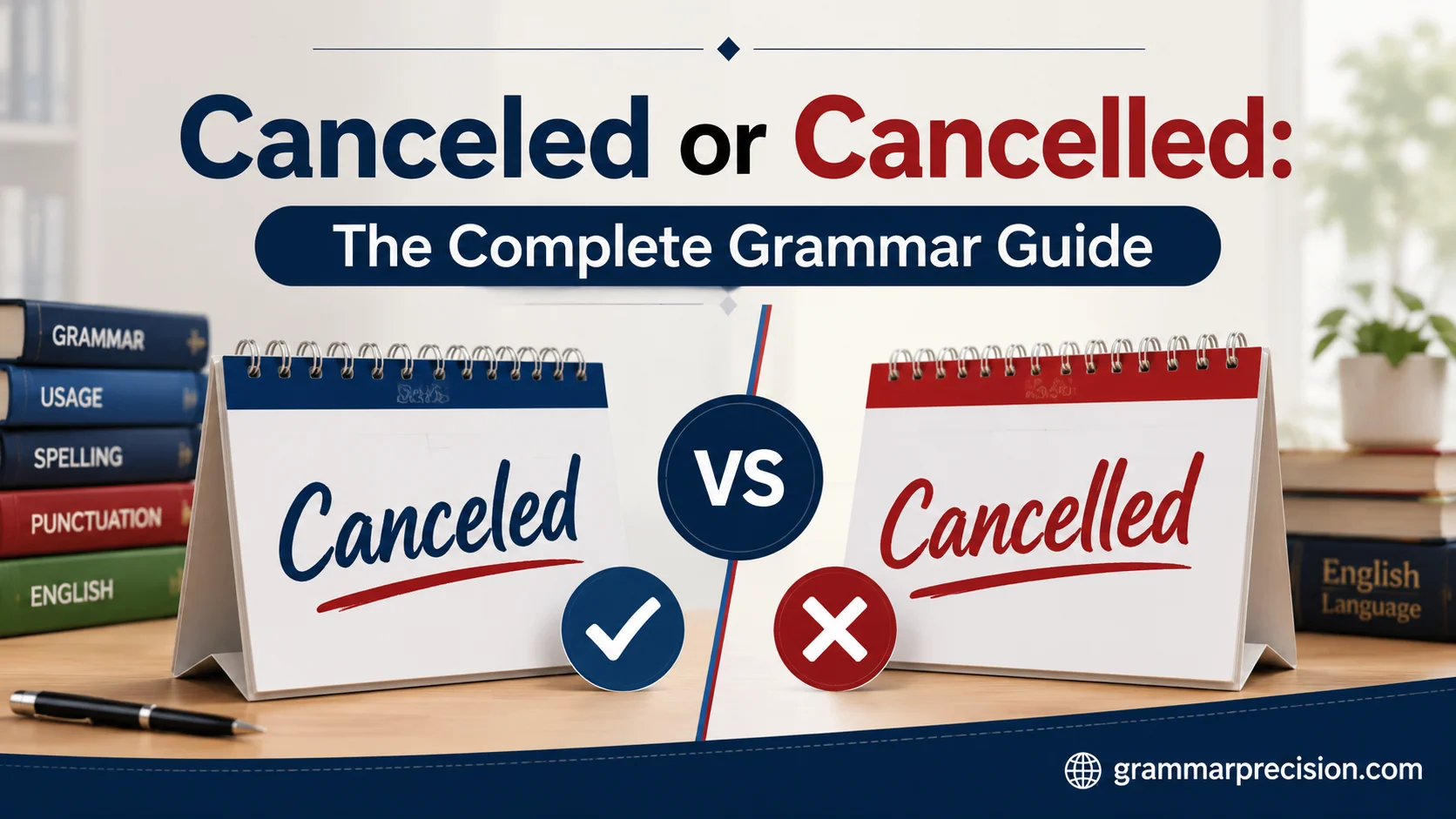
Canceled or Cancelled explains why two spellings can have the same meaning while following different American English and British English spelling conventions in everyday writing.
Canceled and cancelled both mean that a planned event will not happen. Canceled is usually preferred in American English, while cancelled is standard in British English. The difference comes from spelling rules, not meaning. American English uses one L, whereas British English keeps the double L spelling in this word.
You can find this word in event notices, school bulletins, parties, vacations, and major gatherings. When an event gets canceled, it may cause disappointment for students or concertgoers. To keep your communication clear, choose the spelling that matches your version of English. Remember, cancellation always keeps two l’s in both varieties.
Canceled or Cancelled: What Is the Difference?
The difference between canceled and cancelled is mainly based on the variety of English you use.
Both words come from the verb cancel, which means to stop something from happening, remove something, or make something invalid.
For example:
- The airline canceled the flight because of bad weather.
- The airline cancelled the flight because of bad weather.
Both sentences have exactly the same meaning.
The only difference is spelling preference:
| Spelling | Commonly Used In | Example |
| Canceled | American English | The meeting was canceled yesterday. |
| Cancelled | British English | The meeting was cancelled yesterday. |
Think of these spellings like two different road signs pointing to the same destination. The route changes, but the meaning stays the same.
Quick Answer: Which One Should You Use?
Use:
- Canceled if you write mainly for an American audience.
- Cancelled if you write mainly for a British audience.
- Either version is acceptable if your audience uses a different English variety, but consistency matters.
A document that switches between both forms can look careless even though neither spelling is technically wrong.
What Does Canceled Mean?
Canceled is the American English spelling of the past tense and past participle form of cancel.
The word means that something planned, scheduled, or arranged has been stopped.
Common meanings include:
Ending an event
Example:
The concert was canceled because the singer became ill.
The event was scheduled, but it will no longer happen.
Stopping an appointment
Example:
I canceled my dentist appointment because I was traveling.
The appointment was removed from the schedule.
Ending a service or agreement
Example:
She canceled her streaming subscription after one month.
The service was discontinued.
Removing something officially
Example:
The company canceled the order before shipping it.
The order became invalid.
The meaning never changes between canceled and cancelled. Only the spelling changes.
What Does Cancelled Mean?
Cancelled is the British English spelling of the same word.
It carries the exact same definition and appears in countries that commonly follow British spelling standards.
These regions often use cancelled:
- United Kingdom
- Australia
- New Zealand
- South Africa
- Many Commonwealth countries
Examples:
- The football match was cancelled due to heavy rain.
- The appointment was cancelled at the last minute.
- The hotel reservation was cancelled online.
A British newspaper, university, or company would generally choose cancelled because it matches their spelling conventions.
Canceled vs. Cancelled: Complete Comparison Table
Understanding the differences becomes easier when you compare them side by side.
| Feature | Canceled | Cancelled |
| English variety | American English | British English |
| Number of “L” letters | One “l” | Two “l’s” |
| Meaning | Stop or end something | Stop or end something |
| Pronunciation | Same | Same |
| Grammar category | Past tense/past participle | Past tense/past participle |
| Common regions | United States | UK, Australia, New Zealand |
The key point is simple:
Canceled and cancelled mean the same thing. The spelling depends on where your audience is located.
Why Does Canceled Have One “L” and Cancelled Have Two?
The reason behind this difference comes from the way American and British English developed different spelling habits.
English spelling has never been completely uniform. Over hundreds of years, different regions created their own preferences.
During the 18th and 19th centuries, American English began moving toward simplified spelling in several areas. Writers and dictionary makers promoted shorter spellings to make English easier to learn and use.
One major influence was American lexicographer Noah Webster, who supported spelling reforms in the United States.
Some examples of American spelling preferences include:
| American English | British English |
| Color | Colour |
| Center | Centre |
| Traveling | Travelling |
| Labeled | Labelled |
| Canceled | Cancelled |
The change from cancelled to canceled follows this broader pattern of simplifying certain spellings.
The Grammar Rule Behind Canceled vs. Cancelled
The spelling difference comes from how English handles verbs ending in a consonant.
When adding endings like -ed or -ing, English sometimes doubles the final consonant.
However, American and British English often apply different rules.
American English Rule
American English usually does not double the final “l” when the final syllable is not stressed.
So:
- cancel → canceled
- travel → traveled
- label → labeled
British English Rule
British English commonly doubles the final consonant before adding endings.
So:
- cancel → cancelled
- travel → travelled
- label → labelled
Here is a comparison:
| Base Verb | American English | British English |
| Cancel | Canceled | Cancelled |
| Travel | Traveled | Travelled |
| Label | Labeled | Labelled |
| Model | Modeled | Modelled |
This pattern explains why the two spellings exist.
Canceled vs. Cancelled in Real-Life Examples
The easiest way to understand the difference is to see how people use these words naturally.
Events and Entertainment
American English:
The festival was canceled because of safety concerns.
British English:
The festival was cancelled because of safety concerns.
Travel
American English:
My flight was canceled after the airport closed.
British English:
My flight was cancelled after the airport closed.
Business Communication
American English:
The client canceled the contract before signing.
British English:
The client cancelled the contract before signing.
Everyday Conversations
American English:
She canceled dinner plans at the last minute.
British English:
She cancelled dinner plans at the last minute.
The context does not affect the spelling choice. The audience does.
Canceled or Cancelled: Which Spelling Is More Common?
When comparing canceled or cancelled, many people wonder which version appears more often online. The answer depends heavily on the country and the audience.
Because the United States has a large population of English speakers and produces a huge amount of online content, canceled appears frequently across American websites, news platforms, software interfaces, and business communication.
However, cancelled remains extremely common worldwide, especially in countries that follow British English standards.
A writer’s goal should not be choosing the “more popular” spelling. The better approach is choosing the spelling that matches the people reading your content.
For example:
- A US-based company writing customer emails will usually choose canceled.
- A UK university publishing academic materials will usually choose cancelled.
- A global company may select one spelling style and use it consistently across all communication.
Consistency creates professionalism.
A reader might not consciously notice every spelling choice, but inconsistent writing can create a feeling that something is slightly off.
Why American English Uses Canceled Instead of Cancelled
The preference for canceled in American English connects to a larger movement toward simplified spelling.
During the development of American English, many writers and language experts wanted spelling to become more practical. They believed English should be easier to learn and more closely connected to pronunciation.
This approach influenced many common spelling differences.
For example:
| Word Type | American Style | British Style |
| Remove extra letters | Theater | Theatre |
| Simplify endings | Catalog | Catalogue |
| Change spelling patterns | Analyze | Analyse |
| Reduce doubled consonants | Canceled | Cancelled |
American English did not randomly remove letters. Instead, these changes followed broader spelling preferences.
The goal was efficiency.
A shorter spelling could save space in newspapers, books, and educational materials. Over time, these choices became accepted standards.
Also Read This: Stayed or Staid? The Complete Guide to Understanding the Difference
Why British English Keeps the Double “L” in Cancelled
British English generally follows a more traditional spelling pattern for words ending in consonants.
When a word ends with a consonant and receives an ending like -ed or -ing, British English often doubles that consonant.
Examples:
- cancel → cancelled
- travel → travelled
- control → controlled
- label → labelled
This pattern helps maintain the original pronunciation and structure of the word.
British spelling traditions developed over centuries through dictionaries, education systems, publishing standards, and cultural influence.
The double “l” in cancelled is not a mistake or an outdated version. It is simply the preferred spelling style in British English.
Is Canceled or Cancelled More Correct?
This is one of the most common questions people ask.
The answer is simple:
Neither spelling is more grammatically correct.
Both forms are accepted English spellings.
The correct choice depends on the style of English you follow.
Consider this comparison:
The wedding was canceled because of a family emergency.
The wedding was cancelled because of a family emergency.
Both sentences are correct.
The difference is similar to choosing between:
- apartment vs. flat
- elevator vs. lift
- vacation vs. holiday
The meaning remains the same, but the word choice reflects regional language habits.
Is Cancelled Wrong in American English?
No, cancelled is not wrong in American English, but it is less common.
American dictionaries generally recognize both spellings. However, most US style guides recommend canceled as the standard American form.
For example:
- Newspapers in the United States usually prefer canceled.
- American businesses typically use canceled in official communication.
- American schools often teach canceled as the preferred spelling.
That said, you may still see cancelled in American writing, especially from:
- International companies
- British publications
- Writers influenced by British English
- People who prefer traditional spelling
The spelling does not change the meaning or make the sentence incorrect.
Is Canceled Wrong in British English?
No. However, canceled is less common in British English.
A British reader will understand the word immediately, but they may recognize it as an American spelling choice.
For professional writing in the UK, using cancelled usually feels more natural.
For example:
A British company would likely write:
Your appointment has been cancelled.
An American company would likely write:
Your appointment has been canceled.
Both messages communicate the same information.
Canceled vs. Cancelled in Academic Writing
Students often struggle with this spelling difference because academic writing requires consistency.
The best approach is to follow the spelling rules used by your school, university, or instructor.
If You Study in the United States
Use:
- canceled
- canceling
Example:
The professor canceled the lecture because of a scheduling conflict.
If You Study in the United Kingdom
Use:
- cancelled
- cancelling
Example:
The professor cancelled the lecture because of a scheduling conflict.
A spelling variation will rarely affect your grade by itself. However, consistent spelling shows attention to detail.
Canceled vs. Cancelled in Business Writing
Professional communication requires clarity and consistency.
Imagine receiving a company email that says:
Your order has been canceled.
Then another message says:
Your appointment has been cancelled.
Neither sentence is wrong. However, using two different spelling styles in the same brand communication may look unorganized.
Companies often create style guides that answer questions like:
- Should we use American or British English?
- Which spelling conventions should employees follow?
- How should customer messages be written?
A consistent writing style helps build trust.
Example: Customer Service Communication
American company:
We apologize, but your reservation has been canceled due to unexpected circumstances.
British company:
We apologize, but your reservation has been cancelled due to unexpected circumstances.
The message works either way. The spelling simply matches the audience.
Canceled vs. Cancelled in SEO and Online Content
Content creators often ask whether they should target canceled or cancelled for search engines.
The answer depends on your audience.
Search engines understand spelling variations, so using one form does not automatically prevent your content from ranking.
However, matching search intent matters.
For example:
- A website targeting American readers may focus on canceled.
- A website targeting UK readers may focus on cancelled.
Smart content often includes both versions naturally.
Example:
If you’re wondering whether to write canceled or cancelled, the answer depends on whether you follow American or British English.
This approach helps readers from different regions find useful information without making the writing feel forced.
Related Words: Cancelation or Cancellation?
The confusion does not stop with canceled or cancelled.
Many writers also wonder about:
- cancelation
- cancellation
Both spellings exist, but cancellation is much more common.
| Word | Usage |
| Cancellation | Standard and widely accepted |
| Cancelation | Less common alternative |
Examples:
Common:
The airline sent a cancellation notice.
Less common:
The airline sent a cancelation notice.
Most professional writers choose cancellation because it is the established spelling.
Canceling or Cancelling: Another Common Confusion
The same spelling difference appears when adding -ing.
American English:
I am canceling my subscription.
British English:
I am cancelling my subscription.
Comparison:
| Form | American English | British English |
| Past tense | Canceled | Cancelled |
| Present participle | Canceling | Cancelling |
| Noun | Cancellation | Cancellation |
Notice that cancellation usually keeps the double “l” in both varieties.
That is why many people find this word confusing.
Common Mistakes When Using Canceled and Cancelled
Even though the difference is simple, several mistakes appear frequently.
Mixing Both Spellings
Incorrect style:
The event was canceled, but the tickets were later cancelled.
The sentence is understandable, but the spelling style changes halfway through.
Better:
The event was canceled, but the tickets were later canceled.
Or:
The event was cancelled, but the tickets were later cancelled.
Choose one style and stay with it.
Assuming One Version Is Always Correct
Some writers believe:
- “Canceled is the only correct spelling.”
- “Cancelled is the only correct spelling.”
Both ideas are wrong.
English has many regional differences. A spelling preference does not automatically make another version incorrect.
Confusing Cancellation With Cancelled
A common mistake is writing:
The cancelation was unexpected.
Although acceptable, many readers expect:
The cancellation was unexpected.
The second version is more familiar and widely used.
How to Remember the Difference Between Canceled and Cancelled
A few simple memory tricks can help.
Remember the Audience
Think:
- American audience = one L
- British audience = two Ls
This is the easiest rule.
Remember Other Similar Words
If you know:
- traveled vs. travelled
- labeled vs. labelled
you can remember:
- canceled vs. cancelled
The pattern is the same.
Use Your Spell Checker Carefully
Spell check tools often follow your device language settings.
For example:
- US English settings suggest canceled.
- UK English settings suggest cancelled.
A spelling suggestion does not mean another version is wrong. It simply follows a regional preference.
FAQs:
Is Canceled or Cancelled correct?
Yes, both Canceled and Cancelled are correct. The difference is mainly based on the variety of English you use. Canceled is preferred in American English, while Cancelled is the standard spelling in British English.
Which spelling is used in American English?
Canceled is the preferred spelling in American English. It uses one L, following the American tendency to simplify certain spellings. You’ll commonly see it in American books, websites, newspapers, and everyday communication.
Which spelling is used in British English?
Cancelled is the standard spelling in British English. It contains a double L and follows traditional British spelling conventions. Writers in the UK and other regions that follow British English generally use cancelled.
Is cancellation spelled with one L or two?
Cancellation is spelled with two Ls in both American and British English. Although Americans usually write canceled with one L, the noun cancellation keeps the double-L spelling.
Can I use cancelled in American English?
Yes, you can use cancelled in American English, and readers will understand it. However, canceled is the more common and preferred American spelling. For consistency, choose one spelling style and follow it throughout your writing.
Conclusion:
Canceled and cancelled have the same meaning, but their spelling depends on the variety of English you use. American English generally prefers canceled, while British English uses cancelled. Both forms are correct, so your choice should match your audience and writing style. Remember that cancellation always uses two Ls, regardless of the English variety.