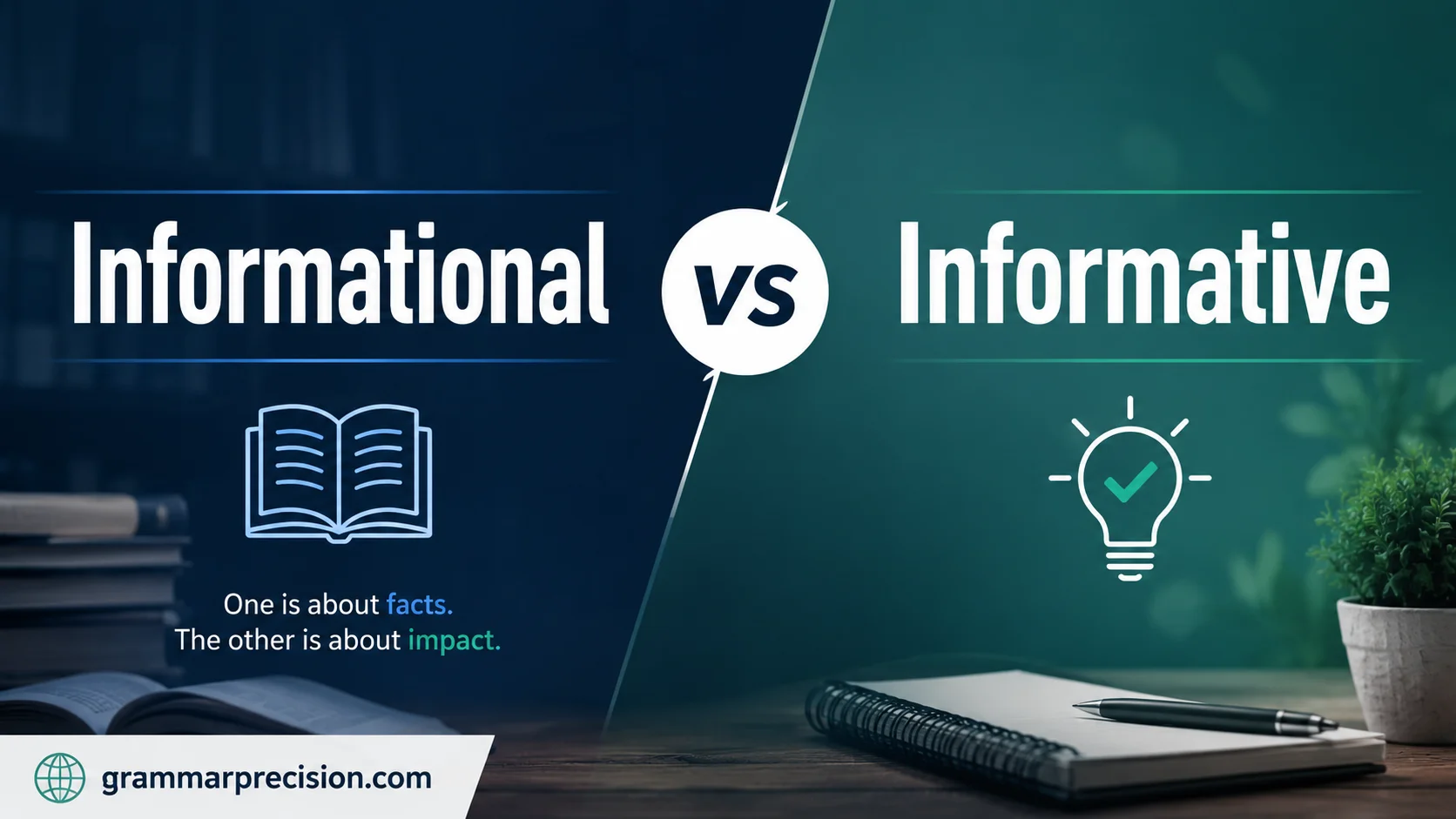
In practice, I noticed Informational vs Informative writing changes how readers learn. One gives facts and data, while the other builds understanding using analysis and AI processing.
This difference improves clarity, structure, and helps in using examples, tables, and semantic insights for better communication.
The idea of Informational vs Informative becomes clearer when you study real content. Informational content focuses on data, while informative content explains meaning through semantic analysis, AI models, and processing systems. This supports better learning, reading experience, and improves understanding of context and clarity.
What Is the Difference Between Informational and Informative?
The simplest way to understand the distinction is this:
- Informational describes content that provides information.
- Informative describes content that provides useful, valuable, or enlightening information.
That might sound like a small difference. In practice, it matters.
A document can be informational without being informative.
For example, a 50 page manual full of technical details contains information. Therefore, it is informational.
However, if the manual is confusing and difficult to understand, readers may not find it informative.
Quick Comparison
| Feature | Informational | Informative |
| Primary Meaning | Contains information | Provides useful information |
| Focus | Content type | Content quality |
| Common Usage | SEO, education, documentation | Writing, communication, teaching |
| Reader Benefit | May vary | Usually high |
| Describes | Purpose | Effectiveness |
Think of it this way:
Informational tells you what something is.
Informative tells you how well it helps the audience.
Informational Meaning
What Does Informational Mean?
The adjective informational describes something created to provide facts, details, data, or knowledge.
The focus stays on the content’s purpose rather than its effectiveness.
When people use informational, they typically discuss resources designed to educate or explain.
Common Examples of Informational Content
You encounter informational materials every day.
Examples include:
- User manuals
- Product specifications
- Educational websites
- Government publications
- Instruction guides
- Research reports
- Training documents
These resources exist primarily to communicate information.
Informational in a Sentence
Here are some examples:
- The website offers informational content about personal finance.
- The brochure contains informational materials for new employees.
- Students received an informational packet before orientation.
- The museum displayed several informational exhibits.
Notice that informational describes the purpose of the content rather than its usefulness.
Informative Meaning
What Does Informative Mean?
The adjective informative describes something that teaches, explains, or increases understanding effectively.
When people call something informative, they’re usually praising it.
The word carries a positive tone because it suggests the audience learned something valuable.
Characteristics of Informative Content
Informative content often includes:
- Clear explanations
- Useful examples
- Practical insights
- Relevant facts
- Easy to understand language
- Helpful context
Informative in a Sentence
Consider these examples:
- The presentation was extremely informative.
- She gave an informative speech about climate science.
- The article provided an informative overview of investing.
- The workshop was both engaging and informative.
In each example, informative describes how helpful the content was to the audience.
Informational vs Informative Comparison Table
The following table highlights the most important differences.
| Category | Informational | Informative |
| Definition | Contains information | Provides useful knowledge |
| Focus | Content purpose | Reader benefit |
| Tone | Neutral | Positive |
| Usage | SEO, education, documentation | Reviews, evaluations, feedback |
| Reader Experience | Not guaranteed | Usually positive |
| Typical Question | What is it for? | Was it helpful? |
A Simple Example
Imagine two travel guides.
Guide A contains hundreds of facts but organizes them poorly.
Guide B contains fewer facts yet explains them clearly.
Both guides are informational.
Only Guide B is truly informative.
That distinction explains why professional writers often prefer informative when discussing quality.
How Search Engines Use Informational Intent
One area where informational appears frequently is search engine optimization.
SEO professionals divide searches into categories based on user goals.
These categories help marketers create content that matches user expectations.
The Four Main Types of Search Intent
| Search Intent | Purpose |
| Informational | Learn something |
| Navigational | Find a specific website |
| Commercial | Research products |
| Transactional | Make a purchase |
Informational Queries
Informational searches occur when users seek knowledge.
Examples include:
- What is artificial intelligence?
- How does solar energy work?
- Why do leaves change color?
- Informational vs informative
The user wants answers rather than products.
Because of this, search engines prioritize educational content.
Navigational Queries
Users already know where they want to go.
Examples:
- YouTube login
- Gmail sign in
- Amazon customer service
The goal isn’t learning. The goal is navigation.
Commercial Queries
These searches happen during product research.
Examples:
- Best laptops for students
- Top running shoes
- iPhone vs Samsung
Users gather information before making a decision.
Transactional Queries
These indicate buying intent.
Examples:
- Buy wireless earbuds
- Order office chair
- Purchase domain name
Users are ready to act.
Also Read This: Deactivate vs Inactivate
Why SEO Experts Prefer the Phrase “Informational Intent”
SEO professionals rarely use informative intent.
Instead, they use informational intent.
Why?
Because the phrase focuses on the purpose of the search rather than the quality of the content.
When someone searches “how to tie a tie,” the query itself is informational.
The resulting article may or may not be informative.
That’s an important distinction.
SEO Example
Search Query:
How to start a podcast
Intent:
Informational
Possible Content Outcome:
Informative or uninformative
The search intent remains informational regardless of content quality.
Why Readers Prefer Informative Content
Although search engines recognize informational intent, readers prefer informative content.
Simply providing information isn’t enough anymore.
Modern audiences expect:
- Clarity
- Context
- Examples
- Practical advice
- Actionable insights
Readers don’t want a data dump.
They want understanding.
The Information Overload Problem
Today’s internet contains billions of pages.
Information isn’t scarce.
Attention is.
The most successful content transforms raw facts into useful knowledge.
That transformation creates informative content.
Famous Quote
“Knowledge is of no value unless you put it into practice.”
This idea explains why informative content consistently outperforms content that merely presents facts.
Informational vs Informative in Education
Teachers use both terms regularly.
However, each serves a different purpose.
Informational Text
Educational standards often define informational text as nonfiction material designed to explain, describe, or inform.
Examples include:
- Textbooks
- Articles
- Biographies
- Encyclopedias
- Scientific reports
Informative Teaching
An informative lesson helps students understand concepts clearly.
A teacher may use:
- Stories
- Visual aids
- Demonstrations
- Analogies
- Discussions
The goal extends beyond presenting facts.
The goal is understanding.
Classroom Example
A science textbook chapter is informational.
A teacher who explains the chapter through experiments creates an informative learning experience.
Informational vs Informative in Marketing
Marketers frequently use both words, although many don’t realize it.
Informational Marketing Content
Examples include:
- Product descriptions
- Feature lists
- FAQs
- Technical specifications
These materials communicate facts.
Informative Marketing Content
Examples include:
- Tutorials
- Buying guides
- Case studies
- Educational webinars
These resources help customers solve problems.
Case Study: Two Fitness Brands
Brand A publishes product specifications.
Brand B publishes workout plans, nutrition guides, and training videos.
Both brands provide information.
However, Brand B creates more informative content.
As a result, customers often spend more time engaging with the brand.
Examples from Business Communication
Businesses rely heavily on clear communication.
Understanding the difference between informational and informative can improve workplace writing.
Informational Documents
Examples include:
- Policy manuals
- Employee handbooks
- Compliance reports
- Technical documentation
Informative Documents
Examples include:
- Training presentations
- Performance reviews
- Educational workshops
- Leadership seminars
A document may be informational because it contains facts.
It becomes informative when employees actually understand and apply those facts.
Sentence Comparisons
The best way to learn the difference is through examples.
Correct Usage
- The company published an informational guide for new customers.
- The guide was highly informative and easy to understand.
- The website offers informational resources about retirement planning.
- Readers found the resources extremely informative.
- The museum created several informational displays.
- Visitors described the exhibits as highly informative.
Notice the pattern.
Informational describes the resource.
Informative describes the audience’s experience.
Common Mistakes Writers Make
Many writers misuse these terms because they focus only on definitions.
Mistake: Treating Them as Perfect Synonyms
Although related, the words aren’t interchangeable in every context.
Incorrect:
The teacher gave an informational lecture.
Better:
The teacher gave an informative lecture.
The second version emphasizes usefulness.
Mistake: Using Informative for Search Intent
Incorrect:
This keyword has informative intent.
Correct:
This keyword has informational intent.
SEO professionals use informational intent because it describes the user’s goal.
Mistake: Ignoring Audience Value
A page can contain thousands of facts.
That doesn’t automatically make it informative.
Readers care about understanding, not information volume.
Similar Words You Might Confuse
Several related adjectives create similar confusion.
Educational vs Informative
| Educational | Informative |
| Designed to teach | Helps readers learn |
| Often structured learning | Can occur anywhere |
A documentary can be informative without being educational.
Instructional vs Informational
| Instructional | Informational |
| Explains how to do something | Provides facts |
| Action focused | Knowledge focused |
Example:
- Recipe = Instructional
- History article = Informational
Descriptive vs Informative
| Descriptive | Informative |
| Paints a picture | Builds understanding |
| Focuses on details | Focuses on knowledge |
A travel article can be descriptive.
A travel guide can be informative.
Expert Tips for Better Word Choice
Strong writers choose words based on meaning rather than habit.
Use Informational When:
- Discussing content categories
- Talking about search intent
- Referring to educational materials
- Describing factual resources
Use Informative When:
- Evaluating usefulness
- Reviewing content quality
- Discussing audience learning
- Highlighting educational value
Quick Memory Trick
Remember this phrase:
Informational = Information Exists
Informative = Information Helps
That simple distinction solves most usage questions.
Quick Reference Chart
| Situation | Best Word |
| SEO search intent | Informational |
| Educational brochure | Informational |
| User manual | Informational |
| Government report | Informational |
| Helpful presentation | Informative |
| Useful article | Informative |
| Insightful webinar | Informative |
| Effective training session | Informative |
Save this table if you frequently write business, academic, or online content.
FAQs:
What is the main difference between informational and informative content?
Informational content mainly shares facts, data, and raw information, while informative content explains those facts in a way that improves understanding and clarity for the reader.
Is informational content less useful than informative content?
No, informational content is not less useful. It is important for quick facts, statistics, and direct data, while informative content is better for learning, explanation, and deeper insight.
Where is informational content mostly used?
Informational content is commonly used in reports, lists, manuals, and data based writing where the goal is to present clear and direct information without deep explanation.
Why is informative content important in learning?
Informative content helps readers understand topics better by adding explanation, context, and meaning, making it easier to build knowledge and long term memory.
Can a single article be both informational and informative?
Yes, many articles combine both styles. They present facts (informational) and also explain them in detail (informative) to improve reader engagement and clarity.
Conclusion:
The difference between informational vs informative content is mainly about depth and explanation. Informational content delivers raw facts and data, while informative content adds meaning, context, and understanding.
Together, both styles improve communication, learning, and knowledge sharing, especially in education, writing, and digital content creation.