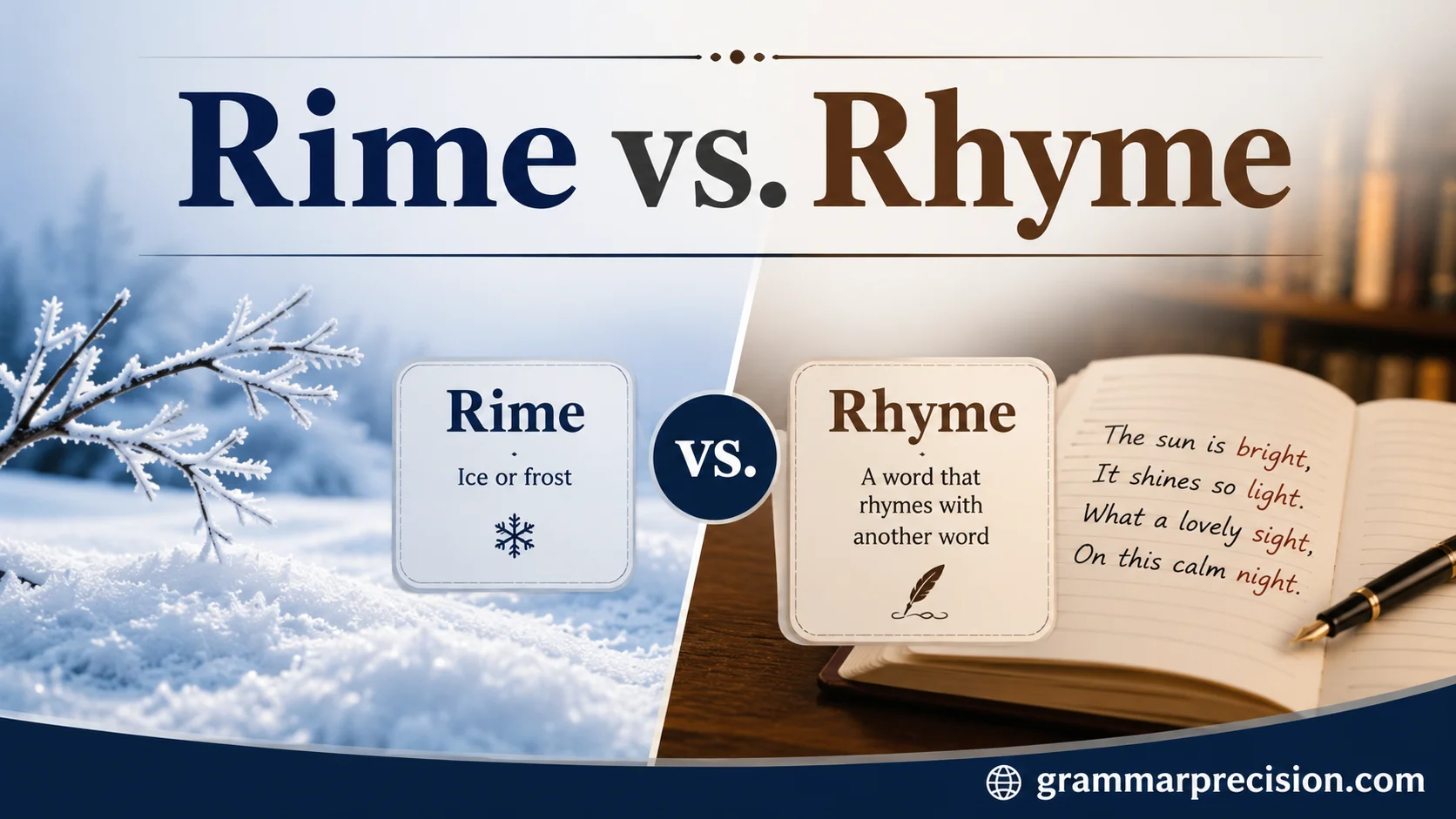
Rime vs. Rhyme confuses many writers because these words sound identical but have different meanings. Understanding their differences helps you use the right word in poetry, writing, and everyday English.
Although rime and rhyme share the same pronunciation, they serve different purposes. Rhyme connects to poetry, songs, and matching sounds, while rime describes frost, ice crystals, and historical language usage. Learning this difference improves your vocabulary and prevents common spelling mistakes.
This complete guide explains rime vs. rhyme with clear definitions, examples, history, and usage tips. Whether you are a student, writer, or language learner, you’ll discover how these words developed and when to use each one correctly.
Rime vs. Rhyme: The Quick Answer
The simplest difference between rime and rhyme is this:
| Word | Meaning | Common Use |
| Rhyme | A similarity between sounds, especially at the ends of words | Poetry, songs, lyrics, literature |
| Rime | A thin layer of frost or an old spelling of rhyme | Weather, historical texts, linguistics |
For example:
- The words light and night have a rhyme because they share similar ending sounds.
- The trees were covered with rime after a freezing night.
Although both words sound the same, their meanings are completely different.
A helpful way to remember them:
Rhyme = rhythm and poetry
Rime = ice and frost
Why Do People Confuse Rime and Rhyme?
The confusion between rime vs. rhyme comes from their shared pronunciation. When spoken aloud, you cannot tell which spelling someone means.
English contains many words called homophones. These are words that sound alike but have different meanings and spellings.
Some examples include:
| Homophones | Meaning Difference |
| Flower / Flour | A plant vs. baking ingredient |
| Sea / See | Ocean water vs. using your eyes |
| Write / Right | Create words vs. correct |
| Rime / Rhyme | Frost or old spelling vs. poetic sound |
The unusual part about rime and rhyme is that they were historically connected. They were not always separate words. Over centuries, English changed the spelling of rime because scholars connected it with Greek and Latin ideas about rhythm and poetry.
This historical connection makes the pair more interesting than ordinary homophones.
What Does Rhyme Mean?
Rhyme refers to a similarity in sound between words, especially when those sounds appear at the end of lines in poetry, songs, or other forms of writing.
When two or more words share matching sounds, they create a musical effect that makes language easier to remember.
For example:
The moon was bright,
Shining through the night.
The words bright and night rhyme because their ending sounds match.
Rhyme has played a major role in storytelling for thousands of years. Before books became common, people used rhyme to remember poems, histories, and important messages.
The Role of Rhyme in Poetry
Poets use rhyme to create structure, emotion, and rhythm. A poem without rhyme can still be powerful, but rhyme adds a musical quality that guides the reader.
Consider this example:
The river flows beneath the sky,
While gentle clouds are passing by.
The rhyme between sky and by creates a smooth connection between the lines.
Poets use different rhyme patterns depending on the effect they want.
Common Types of Rhyme
| Type of Rhyme | Explanation | Example |
| End rhyme | Rhyming words appear at the ends of lines | Star / Far |
| Internal rhyme | Rhyming words appear within the same line | I drove my car very far |
| Perfect rhyme | Words have matching sounds | Cat / Hat |
| Slant rhyme | Words have similar but not identical sounds | Shape / Keep |
| Eye rhyme | Words look similar but sound different | Love / Move |
Each type gives writers a different tool for creating mood and meaning.
Rhyme in Songs and Everyday Language
Rhyme is not limited to poetry. You hear it constantly in modern life.
Songwriters use rhyme because it makes lyrics easier to remember. Advertisers also use rhyming slogans because catchy phrases stay in people’s minds.
Examples:
- “Snap, crackle, pop”
- “Maybe she’s born with it. Maybe it’s Maybelline.”
Even children’s language relies heavily on rhyme:
Twinkle, twinkle, little star,
How I wonder what you are.
The repeated sounds make phrases enjoyable and easier to memorize.
What Does Rime Mean?
The word rime has two major meanings. The most common modern meaning refers to frost. The second meaning is an older spelling related to poetry.
Rime as Frost
In weather terminology, rime describes a coating of ice crystals that forms when water droplets freeze onto cold surfaces.
You may see rime on:
- Tree branches
- Roofs
- Grass
- Mountains
- Windows
- Vehicles
For example:
The mountain peaks were covered with white rime after the freezing storm.
Rime usually appears in very cold, moist conditions. Tiny water droplets in fog or clouds freeze when they touch a surface below freezing temperature.
How Rime Forms
Rime formation follows a simple process:
- Moist air contains tiny water droplets.
- The temperature drops below freezing.
- Droplets touch a cold surface.
- The droplets freeze instantly.
- Ice crystals build up into a white coating.
Scientists often classify rime into different types:
| Type of Rime | Description |
| Soft rime | Light, fluffy ice crystals that form in calm conditions |
| Hard rime | Dense, rough ice formed during strong winds |
| Clear ice rime | Transparent ice caused by larger droplets |
Rime is especially common in mountainous regions where clouds and freezing temperatures meet.
Rime as an Older Spelling of Rhyme
Before modern English spelling became standardized, writers often used rime to describe poetry.
For example, older texts may contain phrases like:
- “The rime of the ancient mariner”
- “A poet’s rime”
The famous poem The Rime of the Ancient Mariner by The Rime of the Ancient Mariner uses the older spelling intentionally.
Today, most writers use rhyme when discussing poetry. However, rime still appears in historical or literary contexts.
The Surprising History Behind Rime and Rhyme
The history of rime vs. rhyme shows how English spelling changes over time.
The word originally came from Old French rime, meaning a series of verses or a poetic composition. It entered English during the Middle Ages.
For many centuries, writers used rime for both:
- Poetry
- Sound patterns in verse
The spelling changed later when scholars believed the word was connected to the Greek word rhythmos, meaning rhythm or measured movement.
As a result, the spelling became:
rime → rhyme
However, the change was based on a misunderstanding because the two words did not actually share the same origin.
Timeline of Rime and Rhyme
| Period | Development |
| Medieval English | Rime was commonly used for poetry |
| Renaissance Period | Scholars began changing spellings based on classical languages |
| 17th–18th Century | Rhyme became the preferred spelling |
| Modern English | Rhyme dominates poetry while rime remains for frost |
This spelling shift explains why English has two words that sound exactly alike.
Rime vs. Rhyme Comparison: Understanding the Difference Clearly
Now that you understand the basic meanings and history behind these words, it becomes easier to see how rime vs. rhyme works in modern English. Although they share pronunciation, their roles are very different.
The word rhyme belongs mostly to the world of language, poetry, and sound. The word rime belongs mainly to nature and historical writing.
Here is a complete comparison:
| Feature | Rime | Rhyme |
| Pronunciation | Same as rhyme | Same as rime |
| Main Meaning | Frost or ice coating | Similar sounds between words |
| Common Field | Weather, linguistics, history | Poetry, music, writing |
| Modern Frequency | Less common | Very common |
| Example | Rime covered the trees. | The poem uses rhyme. |
| Related Words | Frost, ice, freezing | Verse, rhythm, poetry |
The easiest shortcut is:
If you are talking about sounds, choose “rhyme.”
If you are talking about frost, choose “rime.”
Also Read This: Different vs. Differently: What’s the Difference
Rime vs. Rhyme in Poetry: Are They the Same?
This is where many writers become confused.
Historically, rime and rhyme were connected, and older writers sometimes used rime when referring to poetry. However, modern English has created a clear difference.
Today:
- A poet writes a rhyme.
- A weather report describes rime on surfaces.
For example:
✅ Correct:
The songwriter created a beautiful rhyme.
✅ Correct:
The frozen lake was covered with rime.
❌ Incorrect:
The songwriter created a beautiful rime.
❌ Incorrect:
The frozen lake was covered with rhyme.
The meaning changes completely when you switch the spelling.
Famous Literary Examples of Rhyme
Rhyme has shaped some of the most memorable works in English literature. Many famous poems use rhyme patterns to create rhythm and emotional impact.
Example: William Shakespeare’s Sonnets
William Shakespeare frequently used rhyme schemes in his sonnets.
A Shakespearean sonnet usually follows this pattern:
ABAB CDCD EFEF GG
The final two lines form a rhyming couplet that often delivers a strong conclusion.
Example structure:
Line A → sound one
Line B → sound two
Line A → same as line one
Line B → same as line two
This structure helped create a musical flow that readers still enjoy centuries later.
Example: Children’s Poetry
Children’s poems often rely on simple rhymes because repetition helps memory.
Example:
The little mouse ran through the house.
The words mouse and house rhyme, making the sentence more enjoyable and easier to remember.
This explains why rhyme appears frequently in:
- Nursery rhymes
- Educational books
- Songs
- Memory exercises
Famous Example of Rime in Literature
One of the most recognizable uses of the word rime appears in the title of:
The Rime of the Ancient Mariner
Published in 1798, this famous poem uses the older spelling rime.
However, the title does not refer to frost. It refers to a poem or verse composition.
This creates an interesting situation:
- Modern writers would usually write The Rhyme of the Ancient Mariner if they created the title today.
- The original spelling preserves historical English usage.
This example proves that words can carry the history of the language inside them.
Rime vs. Rhyme in British and American English
The difference between these words is mostly the same in both British and American English.
Both varieties use:
- Rhyme for poetry and sound patterns
- Rime for frost
However, British literature may contain more examples of the older spelling because many classic works were written before spelling became fully standardized.
American English generally prefers modern spelling rules, so rhyme appears almost everywhere when discussing poetry.
| English Variety | Poetry Spelling | Frost Meaning |
| American English | Rhyme | Rime |
| British English | Rhyme | Rime |
| Historical English | Rime | Rime |
The meaning remains the same. The difference mainly appears in older texts.
How Dictionaries Define Rime and Rhyme
Modern dictionaries separate these words clearly.
Rhyme Definition
Most dictionaries define rhyme as:
- A repetition of similar sounds
- A word that shares sound patterns with another word
- A poem or verse using matching sounds
Examples:
- Day / Play
- Light / Night
- Running / Coming
Rime Definition
Dictionaries define rime as:
- A coating of frost formed by freezing moisture
- An old spelling of rhyme
Examples:
- Frosty windows covered with rime
- Historical poems using rime
Understanding dictionary meanings helps you avoid confusing these words in formal writing.
Common Mistakes Writers Make With Rime and Rhyme
Even experienced writers sometimes mix up words that sound identical. Here are the most common mistakes.
Using Rime When You Mean Poetry
Incorrect:
This poem has a beautiful rime scheme.
Correct:
This poem has a beautiful rhyme scheme.
The pattern of sounds in poetry is always called a rhyme scheme.
Using Rhyme for Ice or Frost
Incorrect:
The mountains were covered in rhyme.
Correct:
The mountains were covered in rime.
The frozen layer on a mountain is rime.
Assuming Rime Is Always Wrong
Some writers believe rime is simply a spelling mistake. That is not true.
Rime is a legitimate English word with its own meaning.
It appears in:
- Weather reports
- Scientific writing
- Historical literature
- Linguistics
Rime vs. Rhyme Memory Trick
Need a quick way to remember the difference?
Try this:
Rhyme has “hy” like “harmony” because rhymes create harmony in words.
Rime has “i” like “ice” because rime is ice.
Another simple reminder:
Rhyme makes words sing. Rime makes surfaces freeze.
This small phrase can help you remember the correct spelling instantly.
Why Understanding Rime vs. Rhyme Matters
You might wonder whether this small spelling difference really matters.
It does.
Using the correct word improves:
- Writing accuracy
- Professional communication
- Academic work
- Poetry analysis
- Vocabulary skills
A single letter can completely change meaning.
Compare these sentences:
The poet created a clever rhyme.
The sentence discusses writing.
The branches developed a layer of rime.
The sentence discusses weather.
The spelling tells readers exactly what you mean.
Quick Guide: When Should You Use Rime or Rhyme?
Use this simple checklist:
Choose Rhyme when talking about:
- Poetry
- Songs
- Lyrics
- Similar sounds
- Rhyming patterns
- Literary techniques
Examples:
- The poem follows an unusual rhyme scheme.
- These two words rhyme perfectly.
- The singer used rhyme to make the lyrics memorable.
Choose Rime when talking about:
- Frost
- Ice crystals
- Frozen moisture
- Older poetic spelling
Examples:
- A layer of rime covered the windows.
- Scientists studied rime formation on mountain peaks.
- The old manuscript used the spelling rime.
FAQs:
What is the difference between rime and rhyme?
Rhyme refers to the repetition of similar sounds in words, especially in poetry, songs, and literature. Rime usually means a thin layer of frost or ice that forms on cold surfaces. Although they sound the same, their meanings and uses are completely different.
Are rime and rhyme pronounced the same?
Yes, rime and rhyme have the same pronunciation. They are known as homophones, which means they sound alike but have different spellings and meanings. The context of the sentence helps readers understand whether the writer means frost or poetic sound patterns.
Can rime be used in poetry?
Yes, rime can appear in poetry, but it is considered an older spelling of the word rhyme. Historical works, such as The Rime of the Ancient Mariner, use this spelling. In modern English, writers usually use rhyme when discussing poetry and verse.
Is rime a spelling mistake for rhyme?
No, rime is not a spelling mistake. It is a valid English word with its own meaning. Today, it mainly refers to frost formation, but it also appears in older literary texts where it meant a poetic composition or rhyme.
How can I remember the difference between rime and rhyme?
A simple memory trick is to connect rime with ice because both contain the idea of freezing. Remember that rhyme creates musical sounds in words, while rime creates a frozen coating on surfaces. This quick association makes choosing the correct word easier.
Conclusion:
Understanding the difference between rime vs. rhyme helps you write with greater accuracy and confidence. While rhyme belongs to the world of poetry, music, and sound patterns, rime describes frost, ice, and historical language use. These words may sound identical, but their meanings are far apart. By remembering their unique purposes, you can avoid mistakes and choose the right word in every situation.