Hear vs Here is a common English confusion. These homophones sound the same but have different meanings. Understanding their correct use helps learners improve writing, communication, and avoid mistakes daily.
Many learners struggle with Hear and Here because both words sound alike. Hear is a verb connected to listening, auditory perception, and understanding sounds. Here refers to a specific location, place, or position. Learning this distinction improves clarity, supports effective communication, and helps writers create more accurate and natural sentences.
A simple way to remember the difference is through context and practice. If you can hear birds singing, you are receiving sound through the ear. If someone is standing here, they are in a nearby spot or area. Regular proofreading, attention, and guidance help build confidence, improve writing skills, and ensure correctness.
Quick Answer: Hear or Here?
If you’re in a hurry, remember this simple rule:
- Hear = To perceive sound.
- Here = A place, location, or position.
Quick Examples
- I can hear music from the next room.
- Please come here and sit beside me.
Although they sound identical, they serve completely different purposes within a sentence.
Hear vs Here at a Glance
| Word | Meaning | Part of Speech | Example |
| Hear | To perceive sound | Verb | I can hear the birds singing. |
| Here | In this place | Adverb | Please wait here. |
This distinction may seem simple. However, many people still confuse the two because English contains numerous homophones that sound alike but have different meanings and spellings.
What Does “Hear” Mean?
The word hear refers to the ability to perceive sound through your ears. It is a verb that describes the act of listening or becoming aware of sounds.
Whenever you detect noise, speech, music, or any auditory signal, you are hearing.
Definition of Hear
Hear means:
To perceive sound through the ears.
Examples of Hear in Sentences
- I can hear the rain hitting the roof.
- Did you hear what the teacher said?
- We could hear laughter from the hallway.
- She didn’t hear the alarm this morning.
- They heard the announcement over the speaker.
In each example, the word relates directly to sound.
Common Situations Where Hear Is Used
You might use hear when discussing:
- Conversations
- Music
- Warnings
- Announcements
- Sounds in nature
- News and information
For example:
- Have you heard the latest news?
- I can hear thunder in the distance.
Notice that the focus remains on receiving sounds or information.
Common Expressions Using Hear
English speakers frequently use idioms and expressions containing the word hear.
| Expression | Meaning |
| Hear from someone | Receive communication |
| Hear about something | Learn information |
| Hear out | Listen completely |
| Hear a rumor | Receive unofficial information |
| Hear voices | Perceive voices |
Examples:
- I haven’t heard from my friend in weeks.
- Please hear me out before making a decision.
- Have you heard about the new policy?
These expressions appear regularly in both spoken and written English.
What Does “Here” Mean?
Unlike hear, the word here refers to a place or location.
It tells readers or listeners where someone or something is situated.
Definition of Here
Here means:
In, at, or to this place.
Examples of Here in Sentences
- Please sit here.
- My phone is here on the table.
- Come here for a moment.
- We are here to help.
- Leave your shoes here.
Each sentence points to a specific location or position.
Common Uses of Here
The word here often appears when discussing:
- Locations
- Directions
- Presence
- Availability
- Current situations
Examples:
- The package is here.
- Everyone is here today.
- Start reading here.
Popular Expressions Using Here
Many everyday phrases contain the word here.
| Expression | Meaning |
| Here you go | Giving something |
| Here and there | In various places |
| Here we go | Something is beginning |
| Here to stay | Permanent |
| Here comes | Someone or something approaching |
Examples:
- Here you go, your coffee is ready.
- The children were running here and there.
- Here we go again.
These expressions are extremely common in casual conversation.
Hear vs Here: Side by Side Comparison
Understanding the difference becomes easier when you compare the words directly.
| Feature | Hear | Here |
| Meaning | Perceive sound | In this place |
| Type of Word | Verb | Adverb |
| Related To | Listening | Location |
| Pronunciation | Same as here | Same as hear |
| Common Context | Music, sounds, speech | Places, directions |
| Example | I hear birds. | Sit here. |
The Key Difference
The easiest way to remember the distinction is this:
Hear involves your ears. Here involves your location.
That single sentence eliminates most confusion.
Also Read This: Ask a Question or Pose a Question? The Complete Usage Guide
Why Do People Confuse Hear and Here?
The primary reason is simple.
They are homophones.
What Are Homophones?
Homophones are words that sound identical but have different meanings and spellings.
Examples include:
| Word Pair | Meaning Difference |
| Hear / Here | Sound vs Location |
| Their / There | Possession vs Place |
| Sea / See | Ocean vs Vision |
| Right / Write | Correct vs Record |
| Know / No | Understand vs Negative |
Because hear and here share the exact pronunciation, many people rely solely on sound rather than meaning when writing.
As a result, mistakes happen.
The Brain’s Shortcut Problem
When speaking, your brain doesn’t need to choose a spelling.
When writing, however, it must select the correct version.
Since both words sound identical, the brain sometimes chooses the wrong spelling automatically.
This explains why even experienced writers occasionally make the mistake.
Fast Typing Creates Errors
Many modern writing errors happen because of:
- Text messaging
- Social media posting
- Predictive text
- Voice to text software
- Fast typing
For example:
❌ I can here the music.
✔️ I can hear the music.
The writer knows the difference but types the wrong word due to speed.
Memory Trick to Never Mix Them Up Again
The best memory devices are simple.
Fortunately, hear and here offer an easy solution.
The Ear Trick
Look closely at the word:
hEAR
Notice the word EAR inside HEAR.
Since you use your ears to hear sounds, the connection becomes obvious.
HEAR = EAR = SOUND
This is one of the most effective spelling tricks in English.
The Place Trick
Think of HERE as pointing to a location.
Imagine someone saying:
“Come HERE.”
They’re asking you to move toward a place.
So whenever location is involved, choose here.
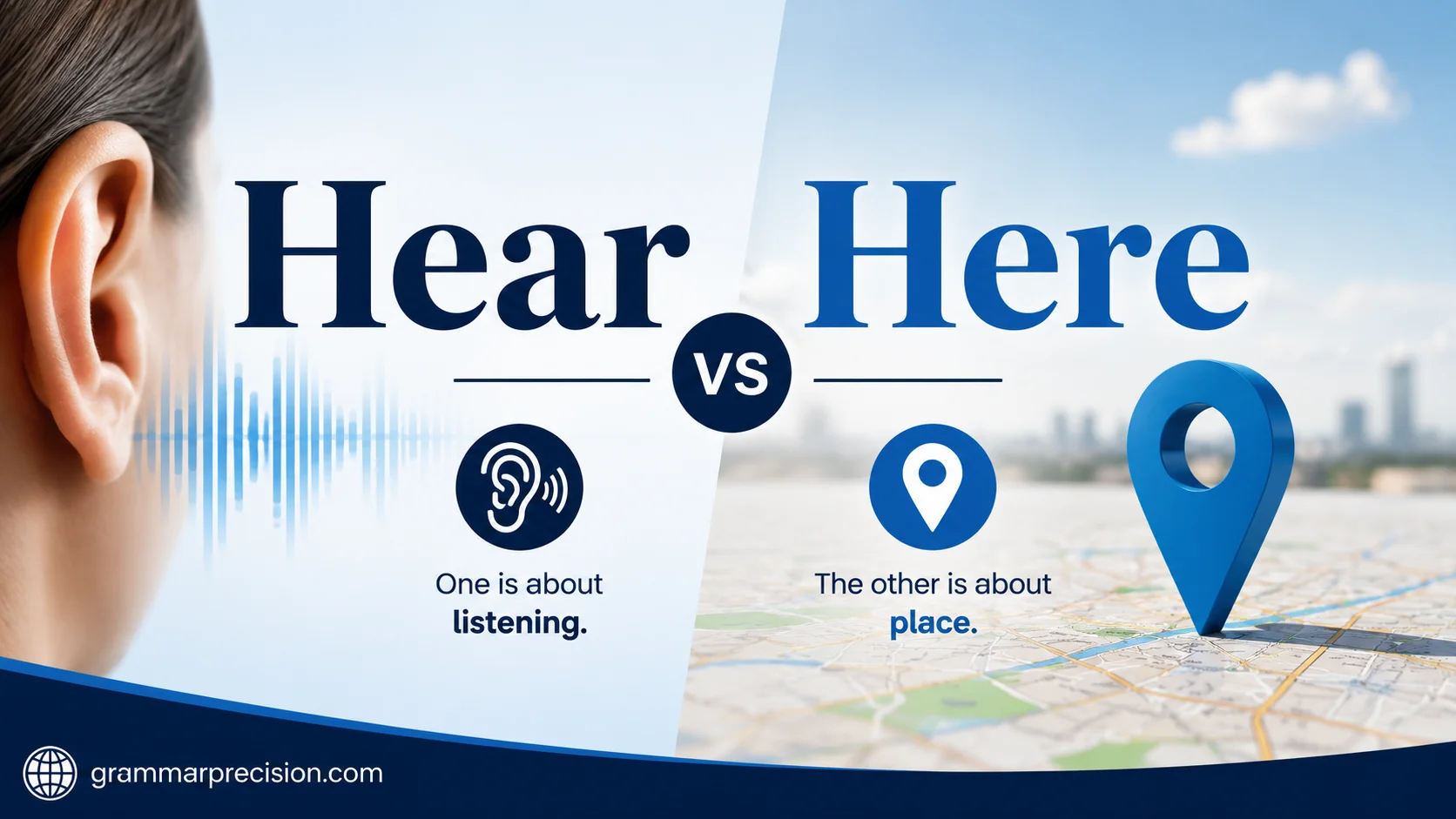
Visual Memory Method
Picture this:
- An ear = hear
- A map pin = here
Creating visual associations dramatically improves long term retention.
Research consistently shows that people remember images faster than abstract rules.
Hear vs Here in Everyday Conversations
Learning grammar rules is useful. Seeing real world examples is even better.
Let’s examine how these words appear in daily life.
Workplace Examples
Correct:
- Did you hear the manager’s announcement?
- Please come here for the meeting.
Incorrect:
- Did you here the manager’s announcement?
- Please come hear for the meeting.
The correct choice becomes obvious once you determine whether the sentence involves sound or location.
School Examples
Correct:
- I could hear the teacher clearly.
- Sit here until class begins.
Students frequently confuse these words during exams and essays. Careful proofreading helps eliminate these mistakes.
Family Conversations
Correct:
- Can you hear me now?
- Come here and look at this.
Notice how naturally both words appear in ordinary speech.
Social Media Examples
Correct:
- Did you hear about the concert?
- Click here to learn more.
This particular pair appears thousands of times daily across websites, blogs, and social media platforms.
Common Mistakes and How to Avoid Them
Even strong writers make occasional errors.
The key is learning how to spot them quickly.
Mistake: Using Here Instead of Hear
Incorrect:
- I can here the birds singing.
Correct:
- I can hear the birds singing.
Why?
Because the sentence involves sound.
Mistake: Using Hear Instead of Here
Incorrect:
- Please wait hear.
Correct:
- Please wait here.
Why?
Because the sentence refers to a location.
Quick Editing Checklist
Before submitting any piece of writing, ask yourself these questions:
- Am I talking about sound?
- Use hear.
- Am I talking about a place?
- Use here.
- Does the sentence involve listening?
- Use hear.
- Does the sentence point to a location?
- Use here.
This simple checklist catches most errors in seconds.
Hear vs Here in Different Writing Situations
Many learners understand the definitions. Problems appear when they encounter different writing contexts.
Let’s look at how these words function in various settings.
Hear vs Here in Formal Writing
Professional documents demand accuracy. A single spelling error can reduce credibility.
Examples:
- We were pleased to hear your feedback.
- The requested information is provided here.
Business communication often uses both words in the same document.
Example:
We were delighted to hear about your success. Additional resources can be found here.
Hear vs Here in Academic Writing
Students frequently encounter these words in essays and research papers.
Examples:
- Researchers could hear subtle differences in pronunciation.
- The relevant data appears here in Table 2.
Academic writing values precision. Choosing the correct word improves clarity.
Hear vs Here in Marketing Content
Digital marketers often use both words.
Examples:
- Click here to download the guide.
- We’d love to hear your thoughts.
Because these phrases appear so often online, understanding the distinction becomes even more important.
Hear vs Here for ESL Learners
English learners face a unique challenge.
Many languages do not contain homophones that create the same level of confusion as English. As a result, learners often rely on pronunciation rather than context.
Common ESL Challenges
Learners may struggle because:
- Both words sound identical.
- Spellings are similar.
- Voice recognition software may create mistakes.
- Fast reading can hide errors.
Practical Learning Strategy
Whenever you encounter one of these words, stop and ask:
“Am I discussing sound or place?”
The answer immediately reveals the correct spelling.
Mini Exercise
Choose the correct word:
- Can you (hear/here) me?
- Please sit (hear/here).
- I can (hear/here) music.
- The answer is right (hear/here).
Answers:
- hear
- here
- hear
- here
Simple exercises like these build long term confidence.
Hear vs Here in Real Life Scenarios
Context is everything.
Let’s explore realistic situations where confusion commonly occurs.
Scenario: Phone Call
Correct:
- Can you hear me clearly?
The speaker is asking about sound quality.
Scenario: GPS Navigation
Correct:
- Turn left from here.
The speaker refers to a location.
Scenario: Classroom
Correct:
- Did everyone hear the instructions?
The focus is listening.
Scenario: Event Registration
Correct:
- Sign your name here.
The focus is a specific place.
These examples show that context always determines the correct choice.
Hear vs Here Example Sentences
Examples help transform grammar rules into practical knowledge.
Beginner Examples
- I can hear the bell ringing.
- Come here immediately.
- Did you hear that noise?
- Sit here beside me.
- We could hear the train approaching.
Intermediate Examples
- She didn’t hear her phone vibrating.
- The documents are stored here.
- I often hear birds singing at sunrise.
- The meeting will take place here tomorrow.
- They were excited to hear the news.
Advanced Examples
- Historians still hear echoes of those events in modern debates.
- The evidence presented here supports the conclusion.
- Investors were relieved to hear positive earnings forecasts.
- The data displayed here illustrates the trend clearly.
- Scientists could hear unusual acoustic patterns during testing.
Business Examples
- We’d like to hear your feedback.
- Please sign here.
- I was happy to hear from your team.
- The agreement is available here.
- Let us hear your proposal.
Digital Marketing Examples
- Click here to learn more.
- We’d love to hear your opinion.
- Subscribe here for updates.
- Customers often hear about us through referrals.
- Register here today.
Hear vs Here in Popular Expressions
English contains many expressions built around these words.
Understanding them improves both writing and speaking.
Common Expressions with Hear
| Expression | Meaning |
| Hear from | Receive communication |
| Hear about | Learn information |
| Hear out | Listen fully |
| Hear a rumor | Learn unofficial news |
| Hear voices | Perceive voices |
Examples:
- Have you heard from Sarah recently?
- Please hear me out before deciding.
Common Expressions with Here
| Expression | Meaning |
| Here you go | Giving something |
| Here we go | Beginning something |
| Here and there | In various places |
| Here to stay | Permanent |
| Here comes | Approaching |
Examples:
- Here you go, your receipt.
- Here comes the bus.
These expressions appear frequently in everyday English.
Hear vs Here in Literature and Famous Writing
Great writers use these words constantly because they represent essential human experiences: listening and location.
Literary Example of Hear
Writers often use hear to create atmosphere.
Example:
She could hear the distant sound of waves crashing against the shore.
This sentence engages the reader’s sense of hearing and creates vivid imagery.
Literary Example of Here
Writers use here to establish setting.
Example:
Here stood the oldest tree in the village.
The word immediately anchors the reader in a specific place.
Why Authors Use These Words
Strong writing appeals to the senses.
Words such as hear, see, feel, and touch help readers experience a scene rather than merely observe it.
Similarly, location words like here, there, and nearby provide spatial awareness.
Together, they make writing more immersive.
Hear vs Here Quiz
Ready to test your knowledge?
Choose the correct word.
Questions
- Can you ______ me?
- Please sit ______.
- I could ______ the thunder.
- The package is ______.
- Did you ______ the announcement?
- Sign your name ______.
- We were glad to ______ the good news.
- The answer appears ______.
- I can ______ music playing.
- Come ______ for a moment.
Answers
- hear
- here
- hear
- here
- hear
- here
- hear
- here
- hear
- here
Scoring Guide
| Score | Level |
| 10/10 | Expert |
| 8 9 | Excellent |
| 6 7 | Good |
| Below 6 | Needs Practice |
If you scored below eight, revisit the memory tricks and example sections.
Case Study: How One Small Mistake Changes Meaning
Consider these two sentences:
Correct Version
I can hear the children playing outside.
The sentence clearly communicates that sounds are being perceived.
Incorrect Version
I can here the children playing outside.
Although readers may understand the intended meaning, the sentence appears unprofessional and grammatically incorrect.
Now examine another example.
Correct Version
Please leave the package here.
This sentence identifies a location.
Incorrect Version
Please leave the package hear.
The sentence becomes confusing because the wrong word changes the intended meaning.
These examples demonstrate why careful word choice matters.
The Psychology Behind Remembering Hear vs Here
Memory researchers often emphasize association techniques.
The brain retains information more effectively when it connects new knowledge to existing concepts.
Why the Ear Trick Works
The word:
HEAR
contains:
EAR
Since hearing depends on ears, the relationship becomes memorable.
Why Visual Learning Helps
Imagine:
- An ear for hear
- A map pin for here
This creates two distinct mental images.
When writing, your brain quickly retrieves the correct association.
The Power of Context
Context remains the strongest memory tool.
Whenever you’re unsure, identify whether the sentence involves:
- Sound
- Listening
- Communication
Or:
- Place
- Position
- Location
The answer reveals the correct spelling.
FAQs:
What is the difference between Hear and Here?
The difference is that Hear relates to listening and sound perception, while Here refers to a specific location or place. Understanding this helps improve English writing and reduces confusion in sentences.
Why do people confuse Hear and Here?
People confuse them because they are homophones, meaning they sound the same but have different meanings and spellings. This leads to mixing, especially in writing, emails, and casual messages.
How can I remember Hear vs Here easily?
You can remember it by linking Hear with ears and sounds, and Here with a place or position. Regular practice and examples improve learning and memory retention.
Where do we use Hear in sentences?
We use Hear when talking about listening, auditory perception, or receiving information through sound. For example, you can hear music, voices, or natural sounds around you.
Where do we use Here in sentences?
We use Here when indicating a location, spot, or presence. For example, “I am here” shows someone is in a specific place or position.
Conclusion:
Understanding Hear vs Here is important for clear English communication. These homophones often create confusion, but with proper practice, examples, and attention, learners can easily master their correct usage.
Using them accurately improves writing clarity, strengthens language skills, and ensures more effective communication in everyday situations.