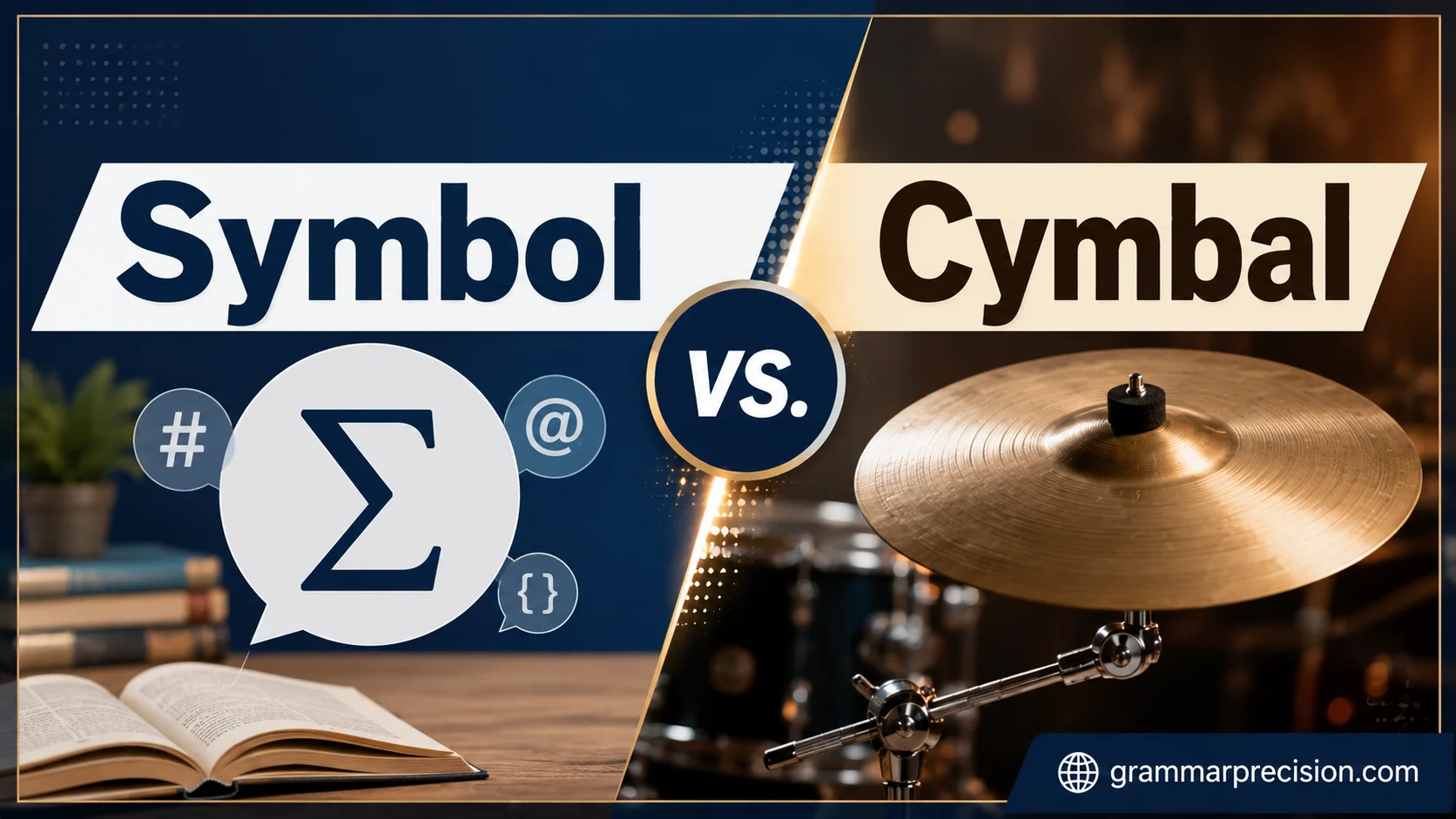
Symbol vs. Cymbal can confuse many writers because these words sound the same but have different meanings. Understanding this difference helps you use the correct word in your writing.
English has many homophones that create spelling challenges, and symbol vs. cymbal is a perfect example. A symbol represents an idea, while a cymbal creates musical sounds. Learning their differences improves your vocabulary and writing accuracy.
Although symbol and cymbal share the same pronunciation, their meanings belong to different worlds. One connects with ideas, signs, and representation, while the other relates to music, instruments, and rhythm. Knowing when to use each word makes your communication clearer.
Symbol vs. Cymbal: Quick Answer
The easiest way to remember the difference is this:
| Word | Meaning | Example |
| Symbol | Something that represents an idea, meaning, or object | A heart is a symbol of love. |
| Cymbal | A metal musical instrument that creates a loud ringing sound | The drummer hit the cymbal during the performance. |
Although symbol and cymbal sound identical, they have different spellings, meanings, and uses.
Think of them like identical twins who chose completely different careers. They may look or sound similar, but their lives are completely separate.
What Is a Symbol?
A symbol is something that stands for or represents something else. It can represent an idea, feeling, organization, culture, religion, or even a scientific concept.
Symbols help people communicate complex thoughts quickly. Instead of explaining a long idea with many words, a simple image or object can express the same message instantly.
For example:
- A red rose is often a symbol of love.
- A dove represents peace.
- A flag represents a country.
- A traffic sign communicates a specific instruction.
Symbols appear everywhere in daily life. You see them on websites, road signs, clothing, books, advertisements, and technology.
Symbol Definition
According to general English usage, a symbol is:
Something used to represent another thing, especially an idea, quality, or concept.
The represented meaning usually depends on shared understanding. A symbol only works because people agree on what it means.
For example, a green traffic light means “go.” The color itself does not naturally mean movement, but society has assigned that meaning to it.
Types of Symbols
Symbols exist in many different areas of life. Here are some common types:
Cultural Symbols
Cultural symbols represent traditions, values, or identities shared by a group of people.
Examples:
- Eagle → strength and freedom in many cultures
- Wedding ring → commitment and marriage
- Flag → national identity
Cultural symbols can vary from one country to another. A symbol that means good luck in one culture might have a different meaning somewhere else.
Religious Symbols
Religious symbols communicate beliefs and spiritual ideas.
Examples include:
- Cross → Christianity
- Crescent moon and star → often associated with Islam
- Om symbol → Hindu traditions
- Dharma wheel → Buddhism
These symbols often carry deep historical and emotional importance for followers.
Mathematical and Scientific Symbols
Science and mathematics use symbols to simplify complicated information.
Examples:
| Symbol | Meaning |
| + | Addition |
| % | Percentage |
| π | Mathematical constant pi |
| H₂O | Water |
| → | Direction or reaction |
Without symbols, scientific formulas and equations would become much longer and harder to understand.
Literary Symbols
Writers often use symbols to add deeper meaning to stories.
For example:
In many novels, a storm may symbolize conflict or emotional struggle. A journey may represent personal growth.
Authors use symbols because they allow readers to discover hidden meanings instead of simply being told what something represents.
What Is a Cymbal?
A cymbal is a round metal percussion instrument used to create sounds in music. Drummers usually play cymbals by striking them with drumsticks or by hitting one cymbal against another.
Unlike a symbol, a cymbal does not represent an idea. It creates sound.
When you hear a loud crash at the end of a song, there’s a good chance a drummer just struck a cymbal.
Cymbal Definition
A cymbal is:
A curved metal percussion instrument that produces a ringing or crashing sound when struck.
Cymbals are commonly made from metal alloys, especially combinations of:
- Copper
- Tin
- Bronze
Their unique shape and material allow them to vibrate and create different tones.
Types of Cymbals
Cymbals come in several varieties. Each type produces a different sound and serves a different purpose in music.
Crash Cymbal
A crash cymbal creates a sharp, explosive sound.
Musicians often use it to:
- Emphasize important moments
- Add energy to songs
- Highlight transitions
For example, a drummer may hit a crash cymbal when a chorus begins.
Ride Cymbal
A ride cymbal produces a smoother, longer-lasting sound.
Drummers use it to maintain rhythm patterns throughout a song.
Unlike a crash cymbal, it does not usually create a sudden burst of sound.
Hi-Hat Cymbals
A hi-hat consists of two cymbals placed together on a stand.
A drummer can control the sound by opening and closing the cymbals using a foot pedal.
Hi-hats are essential in many music styles, including:
- Rock
- Jazz
- Pop
- Hip-hop
Splash Cymbal
A splash cymbal is smaller than most cymbals and creates a quick, bright sound.
Drummers often use it for short musical effects.
China Cymbal
A China cymbal has a unique shape and produces a sharp, aggressive tone.
It appears frequently in:
- Rock music
- Metal music
- Experimental performances
Symbol vs. Cymbal: Key Differences
The biggest difference between symbol and cymbal is their purpose.
A symbol communicates meaning, while a cymbal creates music.
Here is a detailed comparison:
| Feature | Symbol | Cymbal |
| Meaning | Represents an idea or object | A musical instrument |
| Pronunciation | Same as cymbal | Same as symbol |
| Spelling | Starts with “sym” | Starts with “cym” |
| Category | Concept or representation | Percussion instrument |
| Used In | Writing, culture, science, communication | Music and performances |
| Example | A peace sign is a symbol of harmony | The drummer hit the cymbal |
Why Do People Confuse Symbol and Cymbal?
The confusion happens because symbol and cymbal are homophones.
Homophones are words that:
- Sound the same
- Have different meanings
- Often have different spellings
Other examples of homophones include:
| Word Pair | Difference |
| Two / Too | Number vs. also |
| Flower / Flour | Plant vs. baking ingredient |
| Right / Write | Correct vs. create text |
| Sea / See | Ocean vs. using your eyes |
English contains many homophones because the language developed from several sources, including Latin, Greek, French, and Germanic languages.
Symbol vs. Cymbal Pronunciation Guide
Both words have the same pronunciation:
Symbol: /ˈsɪm.bəl/
Cymbal: /ˈsɪm.bəl/
They sound like:
SIM-buhl
The first syllable receives the strongest stress.
Even though pronunciation stays the same, context tells listeners which word you mean.
For example:
- “The dove is a symbol of peace.”
- “The drummer played the cymbal loudly.”
You understand the meaning because the surrounding words provide clues.
Also Read This: In the Agenda or On the Agenda? The Complete Guide
Symbol vs. Cymbal: Word Origins and History
Understanding the origins of symbol and cymbal makes the difference between these two words even easier to remember. Although they sound identical today, they came from completely different historical paths.
The word symbol has a long connection with ideas, signs, and representation. The word cymbal, on the other hand, has always been linked with music and instruments.
The Etymology of Symbol
The word symbol comes from the Greek word symbolon, which originally meant a mark, token, or sign used for identification.
In ancient Greece, a symbol could be a physical object divided into two parts. When two people later matched the pieces together, the object proved their connection or agreement.
Over time, the meaning expanded. Today, a symbol can represent:
- An emotion
- A belief
- A movement
- A company
- A mathematical idea
- A cultural value
For example, the Apple logo is not just a picture of an apple. It has become a symbol associated with technology, design, and innovation.
The Etymology of Cymbal
The word cymbal comes from the Latin word cymbalum, which came from the Greek word kymbalon.
Ancient cymbals were used in religious ceremonies, celebrations, and musical performances. They were usually made from metal and played by striking two pieces together.
Over thousands of years, cymbals evolved into the instruments used today in modern drum kits and orchestras.
The word stayed connected to one main idea:
A metal instrument that creates sound.
Why English Has Words Like Symbol and Cymbal
English often contains words that sound the same but have different meanings. These words can make spelling difficult because pronunciation alone cannot tell you which spelling to choose.
The reason is simple: English borrowed words from many languages.
Throughout history, English collected vocabulary from:
- Latin
- Greek
- French
- Germanic languages
- Norse languages
As these languages mixed together, many words developed similar sounds but different meanings.
For example:
- Symbol entered English through Latin and Greek influences.
- Cymbal entered English through Latin and Greek musical terminology.
They traveled through similar language routes, which explains why they sound alike today.
Symbol vs. Cymbal: How to Use Them Correctly
Knowing the definitions is helpful, but understanding how to use these words in sentences is even more important.
Let’s look at practical examples.
Examples of Symbol in Sentences
- The dove became a symbol of peace after the war.
- The company changed its logo to create a stronger symbol of innovation.
- The mathematical symbol for infinity represents something without an end.
- A wedding ring is often considered a symbol of commitment.
- The national flag serves as a symbol of a country’s identity.
In each sentence, symbol refers to something that carries meaning.
Examples of Cymbal in Sentences
- The drummer hit the cymbal at the end of the song.
- The broken cymbal needed to be replaced before the concert.
- Jazz musicians often use different types of cymbals to create unique sounds.
- The musician polished the golden cymbal before the performance.
- The crash cymbal added excitement to the final part of the song.
In these examples, cymbal always relates to music.
A Simple Memory Trick to Remember Symbol vs. Cymbal
Many people struggle with these words because they cannot remember the spelling. A simple memory trick can solve the problem.
Remember: Symbol = Meaning
The word symbol starts with “sym”, which can remind you of something symbolic.
A symbol shows an idea.
Examples:
- Heart → love
- Flag → country
- Light bulb → idea
Think:
“A symbol sends a message.”
Remember: Cymbal = Music
The word cymbal starts with “cym”, which is connected to the musical instrument.
Think:
“A cymbal crashes during a song.”
The letter C in cymbal can remind you of:
C = Crash
A cymbal creates a crash sound.
Common Mistakes When Using Symbol and Cymbal
Even experienced writers sometimes confuse these words. The mistakes usually happen because people focus on sound instead of meaning.
Here are the most common errors.
Mistake: Writing Cymbal When You Mean Symbol
Incorrect:
The heart is a cymbal of love.
Correct:
The heart is a symbol of love.
Why?
A heart represents love. It does not create music.
Mistake: Writing Symbol When You Mean Cymbal
Incorrect:
The drummer hit the symbol during the concert.
Correct:
The drummer hit the cymbal during the concert.
Why?
The drummer played an instrument, not an idea.
Mistake: Assuming Similar Sounds Mean Similar Meanings
English pronunciation can be tricky.
Words that sound alike may have completely unrelated meanings.
For example:
- Knight and night
- Pair and pear
- Cymbal and symbol
The sound connects them, but the meaning separates them.
Symbol vs. Cymbal in Different Contexts
The surrounding words usually reveal which word you need.
In Literature
Writers usually use symbol.
Example:
The broken mirror was a symbol of the character’s damaged relationship.
The mirror represents an idea, so symbol is correct.
In Music
Musicians usually use cymbal.
Example:
The drummer added a cymbal crash before the final chorus.
The sentence discusses an instrument, so cymbal is correct.
In Science
Scientists often use symbol.
Examples:
- H represents hydrogen.
- Na represents sodium.
- The plus sign represents addition.
These are all scientific symbols.
Symbol vs. Cymbal: Real-Life Comparison
Imagine you are watching a movie.
During an emotional scene, the director shows a character holding a white flower. The flower represents hope.
That flower is a symbol.
Later, during an exciting action scene, the drummer hits a loud metal plate in the soundtrack.
That instrument is a cymbal.
One communicates an idea. The other creates a sound.
Practice Quiz: Can You Choose the Correct Word?
Test your knowledge.
Fill in the blanks with symbol or cymbal.
Questions
- The dove is a ______ of peace.
- The drummer struck the ______ during the final song.
- The recycling logo is a ______ that represents environmental protection.
- The musician bought a new ______ for his drum set.
- The number sign is a mathematical ______.
Answers
- Symbol
- Cymbal
- Symbol
- Cymbal
- Symbol
If you scored five out of five, you’ve mastered the difference.
Expert Tips to Avoid Confusing Symbol and Cymbal
Here are some practical strategies that can help you remember these words permanently:
Look at the Meaning First
Before choosing the spelling, ask yourself:
“Am I talking about an idea or an instrument?”
- Idea, representation, meaning → symbol
- Music, drums, sound → cymbal
Use the Sentence Around the Word
Context gives you clues.
For example:
The ______ represented freedom.
Freedom is an idea, so the answer is symbol.
The drummer repaired the ______ before the show.
A drummer repairs instruments, so the answer is cymbal.
Create Your Own Examples
Writing personal examples helps your brain remember vocabulary better.
Try creating sentences like:
- “The flag is a symbol of my country.”
- “The cymbal made a powerful sound during the performance.”
The more you use the words, the easier they become.
FAQs:
What is the difference between a symbol and a cymbal?
A symbol is something that represents an idea, object, belief, or meaning, while a cymbal is a musical instrument made of metal that produces a ringing or crashing sound. Although both words have the same pronunciation, their meanings and uses are completely different.
Are symbol and cymbal pronounced the same?
Yes, symbol and cymbal are homophones, which means they sound identical but have different spellings and meanings. Both words are pronounced as “SIM-buhl.” The context of a sentence helps you understand which word someone means.
Can a cymbal be a symbol?
A cymbal can become a symbol if it represents something beyond its musical purpose. For example, a picture of a cymbal may represent music or performance, but the actual instrument used by a drummer is still called a cymbal.
How can I remember the difference between symbol and cymbal?
You can remember the difference by focusing on their meanings. A symbol stands for something, such as love, peace, or a company. A cymbal makes sound, especially in a drum set. Think: symbol = meaning, cymbal = music.
Why do people confuse symbol and cymbal?
People confuse symbol and cymbal because they have the same pronunciation but different spellings. English contains many homophones that sound alike, which makes them challenging. Paying attention to the sentence’s meaning will help you choose the correct word.
Conclusion:
Understanding the difference between symbol vs. cymbal helps you avoid common spelling mistakes and communicate more clearly. A symbol represents an idea or message, while a cymbal creates sound in music. Even though these words sound the same, their meanings are completely different. Remembering this simple difference will make your writing, vocabulary, and English skills stronger.