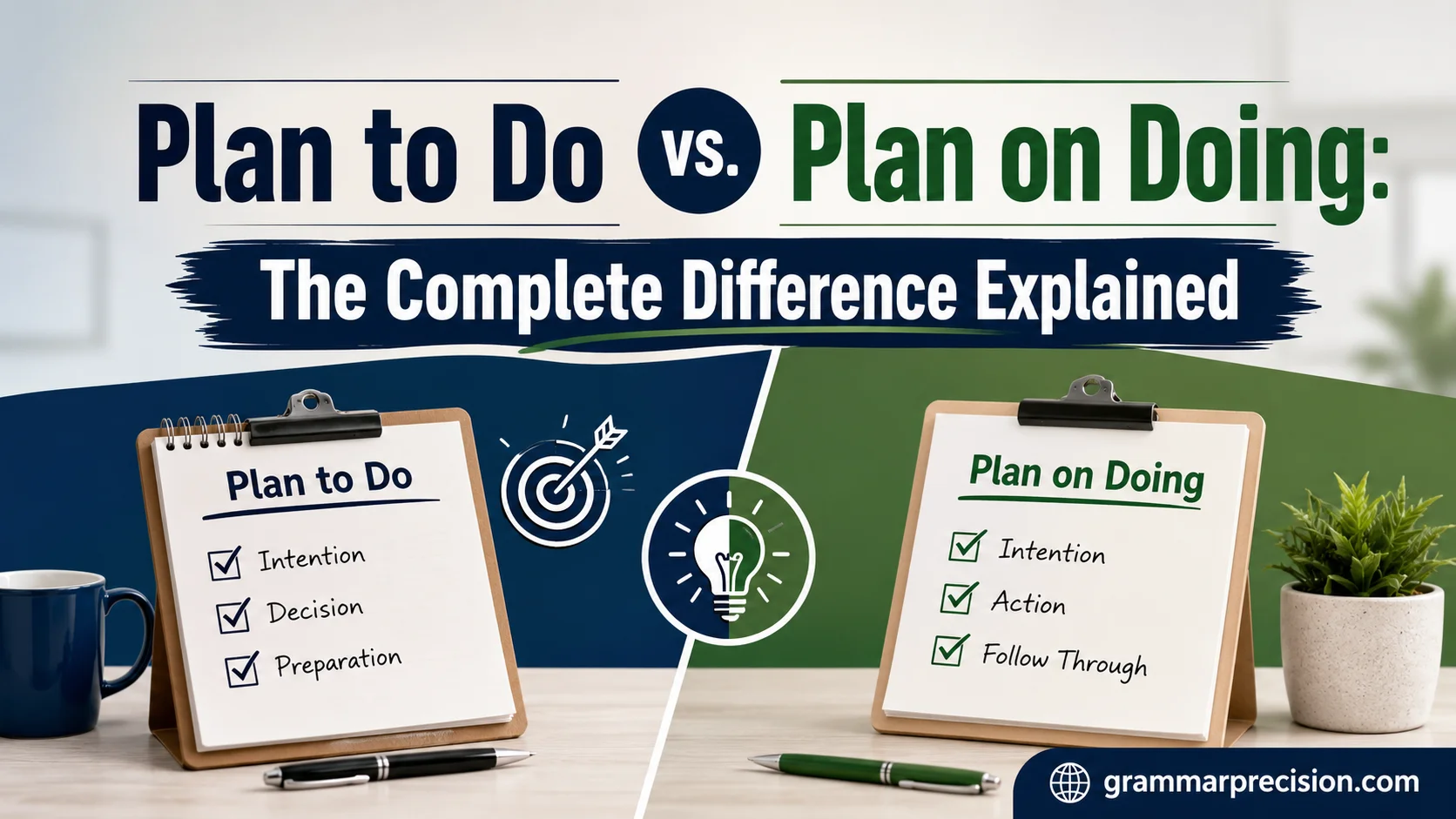
Plan to Do vs. Plan on Doing can confuse even confident English speakers. Both forms express future intentions, but their grammar, structure, and usage differ in important ways. Understanding the distinction helps you sound natural.
The phrase “plan to do” is the more common and direct structure. You use it when someone has a clear intention to perform an action. For example, “I plan to visit New York next month.” This construction sounds natural in everyday conversations, professional writing, and formal situations.
Meanwhile, “plan on doing” also expresses an intention or expectation, but it uses a different grammatical pattern. You’ll usually find it in conversational American English, especially when discussing something you expect or intend to happen. Learning when to use each structure can make your English more accurate, natural, and confident.
Plan to Do vs. Plan on Doing: Quick Answer
Here’s the fastest way to remember the difference:
| Expression | Pattern | Example | Main idea |
| Plan to do | plan + to + base verb | I plan to leave early. | Intention or decision |
| Plan on doing | plan + on + -ing verb | I plan on leaving early. | Intention, expectation, or anticipated action |
Both sentences can communicate essentially the same intention.
However, “plan to” often sounds more direct and neutral, especially in professional or formal writing. “Plan on doing” is also standard English, but it frequently feels more conversational.
The key grammar rule is even easier:
Plan to + verb
Plan on + verb-ing
That small distinction prevents most mistakes.
What Is “Plan to Do”?
Meaning and Grammar Pattern
Plan to do means to intend or decide to perform an action in the future.
The structure is:
Subject + plan/plans/planned + to + base verb
Examples include:
- I plan to study tonight.
- She plans to move next year.
- We plan to visit Chicago in July.
- They planned to arrive early.
- He is planning to start a business.
Notice what comes after to. The verb stays in its base form.
You say:
I plan to work.
Not:
I plan to working.
The word to here introduces an infinitive. That’s why the following verb takes its basic form.
When Should You Use “Plan to Do”?
Use plan to do when you want to state an intention clearly and directly.
It works especially well when:
- You’re describing a personal goal.
- You’re discussing a future decision.
- You’re writing professionally.
- You’re explaining an organized course of action.
- You want the sentence to sound concise.
For example:
The company plans to expand its services next year.
That sentence sounds clean and professional. There’s no extra grammatical baggage hanging around the main idea.
You can also use plan to for questions:
Do you plan to attend the meeting?
And for negative statements:
I don’t plan to change my schedule.
The same structure remains intact.
What Is “Plan on Doing”?
Meaning and Grammar Pattern
Plan on doing also expresses an intention. In some contexts, however, plan on can emphasize what you expect or anticipate happening.
The structure is:
Subject + plan/plans/planned + on + verb-ing
Examples:
- I plan on staying home tonight.
- She plans on applying for the position.
- We plan on visiting our grandparents.
- They planned on leaving before sunrise.
- He’s planning on buying a new car.
The crucial point is that on is a preposition in this construction. The verb that follows it takes the -ing form.
That gives you:
plan on going
plan on studying
plan on working
plan on moving
You should not write:
plan on to go
The grammar pattern doesn’t work that way.
When Should You Use “Plan on Doing”?
Use plan on doing when the sentence naturally fits an -ing construction and especially when you’re speaking in an everyday, conversational setting.
For example:
We’re planning on having dinner around seven.
That sounds perfectly natural in ordinary conversation.
You might also use it when the idea involves expecting or accounting for something:
We didn’t plan on getting so much snow.
Here, plan on goes beyond a simple personal intention. It can mean that the speaker didn’t anticipate or expect the event.
That secondary use is important because it reveals one of the biggest differences between the two constructions.
Plan to Do vs. Plan on Doing: The Grammar Difference
The meaning may overlap, but the grammar does not.
| Feature | Plan to do | Plan on doing |
| Verb pattern | plan + to + base verb | plan + on + -ing |
| Example | I plan to drive. | I plan on driving. |
| Verb form | Infinitive | Gerund after a preposition |
| Common meaning | Intention | Intention or expectation |
| Tone | Direct and neutral | Often conversational |
| Formal writing | Very natural | Correct, but sometimes less concise |
| Common error | plan to driving | plan on to drive |
Think of the two patterns as two different roads leading to a similar destination.
The first road uses to + base verb.
The second road uses on + -ing.
You can’t combine the road signs.
Why Is “Plan on to Do” Wrong?
Consider this sentence:
❌ I plan on to visit Boston.
The problem is the verb form after on.
Because on functions as a preposition in this construction, the following verb should appear as an -ing form.
Correct:
I plan on visiting Boston.
Likewise, you shouldn’t mix the structure in the opposite direction:
❌ I plan to visiting Boston.
Correct:
I plan to visit Boston.
Once you memorize the two formulas, these errors become much easier to spot.
Plan to Do vs. Plan on Doing: Do They Mean Exactly the Same Thing?
Not always, but often enough that they can sound interchangeable.
In ordinary sentences about personal intentions, the difference can be extremely small.
Compare:
I plan to attend the conference.
I plan on attending the conference.
Both tell the reader that attending the conference is the speaker’s intention.
However, plan on has another useful meaning: to expect or anticipate something.
For example:
We didn’t plan on the flight being delayed.
The speaker isn’t necessarily saying that someone intended the delay. Quite the opposite. The delay was not expected.
That distinction makes plan on especially useful when talking about circumstances, outcomes, or events that someone has considered in advance.
Cambridge also distinguishes between plan on doing something and plan on someone or something doing something.
A Subtle Difference in Perspective
Consider these sentences:
I plan to finish the report tonight.
I plan on finishing the report tonight.
The first sounds slightly more direct and deliberate. The second can feel a little more conversational.
That doesn’t mean the second sentence expresses uncertainty. You shouldn’t treat plan on as automatically weaker.
Context matters.
A sentence such as:
We plan on opening the store in September.
can express a very serious business intention.
So, avoid the oversimplified rule that “plan to” means certainty while “plan on” means uncertainty.” Native speakers don’t consistently use the expressions that way.
Plan to vs. Plan on in American English
Both expressions occur naturally in American English.
The choice usually depends on the sentence, audience, and style rather than a strict rule that bans one form in a particular situation.
Everyday Conversation
In casual conversation, plan on doing is extremely natural.
Are you planning on coming tonight?
I’m planning on taking Friday off.
We’re planning on staying for another hour.
You’ll hear these constructions frequently in ordinary speech.
Professional Writing
Plan to do often has an advantage in business writing because it’s compact and direct.
Compare:
The department plans to launch the program in August.
with:
The department plans on launching the program in August.
Both are grammatical. The first simply feels more streamlined in many professional contexts.
Academic Writing
For formal academic prose, plan to can also be a convenient choice when discussing intended actions.
For example:
The researchers plan to examine three variables.
That wording is straightforward and economical.
Still, plan on doing isn’t automatically ungrammatical or inappropriate in formal writing. Context and overall style matter more than a rigid “formal versus informal” rule.
Also Read This: Ambiance vs. Ambience: Which Spelling Is Correct?
Plan to Do vs. Plan on Doing in Real-Life Situations
The easiest way to understand the distinction is to see both forms working in realistic settings.
Work and Career
I plan to apply for the position next week.
I plan on applying for several positions.
Both work. The first is slightly more direct. The second fits naturally into a conversational discussion about job hunting.
Travel
We plan to visit Seattle in October.
We plan on visiting Seattle in October.
Again, both are correct.
Education
She plans to study engineering.
She plans on studying engineering.
Both sentences communicate her educational intention.
Personal Goals
I plan to exercise more regularly.
I plan on exercising more regularly.
The meaning remains close, although the second has a more conversational rhythm.
Unexpected Circumstances
This is where plan on can become more distinctive:
We didn’t plan on the weather changing so quickly.
Here, plan on means something close to expect or anticipate.
You could rephrase the idea as:
We didn’t expect the weather to change so quickly.
That substitution shows why plan on sometimes carries a meaning that goes beyond personal intention.
A Practical Case Study: Choosing the Better Expression
Imagine a manager writing a project update.
Version A:
Our team plans to launch the new website in September.
Version B:
Our team plans on launching the new website in September.
Neither sentence is grammatically wrong.
However, Version A sounds slightly sharper for a formal project update. It puts the action immediately after the planning verb and keeps the sentence compact.
Now imagine the same manager talking to a coworker:
We’re planning on launching the site in September.
That version sounds completely natural in conversation.
The lesson isn’t that one expression is “correct” while the other is “incorrect.” The better choice depends on context, rhythm, and purpose.
Common Mistakes With “Plan to” and “Plan on”
“Plan to Doing”
Incorrect:
❌ I plan to going tomorrow.
Correct:
I plan to go tomorrow.
Remember: to + base verb.
“Plan on To Do”
Incorrect:
❌ I plan on to go tomorrow.
Correct:
I plan on going tomorrow.
Remember: on + -ing.
“Planning to Doing”
Incorrect:
❌ She is planning to moving abroad.
Correct:
She is planning to move abroad.
“Planning on To Do”
Incorrect:
❌ They’re planning on to start early.
Correct:
They’re planning on starting early.
“I Am Plan to…”
Incorrect:
❌ I am plan to travel next month.
Correct:
I plan to travel next month.
Or:
I am planning to travel next month.
The verb plan must still be conjugated correctly.
Questions and Negative Sentences
The same patterns remain valid when you ask questions or make negative statements.
Questions With “Plan to”
Do you plan to attend?
Does she plan to stay?
Did they plan to leave early?
Questions With “Plan on”
Do you plan on attending?
Does she plan on staying?
Did they plan on leaving early?
Negative Forms
I don’t plan to move.
I don’t plan on moving.
We didn’t plan to stay overnight.
We didn’t plan on staying overnight.
Notice that the internal structures never change.
Plan to → base verb
Plan on → -ing form
That rule remains stable regardless of the tense or sentence type.
Plan to Do vs. Intend to Do vs. Plan on Doing
These expressions overlap, but they aren’t identical in style.
| Expression | Typical meaning | Example |
| Plan to | Have an intention or arrangement | I plan to leave tomorrow. |
| Plan on | Intend or anticipate | I plan on leaving tomorrow. |
| Intend to | Have a clear purpose or intention | I intend to finish the project. |
| Expect to | Believe something will happen | I expect to finish by Friday. |
| Hope to | Want something to happen | I hope to finish by Friday. |
This comparison reveals an important point.
Intend often sounds more deliberate or formal.
Expect focuses on what you believe will happen.
Hope expresses desire rather than a definite plan.
Plan sits somewhere in the middle: it usually involves an intended future action.
Can “Plan On” Be Followed by a Noun?
Yes.
This is another useful feature that learners sometimes miss.
You can say:
We plan on a long journey.
However, when you mean an action, the standard pattern is generally:
We plan on taking a long journey.
There’s also a broader construction in which plan on refers to another person or event:
We didn’t plan on the meeting lasting three hours.
This construction is especially useful when discussing something that happened or was expected.
The grammar becomes more flexible because the speaker isn’t simply describing their own intended action.
Is “Plan on Doing” More Casual?
Often, yes in feel, but not as a strict grammar rule.
Many speakers find plan to slightly more direct or formal, while plan on doing fits comfortably into casual conversation.
Still, don’t assume that plan on belongs only in informal speech.
For example:
The company plans on expanding its operations.
That sentence can appear in professional communication without creating a grammatical problem.
If you want the most concise option for formal prose, however, plan to is often the cleaner choice.
How to Choose the Right Expression
When you’re stuck between the two, use this simple decision guide.
Choose “plan to + verb” when:
- You want a direct statement of intention.
- You’re writing a formal email.
- You’re preparing professional or academic prose.
- You want a concise sentence.
- You’re discussing a specific action.
Choose “plan on + -ing” when:
- You’re speaking conversationally.
- The -ing structure sounds more natural in context.
- You’re describing an anticipated event.
- You want to emphasize what you expect or intend to happen.
When both sound equally natural, either can work.
The choice often comes down to style rather than correctness.
Easy Memory Trick
Here’s the simplest trick to keep the patterns straight:
TO → DO
ON → ING
So:
I plan to travel.
But:
I plan on traveling.
Think of “on” as a signpost pointing toward an -ing form.
Once you associate the preposition with the gerund, the most common mistake—plan on to do—becomes much easier to avoid.
FAQs:
Is “plan to do” grammatically correct?
Yes, “plan to do” is grammatically correct and very common. It uses plan + to + base verb to describe an intention or decision. For example, “I plan to study tonight.” This structure works naturally in both formal and informal English.
Is “plan on doing” correct English?
Yes, “plan on doing” is also correct. It follows the pattern plan on + gerund (-ing). For example, “We plan on visiting Chicago this summer.” It’s especially common in conversational American English and sounds natural in everyday speech.
What is the difference between “plan to do” and “plan on doing”?
The main difference is their grammatical structure. “Plan to do” uses an infinitive, while “plan on doing” uses a gerund. Both can express future intentions, so the choice often depends on sentence structure, context, and personal preference.
Can I use “plan to do” in formal writing?
Yes. “Plan to do” is an excellent choice for formal writing because it’s clear, direct, and widely accepted. You can use it in academic, professional, and business contexts. For example, “The company plans to expand its operations next year.”
Which is more common: “plan to do” or “plan on doing”?
“Plan to do” is generally more versatile and widely used across different types of English. “Plan on doing” is also common, particularly in American English. If you’re unsure which one to choose, “plan to do” is usually the safest option.
Conclusion:
Both “plan to do” and “plan on doing” are grammatically correct ways to express future intentions. The first uses an infinitive, while the second uses a gerund. Although their meanings are often similar, “plan to do” is more versatile and suitable for formal writing. Choose the structure that fits your sentence, context, and intended tone naturally.