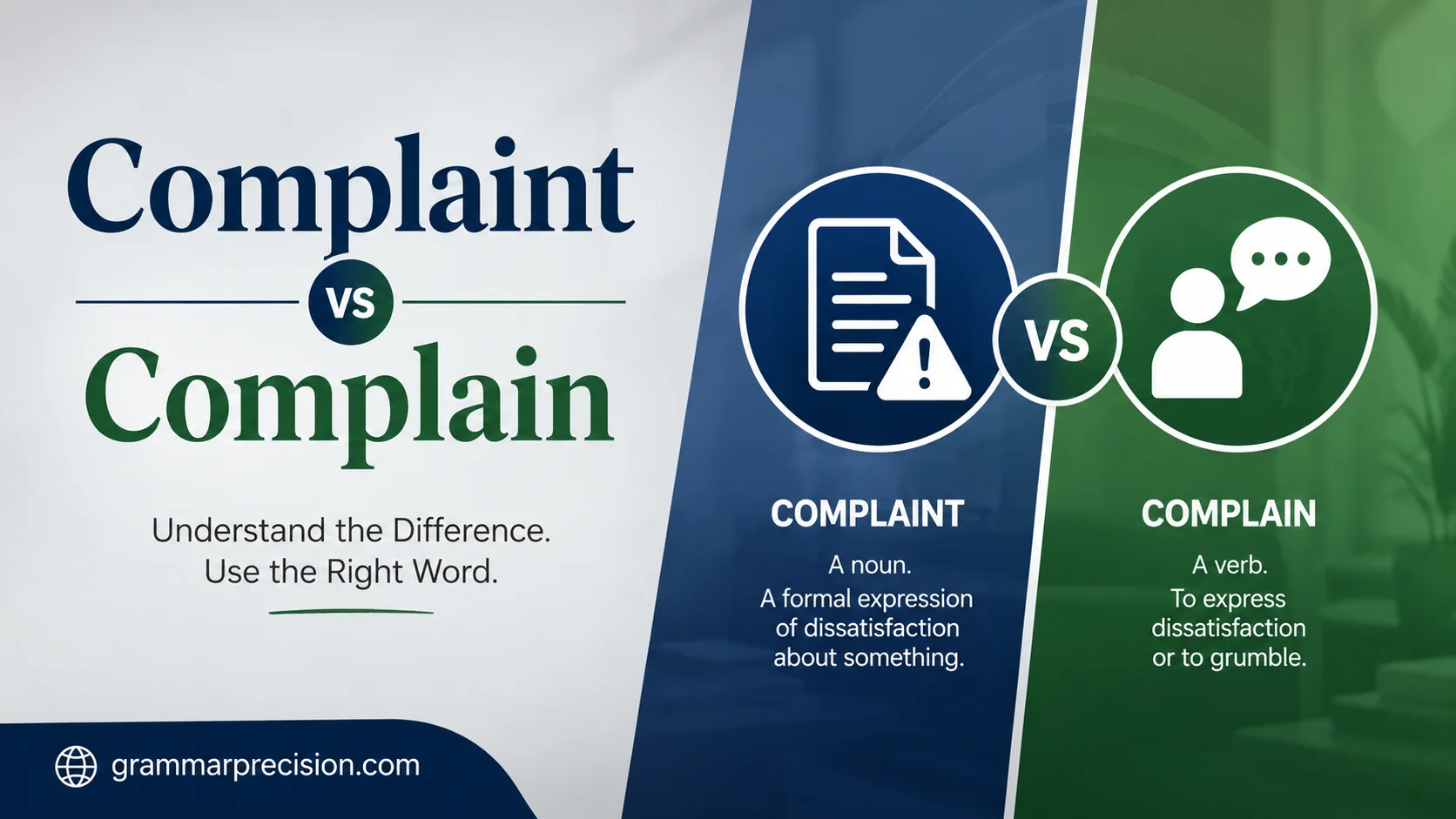
Complaint vs Complain is a common English grammar topic that often confuses learners. These similar words have different functions, and knowing the correct usage helps improve writing, speaking, and communication skills.
Many English learners struggle to understand the difference between complaint and complain because they look and sound similar. A complaint is a noun that expresses dissatisfaction, discomfort, or unhappiness, while complain is a verb used when someone is expressing those feelings in everyday situations and conversations.
Using the correct word improves clarity, accuracy, and professionalism in emails, reviews, business communication, and formal writing. Understanding this important grammar distinction builds confidence, reduces confusion, and helps learners communicate more effectively in both personal and professional environments.
Complaint vs Complain: The Core Difference Explained Clearly
Let’s make this super simple.
- Complain = action (verb)
- Complaint = thing (noun)
That’s the foundation.
Now look at these examples:
- I complain about the noise every night.
- I made a complaint about the noise.
Same idea, different grammar role. One shows action, the other shows a record or statement.
Quick Comparison Table: Complaint vs Complain
| Word | Type | Meaning | Example |
| Complain | Verb | To express dissatisfaction | I complain about delays. |
| Complaint | Noun | A statement of dissatisfaction | She filed a complaint. |
This table is small, but it clears most confusion instantly.
Why People Confuse Complaint and Complain
The confusion comes from word families in English.
Words often follow patterns like:
- explain → explanation
- apply → application
- complain → complaint
So learners assume everything behaves logically. But English doesn’t always play fair.
Another reason is context. Both words appear in similar places like:
- customer service
- workplace issues
- school rules
- online reviews
So your brain keeps mixing them up.
The Simple Memory Trick That Actually Works
Here’s a trick that sticks:
Think: Action vs Thing
- If someone is doing something, use complain
- If you are talking about a record or issue, use complaint
Example:
- She complains about slow service.
- She made a complaint about slow service.
Now imagine:
- complain = talking, reacting, expressing
- complaint = document, form, written issue
That mental picture makes it easier to remember.
What Does Complain Mean?
Complain is a verb, which means it shows action.
When you complain, you are expressing dissatisfaction.
Common patterns:
- complain about something
- complain to someone
- complain of something (formal)
Examples:
- I complain about traffic every morning.
- He complains to the manager often.
- Patients complain of pain after surgery.
It always feels like something happening live.
What Does Complaint Mean?
Complaint is a noun. It refers to the actual issue or statement.
Think of it as the “result” of complaining.
Common uses:
- file a complaint
- submit a complaint
- customer complaint
- formal complaint
Examples:
- The company received a complaint about late delivery.
- The school logged a noise complaint.
- HR reviewed the complaint carefully.
Here, the complaint is something you can store, track, or resolve.
The Grammar Logic Behind Complaint vs Complain
Here’s a simple transformation pattern:
| Verb | Noun |
| complain | complaint |
| explain | explanation |
| move | movement |
| develop | development |
This helps you understand how English builds words.
But remember: usage still depends on context, not just structure.
Also Read This: Fillet vs Filet
A Real-Life Story to Lock the Difference in Your Mind
Imagine you visit a café.
Your coffee is cold.
You say:
“I’m going to complain about this.”
Later, the manager writes:
“We received a complaint from a customer.”
Same situation:
- You perform action → complain
- Business records issue → complaint
That’s the easiest way to remember it.
Common Mistakes People Make
Here are errors that sound wrong immediately:
Wrong:
- I made a complain yesterday.
- She complaint about the service.
- They are complaint again.
Correct:
- I made a complaint yesterday.
- She complains about the service.
- They are complaining again.
The problem happens when noun and verb forms get mixed.
Complaint vs Complain in Daily Life
You’ll see these words everywhere.
At work:
- Employees complain about workload.
- HR receives complaints from staff.
At school:
- Students complain about homework.
- Teachers handle complaints from parents.
Online:
- Users complain about bugs.
- Companies respond to complaints quickly.
Same pattern everywhere.
Complaint vs Complain in Professional English
In business writing, word choice matters a lot.
Formal “complaint” phrases:
- We acknowledge your complaint.
- Your complaint is under review.
- Submit a complaint form.
Better alternatives for “complain”:
Instead of saying:
- “I want to complain.”
Try:
- “I would like to raise a concern.”
- “I’d like to report an issue.”
These sound more professional and calm.
American vs British Usage
Good news: no real difference in grammar.
Both use:
- complain (verb)
- complaint (noun)
However:
- American English is more direct
- British English sounds slightly more formal in complaints
But rules stay the same.
Synonyms That Improve Your Writing
For Complaint (noun):
- grievance
- issue
- concern
- objection
- report
For Complain (verb):
- grumble
- protest
- criticize
- object
- voice concern
Using these helps your writing feel richer and less repetitive.
Complaint vs Complain in Email Writing
Emails are where mistakes are common.
Weak example:
I want to complain about your service.
Better:
I would like to raise a complaint regarding your service.
Even better:
I am writing to report an issue with your service delivery.
Small change, big improvement in tone.
Mini Case Study: Customer Service Flow
A customer experiences slow internet.
Step 1:
Customer complains to support.
Step 2:
Support logs a complaint.
Step 3:
Technical team resolves it.
This shows how both words work together in real systems.
Common Phrases You Should Remember
With Complaint:
- file a complaint
- register a complaint
- resolve a complaint
- complaint handling
With Complain:
- complain about noise
- complain to manager
- stop complaining
- complain frequently
These are very common in real communication.
Pronunciation Tip
- complain → com-PLAIN
- complaint → com-PLAINT
They sound close but the ending changes meaning completely.
Think:
- complain = action flowing out
- complaint = thing stored or recorded
Why This Confusion Happens So Often
English is full of irregular patterns.
Some are simple:
- move → movement
Some are tricky:
- complain → complaint
Because of this, learners often guess instead of understanding.
That’s why this pair causes confusion even at advanced levels.
Practice Section
Choose the correct word:
- I want to ___ about the noise.
- She filed a formal ___.
- They often ___ about delays.
- The manager checked the ___.
Answers:
- complain
- complaint
- complain
- complaint
Quick Cheat Sheet
- Complain = verb (action)
- Complaint = noun (thing/record)
- One describes doing something
- The other describes the issue itself
- Both often appear in real-life communication
FAQs:
What is the difference between complaint and complain?
A complaint is a noun that refers to a statement of dissatisfaction, discomfort, or unhappiness. Complain is a verb that describes the action of expressing those feelings. Understanding this distinction helps improve grammar and communication.
Is complaint a noun or a verb?
The word complaint is always a noun. It refers to a problem, concern, or expression of dissatisfaction. For example, a customer may submit a complaint about a poor service or defective product.
How do I use complain in a sentence?
Complain is a verb and is used when someone expresses dissatisfaction or discomfort. For example: “Many customers complain when they experience delays or poor service.” It describes an action, not a thing.
Why do people confuse complaint and complain?
People often confuse these words because they are similar, sound alike, and are easy to mistype. However, remembering that complaint is a noun and complain is a verb can make the correct usage much easier.
Which word is more common: complaint or complain?
Both words are common in English, but their usage depends on the context. Complaint frequently appears in business communication, customer messages, and formal writing, while complain is commonly used in everyday conversations and spoken communication.
Conclusion:
Understanding Complaint vs Complain is essential for clear and effective communication. A complaint is a noun that refers to an issue or expression of dissatisfaction, while complain is a verb that describes the act of expressing those feelings.
Learning this important grammar rule improves clarity, accuracy, and confidence in writing, emails, reviews, and everyday conversations. By using each word correctly, you can avoid common mistakes and communicate more professionally.