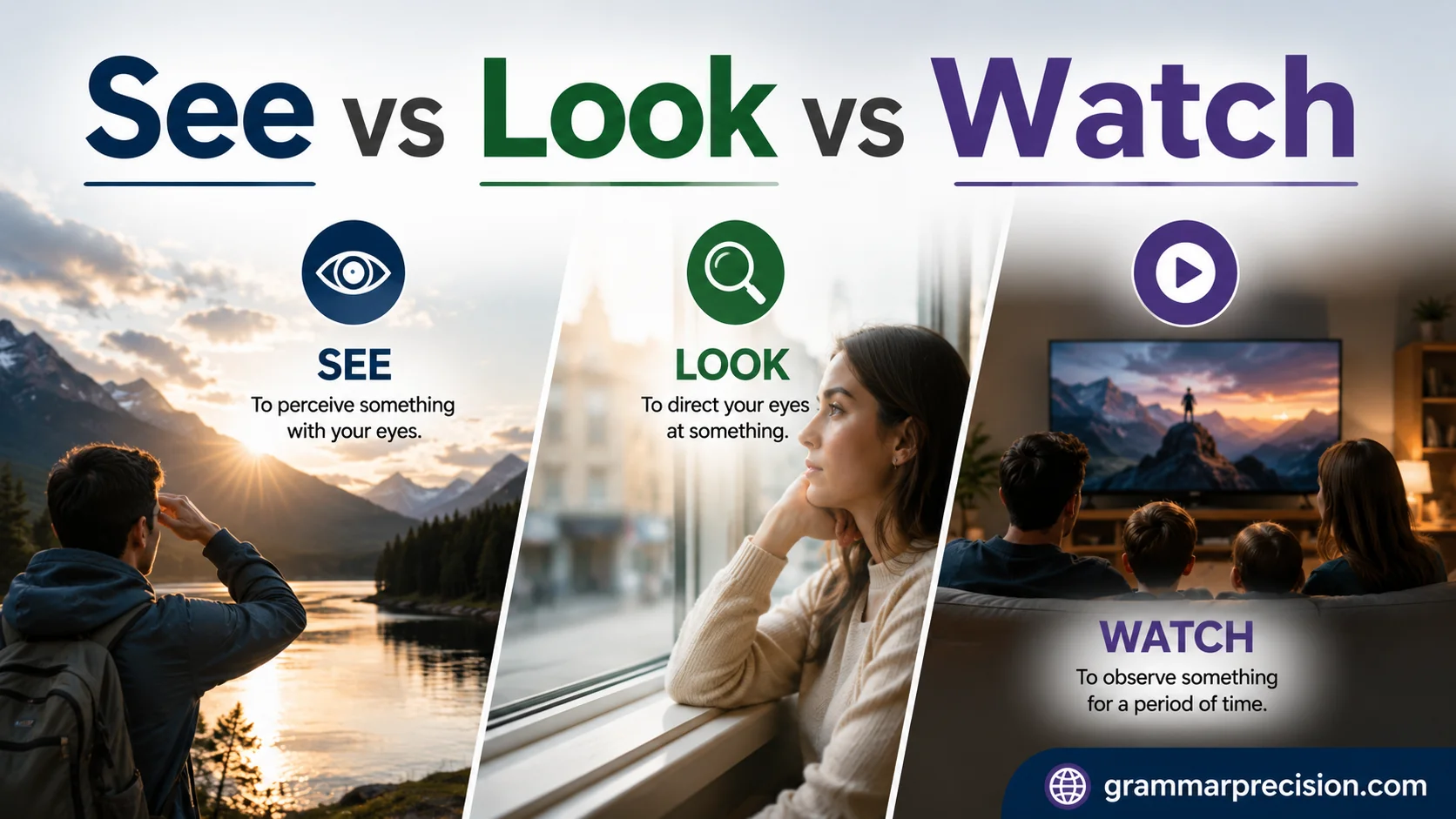
See vs Look vs Watch is a common confusion in English where learners struggle to understand how see, look, and watch differ in meaning and everyday usage clearly in simple communication.
Many learners notice that in real, usage, experience, they often realize that these words are not just grammar, rules but part of natural, behavior in communication when they see, something they simply, notice it, when they look they start directing, their eyes, and when they watch they spend time, observing, and understanding carefully in context.
English learners often come, across, early, study, situations where they try to apply one meaning but context, forces, them to adjust because concepts, are expressed, differently in other languages. This confusion, grows when students try to understand differences, and uses of each word, but with practice, this group, becomes easier and improves attention, focus, and observation skills in both writing and speaking naturally.
See vs Look vs Watch: Why These Words Confuse So Many Learners
Most learners treat these words as direct synonyms for “to view something.” That is where the problem begins.
English does not only care about what you do with your eyes. It also cares about how you do it.
Think of it like this:
- See = it happens naturally, without effort
- Look = you choose to direct your eyes
- Watch = you focus over time with attention
Here is a simple analogy.
Imagine your eyes are a camera:
- “See” is like the camera recording everything automatically.
- “Look” is like turning the camera toward something specific.
- “Watch” is like recording a movie scene with full focus.
That mental model alone fixes half the confusion.
The Core Meaning of See vs Look vs Watch in Simple English
See: When Your Eyes Catch Something Naturally
You use see when something enters your vision without effort.
You are not trying. It just happens.
Real meaning:
- Passive perception
- No intention required
- Instant awareness
Examples:
- I see a bird outside the window.
- Did you see that car accident?
- I can see the mountains from here.
Key idea:
You don’t “try” to see. It just happens when your eyes are open.
Look: When You Direct Your Attention
You use look when you intentionally focus your eyes on something.
You are actively choosing where to direct your attention.
Real meaning:
- Intentional action
- Short focus
- Directed attention
Examples:
- Look at this photo.
- She looked at me and smiled.
- I am looking for my phone.
Key idea:
You control “look.” It always involves intention.
Watch: When You Observe Over Time
You use watch when you pay attention to something that changes or moves over time.
Real meaning:
- Continuous attention
- Often involves movement or activity
- Longer duration
Examples:
- I watch TV every night.
- We watched the football match.
- He is watching the kids in the park.
Key idea:
You don’t just glance. You stay focused.
See vs Look vs Watch in Real Life Situations
Understanding rules is helpful, but real fluency comes from context.
At Home
- I see dust on the table.
- I look at the recipe while cooking.
- I watch a cooking video on YouTube.
At School or Work
- I see a mistake in the report.
- I look at the instructions carefully.
- I watch a presentation.
In Social Life
- I see my friend at the market.
- I look at someone when they talk.
- I watch my friend play cricket.
Entertainment
- I see a trailer online.
- I look at movie reviews.
- I watch a movie.
Quick Table for Clarity
| Word | Attention Level | Duration | Intention | Example |
| See | Low | Instant | No | I see a bird |
| Look | Medium | Short | Yes | Look at that |
| Watch | High | Long | Yes | Watch a film |
Common Mistakes Learners Make (And How to Fix Them)
Many learners use these words incorrectly because they translate directly from their native language.
Mistake 1: “I am seeing TV”
❌ Wrong
✔ Correct: I am watching TV
Why?
TV requires attention over time.
Mistake 2: “Look a movie”
❌ Wrong
✔ Correct: Watch a movie
Why?
Movies are long and require continuous focus.
Mistake 3: “I see at him”
❌ Wrong
✔ Correct: I look at him
Why?
“See” does not take intentional direction.
Mistake 4: “Watch this picture”
❌ Wrong
✔ Correct: Look at this picture
Why?
Pictures do not move or change over time.
Also Read This: Please Advise vs Please Advice
Native Speaker Thinking Pattern (The Hidden Rule)
Native speakers don’t consciously think about grammar rules when choosing these words. They think in terms of attention flow.
Here is what happens in their mind:
- If it is automatic → they say “see”
- If it is intentional → they say “look”
- If it continues over time → they say “watch”
That is it.
No complicated grammar needed.
Phrasal Verbs That Change Everything
Now let’s level up your English. These words are not just basic verbs. They also form powerful phrasal verbs.
See Phrasal Verbs
- see through → understand hidden truth
- I can see through his lies.
- see off → say goodbye at departure
- I went to the airport to see her off.
Look Phrasal Verbs
- look after → take care of
- She looks after her younger brother.
- look into → investigate
- The manager will look into the issue.
- look up → search for information
- I looked up the word in the dictionary.
Watch Phrasal Verbs
- watch out → be careful
- Watch out for cars.
- watch over → protect or supervise
- The teacher watches over the class.
Emotional Meaning Behind See vs Look vs Watch
Here is something most grammar books never tell you.
These words carry emotional weight.
See = Neutral Awareness
- Calm
- Passive
- Observational
Example:
- I see what you mean.
Look = Curiosity or Focus
- Active interest
- Attention shift
Example:
- Look, I think we need to talk.
Watch = Care or Concern
- Protective
- Engaged
- Continuous attention
Example:
- I watch my younger sister carefully.
Real Conversation Examples (Before and After)
Let’s make this practical.
Example 1: Talking About TV
❌ I see TV every night
✔ I watch TV every night
Example 2: Asking Someone to Focus
❌ See this photo
✔ Look at this photo
Example 3: Noticing Something
❌ I look a bird
✔ I see a bird
Example Dialogue
A: Did you see the accident?
B: Yes, I saw it from across the street. I stopped to watch what happened.
Notice how all three words can appear in one short conversation, each with a different role.
Memory Tricks That Actually Work
Here are simple ways to remember the difference.
Trick 1: The Effort Rule
- See = no effort
- Look = small effort
- Watch = long effort
Trick 2: The Movie Rule
- See = spot the cinema
- Look = check the poster
- Watch = enjoy the movie
Trick 3: The Action Rule
- See = happens to you
- Look = you choose it
- Watch = you stay with it
Mini Practice Section
Try choosing the correct word.
Fill in the blanks:
- I ___ a dog in the street.
- Please ___ at this document.
- We ___ the game last night.
- Did you ___ him leave?
- I am ___ for my keys.
Answers:
- see
- look
- watched
- see
- looking
Common Misunderstandings That Confuse Learners
Let’s clear up deeper confusion.
“See” does NOT mean attention
Many learners think “see” means focusing. It does not.
You can see something without even noticing it.
Example:
- I saw him, but I did not recognize him.
“Look” does NOT mean long attention
Some learners think “look” equals watching. It does not.
It is usually short and intentional.
Example:
- Look at me for a second.
“Watch” is NOT just TV
Yes, you watch TV, but that is not the full story.
You also:
- watch people
- watch events
- watch movement
- watch changes
Quick Fluency Upgrade Tips
If you want to sound more natural in English, do this:
- Stop translating directly from your language
- Think in terms of attention and time
- Listen to native speakers in movies or podcasts
- Notice how often they use these words differently
Small change, big impact.
Final Cheat Sheet: See vs Look vs Watch
| Word | Meaning | Use it when |
| See | Notice naturally | Something enters your vision |
| Look | Direct attention | You focus briefly |
| Watch | Continuous attention | Something moves or changes |
FAQs:
What is the difference between see, look, and watch?
See means to simply notice something, look means to direct your eyes, and watch means to observe something carefully for a period of time with attention.
When do we use “see” in daily English?
We use see when something enters our vision naturally without effort, like noticing a person or object without focusing on it intentionally.
How is “look” different from “see”?
Look is intentional because you actively direct your eyes toward something, unlike see, which happens automatically without effort.
Why do learners confuse look and watch?
Learners confuse them because both involve attention, but watch requires longer focus and continuous observation while look is usually brief and direct.
Can watch be used for everything we see?
No, watch is only used when something is moving or changing and you are paying continuous attention, like watching TV, a movie, or a game.
Conclusion:
Understanding see, look, and watch helps improve English communication and makes sentences more clear and natural. The key difference lies in attention level: see is passive, look is intentional, and watch is continuous observation.
Learning these differences improves speaking, writing, and overall language fluency in real life situations.