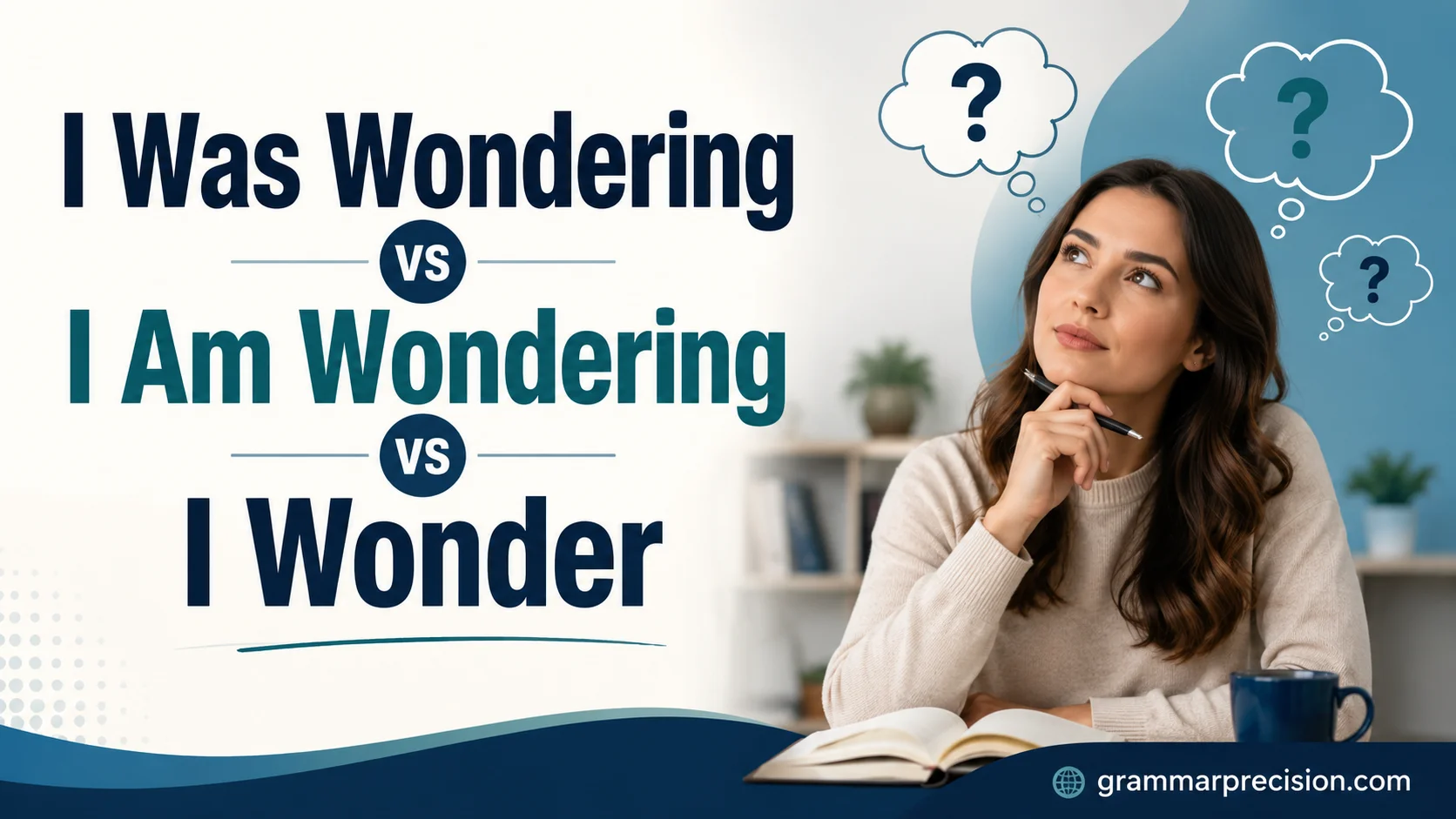
Understanding I Was Wondering vs I Am Wondering vs I Wonder helps improve English communication. These phrases express curiosity differently and affect tone, politeness, and meaning in conversations, emails, and writing.
Choosing the correct expression creates clear communication and a professional tone. I Was Wondering is often used for polite requests and careful questions, while I Am Wondering shows active curiosity in the present. These differences improve clarity and make messages more effective.
Using these phrases correctly strengthens spoken English and written English. I Wonder expresses general interest or reflection, whereas I Was Wondering sounds more respectful. Understanding their usage, context, and level of politeness helps build better communication skills and natural conversations.
Why “I Was Wondering vs I Am Wondering vs I Wonder” Confuses So Many People
At first glance, these phrases look like simple tense changes. In reality, they do much more than show time.
They also show:
- Tone
- Politeness
- Distance
- Confidence
- How active the thought is
That means one phrase can sound direct, another can sound thoughtful, and another can sound soft and polite. In everyday English, that difference matters a lot.
For example, compare these three lines:
- I wonder if she is coming.
- I am wondering if she is coming.
- I was wondering if she is coming.
All three can talk about the same idea. Still, they feel different.
The first sounds like a general thought or curiosity.
The second sounds like the thought is happening right now.
The third often sounds softer, more polite, and less direct.
That small shift can change how your message lands.
Quick Answer: What Is the Difference Between I Was Wondering, I Am Wondering, and I Wonder?
Here is the simple version.
| Phrase | Main Meaning | Tone | Best Use |
| I wonder | General curiosity or a present thought | Neutral, thoughtful, direct | Everyday speech, reflection, opinions |
| I am wondering | A thought happening right now | Active, immediate, slightly conversational | When you are currently thinking about something |
| I was wondering | A past form used to soften a question or request | Polite, gentle, indirect | Emails, formal speech, respectful requests |
If you remember only one thing, remember this:
- I wonder = a general idea or present curiosity
- I am wondering = an active thought in progress
- I was wondering = a soft, polite way to ask
That is the core difference. Everything else builds from it.
I Wonder Meaning and Usage
What “I Wonder” Means
I wonder usually means that you are thinking about something, asking yourself a question, or expressing curiosity. It often sounds natural, calm, and reflective.
Examples:
- I wonder why he left so early.
- I wonder what she thinks about the plan.
- I wonder if this will work.
This phrase often appears when someone is not asking another person directly. Instead, they are thinking out loud.
When to Use “I Wonder”
Use I wonder when you want to:
- Express curiosity
- Share a thought
- Ask a rhetorical question
- Sound reflective or thoughtful
It works well in both speech and writing.
Natural Examples of “I Wonder”
- I wonder what happened after the meeting.
- I wonder whether they will approve the proposal.
- I wonder why the train is late again.
These sound natural because they reflect real thinking. They do not feel stiff or forced.
What Tone Does “I Wonder” Create?
This phrase often sounds:
- Thoughtful
- Curious
- Neutral
- Slightly philosophical
It is not usually the best choice when you want to make a polite request. For that, I was wondering often works better.
I Am Wondering Meaning and Usage
What “I Am Wondering” Means
I am wondering shows that the thought is happening now. It sounds active and immediate. The speaker is in the middle of thinking.
Examples:
- I am wondering whether we should leave now.
- I am wondering if this is the best choice.
- I am wondering what to do next.
This phrase often feels more temporary than I wonder. It suggests that the speaker is still processing the idea.
When to Use “I Am Wondering”
Use I am wondering when:
- You are thinking through a decision
- You want to show uncertainty in the moment
- You are speaking casually and naturally
- You want to highlight the ongoing nature of your thought
Natural Examples of “I Am Wondering”
- I am wondering if I should call him first.
- I am wondering whether this price is worth it.
- I am wondering how long the line will be.
These examples sound like live mental processing. The speaker is not finished thinking yet.
Tone of “I Am Wondering”
This phrase can sound:
- Reflective
- Current
- Slightly hesitant
- Personal
It is useful when you want to sound honest about your thought process. In conversation, it often feels warmer and more immediate than I wonder.
I Was Wondering Meaning and Usage
Why “I Was Wondering” Sounds So Polite
I was wondering is one of the most useful polite expressions in English. Although it uses the past tense, it often refers to a present request or question.
That is the interesting part.
The past form softens the message.
Instead of sounding sharp or demanding, you sound considerate.
Example:
- I was wondering if you could help me.
- I was wondering whether you had time for a quick call.
- I was wondering if this seat is taken.
These all feel gentle. They give the other person space to respond without pressure.
When to Use “I Was Wondering”
Use I was wondering when you want to:
- Make a polite request
- Ask a question without sounding too direct
- Sound respectful in email or speech
- Soften an ask to avoid sounding pushy
Natural Examples of “I Was Wondering”
- I was wondering if you could send the file today.
- I was wondering whether you had any updates.
- I was wondering if we could meet tomorrow.
These are classic, natural English phrases. They work especially well in workplace messages, customer service, and formal conversations.
Why the Past Tense Works Here
The past tense in I was wondering does not always mean the wondering is really over. Instead, it helps make the question feel less abrupt.
Think of it like knocking gently instead of banging on a door.
- Can you help me? sounds direct.
- I was wondering if you could help me? sounds softer.
Same request. Different feel.
I Wonder vs I Am Wondering vs I Was Wondering: Side by Side Comparison
Sometimes the fastest way to learn is to compare the phrases directly.
| Phrase | Grammar Form | Meaning | Tone | Best Situation |
| I wonder | Present simple | General curiosity or reflection | Direct and thoughtful | Thinking, observation, opinions |
| I am wondering | Present continuous | Ongoing thought right now | Active and current | Decision making, live thinking |
| I was wondering | Past continuous like softener | Polite indirect question or request | Gentle and respectful | Emails, requests, formal speech |
Another Easy Way to See It
- I wonder = “This is my thought.”
- I am wondering = “I am still thinking about this.”
- I was wondering = “May I ask this politely?”
That tiny change in sentence shape changes the whole social effect.
Also Read This: Complaint vs Complain
Real Life Dialogue Examples
Everyday Conversation
Situation: Two friends are deciding where to eat.
- I wonder if the café is still open.
- I am wondering whether we should just order delivery.
- I was wondering if you wanted pizza instead.
Each sentence works. But each one feels different.
The first is a general thought.
The second shows active decision making.
The third sounds like a polite suggestion.
Workplace Conversation
Situation: An employee wants to ask a manager about a deadline.
- I wonder if the deadline changed.
- I am wondering whether I missed an update.
- I was wondering if you could confirm the deadline.
The last one is the safest choice in formal communication because it sounds respectful and non pushy.
Email Example
Too direct:
- Send me the report today.
Better:
- I was wondering if you could send the report today.
That tiny shift can make your message feel much more professional and polite.
When to Use I Wonder in Writing and Speech
Best Uses
Use I wonder when you want to sound:
- Thoughtful
- Reflective
- Curious
- Neutral
Good Examples
- I wonder why people love that show so much.
- I wonder what makes a city feel alive.
- I wonder whether she noticed the change.
Common Mistake
Some learners use I wonder when they really want to make a request. That can sound too direct or too strange in certain settings.
For example:
- I wonder if you can help me sounds understandable.
- I was wondering if you could help me sounds more natural and polite.
When to Use I Am Wondering
Best Uses
Use I am wondering when the thought is active and happening now.
It fits situations like:
- Brainstorming
- Comparing options
- Thinking aloud
- Expressing uncertainty
Good Examples
- I am wondering whether to accept the offer.
- I am wondering if this route is faster.
- I am wondering how much time we still have.
Common Mistake
Some people overuse I am wondering in places where I wonder sounds cleaner.
Example:
- I am wondering why he is late every day.
This is not wrong. It just sounds more like live thinking than a simple reflection. Sometimes I wonder why he is late every day is smoother.
When to Use I Was Wondering
Best Uses
Use I was wondering when you want to sound:
- Polite
- Soft
- Respectful
- Indirect
Good Examples
- I was wondering if you could review this draft.
- I was wondering whether you had a moment.
- I was wondering if this is the right form.
Common Mistake
A lot of learners think was means the question is in the past. Not always.
In many cases, I was wondering is just a polite opener. It does not mean the thought is outdated. It simply makes the request gentler.
A Simple Decision Guide
Sometimes grammar rules get easier when you turn them into a decision path.
Ask Yourself These Questions
Are you just expressing curiosity?
Use I wonder.
Example:
I wonder why the sky looks red tonight.
Are you thinking through something right now?
Use I am wondering.
Example:
I am wondering whether I should stay home or go out.
Are you making a polite request?
Use I was wondering.
Example:
I was wondering if you could call me back.
That is the quickest way to choose.
Mini Case Studies: Which Phrase Sounds Best?
Case Study: Asking a Professor for Help
Less effective:
- I wonder if you can explain this again.
Better:
- I was wondering if you could explain this again.
Why? Because the second version sounds polite and respectful. In academic or formal settings, tone matters.
Case Study: Thinking Out Loud With a Friend
Natural:
- I wonder if he forgot the meeting.
- I am wondering whether he got stuck in traffic.
Both work. The second feels more immediate.
Case Study: Writing an Email at Work
Best choice:
- I was wondering if you had any updates on the project.
This sounds professional, calm, and courteous. It avoids pressure.
Case Study: Casual Chat
Natural:
- I wonder what she meant by that.
This sounds relaxed and conversational.
Common Mistakes People Make with Wonder Phrases
Mixing Up Politeness and Tense
A common error is assuming the “past” in I was wondering means the speaker is talking about a completed action. In many cases, it is just a polite form.
Using the Wrong Level of Formality
- I wonder if you can help me may sound too plain in an email.
- I was wondering if you could help me usually sounds better.
Repeating the Same Form Too Often
Good writing uses variety. If every sentence begins the same way, the text feels flat.
Instead of saying:
- I wonder
- I wonder
- I wonder
Try mixing in:
- I am wondering
- I was wondering
- I think
- I am curious about
- It makes me wonder
That gives your writing more rhythm.
Using “I Am Wondering” When You Want a Softer Tone
Sometimes I am wondering sounds too active or too direct for a polite request. In those cases, I was wondering usually works better.
A Practical Table for Real Usage
| Situation | Best Phrase | Why |
| Casual reflection | I wonder | Natural and simple |
| Live thinking | I am wondering | Shows active thought |
| Polite request | I was wondering | Softens the question |
| Email to boss | I was wondering | Respectful and professional |
| Conversation with friend | I wonder or I am wondering | Both can sound natural |
| Asking a stranger something | I was wondering | Less direct |
Useful Patterns and Sentence Frames
“I wonder if…”
Use this when you are curious about a possibility.
- I wonder if she knows the answer.
- I wonder if we missed the train.
“I am wondering whether…”
Use this when you are actively considering options.
- I am wondering whether to go now or later.
- I am wondering whether this is worth the cost.
“I was wondering if…”
Use this when you want to make a request politely.
- I was wondering if you could share the notes.
- I was wondering if this seat is free.
These frames are easy to remember and very useful in real life.
How Native Speakers Use These Phrases Naturally
Native speakers do not always think in grammar labels. They think in tone.
That is why the same person might say:
- I wonder what happened
- I am wondering if we should leave
- I was wondering if you had a second
They choose based on context, not just tense.
This is a big reason these expressions feel confusing to learners. Grammar books often explain the form, but real speech depends on social purpose.
The question is not only “What tense is this?”
It is also “What does this sound like to the other person?”
That is the real skill.
What Sounds Natural vs What Sounds Robotic
Natural
- I was wondering if you could help me.
- I wonder why she did that.
- I am wondering whether this is the right path.
Robotic or Overdone
- I am wondering if maybe possibly you could perhaps help me.
- I wonder that you are late.
- I was wondered if you can help.
Natural English stays clear and clean. It does not pile on extra words unless they add real value.
Quick Memory Tricks
Here are a few simple ways to remember the difference.
Think of “I wonder” as your inner voice
It is the basic curiosity phrase.
Think of “I am wondering” as a thought in motion
Your mind is still working on it.
Think of “I was wondering” as a polite knock
It softens the ask.
Those images help more than memorizing dry rules.
Expert Tip: Focus on Intent, Not Just Grammar
This is where many learners level up.
Instead of asking only, “Which tense is correct?” ask:
- Am I showing curiosity?
- Am I thinking right now?
- Am I making a polite request?
- Do I need to sound direct or gentle?
When you match the phrase to your intent, the sentence almost writes itself.
That is how fluent communication works. It is not just about grammar. It is about effect.
FAQs:
What is the main difference between I Was Wondering, I Am Wondering, and I Wonder?
The main difference is tone and context. I Was Wondering is usually more polite and indirect, I Am Wondering shows a current thought or question, and I Wonder expresses general curiosity or reflection.
Is I Was Wondering more polite than I Am Wondering?
Yes, I Was Wondering often sounds more polite, respectful, and less direct. It is commonly used in professional communication, emails, and when making requests.
When should I use I Am Wondering?
Use I Am Wondering when you are thinking about something right now. It expresses active curiosity and is useful when discussing a current question, concern, or situation.
Can I Wonder be used in formal writing?
Yes, I Wonder can be used in both formal and informal situations. However, it is more commonly used to express general interest, reflection, or personal thoughts rather than making requests.
Why is it important to understand these phrases?
Understanding these expressions improves clarity, communication skills, and English fluency. Using the correct phrase helps convey the right meaning, tone, and level of politeness in different situations.
Conclusion:
Understanding the differences between I Was Wondering, I Am Wondering, and I Wonder is essential for effective communication.
Each phrase carries a unique tone, meaning, and purpose. By learning their proper usage, context, and level of politeness, you can improve both spoken English and written English, making your conversations, emails, and writing sound more natural, clear, and professional.