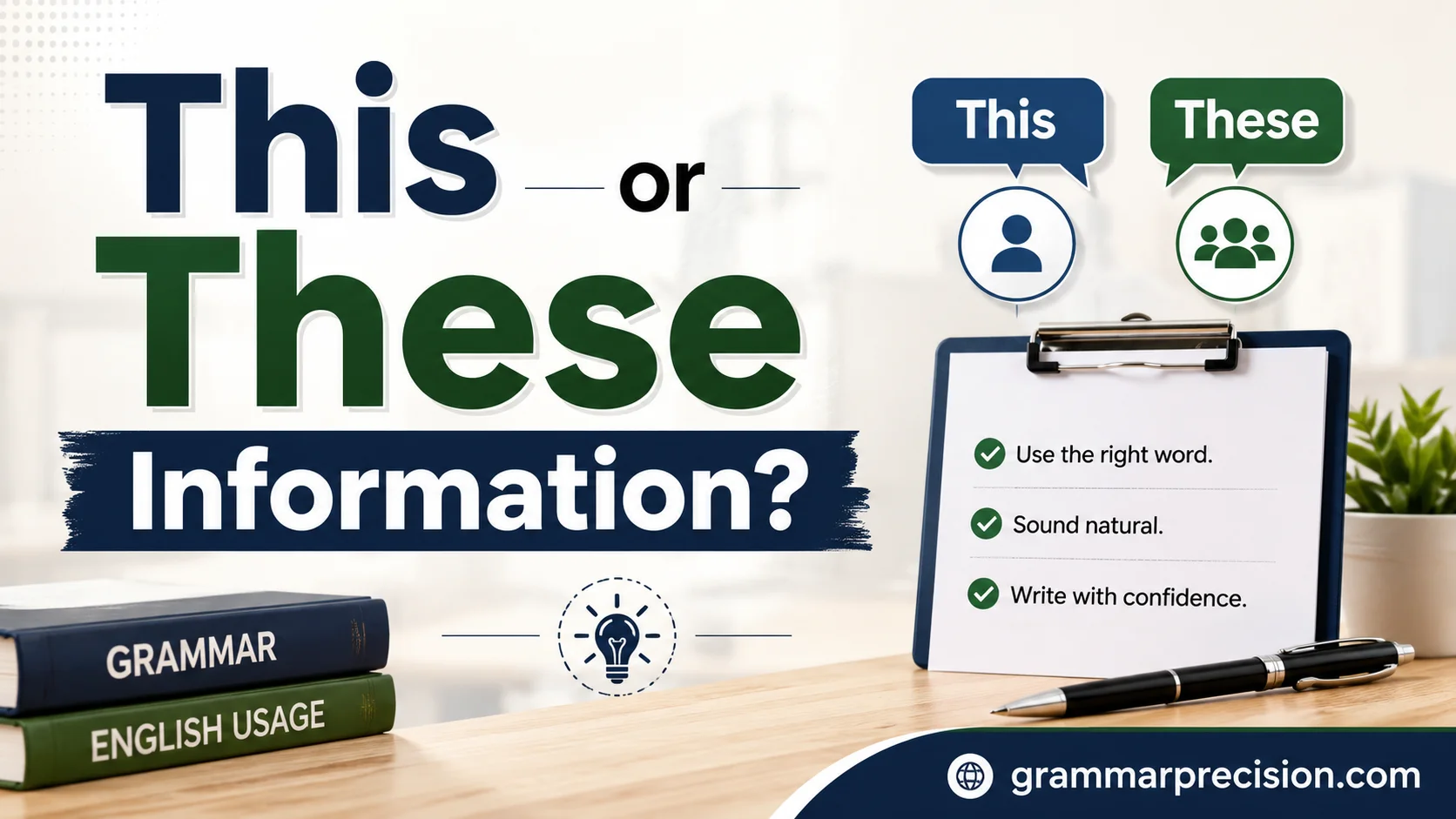
This or These Information? often confuses English learners because information is an uncountable noun. Understanding the correct usage helps you communicate more naturally, accurately, and confidently in everyday English.
Many people wonder whether they should say “this information” or “these information.” The correct choice is “this information” because information is an uncountable noun and always takes singular demonstratives. If you’re referring to multiple pieces, say “these pieces of information” instead for proper grammar.
Learning the difference between this and these with information can instantly improve your writing and speaking. Once you understand this simple grammar rule, you’ll avoid a common mistake, sound more fluent, and write with greater clarity, confidence, and accuracy every time.
Is “This or These Information” Correct? The Simple Answer
When choosing between “this information” and “these information,” only one option is grammatically correct.
✅ Correct: This information is helpful.
❌ Incorrect: These information are helpful.
The reason is simple: information does not have a plural form in standard English. Although you may receive many facts or details, English treats the word information as one general concept.
Think of information like water. You can have a lot of water, but you don’t usually count it as “two waters” unless you are talking about specific servings or bottles.
The same idea applies to information:
- Some information ✅
- More information ✅
- A lot of information ✅
- Three pieces of information ✅
- Informations ❌
- These information ❌
Why “This Information” Is Correct
The phrase “this information” works because this can describe both singular nouns and uncountable nouns.
In English, demonstrative words follow specific rules:
| Demonstrative | Used With | Example |
| This | Singular or uncountable nouns | This information is valuable. |
| That | Singular or uncountable nouns | That information was incorrect. |
| These | Plural countable nouns | These facts are valuable. |
| Those | Plural countable nouns | Those reports were incorrect. |
Since information is uncountable, it connects naturally with this or that.
Examples of “This Information” in Sentences
- This information explains the problem clearly.
- I found this information on the company’s website.
- This information will help you make a better decision.
- Please check whether this information is accurate.
Notice that the verb also stays singular:
✅ This information is correct.
❌ This information are correct.
Even though information may contain many facts, English grammar treats it as a singular idea.
Why “These Information” Is Incorrect
The confusion happens because people often think about information as a collection of separate facts.
For example, imagine a research report containing:
- customer statistics
- survey results
- market trends
- financial details
You may think:
“These are many things, so I should say these information.”
However, English does not view information as the individual items themselves. It views information as the overall knowledge you receive.
The word these requires a plural countable noun.
For example:
✅ These facts are important.
✅ These details are useful.
✅ These reports are accurate.
❌ These information are important.
The solution is simple: replace information with a countable word when you want to use these.
This Information vs These Pieces of Information
One of the biggest grammar mistakes happens because writers confuse information with pieces of information.
The phrase “pieces of information” is countable.
Compare these examples:
| Incorrect Sentence | Correct Sentence |
| I received three informations. | I received three pieces of information. |
| These information are new. | These pieces of information are new. |
| An information surprised me. | A piece of information surprised me. |
The word piece acts as the counting unit.
Just like you say:
- A piece of advice
- A piece of furniture
- A piece of news
You say:
- A piece of information
Understanding Why Information Is an Uncountable Noun
To fully understand “this or these information,” you need to understand uncountable nouns.
An uncountable noun describes something that cannot usually be divided into separate units when we talk about it generally.
Common uncountable nouns include:
- Information
- Advice
- Knowledge
- Research
- Equipment
- Furniture
- Money
- Traffic
These words represent ideas, materials, or collections rather than individual objects.
For example:
You can count:
- One book
- Two books
- Five books
But you cannot normally count:
- One information ❌
- Two informations ❌
Instead, you change the structure:
- One piece of information
- Two pieces of information
Information vs Facts: What’s the Difference?
Many people use information and facts interchangeably, but they are not exactly the same.
A fact is a specific piece of truth or knowledge.
Information is the broader collection or communication of facts.
For example:
“The Earth revolves around the Sun” is a fact.
A science article containing hundreds of facts is information.
This difference explains why these sentences work:
✅ This information is useful.
✅ These facts are useful.
The first refers to a general collection of knowledge. The second refers to separate, countable facts.
Common Mistakes With the Word “Information”
Many grammar mistakes happen because learners apply normal noun rules to information.
Here are the most common errors:
| Common Mistake | Correct Version | Reason |
| These information are helpful. | This information is helpful. | Information is uncountable. |
| I need an information. | I need some information. | Information cannot use “a/an.” |
| She gave me many informations. | She gave me a lot of information. | Information has no plural form. |
| These informations are important. | These pieces of information are important. | Pieces make it countable. |
Can You Say “Informations” in English?
In standard modern English, “informations” is usually incorrect.
Native speakers almost always use information without adding -s.
Incorrect:
The teacher provided many informations about the exam.
Correct:
The teacher provided a lot of information about the exam.
However, in some specialized contexts, especially when translating from other languages or in rare technical usage, you might see informations. But for everyday English, academic writing, and professional communication, avoid it.
A good rule:
Never add “s” to information unless you are following a very specific technical style guide.
Better Alternatives to “These Information”
If you want to refer to multiple items, you have several natural options.
Instead of:
❌ These information are important.
Use:
These Facts
Example:
✅ These facts support the argument.
Use this when you are talking about specific pieces of truth.
These Details
Example:
✅ These details explain what happened.
Use this when referring to smaller parts of a larger topic.
These Points
Example:
✅ These points should be discussed during the meeting.
Use this for ideas, arguments, or discussion topics.
These Pieces of Information
Example:
✅ These pieces of information helped solve the problem.
Use this when you want to count individual items.
How Native Speakers Usually Use “Information”
Native speakers rarely think about whether information is singular or plural. They simply follow common patterns.
You will often hear:
- I need more information.
- Can you give me some information?
- Where did you find this information?
- That information is outdated.
- The information was helpful.
You will almost never hear:
- I need an information.
- These information are useful.
- Many informations were shared.
Natural English depends on these fixed patterns.
How to Use “This,” “That,” “These,” and “Those” With Information Correctly
The words this, that, these, and those are called demonstratives. They help you point to specific things, ideas, or objects. Choosing the right one depends on whether the noun is singular, plural, countable, or uncountable.
When you use the word information, the choice becomes easier once you understand the pattern.
| Word | Correct Usage | Example |
| This | One idea or uncountable information close to you | This information is useful. |
| That | One idea or uncountable information farther away | That information seems outdated. |
| These | Multiple countable items | These details are important. |
| Those | Multiple countable items farther away | Those reports contain errors. |
Because information is uncountable, you should normally use:
- This information
- That information
You should not use:
- These information
- Those information
Examples in Context
Imagine you are reviewing a business report with your team.
You might say:
✅ This information shows that sales increased last month.
You are talking about the overall data in front of you.
However, if you point to separate charts, you would say:
✅ These charts show that sales increased last month.
The difference is not about the amount of information. It is about whether you are naming the whole idea or the individual items.
Also Read This: Sneaked or Snuck: The Complete Grammar Guide
How to Talk About Multiple Pieces of Information
Although information itself is uncountable, you can still talk about individual items of information. English simply requires a counting word.
The most common phrase is:
a piece of information
This phrase allows you to count information.
Examples:
- I have one piece of information to share.
- She gave me three pieces of information about the project.
- These pieces of information changed my opinion.
- Each piece of information helped solve the mystery.
Think of “piece” as a container. You cannot count the information directly, but you can count the pieces that carry it.
Similar examples include:
| Uncountable Noun | Counting Expression |
| Information | A piece of information |
| Advice | A piece of advice |
| News | A piece of news |
| Research | A study / research project |
| Furniture | A piece of furniture |
This Information or These Details: Which One Should You Choose?
Many writers make mistakes because they use information when they actually mean details.
Although these words are related, they have different meanings.
Information
Information refers to knowledge, facts, or understanding in a general sense.
Example:
This information helped me understand the situation.
The speaker refers to the overall knowledge.
Details
Details refer to individual facts or specific points.
Example:
These details helped me understand the situation.
The speaker refers to separate pieces of information.
Here is a simple comparison:
| Word | Countable? | Example |
| Information | No | This information is accurate. |
| Detail | Yes | These details are accurate. |
| Fact | Yes | These facts are accurate. |
| Data | Usually uncountable or plural depending on style | This data is accurate. |
Information Grammar in Professional Writing
Using “this information” correctly matters because grammar mistakes can affect how professional your writing sounds.
In workplaces, universities, and formal communication, small errors can distract readers from your message.
Compare these examples:
Incorrect Email Sentence:
These information are necessary for completing the report.
Correct Email Sentence:
This information is necessary for completing the report.
The second sentence sounds natural and professional.
Examples in Different Situations
Business Communication
Incorrect:
These information will help us improve our strategy.
Correct:
This information will help us improve our strategy.
Academic Writing
Incorrect:
These information proves the theory.
Correct:
This information proves the theory.
Everyday Conversation
Incorrect:
Can you check these information?
Correct:
Can you check this information?
Or:
Can you check these details?
Why English Learners Often Say “These Information”
The phrase “these information” is especially common among English learners because many languages treat information differently.
In some languages, the equivalent of information may have a plural form. When speakers transfer that grammar pattern into English, they naturally add -s or use plural words like these.
This is called language transfer.
For example:
A learner thinks:
“I have many pieces of information, so information must be plural.”
But English works differently:
“I have a lot of information.”
The quantity changes, but the noun stays the same.
Quick Memory Tricks for Using Information Correctly
Grammar rules become easier when you connect them to simple reminders.
Memory Trick One: Information Is Like Water
You can have:
- A glass of water
- A bottle of water
- A lot of water
But you usually don’t say:
- Two waters
Information works the same way:
- A piece of information
- A lot of information
- Some information
Memory Trick Two: Replace Information With Details
If you are unsure whether to use this or these, replace information with a countable word.
Example:
“These information are useful.”
Replace information:
“These details are useful.”
The sentence now sounds correct because details can be plural.
But with information:
“This information is useful.”
Real-Life Case Study: Fixing a Common Workplace Mistake
Imagine an employee writes this message:
“These information from the customer are incorrect.”
The sentence has two problems:
- These information is incorrect.
- Information are should be information is.
A professional correction would be:
“This information from the customer is incorrect.”
Or, if referring to separate items:
“These details from the customer are incorrect.”
The meaning becomes clearer and the grammar improves instantly.
FAQs:
Is “These Information” Ever Correct?
No. “These information” is not grammatically correct because information is an uncountable noun. You should say “this information” instead. If you need to refer to multiple items, use “these pieces of information.”
Why Is Information an Uncountable Noun?
Information represents knowledge or facts as a whole rather than individual items. Since it cannot normally be counted, it takes singular verbs and singular demonstratives like this and that, not these or those.
How Do I Refer to Multiple Information Items?
When talking about several separate facts, use countable expressions such as “pieces of information,” “bits of information,” or “items of information.” Then you can correctly say “these pieces of information.”
Can I Say “This Information Is”?
Yes. “This information is” is the correct and natural expression in English. Because information is singular in grammar, it should always be followed by a singular verb, such as is, was, or has.
What Are Common Mistakes with Information?
Common mistakes include saying “these information,” “many informations,” or “an information.” Instead, use “this information,” “much information,” or “a piece of information” to keep your English grammatically correct.
Conclusion:
Choosing between “this” and “these” becomes easy once you remember that information is an uncountable noun. Always use “this information” when referring to information in general, and use “these pieces of information” when discussing multiple facts. Following this simple grammar rule will make your writing, speaking, and overall English accuracy much stronger.