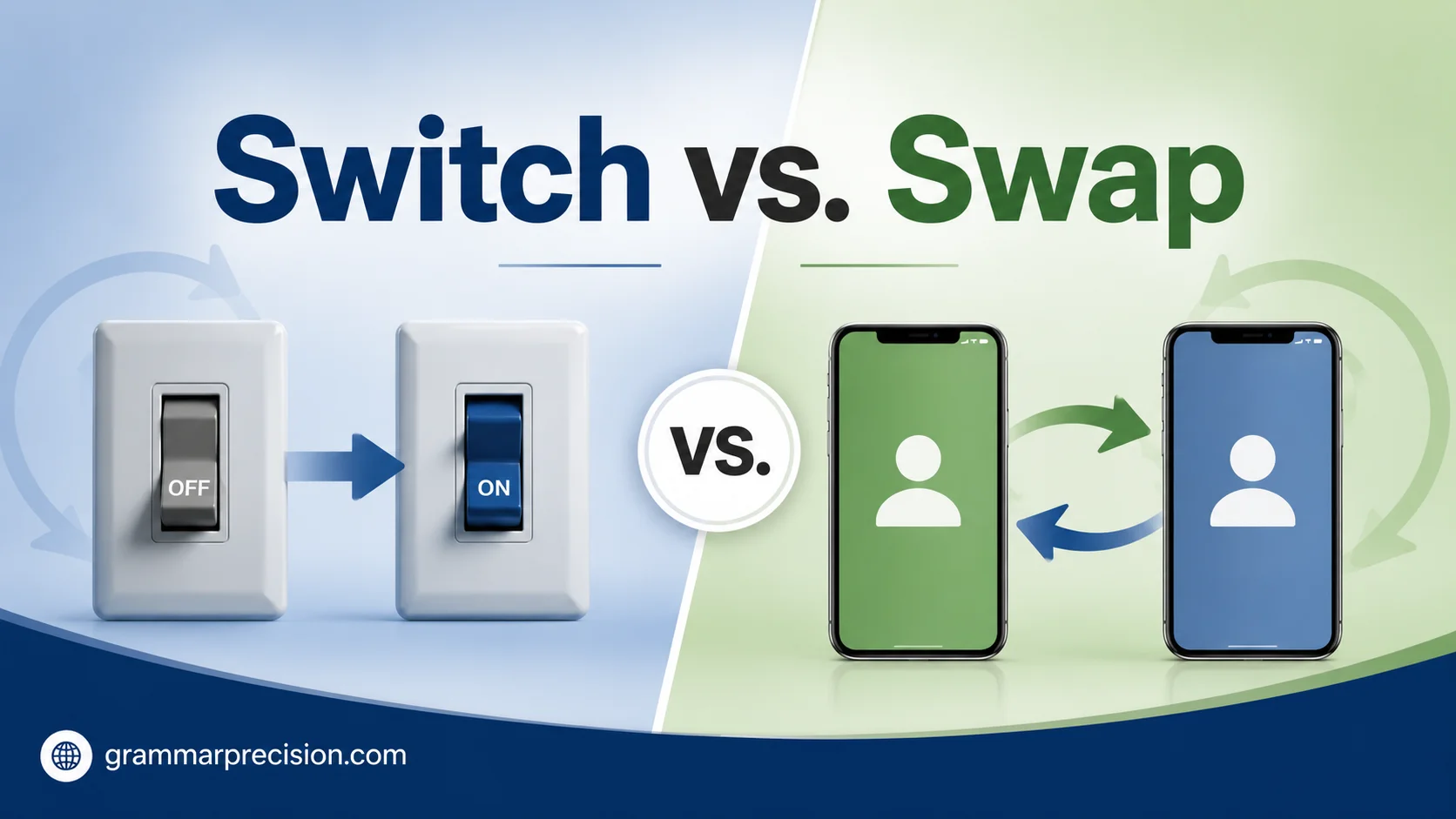
Switch vs. Swap: Why One Means Change and the Other Means Exchange
Switch vs. Swap explains the difference between two commonly confused words. While switch means changing from one thing to another, swap focuses on exchanging items between people. Understanding their meanings helps improve your English communication and word choice.
A switch usually refers to a change in position, choice, or condition without necessarily involving another person. For example, you can switch seats or switch plans. It highlights replacement or transformation from one option to another in different situations.
A swap, however, means a direct exchange between two sides where each person gives and receives something. You can swap clothes, ideas, or tasks with someone. The main focus is sharing, trading, or exchanging rather than simply making a change.
Quick Difference Summary
The simplest way to understand switch vs. swap is this:
- Switch means to change from one thing to another.
- Swap means to exchange one thing for another.
Consider these examples:
- I switched from coffee to tea.
- We swapped our seats on the plane.
In the first sentence, one preference changed to another. In the second sentence, two people exchanged positions.
That small distinction makes all the difference.
The Hidden Concept Behind Each Word
Language often reflects how people think. The meanings of switch and swap reveal two different actions.
Switch = Change Direction
When you switch something, you move from one state, option, or position to another.
Think of a light switch.
You move from:
OFF → ON
Or:
ON → OFF
The focus is on changing states.
Examples:
- Switch careers.
- Switch channels.
- Switch teams.
- Switch operating systems.
- Switch your attention.
In each case, something changes from one condition to another.
Swap = Exchange Ownership
When you swap something, two items trade places.
Visualize it this way:
A ↔ B
Both items are involved in an exchange.
Examples:
- Swap baseball cards.
- Swap clothes.
- Swap gifts.
- Swap recipes.
- Swap responsibilities.
The focus is not on change alone. The focus is on exchange.
Visual Diagram: How Switch and Swap Work
Switch
Current Option → New Option
Example:
Android → iPhone
Swap
Item A ↔ Item B
Example:
Your seat ↔ My seat
This visual shortcut helps many learners remember the distinction instantly.
What Does Switch Mean?
The word switch functions as both a noun and a verb.
As a verb, it means changing from one thing to another.
Examples:
- Switch lanes while driving.
- Switch jobs.
- Switch browsers.
- Switch strategies.
As a noun, it often refers to a device that controls a flow of electricity or a change mechanism.
Examples:
- Turn off the switch.
- The switch controls the lights.
Common Characteristics of Switching
A switch usually involves:
- Change
- Movement
- Transition
- Replacement
- Adjustment
The previous option is left behind while the new option becomes active.
What Does Swap Mean?
The word swap is also used as both a noun and a verb.
As a verb, it means exchanging one item, role, or position for another.
Examples:
- Swap jackets.
- Swap partners.
- Swap schedules.
- Swap assignments.
As a noun, it refers to the exchange itself.
Examples:
- We made a quick swap.
- The player swap benefited both teams.
Common Characteristics of Swapping
A swap usually involves:
- Exchange
- Trade
- Mutual agreement
- Two-way movement
- Equal participation
Unlike switching, swapping generally requires two items or parties.
Switch vs. Swap: Side-by-Side Comparison
| Feature | Switch | Swap |
| Core Meaning | Change | Exchange |
| Direction | One-way | Two-way |
| Number of Items | Usually one changes | Usually two trade |
| Focus | Transition | Trade |
| Common Context | Technology, habits, preferences | Trading, exchanging possessions |
| Requires Mutual Exchange | No | Usually yes |
| Example | Switch phones | Swap phones |
This table highlights the essential difference that many learners overlook.
Switch vs. Swap in Everyday Conversation
Native English speakers use both words frequently. The context determines which sounds natural.
Switching Preferences
You might say:
- I switched to a healthier diet.
- She switched from Windows to Mac.
- They switched schools last year.
These examples involve moving from one option to another.
Swapping Possessions
You might say:
- We swapped books after reading them.
- The kids swapped toys.
- They swapped tickets.
These examples involve exchanging items.
Switch vs. Swap in Technology
Technology offers some of the clearest examples of these words.
Switching Devices
Many users switch between devices daily.
Examples:
- Switch from Android to iPhone.
- Switch from Chrome to Firefox.
- Switch from Wi-Fi to mobile data.
The emphasis is on changing systems.
Swapping Components
Technicians often swap hardware.
Examples:
- Swap RAM modules.
- Swap hard drives.
- Swap batteries.
The emphasis is on exchanging parts.
Real-World Example
Imagine a technician replacing a defective battery.
If the old battery is removed and a new one is installed, professionals often say they swapped the battery.
If a customer moves from one phone model to another, they switch phones.
The subtle difference matters.
Switch vs. Swap in Gaming
Gaming communities use both terms extensively.
When Gamers Use Switch
Examples:
- Switch weapons.
- Switch characters.
- Switch game modes.
- Switch servers.
These actions involve changing selections.
When Gamers Use Swap
Examples:
- Swap inventory items.
- Swap equipment.
- Swap player positions.
- Swap trading cards.
These actions involve exchanges.
Competitive Gaming Example
A player may switch from an aggressive strategy to a defensive strategy.
Meanwhile, two teammates may swap roles during a match.
Different action. Different word.
Switch vs. Swap in Business
Business communication frequently uses these terms.
Switching in Business
Examples include:
- Switching suppliers.
- Switching software platforms.
- Switching marketing strategies.
- Switching leadership styles.
The company changes direction.
Swapping in Business
Examples include:
- Swapping assets.
- Swapping office locations.
- Swapping project responsibilities.
- Swapping shifts.
The company exchanges resources or duties.
Business Case Study
Imagine two employees.
Employee A works Monday.
Employee B works Tuesday.
They agree to exchange schedules.
This action is a swap, not a switch.
However, if the company changes from remote work to hybrid work, that is a switch.
Also Read This: I Ordered vs. I Have Ordered: The Complete Guide To Understand
Switch vs. Swap in Education
Students encounter these words frequently.
Educational Uses of Switch
- Switch majors.
- Switch classes.
- Switch schools.
- Switch study methods.
Educational Uses of Swap
- Swap notes.
- Swap textbooks.
- Swap seats.
- Swap project roles.
Notice the pattern.
Changing direction involves switching.
Exchanging items involves swapping.
Commonly Confused Alternatives
Many words overlap with switch and swap. Understanding these relationships can improve vocabulary and precision.
Switch vs. Change
Both involve movement from one state to another.
Example:
- Change careers.
- Switch careers.
These often mean nearly the same thing.
However, switch usually implies selecting a specific alternative.
Swap vs. Exchange
These words are extremely similar.
Examples:
- Swap gifts.
- Exchange gifts.
In most situations, they are interchangeable.
Exchange often sounds slightly more formal.
Switch vs. Replace
Replace means putting something new in place of something old.
Example:
- Replace the battery.
Switch often emphasizes the action of changing rather than the substitution itself.
Swap vs. Trade
Trade commonly involves value or commerce.
Swap is broader and often more casual.
Example:
- Trade stocks.
- Swap baseball cards.
Common Mistakes People Make
Mistake: Using Swap for Personal Changes
Incorrect:
- I swapped to a vegetarian diet.
Correct:
- I switched to a vegetarian diet.
A diet change isn’t an exchange.
Mistake: Using Switch for Exchanges
Incorrect:
- We switched baseball cards.
Correct:
- We swapped baseball cards.
Cards were exchanged.
Mistake: Assuming They Always Mean the Same Thing
While overlap exists, the words often emphasize different actions.
Choosing the wrong one can make a sentence sound unnatural.
Native Speaker Usage Patterns
Understanding how native speakers use these words can help you sound more natural.
Common Uses of Switch
- Switch jobs
- Switch lanes
- Switch schools
- Switch browsers
- Switch careers
- Switch channels
Common Uses of Swap
- Swap gifts
- Swap seats
- Swap recipes
- Swap cards
- Swap clothing
- Swap responsibilities
Learning these collocations improves fluency significantly.
Practical Examples of Switch vs. Swap
Example Set One
Switch:
- She switched banks.
- He switched careers.
- They switched hotels.
Swap:
- She swapped dresses with her sister.
- He swapped tickets with a friend.
- They swapped rooms.
Example Set Two
Switch:
- I switched from tea to coffee.
- We switched strategies.
- They switched platforms.
Swap:
- I swapped books with my cousin.
- We swapped gifts.
- They swapped positions.
Example Set Three
Switch:
- The company switched providers.
- The student switched majors.
- The athlete switched teams.
Swap:
- The company swapped office spaces.
- The students swapped notes.
- The athletes swapped jerseys.
Memory Trick to Remember the Difference
Here’s an easy memory trick.
Think of the Letter “W”
The word swap contains the letter W.
That W can remind you of:
With
When you swap, you exchange something with someone else.
Example:
- I swapped my jacket with my friend.
Think of the Letter “I”
The word switch contains the idea of changing individual choices.
Example:
- I switched careers.
This simple association works surprisingly well.
Quick Reference Cheat Sheet
| Situation | Correct Word |
| Change careers | Switch |
| Change schools | Switch |
| Change teams | Switch |
| Exchange gifts | Swap |
| Exchange seats | Swap |
| Exchange cards | Swap |
| Change channels | Switch |
| Exchange responsibilities | Swap |
| Change browsers | Switch |
| Exchange clothing | Swap |
Keep this table handy whenever you’re unsure.
Why Understanding Switch vs. Swap Matters
Strong communication depends on precision.
Using the right word helps:
- Improve writing clarity.
- Sound more fluent.
- Avoid misunderstandings.
- Communicate professionally.
- Build confidence in English.
While many readers will understand your meaning either way, selecting the correct term demonstrates stronger language skills.
As the famous writer Mark Twain once observed:
“The difference between the almost right word and the right word is really a large matter.”
That principle applies perfectly to switch and swap.
FAQs:
Can switch and swap ever mean the same thing?
Sometimes. In casual speech, people may use them interchangeably. However, switch generally emphasizes changing while swap emphasizes exchanging.
Is swapping always mutual?
Most of the time, yes. Swapping usually involves two parties or two items exchanging places.
Can I switch seats?
Yes. If you move to a different seat, you can switch seats.
Can I swap seats?
Yes. If you exchange seats with another person, swap is often more precise.
Is swap more informal than exchange?
Generally, yes. Swap often sounds more casual while exchange sounds more formal.
Which word is more common in technology?
Both appear frequently. Switch is common when changing systems. Swap is common when exchanging components.
Is switching always one-way?
Typically, yes. The focus is on moving from one option to another rather than exchanging two items.
Conclusion:
Understanding the difference between switch and swap makes your English more accurate and effective. A switch is about making a change from one thing to another, while a swap involves a direct exchange between two people or things. Using these words correctly helps you communicate your ideas clearly and avoid common language mistakes.