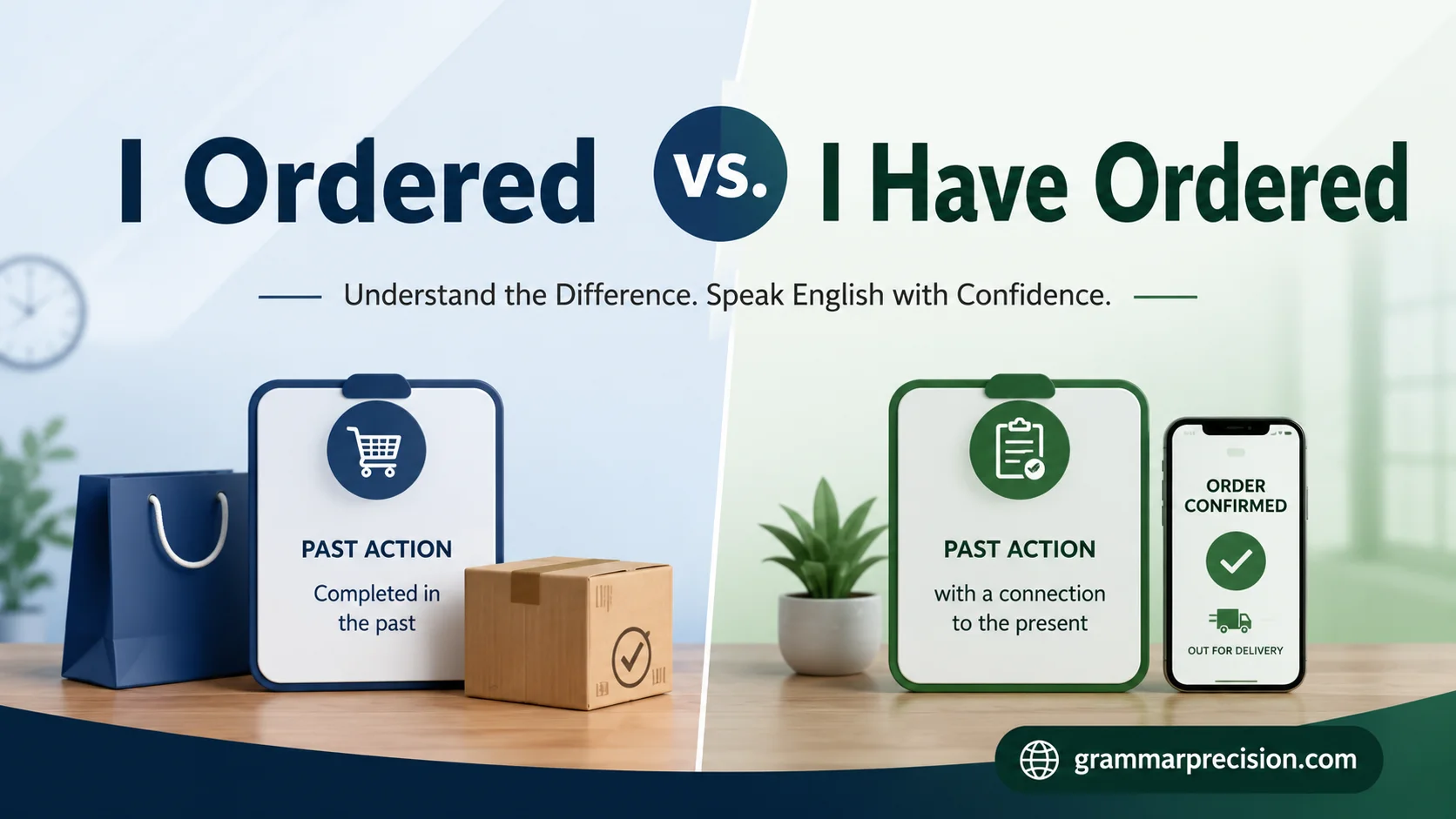
I Ordered vs. I Have Ordered explains how tense changes the meaning of a sentence. This guide helps understand the difference between simple past tense and present perfect tense with clear examples.
In everyday English, I ordered shows a finished action at a known time, such as I ordered pizza last night. It focuses on the past action, exact details, and clear timing. This form is natural in daily conversation because it gives quick understanding and improves real communication.
I have ordered uses the present perfect tense to show a connection between the past and the current state. The focus is on the result rather than the exact time. This usage helps learners in professional writing, formal contexts, and avoids misunderstandings in spoken and written English.
I Ordered vs. I Have Ordered at a Glance
Before diving deeper, here’s a quick comparison.
| Feature | I Ordered | I Have Ordered |
| Tense | Simple Past | Present Perfect |
| Focus | Completed action in the past | Past action connected to the present |
| Specific time allowed? | Yes | No |
| Common use | Stories, reports, completed events | Updates, recent actions, ongoing relevance |
| Example | I ordered a laptop yesterday. | I have ordered a laptop. |
Quick Rule
Use “I ordered” when the action belongs to a finished time in the past.
Use “I have ordered” when the action still matters right now.
That simple distinction solves most grammar problems related to these phrases.
What Does “I Ordered” Mean?
The phrase I ordered uses the Simple Past Tense.
It describes an action that happened and finished at a specific point in the past.
Structure
Subject + Past Tense Verb
Example:
- I ordered pizza.
- I ordered a new phone.
- I ordered the documents yesterday.
The action is complete. The focus stays on the past event itself.
Examples in Everyday Conversation
Consider these sentences:
- I ordered coffee this morning.
- I ordered a taxi after work.
- I ordered new shoes last week.
Each sentence refers to a completed action at a known or understood time.
Why Native Speakers Use It
Native speakers often use I ordered when telling stories or discussing completed events.
For example:
“I ordered a burger, waited twenty minutes, and finally got my meal.”
The speaker is describing a sequence of past actions.
What Does “I Have Ordered” Mean?
The phrase I have ordered uses the Present Perfect Tense.
This tense connects a past action to the present moment.
Structure
Subject + Have/Has + Past Participle
Example:
- I have ordered a laptop.
- I have ordered dinner.
- I have ordered the supplies.
The action happened in the past, but its result still matters now.
Examples
Imagine these situations:
- I have ordered the tickets. (The tickets are now on the way.)
- I have ordered lunch. (Lunch should arrive soon.)
- I have ordered the replacement part. (The order has been placed.)
The speaker focuses on the current result rather than the past action.
Why Present Relevance Matters
The Present Perfect often answers the question:
“Why is this important right now?”
For example:
“I have ordered the equipment, so we can start the project next week.”
The ordering happened earlier, but the result affects the present situation.
The Core Difference Explained Simply
Many learners memorize grammar rules but still struggle in real conversations.
The easiest way to understand the difference is this:
I Ordered = Focus on the Past Event
Example:
I ordered a laptop yesterday.
The important information is when the order happened.
I Have Ordered = Focus on the Current Result
Example:
I have ordered a laptop.
The important information is that the laptop order now exists.
Think of it this way:
| Question | Best Answer |
| What happened yesterday? | I ordered a laptop. |
| Have you purchased the laptop yet? | I have ordered a laptop. |
Visual Timeline Comparison
PAST —————— NOW
I ordered a laptop yesterday.
X
PAST —————— NOW
I have ordered a laptop.
X ————-> Result still matters
This timeline helps explain why Present Perfect creates a bridge between past and present.
Easy Decision Rule
When you’re unsure which phrase to use, ask yourself three questions.
Is a Specific Time Mentioned?
If yes, use I ordered.
Examples:
- I ordered it yesterday.
- I ordered it last week.
- I ordered it in May.
Does the Result Matter Right Now?
If yes, use I have ordered.
Examples:
- I have ordered the replacement.
- I have ordered the materials.
- I have ordered the package.
Are You Giving a Status Update?
If yes, Present Perfect often sounds more natural.
Example:
I have ordered everything we need for the event.
Real-Life Scenarios
Understanding grammar becomes easier when you see it in action.
Restaurant Orders
Correct:
- I ordered pasta last night.
- I have ordered our drinks.
Why?
The first sentence refers to a completed meal in the past.
The second sentence informs others that the drinks are now on their way.
Online Shopping
Correct:
- I ordered a gaming laptop yesterday.
- I have ordered the laptop already.
The first focuses on when the purchase happened.
The second emphasizes that the purchase has been completed.
Workplace Communication
Employees often use Present Perfect for updates.
Examples:
- I have ordered the office supplies.
- I have ordered the replacement equipment.
These statements communicate progress.
Customer Support Requests
Customer:
I ordered the product two weeks ago.
Support Agent:
I can see that you have ordered the product successfully.
Notice how each sentence serves a different purpose.
Academic Writing
In academic contexts:
- Researchers often use Simple Past when discussing completed studies.
- Present Perfect appears when discussing findings relevant to current knowledge.
Example:
- Scientists conducted the experiment in 2023.
- Researchers have discovered several important patterns.
Common Mistakes Learners Make
Even advanced English learners make these errors.
Using Present Perfect With Finished Time Expressions
Incorrect:
❌ I have ordered it yesterday.
Correct:
✅ I ordered it yesterday.
Why?
Words like:
- yesterday
- last week
- last month
- in 2024
refer to finished periods of time.
Present Perfect cannot be used with them.
Using Simple Past for Current Updates
Sometimes learners say:
❌ I ordered the supplies.
While grammatically correct, it may sound incomplete if you’re giving a status update.
More natural:
✅ I have ordered the supplies.
Mixing Time References
Incorrect:
❌ I have ordered it last Friday.
Correct:
✅ I ordered it last Friday.
Overusing Present Perfect
Many learners believe Present Perfect sounds more advanced.
It doesn’t.
Native speakers choose the tense that matches the context.
Sometimes the Simple Past is the best choice.
Also Read This: Insight vs. Incite: The Complete Word Usage Guide
Case Study: A Business Email Example
Consider this email.
Version A
I ordered the equipment.
The sentence is correct.
However, the recipient may wonder:
“When?”
Version B
I have ordered the equipment.
This sounds like a status update.
The message implies:
“The task is completed.”
That’s why professionals often prefer Present Perfect when reporting progress.
British English vs. American English Usage
This area creates additional confusion.
British English
British speakers use Present Perfect more frequently.
Examples:
- I have just ordered lunch.
- I have already sent the report.
American English
Americans often use both forms.
Examples:
- I just ordered lunch.
- I have just ordered lunch.
Both can sound natural in American English.
Common Time Expressions With Each Tense
Words Often Used With “I Ordered”
- yesterday
- last night
- last year
- last month
- two days ago
- in January
Examples:
- I ordered the book last week.
- I ordered the replacement yesterday.
Words Often Used With “I Have Ordered”
- already
- recently
- just
- yet
- so far
- lately
Examples:
- I have already ordered the tickets.
- I have recently ordered new equipment.
Native Speaker Insights
Native speakers rarely think about grammar formulas.
Instead, they think about meaning.
When discussing a completed event, they naturally choose Simple Past.
When discussing a current situation, they naturally choose Present Perfect.
This subtle difference makes speech sound more authentic.
Example
Question:
Did you buy the software?
Natural answer:
Yes, I have ordered it.
Question:
When did you buy it?
Natural answer:
I ordered it on Monday.
Notice how the question determines the tense.
Memory Trick for Instant Recall
Remember this simple phrase:
Past Event = I Ordered
Present Result = I Have Ordered
Whenever you’re uncertain, ask:
Am I talking about the event or the result?
That question usually reveals the correct answer immediately.
Comparison Examples
Example Set One
I ordered a new laptop yesterday.
Focus: The purchase date.
I have ordered a new laptop.
Focus: The laptop is now expected to arrive.
Example Set Two
I ordered dinner at 7 PM.
Focus: Specific time.
I have ordered dinner.
Focus: Dinner is coming.
Example Set Three
I ordered the documents last week.
Focus: Past action.
I have ordered the documents.
Focus: Task completed.
Quick Cheat Sheet
| Situation | Correct Choice |
| Specific past time mentioned | I Ordered |
| Status update | I Have Ordered |
| Storytelling | I Ordered |
| Current relevance | I Have Ordered |
| Yesterday, last week, last year | I Ordered |
| Already, recently, yet | I Have Ordered |
Practice Quiz
Choose the correct answer.
Question 1
___ the tickets yesterday.
A. I ordered
B. I have ordered
Answer: A
Question 2
I ___ the supplies already.
A. ordered
B. have ordered
Answer: B
Question 3
I ___ lunch an hour ago.
A. ordered
B. have ordered
Answer: A
Question 4
I ___ the replacement part, so the repair can begin.
A. ordered
B. have ordered
Answer: B
Question 5
I ___ that computer last month.
A. ordered
B. have ordered
Answer: A
FAQs:
What is the difference between I Ordered and I Have Ordered?
I ordered uses the simple past tense and describes a completed action at a specific time. I have ordered uses the present perfect tense and focuses on the result or connection with the present situation without mentioning an exact time.
When should I use I Ordered in a sentence?
Use I ordered when you are talking about something that happened and finished in the past. For example, I ordered pizza last night shows a known time and a completed action.
When should I use I Have Ordered instead of I Ordered?
Use I have ordered when the exact time is not important and the focus is on the current result. For example, I have ordered pizza means the order is placed and it may arrive soon.
Can I Ordered and I Have Ordered mean the same thing?
Sometimes both sentences describe a similar action, but their meaning changes because of tense. I ordered highlights the past action, while I have ordered highlights the present effect of that action.
How can learning this difference improve my English?
Understanding the difference between I ordered and I have ordered improves clarity, accuracy, and real communication. It helps learners choose the correct form in daily conversation, professional writing, and formal situations.
Conclusion:
The difference between I Ordered and I Have Ordered is mainly about time, focus, and context. The simple past tense talks about a finished event, while the present perfect tense connects a past action with the present. Learning this small but important grammar difference helps you communicate with more confidence and accuracy.