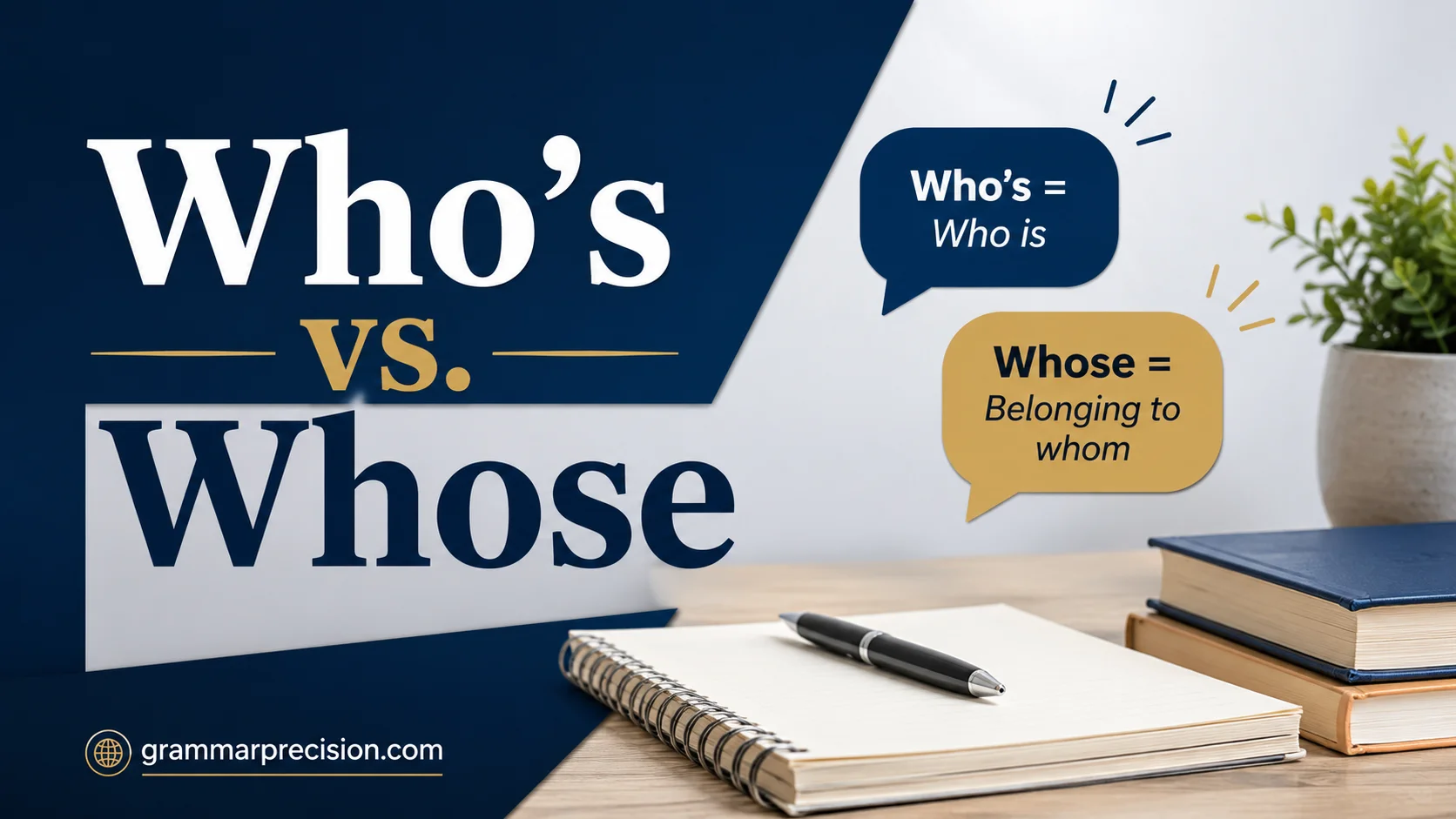
Who’s vs. Whose: The Complete Guide With Rules, Examples, and Easy Memory Tricks helps readers understand the difference between these confusing words with simple explanations, practical examples, and useful tips.
Many writers struggle with who’s vs. whose because they sound similar but have different meanings. This complete guide explains the rules, common mistakes, and easy ways to remember when using each word correctly in everyday writing and conversations.
Learning the difference between who’s and whose improves your grammar skills and makes your sentences clearer. With simple examples, helpful memory tricks, and detailed explanations, you can confidently use these words without confusion in any situation.
Who’s vs. Whose: The Main Difference Explained
The easiest way to understand who’s vs. whose is to remember that they serve different purposes.
| Word | Meaning | Function | Example |
| Who’s | Who is / Who has | Contraction | Who’s calling you? |
| Whose | Belonging to someone | Shows possession | Whose book is this? |
The biggest difference is this:
Who’s talks about a person or action. Whose talks about ownership.
Think of it like this:
- Who’s = Who + action
- Whose = Who + belongs to
For example:
Who’s your teacher?
Meaning:
Who is your teacher?
Now:
Whose teacher is he?
Meaning:
Which person does he teach?
The spelling looks close, but the meaning changes.
What Does “Who’s” Mean?
The word who’s is a contraction. A contraction combines two words into a shorter form.
In this case:
Who’s = Who is
or
Who’s = Who has
The apostrophe replaces the missing letters.
Just like:
- do not → don’t
- cannot → can’t
- she is → she’s
- who is → who’s
The apostrophe in who’s does not show ownership. It simply shows that letters have been removed.
Who’s Meaning “Who Is”
Most of the time, who’s means who is.
Examples:
- Who’s coming to the party tonight?
- Who’s responsible for this project?
- Who’s your favorite author?
- Who’s waiting outside?
Let’s break one down:
Who’s waiting outside?
Replace “who’s” with “who is”:
Who is waiting outside?
The sentence still makes sense.
That means who’s is correct.
Who’s Meaning “Who Has”
Sometimes who’s means who has.
This happens when “has” works as a helping verb.
Examples:
- Who’s finished the assignment?
- Who’s already eaten dinner?
- Who’s seen this movie before?
Replace the word:
Who’s finished the assignment?
becomes:
Who has finished the assignment?
The meaning stays the same.
What Does “Whose” Mean?
The word whose shows ownership or possession.
It asks:
Who does this belong to?
Examples:
- Whose phone is ringing?
- Whose jacket is this?
- Whose idea was better?
- Whose car is parked outside?
In every example, someone owns or controls something.
Let’s look deeper:
Whose keys are these?
The question is not asking:
“Who is keys?”
That makes no sense.
It asks:
“Who owns these keys?”
Therefore, whose is correct.
The Fastest Trick to Remember Who’s vs. Whose
Grammar becomes much easier when you use a simple test.
The Replacement Trick
Whenever you’re unsure, replace who’s with:
- who is
- who has
If the sentence still works, use who’s.
If it doesn’t, use whose.
Example One:
Who’s at the door?
Replace:
Who is at the door?
It works.
Correct answer:
✅ Who’s at the door?
Example Two:
Whose bag is this?
Try replacing:
Who is bag is this?
That sounds wrong.
So:
✅ Whose bag is this?
The Ownership Question Trick
Ask yourself:
“Am I asking who owns something?”
If yes, choose whose.
Examples:
- Whose shoes are these?
- Whose opinion matters most?
- Whose responsibility is it?
You’re asking about belonging.
Who’s vs. Whose Examples You’ll Actually Use
Learning grammar rules is useful. Seeing real examples makes them stick.
| Sentence | Correct Word | Explanation |
| Who’s your new manager? | Who’s | Means “Who is” |
| Whose manager approved this? | Whose | Shows ownership/connection |
| Who’s going to the event? | Who’s | Means “Who is” |
| Whose tickets are these? | Whose | Asks about possession |
| Who’s completed the task? | Who’s | Means “Who has” |
| Whose idea was accepted? | Whose | Shows belonging |
Common Mistakes People Make With Who’s and Whose
Even experienced writers make mistakes with these words.
Here are the most common problems.
Mistake: Using Who’s to Show Ownership
Incorrect:
❌ Who’s phone is this?
Many people think the apostrophe shows possession because words like:
- John’s car
- Sarah’s book
use apostrophes.
However, who’s does not mean possession.
Correct:
✅ Whose phone is this?
Mistake: Using Whose When You Mean Who Is
Incorrect:
❌ Whose coming to the meeting?
Ask yourself:
Can you replace it?
“Who is coming to the meeting?”
Yes.
Correct:
✅ Who’s coming to the meeting?
Mistake: Thinking Every Apostrophe Means Ownership
This is a common grammar trap.
Apostrophes have different jobs.
They can show:
Contractions
Example:
- it’s = it is
- who’s = who is
Possession
Example:
- Sarah’s laptop
- the dog’s toy
But whose is already the possessive form.
Who’s vs. Whose vs. Whom: Understanding the Bigger Picture
Many people only struggle with who’s and whose because they haven’t learned the related words.
Let’s compare them.
| Word | Purpose | Example |
| Who | Subject | Who called you? |
| Whom | Object | Whom did you invite? |
| Who’s | Who is / Who has | Who’s coming? |
| Whose | Ownership | Whose coat is this? |
Here’s an easy way to remember:
- Who does the action
- Whom receives the action
- Who’s means who is
- Whose means belonging
Why People Confuse Who’s and Whose
The confusion happens for several reasons.
They Sound Identical
When spoken aloud:
- who’s
- whose
sound exactly the same.
This makes listening-based learning difficult.
Apostrophes Create Confusion
Many learners assume:
“Apostrophe means ownership.”
That rule works sometimes.
Examples:
- Mike’s phone
- Lisa’s bag
But contractions also use apostrophes:
- isn’t
- doesn’t
- who’s
English has exceptions, and this is one of them.
English Has Many Similar-Looking Words
English contains many confusing pairs:
- your vs. you’re
- their vs. there vs. they’re
- its vs. it’s
- who’s vs. whose
These words look similar but carry different meanings.
Real-Life Case Study: How This Mistake Changes Meaning
Imagine a workplace email.
Incorrect:
Who’s report is ready for review?
The reader may understand what you mean, but the grammar is incorrect.
Correct:
Whose report is ready for review?
Now the sentence clearly asks about ownership.
Another example:
Incorrect:
Whose responsible for the presentation?
Correct:
Who’s responsible for the presentation?
The first sentence asks:
“Which person owns responsible?”
That makes no sense.
The second asks:
“Who is responsible?”
Also Read This: Based Out Of vs Based In: The Complete Guide to Using These Phrases Correctly
Who’s vs. Whose in Professional Writing
Small grammar mistakes can affect how people view your writing.
A single incorrect word may not ruin a message, but repeated errors can make writing appear less polished.
This matters in:
- Business emails
- Academic papers
- Website content
- Resumes
- Reports
Example:
Less professional:
Who’s information should I use?
Professional:
Whose information should I use?
Clear grammar creates clearer communication.
Quick Visual Guide: Who’s vs. Whose
WHO’S
|
——————–
| |
Who is Who has
WHOSE
|
——————–
|
Ownership
|
“Who does it belong to?”
Practice Quiz: Choose Who’s or Whose
Test yourself.
Question 1:
_____ coming to dinner tonight?
Answer:
Who’s
Why?
Who’s = Who is.
Question 2:
_____ backpack is on the chair?
Answer:
Whose
Why?
The question asks about ownership.
Question 3:
_____ already finished the project?
Answer:
Who’s
Why?
Who’s = Who has.
Question 4:
_____ idea was chosen?
Answer:
Whose
Why?
The idea belongs to someone.
Simple Cheat Sheet for Who’s vs. Whose
| If you mean… | Use |
| Who is | Who’s |
| Who has | Who’s |
| Belongs to someone | Whose |
Remember:
Who’s = who is / who has
Whose = ownership
That one rule solves almost every situation.
FAQs:
What is the difference between who’s and whose?
Who’s is a contraction of “who is” or “who has,” while whose shows ownership or possession. For example, “Who’s coming today?” means “Who is coming today?” and “Whose book is this?” asks about the owner of the book.
How can I easily remember who’s vs. whose?
A simple memory trick is to replace the word with “who is” or “who has.” If the sentence makes sense after replacing it, use who’s. If it shows possession, use whose.
Is whose only used for people?
No, whose can be used for both people and things. It shows a connection or ownership. For example, “The house whose roof is damaged” uses whose to describe the relationship between the house and its roof.
Why do people confuse who’s and whose?
People confuse who’s and whose because they have the same pronunciation but different meanings and spellings. These words are called homophones, which sound similar but have different uses in sentences.
Can who’s be used to show possession?
No, who’s cannot show possession. It is only a short form of who is or who has. To talk about ownership, always use whose.
Conclusion:
Understanding who’s vs. whose is simple when you learn their correct rules. Remember that who’s means who is or who has, while whose shows ownership. Using these easy rules, examples, and memory tricks will help you improve your grammar skills and write more clear and accurate sentences.