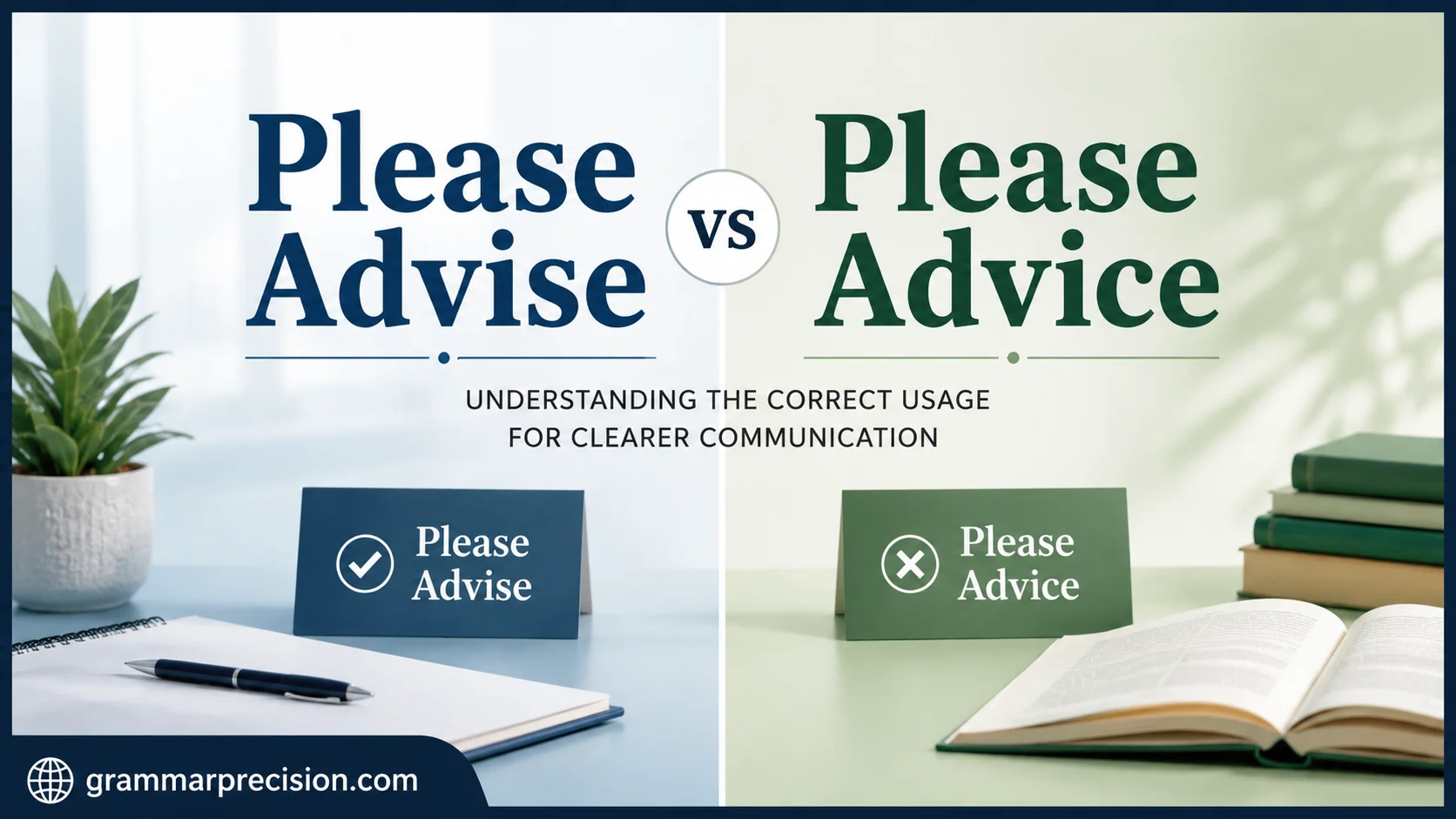
Please Advise vs Please Advice is confusing but correct usage depends on grammar rules and formal email communication clarity so writers must understand verb and noun difference carefully usage context.
In professional writing many people get confused because advise is a verb and advice is a noun especially in emails where tone and clarity matter for communication. Using correct phrase helps avoid misunderstanding and makes message professional and polite in workplace settings and business correspondence when requesting guidance or suggestions from others very important point.
English language often creates confusion because many words are homonyms and sound similar but have different meanings especially in writing where learners struggle to understand correct usage of advice and advise in sentences and emails leading to mistakes in professional communication that affect clarity and reader understanding across formal and informal contexts every time used.
Why “Please Advise vs Please Advice” Confuses So Many People
This confusion doesn’t come from laziness. It comes from how English sounds.
When you say it out loud, both phrases feel almost identical:
- Please advise
- Please advice
They sound close enough that your brain treats them like twins. But grammatically, they are not even in the same category.
Here’s the real issue:
- English has many word pairs where one is a verb and one is a noun
- When spoken quickly, they blend together
- Autocorrect doesn’t always catch the error
So people assume both versions are fine. They’re not.
The Quick Answer You Came For
Let’s make this crystal clear.
- Advise = verb (an action)
- Advice = noun (a thing)
So:
- ✔ “Please advise” = correct
- ❌ “Please advice” = incorrect
That’s it. Simple rule. But let’s go deeper so you actually remember it.
What “Advise” Really Means (The Action Word)
The word advise is a verb. It means:
To give guidance, recommendations, or suggestions.
You are doing something when you advise.
Examples in real life:
- I advise you to double check your email before sending it.
- The doctor advised rest after the surgery.
- She advised him to apply early for the job.
Notice something important?
Someone is actively giving guidance. That’s the key.
A simple mental picture:
Think of “advise” like a person speaking.
It moves. It acts. It does something.
What “Advice” Really Means (The Thing You Receive)
Now switch gears.
Advice is a noun. It means:
Guidance or recommendations given to someone.
It’s not an action. It’s a thing you receive or hold onto.
Examples:
- I need your advice on this decision.
- Her advice helped me avoid a mistake.
- He gave me great advice about interviews.
A simple mental picture:
Think of “advice” like a package.
You receive it. You carry it. You use it.
It doesn’t do anything by itself.
The Golden Rule That Never Fails
Here’s the trick that English teachers love for a reason:
If someone is doing the action, use advise.
If you can “give it” or “take it,” use advice.
Try this test:
- Can I give advice? ✔ Yes
- Can I give advise? ❌ No
That one switch makes everything clear.
Why “Please Advice” Feels Right (But Is Wrong)
Let’s be honest. “Please advice” looks correct at first glance.
Why?
Because English often confuses learners with silent grammar rules.
Here’s what happens in your brain:
- You hear “advise” and “advice” spoken similarly
- You assume both work as polite requests
- You match it with “please” and it feels natural
But grammar doesn’t care about how it feels. It cares about structure.
And structure says:
- You can request an action → Please advise
- You cannot request a noun → ❌ Please advice
It’s like saying:
- “Please help” ✔
- “Please helpness” ❌ (sounds absurd, right?)
Same logic applies here.
Real Life Usage: Where This Mistake Actually Happens
This confusion shows up most often in professional communication.
Common situations:
- Emails to managers
- Customer support messages
- Academic writing
- Job applications
- Legal correspondence
One small mistake can subtly affect tone.
For example:
❌ “Please advice on this matter.”
✔ “Please advise on this matter.”
The second version feels smoother and more professional.
Case Study: Why Small Grammar Mistakes Matter in Emails
Let’s look at a simple real world scenario.
Situation:
A candidate emails a hiring manager.
Email A (incorrect):
Please advice me on the next steps.
Email B (correct):
Please advise me on the next steps.
Outcome difference:
- Email A: sounds slightly unpolished
- Email B: sounds confident and professional
Now here’s the key insight:
Recruiters often read dozens of emails per day. Small grammar mistakes don’t always disqualify you, but they do shape perception.
It’s like wearing slightly wrinkled clothes to an interview. Nothing major. Just noticeable.
Side by Side Comparison Table
| Feature | Sleeve | Sleave |
| Correct Spelling | Sleeve | Sleave |
| Dictionary Recognition | Recognized in standard English dictionaries | Generally not recognized as a standard English word |
| Meaning | A part of a garment that covers the arm | Usually considered a misspelling of sleeve |
| Part of Speech | Noun | Not commonly used in modern English |
| Usage Frequency | Very common | Extremely rare |
| Example Sentence | She rolled up her sleeve before washing dishes. | Incorrect: She rolled up her sleave before washing dishes. |
| Accepted in Formal Writing | Yes | No |
| Accepted in Academic Writing | Yes | No |
| Accepted in Business Communication | Yes | No |
| SEO/Search Intent | Users often search for clothing related information | Users typically search it to verify spelling or meaning |
| Grammar Status | Correct English word | Usually an incorrect spelling of sleeve |
| Recommended Usage | Always use sleeve when referring to the arm section of clothing | Avoid using sleave unless discussing historical or dialectal usage |
Polite Alternatives to “Please Advise”
Here’s something most guides miss.
“Please advise” is correct, but it can sometimes feel a bit blunt.
So in professional writing, people often switch to softer alternatives:
Better options:
- Kindly advise
- Please provide guidance
- I would appreciate your input
- Could you advise me on this?
- I’d like your recommendation
Example upgrade:
Instead of:
Please advise on the report.
Try:
I’d appreciate your input on the report when you have time.
Same meaning. Softer tone. More natural flow.
Also Read This: Sleeve vs Sleave
Why This Confusion Appears in Search Engines
If you’ve searched this topic, you’re not alone. It’s one of the most common grammar queries online.
Here’s why it trends:
- Students checking assignments
- Professionals writing emails
- ESL learners improving English
- Job seekers polishing communication
Search engines see millions of variations like:
- “please advise or advice”
- “is please advice correct”
- “how to use advise in sentence”
This creates a strong SEO signal because the intent is urgent and practical.
People don’t search this for fun. They search it to avoid making mistakes in real communication.
Memory Trick That Actually Works
Let’s make it stick.
Try this:
“If you can DO it, it’s advise.
If you can HAVE it, it’s advice.”
Break it down:
- Give advice → noun (thing)
- Advise someone → verb (action)
Another trick:
- Advice has a C → think Content (a thing)
- Advise has an S sound → think Speak (an action)
Slightly silly. But it works.
Common Mistakes People Make
Here are the biggest errors to avoid:
Mistake 1: Using “please advice”
This is the most common. It always sounds wrong in formal writing.
Mistake 2: Mixing forms in the same sentence
Example:
- ❌ “I advice you to take this advice.”
Correct:
- ✔ “I advise you to take this advice.”
Mistake 3: Overusing “advise” in formal tone
Some writers repeat it too often, which makes writing stiff.
Quick Fix Cheat Sheet
Keep this in mind:
- Want action? → use advise
- Want a thing? → use advice
- Writing emails? → “Please advise” is correct
- Unsure? → replace with “help” and test the sentence
Example test:
- “Please help me” ✔
- “Please help advice me” ❌
If it sounds weird, it probably is.
FAQs:
What is the correct: Please Advise or Please Advice?
The correct phrase is Please Advise. Here, advise is a verb, while advice is a noun, so using the right form ensures correct grammar and clear communication in emails and formal writing.
Why do people get confused between advise and advice?
People get confused because both words sound similar and are homonyms in English. However, their meaning, usage, and grammar role are different, which often leads to mistakes in writing and emails.
Is “Please Advice” ever correct?
No, Please Advice is not correct because advice is a noun and cannot be used as a request verb. In formal or professional communication, only Please Advise is considered grammatically accurate.
Why does “Please Advise” sometimes sound rude?
Some readers may feel Please Advise sounds direct or demanding, especially in emails. That is why it is advised to use it carefully and ensure the message tone remains polite and professional.
How can I avoid mistakes in using advise and advice?
You can avoid mistakes by remembering that advise = action (verb) and advice = information (noun). Practicing real email examples helps improve clarity, accuracy, and professional communication.
Conclusion:
In conclusion, understanding the difference between Please Advise and Please Advice is important for clear and professional writing. The correct usage depends on knowing that advise is a verb while advice is a noun, which directly impacts grammar accuracy and communication clarity.
Using the right form helps you write more polished emails, avoid confusion, and maintain a professional tone in all types of business correspondence and everyday writing.