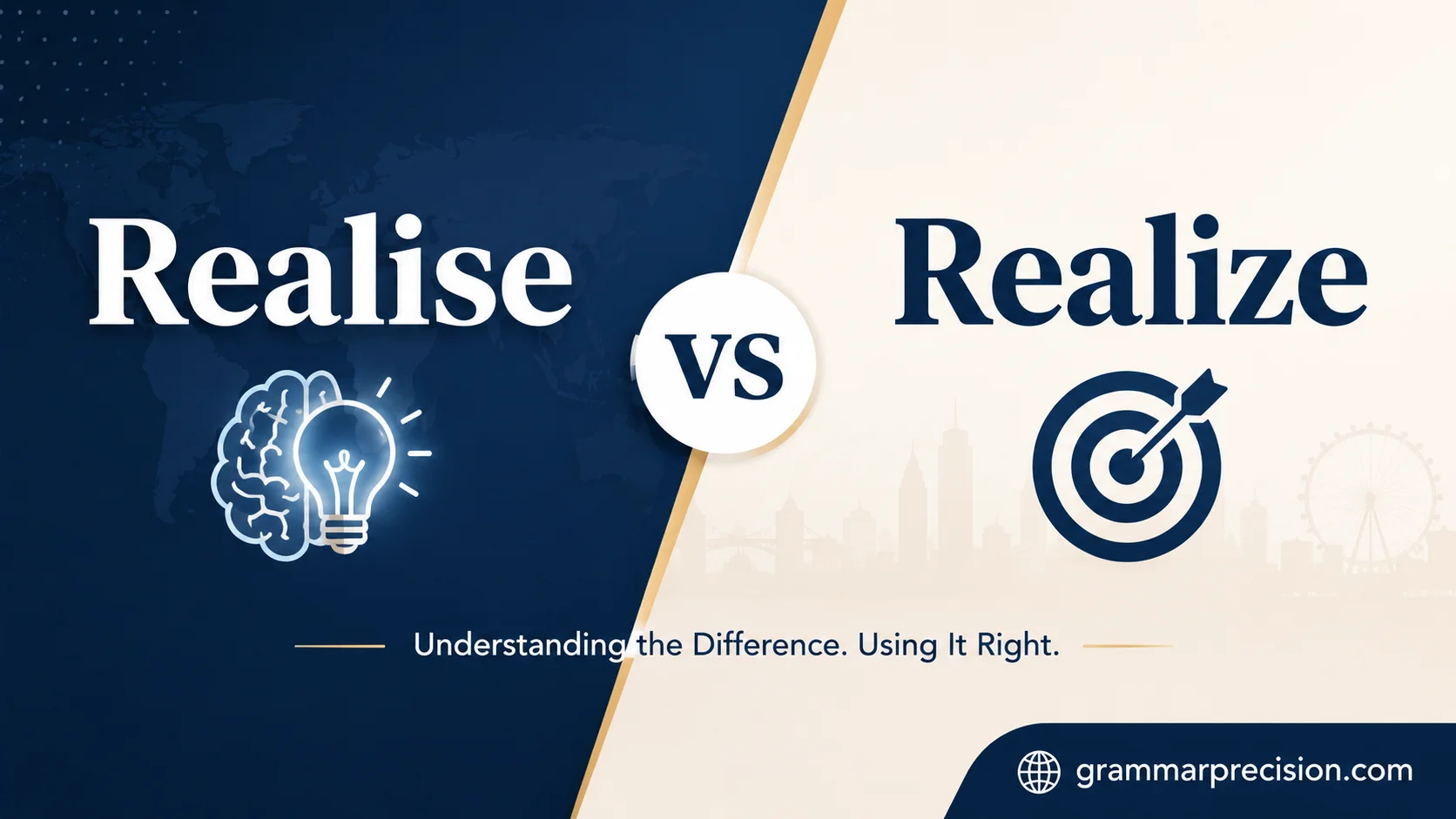
Realise vs Realize often confuses writers because both forms share the same meaning. The choice depends on regional spelling preferences, audience expectations, and accepted language standards in English.
Many people believe Realise and Realize are different words, but they are simply alternate spellings of the same term. In American English and Canadian English, Realize is the preferred spelling, while Realise is more common in UK English, Australia, and New Zealand. Understanding these regional differences helps maintain consistency in writing.
For professional writing, choosing the correct spelling improves clarity, accuracy, and overall text quality. A reliable style guide, proper proofreading, and awareness of language conventions can prevent common mistakes. Whether you use Realise or Realize, matching your spelling to the intended audience ensures effective communication and a polished result.
Realise vs Realize Meaning: What Does It Actually Mean?
Before comparing spellings, you need to understand the meaning clearly.
Both “realise” and “realize” mean:
- To become aware of something
- To suddenly understand a fact or truth
- To achieve or accomplish something
Simple examples
- I realized I forgot my keys at home.
- She realised the truth too late.
- They realized their dream of opening a business.
The meaning stays identical no matter which spelling you use. The only thing that changes is the audience and regional preference.
Why Two Spellings Exist in English
English didn’t evolve in a straight line. It spread across continents, mixed with other languages, and adapted to different cultures.
The real split happened in the 18th and 19th centuries.
The Noah Webster Influence
One man played a huge role in the “z” spelling: Noah Webster, an American lexicographer.
He believed American English should:
- Simplify spelling
- Remove unnecessary letters
- Create a distinct identity from British English
So words like:
- realise → realize
- organise → organize
- colour → color
- centre → center
This wasn’t random. It was intentional language reform.
Key historical insight
Webster wanted spelling to match pronunciation more closely. The “z” sound reflects pronunciation better in American English, which is why it stuck.
British vs American English: The Core Difference
Let’s make this extremely clear.
| Concept | British English | American English |
| Realise/Realize | Realise | Realize |
| Organise/Organize | Organise | Organize |
| Colour/Color | Colour | Color |
| Centre/Center | Centre | Center |
| Defence/Defense | Defence | Defense |
Quick rule to remember
- British English tends to keep traditional spellings
- American English prefers simplified versions
Where Each Spelling Is Used Today
This is where most guides stop—but real world usage is more dynamic.
Countries using “Realise” (British English influence)
- United Kingdom
- Australia
- New Zealand
- India
- South Africa
- Most Commonwealth countries
Countries using “Realize” (American English influence)
- United States
- Philippines
- Latin American English contexts (influenced by US media)
Important twist
Even within countries, usage can vary depending on:
- Education system
- Media exposure
- Professional industry
For example, many Indian writers switch between both depending on whether they target UK or US audiences.
Why This Small Difference Matters More Than You Think
At first, it feels like a minor detail. But in real writing situations, spelling choice has real consequences.
1. Audience trust
Readers subconsciously notice spelling consistency.
If your article mixes:
- realise
- realize
It can look careless, even if your content is strong.
2. Professional credibility
Businesses, publishers, and academic institutions expect consistency.
A UK based publication using “realize” may look out of place, and vice versa.
3. SEO performance
Search engines interpret spelling based on user intent.
For example:
- UK users search “how to realise your goals”
- US users search “how to realize your goals”
Using the wrong variant can slightly affect ranking relevance.
Also Read This: Spiritual OR Schpiel Meaning: The Hidden Truth Behind Spiritual Talk That Actually Sells You an Idea
Realise vs Realize in SEO: What Actually Works
SEO is where this topic becomes strategically important.
Search engines don’t punish either spelling. Instead, they match content to user location and search behavior.
Keyword variation examples
- realize meaning
- realise meaning UK
- how to realize your dreams
- what does realise mean
Smart SEO strategy
If you want global traffic:
- Use one primary spelling (based on target audience)
- Include the alternative spelling naturally in content
- Avoid mixing randomly in the same sentence block
Common Mistakes Writers Make
Even experienced writers slip up here.
Mixing spellings randomly
Bad example:
I realised I needed to realize my mistake.
This looks inconsistent and unprofessional.
Over correcting with tools
Auto correct tools sometimes switch spelling based on system language, not content strategy.
Assuming one is “correct”
Both are correct. The mistake is using the wrong one for your audience.
Memory Tricks to Never Confuse Realise vs Realize
Here are simple ways to remember:
Method 1: Geography trick
- “S” = Spelling for UK
- “Z” = Zoom (American fast style)
Method 2: Sound association
Americans pronounce words slightly more sharply. The “z” reflects that sound.
Method 3: Audience rule
Ask yourself:
Who am I writing for?
That alone solves 90% of confusion.
Case Study: How Spelling Impacts Real Content Performance
Let’s look at a practical SEO scenario.
Scenario
A blog targets the keyword:
“how to realize your potential”
Version A (US focused)
Uses:
- realize
- organize
- color
Results:
- Higher ranking in US search results
- Strong CTR in American audience
Version B (UK focused)
Uses:
- realise
- organise
- colour
Results:
- Higher ranking in UK search results
- Better engagement in Commonwealth regions
Key takeaway
Same content. Same quality. Different spelling = different audience reach.
The Psychology Behind Spelling Preference
This is where it gets interesting.
People associate spelling with identity.
British English perception
- Formal
- Traditional
- Academic
- Structured
American English perception
- Modern
- Direct
- Efficient
- Globalized
These are not rules, just perceptions. But perception influences trust.
Quick Comparison Table: Realise vs Realize in Real Use
| Context | Realise (UK) | Realize (US) |
| Academic writing | Preferred in UK | Preferred in US |
| News media | BBC style | CNN style |
| Business writing | Commonwealth companies | US corporations |
| SEO targeting | UK traffic | US traffic |
| Everyday writing | Common | Common |
Expert Writing Tip: The Hybrid Strategy
If you target a global audience, you can use a smart hybrid approach.
Option 1: Primary + secondary spelling
- Choose one dominant form
- Sprinkle the other variant in FAQs or supporting sections
Option 2: Separate pages strategy
- Page 1: “realise meaning” (UK SEO)
- Page 2: “realize meaning” (US SEO)
Option 3: Geo targeted content
Use hreflang tags to serve correct spelling based on location.
Common Myths About Realise vs Realize
Myth: One is incorrect
False. Both are grammatically correct.
Myth: “Z” spelling is lazy
False. It comes from systematic language reform.
Myth: British English is more proper
False. It’s just traditional spelling preference.
Myth: Search engines prefer one
False. Search engines adapt to user behavior, not bias.
Real World Writing Examples
British English example
I realised the importance of consistency in writing after years of practice.
American English example
I realized the importance of consistency in writing after years of practice.
Same meaning. Same message. Different audience tone.
Final Rule for Writers and Bloggers
If you remember only one thing, make it this:
Spelling is not about correctness. It is about audience alignment.
Choose based on:
- Who reads your content
- Where they live
- What language standard they expect
Then stay consistent. That’s where professionalism shows.
FAQs:
Is there any difference between Realise and Realize?
No, there is no difference in meaning between Realise and Realize. They are simply different spellings of the same word. The choice depends on regional spelling conventions and the audience you are writing for.
Which spelling is used in American English?
In American English, Realize is the preferred spelling. It is the form most commonly found in publications, educational materials, and professional writing across the United States.
Why is Realise common in the UK?
Realise is widely used in UK English because it follows long established British spelling conventions. It is also common in countries such as Australia and New Zealand, where British spelling traditions remain influential.
How can I choose the correct spelling?
The best way to choose is to consider your audience and follow the relevant style guide. If you are writing for readers in the US, use Realize. If your audience is in the UK or other British English regions, use Realise.
Can I use both spellings in the same document?
It is possible, but it is generally not recommended. Maintaining consistency throughout a document improves clarity, professionalism, and overall text quality. Choose one spelling and use it consistently.
Conclusion:
Understanding Realise vs Realize is important for clear and effective communication. Both forms have the same meaning, but their usage depends on regional preferences and language conventions. By considering your audience, following a suitable style guide, and maintaining consistency, you can improve the accuracy, clarity, and professional quality of your writing.