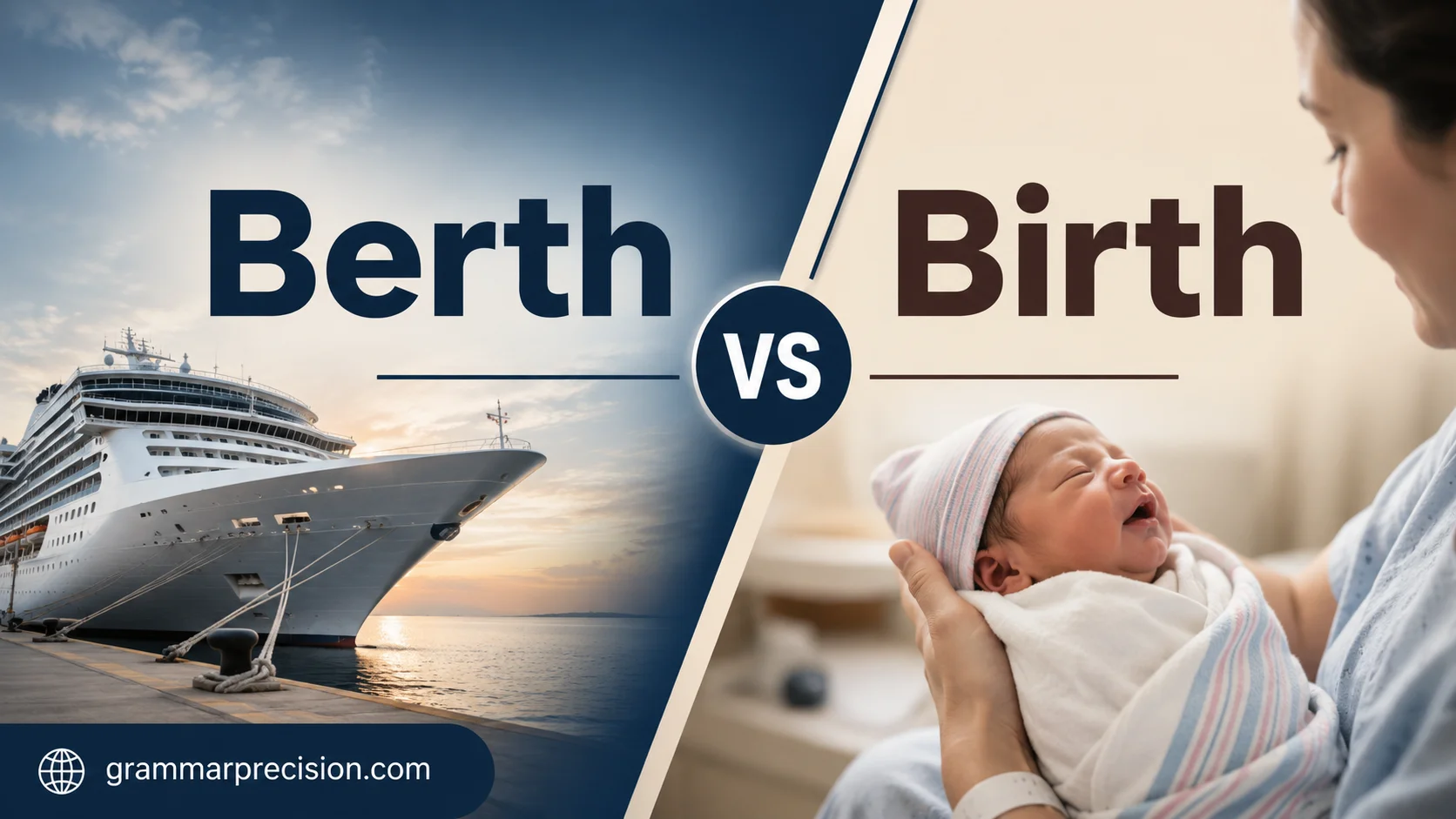
Berth vs Birth is often confusing because both sound similar in language use, yet their meanings are different in writing, conversation, and communication, creating mix and unclear understanding.
Berth is a noun meaning a place to sleep on train, ship, or boat, inside cabin, bunk, or compartment during travel and journey. It also shows position, team role, or placement in a system, where someone stays at location, station, harbor, or port, linked with transportation, marine use.
Birth refers to Life, Beginning, and Creation, meaning arrival of baby, infant, or newborn from mother’s body through childbirth, delivery, or pregnancy. It shows origin, start, and development of existence, growth, and formation, often confused in language due to homophones, but becomes clear with practice and difference understanding.
Berth vs Birth: Quick Answer
The difference between berth and birth is straightforward:
| Word | Meaning | Common Contexts |
| Berth | A designated sleeping space, docking place, or qualification spot | Trains, ships, sports |
| Birth | The act of being born or the beginning of something | Family, medicine, history |
Quick Examples
- We reserved a berth on the overnight train.
- The team secured a playoff berth after winning the match.
- She gave birth to a healthy baby.
- The invention marked the birth of a new era.
A simple rule can help:
If the topic involves life or beginnings, use birth. If it involves transportation, docking, sleeping compartments, or sports qualification, use berth.
Why People Confuse Berth and Birth
The confusion usually comes from three factors.
Similar Pronunciation
In everyday conversation, both words sound very similar. Depending on regional accents, the difference can be subtle.
Similar Spelling
Only one letter separates the two words. When writing quickly, many people accidentally type one instead of the other.
Context Misunderstanding
Many people rarely encounter the word berth outside transportation or sports. Since birth appears much more frequently in daily language, writers sometimes use it automatically.
For example:
❌ The football team earned a playoff birth.
✅ The football team earned a playoff berth.
The incorrect version changes the intended meaning entirely.
What Does Berth Mean?
The word berth refers to a designated place assigned for a particular purpose.
Depending on the context, it may describe:
- A sleeping compartment
- A ship’s docking location
- A reserved position
- A qualification spot in sports
The term originated from maritime language and gradually expanded into other fields.
Berth in Transportation
When traveling overnight on trains or ships, passengers often reserve a berth.
Examples:
- We booked a lower berth for the journey.
- The cruise ship offered luxury berths.
- Each passenger received an assigned berth.
In this context, a berth functions as a sleeping space.
Berth in Maritime Usage
Ships dock at berths in ports and harbors.
Examples:
- The cargo vessel reached its berth at dawn.
- Harbor officials assigned a new berth to the tanker.
- The captain maneuvered the ship into its berth.
Ports often contain hundreds of berths for different vessel sizes.
Berth in Sports
Sports organizations frequently use the word berth to describe qualification for a tournament or playoff.
Examples:
- The victory secured a playoff berth.
- The team earned an automatic berth.
- The championship berth remained undecided.
This meaning has become especially common in American sports reporting.
Understanding Birth: Meaning and Definition
Unlike berth, birth relates directly to life, creation, or beginnings.
The word refers to:
- The act of being born
- The process of childbirth
- The origin of something
- The start of an idea, movement, or era
Birth is among the oldest and most fundamental concepts in human language.
Birth as a Biological Event
Most commonly, birth refers to the arrival of a baby.
Examples:
- The hospital recorded the birth at 8:15 a.m.
- Friends celebrated the baby’s birth.
- Modern medicine has improved birth outcomes.
Every culture around the world recognizes birth as a major life event.
Birth as an Origin
Birth can also describe the beginning of something non-physical.
Examples:
- The internet revolution marked the birth of digital communication.
- The discovery led to the birth of a new industry.
- The agreement resulted in the birth of a powerful alliance.
In these examples, birth symbolizes creation rather than childbirth.
Berth vs Birth: Side-by-Side Comparison
Understanding both words becomes easier when viewed together.
| Feature | Berth | Birth |
| Primary Meaning | Assigned space or position | Act of being born |
| Common Context | Ships, trains, sports | Family, medicine, history |
| Part of Speech | Noun | Noun |
| Pronunciation | Burth | Burth |
| Related Concepts | Docking, sleeping, qualification | Life, origin, creation |
| Frequency | Less common | Very common |
This comparison highlights why context matters so much.
How to Use Berth Correctly in Sentences
Many writers understand the definition but struggle with practical usage.
The following examples demonstrate correct application.
Travel Examples
- We upgraded to a first-class berth.
- The overnight train included comfortable sleeping berths.
- Passengers boarded and located their assigned berths.
Maritime Examples
- The ship remained at its berth overnight.
- Harbor workers prepared the berth for arrival.
- The vessel departed its berth before sunrise.
Sports Examples
- The win guaranteed a postseason berth.
- The team captured the final tournament berth.
- Several schools competed for a championship berth.
Business Examples
Though less common, berth may describe a position or opportunity.
- She landed a prestigious berth at the company.
- The internship offered a valuable career berth.
How to Use Birth Correctly in Sentences
Birth appears in a much wider variety of situations.
Family and Medical Examples
- The family celebrated the child’s birth.
- Doctors assisted during the birth.
- Birth rates increased in the region.
Historical Examples
- Historians study the birth of civilizations.
- The event marked the birth of democracy.
- Scholars debated the birth of the empire.
Creative and Figurative Examples
- The project gave birth to new ideas.
- Innovation often emerges from the birth of curiosity.
- The movement witnessed the birth of lasting change.
These examples show how flexible the word has become.
The Fascinating Origins of Berth and Birth
Word origins often reveal why meanings developed differently.
Origin of Berth
Linguists trace berth to maritime terminology used by sailors.
Initially, it described sufficient space for a ship to maneuver safely. Over time, the meaning expanded to include sleeping accommodations and reserved positions.
Origin of Birth
Birth derives from ancient Germanic language roots connected to carrying, bearing, and bringing forth life.
Because human existence begins with birth, the term naturally evolved into a metaphor for origins and beginnings.
The two words developed independently despite their similar sounds.
Also Read This: Realise vs Realize: The Complete Global Guide
Real-Life Examples of Berth vs Birth
Understanding how these words appear in everyday communication makes the distinction easier.
Example One: Travel
Incorrect:
“The passenger reserved a birth on the train.”
Correct:
“The passenger reserved a berth on the train.”
Example Two: Family
Incorrect:
“The family celebrated the berth of their daughter.”
Correct:
“The family celebrated the birth of their daughter.”
Example Three: Sports
Incorrect:
“The team earned a playoff birth.”
Correct:
“The team earned a playoff berth.”
Example Four: Innovation
Incorrect:
“The invention marked the berth of a new technology.”
Correct:
“The invention marked the birth of a new technology.”
These examples illustrate how one letter can dramatically alter meaning.
Common Mistakes Writers Make
Many errors appear repeatedly across emails, articles, social media posts, and student assignments.
Mistake: Using Birth for Sports Qualification
Incorrect:
- World Cup birth
- Playoff birth
- Championship birth
Correct:
- World Cup berth
- Playoff berth
- Championship berth
Mistake: Using Berth for Childbirth
Incorrect:
- Berth certificate
- Date of berth
- Giving berth
Correct:
- Birth certificate
- Date of birth
- Giving birth
Mistake: Ignoring Context
Always ask yourself:
Is the sentence about life or beginnings?
If yes, choose birth.
Is it about transportation, docking, sleeping space, or qualification?
If yes, choose berth.
Memory Tricks to Remember Berth vs Birth
Simple memory devices can eliminate confusion permanently.
The Ship Trick
Notice that berth contains the letter combination associated with harbor and docking concepts.
Think:
Berth = Boat
Both begin with “B.”
The Baby Trick
Birth is directly connected to babies.
Think:
Birth = Baby
Again, both start with “B.”
The Sports Trick
Teams earn a berth in tournaments.
Nobody earns a birth in a playoff bracket.
Visualizing athletes celebrating qualification helps reinforce the correct term.
FAQs:
What is the main difference between berth and birth?
Berth refers to a place to sleep on a train, ship, or boat, while birth refers to the arrival of a baby or the beginning of life. One is related to travel and position, the other to life and creation.
Why do people confuse berth and birth?
People confuse them because both are homophones, meaning they have similar sound but different meanings. This leads to confusion in writing, conversation, and communication, especially in everyday language use.
Where is the word berth commonly used?
Berth is commonly used in transportation contexts, especially on trains, ships, and boats, where it refers to a sleeping place, cabin, bunk, or docking space for a vessel or passenger.
What does birth represent in simple terms?
Birth represents the beginning of life, the arrival of a baby, and the emergence of a newborn from the mother’s body. It is also used for the start or origin of something new.
How can we easily remember berth vs birth?
You can remember that berth has “e” like sleep (think train or ship bed), while birth has “i” like life. This simple memory trick helps avoid mistakes in language and vocabulary.
Conclusion:
Understanding berth vs birth is important for clear communication in English. Although both words sound similar, their meanings are completely different.
One is linked with travel, accommodation, and transport, while the other is related to life, creation, and origin. With practice, awareness of homophones, and simple memory tricks, learners can easily avoid confusion and improve their writing and speaking skills in everyday language use.