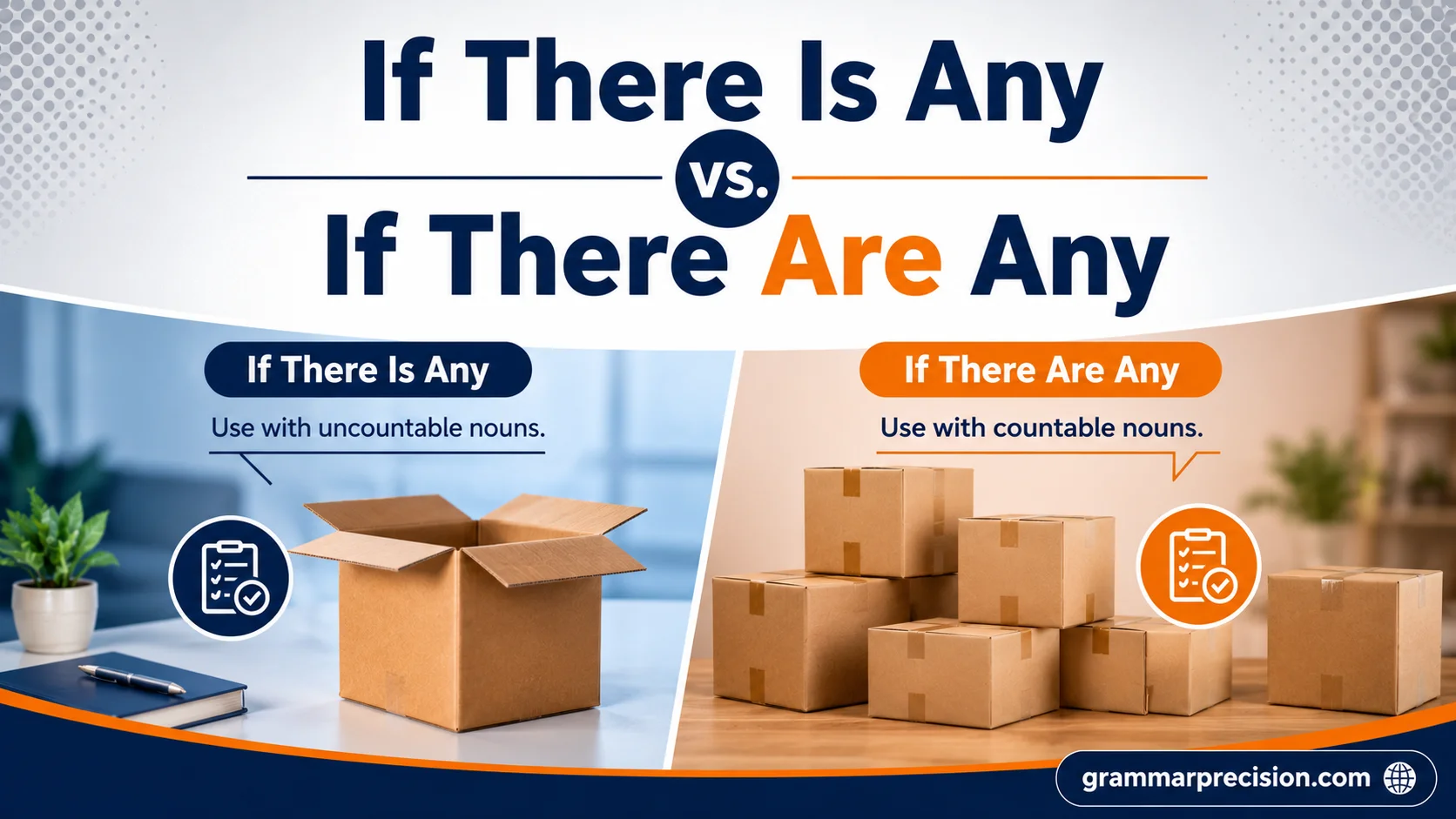
If There Is Any vs. If There Are Any is a common grammar confusion that affects many English learners. Understanding this difference helps you choose the correct phrase and write more accurate sentences in everyday and professional communication.
English grammar often depends on small details, and noun agreement plays a major role in choosing between these phrases. The word “any” does not decide the verb; the noun that follows it determines whether you should use “is” or “are.”
Learning the difference between if there is any and if there are any can improve your writing and speaking skills. Whether you are creating emails, essays, or conversations, using the correct phrase makes your English sound more natural, clear, and grammatically correct.
If There Is Any vs. If There Are Any: Quick Grammar Rule
Before going deeper, remember this simple rule:
| Phrase | Used With | Example |
| If there is any | Singular nouns or uncountable nouns | If there is any problem, let me know. |
| If there are any | Plural countable nouns | If there are any problems, let me know. |
The word “any” does not decide the verb. The noun after it determines whether you use is or are.
Examples:
- If there is any information, please share it.
- If there are any questions, feel free to ask.
In the first sentence, information is uncountable, so we use is. In the second sentence, questions is plural, so we use are.
Understanding If There Is Any: Meaning, Rules, and Examples
The phrase “if there is any” is used when you talk about one thing or something that cannot be counted separately.
The basic structure is:
If + there + is + any + noun
Examples:
- If there is any problem, contact me.
- If there is any confusion, ask for clarification.
- If there is any water left, save it for later.
The phrase works because the nouns are either singular or uncountable.
When to Use If There Is Any With Singular Nouns
Use “if there is any” when the noun refers to one specific thing, issue, or possibility.
Examples:
✅ If there is any mistake in the document, correct it.
✅ If there is any reason to cancel the meeting, tell me.
✅ If there is any chance of success, we should continue.
Incorrect:
❌ If there are any mistake in the document.
✅ If there is any mistake in the document.
The noun mistake is singular, so the correct verb is is.
If There Is Any With Uncountable Nouns: Complete Explanation
Another important use of “if there is any” is with uncountable nouns.
Uncountable nouns describe things that we usually cannot count individually.
Common examples include:
| Uncountable Noun | Correct Sentence |
| Information | If there is any information available, send it. |
| Advice | If there is any advice you need, ask me. |
| Money | If there is any money remaining, save it. |
| Time | If there is any time available, call me. |
| Help | If there is any help required, contact us. |
You cannot normally say:
❌ Two informations
❌ Three advices
Instead, English uses:
✅ Two pieces of information
✅ Three pieces of advice
Understanding If There Are Any: Meaning, Rules, and Examples
The phrase “if there are any” is used with plural countable nouns. These nouns describe things that can be counted and exist in more than one quantity.
The structure is:
If + there + are + any + plural noun
Examples:
- If there are any questions, ask the teacher.
- If there are any changes, update the file.
- If there are any problems, report them.
Here, the nouns are plural:
- Questions
- Changes
- Problems
That is why we use are.
When to Use If There Are Any With Plural Nouns
Use “if there are any” when you are talking about multiple items, people, problems, or situations.
Examples:
✅ If there are any errors in the article, fix them.
✅ If there are any updates, I will inform you.
✅ If there are any opportunities, apply quickly.
Incorrect:
❌ If there is any errors in the article.
✅ If there are any errors in the article.
The noun errors is plural, so it needs are.
If There Is Any vs. If There Are Any: Key Differences Explained
The easiest way to understand the difference is to examine the noun.
| Feature | If There Is Any | If There Are Any |
| Verb Used | Is | Are |
| Noun Type | Singular or uncountable | Plural countable |
| Refers To | One thing or an amount | Multiple things |
| Example | If there is any issue… | If there are any issues… |
Compare these examples:
Singular noun:
If there is any question, contact me.
Plural noun:
If there are any questions, contact me.
Both sentences are correct. The only difference is the number of the noun.
Why If There Is Any and If There Are Any Both Use “Any”
Many learners think “any” always requires a plural noun, but that is a common misunderstanding.
The word any can work with:
- Singular countable nouns
- Plural countable nouns
- Uncountable nouns
Examples:
Singular
- Is there any reason?
- If there is any chance…
Plural
- Are there any reasons?
- If there are any chances…
Uncountable
- Is there any information?
- If there is any information…
The important factor is the noun, not the word any.
Also Read This: Here It Is or Here Is It? Which Phrase Is Grammatically Correct?
Common Mistakes in If There Is Any vs. If There Are Any Usage
Many English learners make similar mistakes when using these phrases.
Using If There Is Any With Plural Nouns
Wrong:
❌ If there is any questions, ask me.
Correct:
✅ If there are any questions, ask me.
Why?
Because questions refers to more than one thing.
Using If There Are Any With Uncountable Nouns
Wrong:
❌ If there are any information available, share it.
Correct:
✅ If there is any information available, share it.
Why?
Because information is an uncountable noun.
Assuming Any Always Means Multiple Things
The word any does not automatically mean plural.
Examples:
- If there is any reason…
- If there are any reasons…
- If there is any water…
The meaning changes depending on the noun.
Real-Life Examples of If There Is Any vs. If There Are Any
Grammar becomes easier when you see how these phrases appear in real communication.
If There Is Any vs. If There Are Any in Workplace Writing
Professional communication often uses these expressions.
Examples:
- If there are any concerns, please contact the support team.
- If there is any additional information needed, let us know.
The first sentence discusses multiple concerns. The second discusses information, which is uncountable.
If There Is Any vs. If There Are Any in Daily Conversations
People use these phrases naturally in everyday speech.
Examples:
- If there is any food left, put it in the refrigerator.
- If there are any snacks available, bring some.
Food usually refers to an amount, while snacks refer to separate items.
If There Is Any vs. If There Are Any in Academic Writing
Students often use these phrases in essays and reports.
Examples:
- If there is any evidence supporting this idea, researchers should analyze it.
- If there are any differences between the studies, explain them clearly.
How to Choose Between If There Is Any and If There Are Any Quickly
Follow these three simple steps:
Find the Noun After Any
Example:
“If there ___ any books…”
The noun is books.
Identify the Noun Type
Ask yourself:
- Is it one thing?
- Is it more than one thing?
- Is it uncountable?
Books = plural.
Select Is or Are
Use:
- Singular or uncountable → is
- Plural → are
Correct sentence:
✅ If there are any books available…
Practice Exercises for If There Is Any vs. If There Are Any
Choose the correct option:
If there ___ any problem, tell me immediately.
Answer: ✅ is
Reason: Problem is singular.
If there ___ any mistakes, correct them before submission.
Answer: ✅ are
Reason: Mistakes is plural.
If there ___ any information about the event, share it.
Answer: ✅ is
Reason: Information is uncountable.
If there ___ any questions, the teacher will answer them.
Answer: ✅ are
Reason: Questions is plural.
FAQs:
What is the difference between If There Is Any and If There Are Any?
If there is any is used with singular nouns or uncountable nouns, while if there are any is used with plural countable nouns. For example, we say “If there is any information available” because information is uncountable, but “If there are any questions” because questions is plural.
Can If There Is Any be used with plural nouns?
No, if there is any should not be used with plural nouns. When you talk about more than one person, object, or idea, you need to use if there are any. For example, “If there are any mistakes in the report, correct them” is the correct sentence.
Is the word Any always followed by a plural noun?
No, any can be followed by singular, plural, or uncountable nouns depending on the meaning. For example, “any problem” is singular, “any problems” is plural, and “any advice” is uncountable. The noun type decides whether you use is or are.
Which phrase is more common in everyday English: If There Is Any or If There Are Any?
Both phrases are commonly used in everyday English. The choice depends on the noun that follows “any.” Native speakers use “if there is any” for single things or amounts and “if there are any” for multiple items, questions, or problems.
How can I remember the difference between If There Is Any and If There Are Any?
A simple way to remember is to focus on the noun after “any.” If the noun is singular or uncountable, use “is.” If the noun is plural, use “are.” This quick rule will help you avoid common grammar mistakes.
Conclusion:
Understanding If There Is Any vs. If There Are Any becomes easy when you pay attention to the noun that follows the phrase. The main rule is simple: use “if there is any” with singular and uncountable nouns, and use “if there are any” with plural nouns.
By practicing these structures with real examples, you can make your writing clearer, your conversations more natural, and your grammar more accurate. Small grammar choices often create a big difference in how confidently you communicate in English.