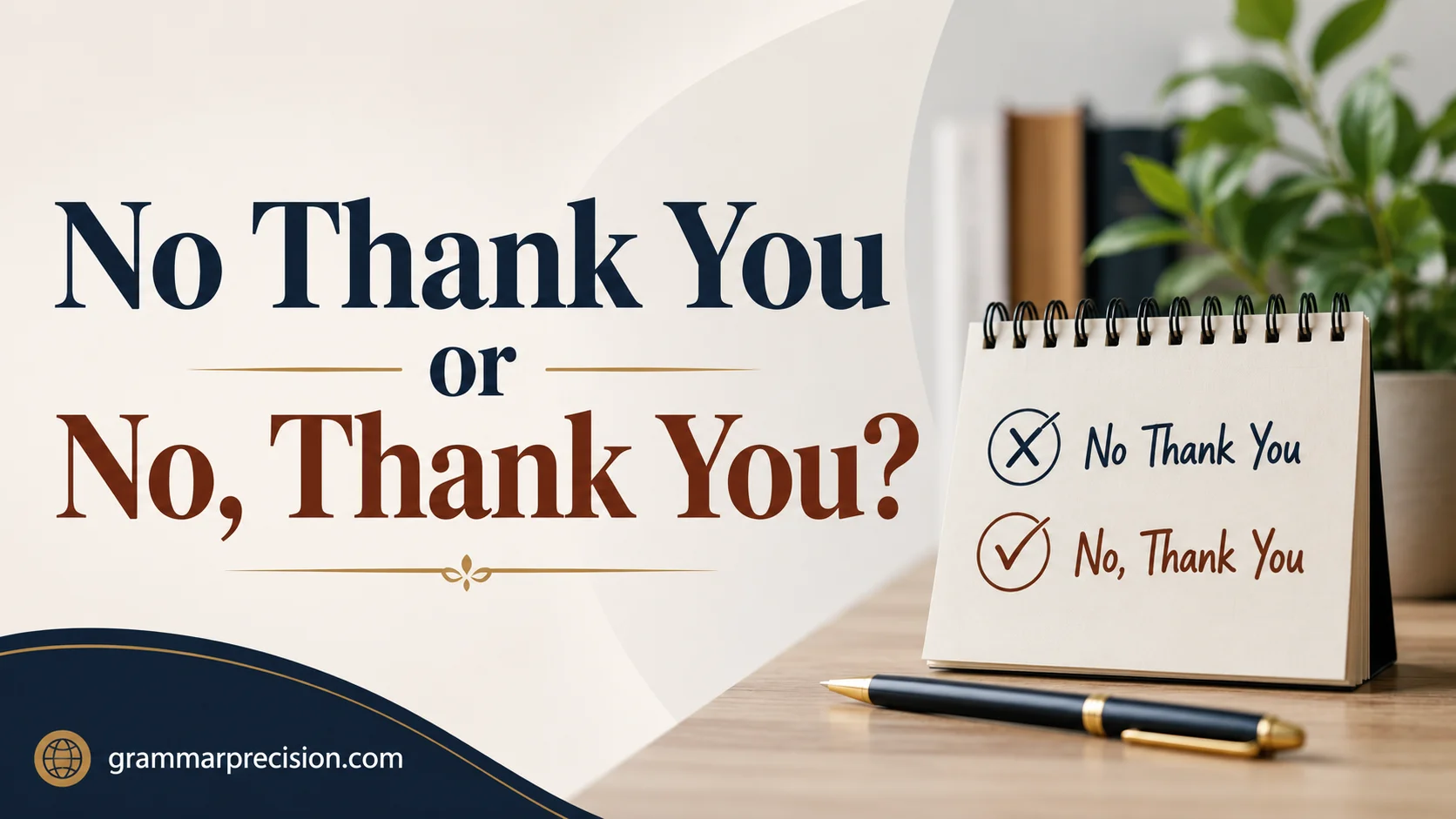
No Thank You or No, Thank You? often confuses writers because one small comma can completely change the tone, meaning, and politeness of a sentence in emails, letters, and everyday writing situations.
Many people struggle with comma rules while writing a polite email, friendly letter, or short message. A carefully placed comma can make sentences feel clearer, warmer, and more conversational. In my own experience, using the correct punctuation improves everyday communication and helps readers understand the intended tone without creating unnecessary confusion or misunderstanding during conversations.
A simple phrase like thank you may look harmless, yet the difference between versions can affect the reader’s reaction. Good punctuation adds clarity, creates a more polished style, and helps writers express gratitude naturally. If you are writing to a friend, colleague, or teacher, understanding these easy rules makes communication smoother, friendlier, and easier to read overall.
Why “No Thank You or No, Thank You” Confuses So Many People
English is full of expressions where tone matters more than structure. This is one of them.
When someone writes:
- No thank you
- No, thank you
They are technically refusing something in both cases. The meaning does not change. But your brain reacts differently to each version.
Why?
Because language is not just grammar. It carries rhythm, pause, and emotional intent.
A comma creates a pause. That pause changes how the message feels.
Think of it like this:
“No thank you” feels like one fast, direct response.
“No, thank you” feels like a pause before polite closure.
That small pause is where tone lives.
The Grammar Behind “No, Thank You” and Why the Comma Matters
Let’s keep this simple.
In standard English usage, “No, thank you” is considered the more grammatically correct and polite form in most contexts.
The comma separates two ideas:
- “No” = refusal
- “Thank you” = politeness marker
So the structure becomes:
No [pause], thank you.
That pause is important because English often relies on rhythm to show respect, not just words.
What the comma actually does in communication
- It adds a natural spoken pause
- It softens the refusal
- It keeps the tone polite and balanced
Without the comma, the phrase feels tighter and more direct.
How Tone Changes Everything in “No Thank You or No, Thank You”
Let’s compare the emotional impact of both versions in real life.
| Phrase | Tone | Emotional Effect | Perception |
| No thank you | Direct, flat | Neutral to firm | Quick refusal |
| No, thank you | Polite, soft | Warm and respectful | Gentle decline |
Even though the meaning is identical, the emotional delivery is not.
And in real conversations, delivery often matters more than grammar accuracy.
The Psychology of Polite Refusal in Everyday Language
Human communication is deeply emotional. We don’t just hear words. We interpret intent.
When someone says “no thank you”, the brain may interpret:
- A firm boundary
- A slightly cold tone
- A quick shutdown of the offer
When someone says “no, thank you”, the brain often reads:
- A respectful refusal
- Social warmth
- Emotional softness
Why this happens naturally
The comma creates a pause that mimics spoken language. Linguists call this a prosodic break.
That break gives the listener a moment to process the refusal before hearing the politeness.
So it feels like:
“I’m saying no… but I still respect you.”
Real-Life Usage of “No Thank You or No, Thank You” in Different Situations
At a restaurant
Waiter: “Would you like more bread?”
- No thank you → quick and efficient
- No, thank you → polite and friendly
Both are correct. But the second one feels more socially warm.
In a professional setting
Colleague: “Can you take this extra task?”
- No thank you → firm and slightly distant
- No, thank you → polite but clear refusal
In workplaces, tone affects relationships more than people realize.
In casual texting
People often shorten phrases online:
- “no thanks”
- “no thank you”
- “no, thank you”
Shorter versions feel casual, while comma usage still adds politeness even in digital form.
Why People Often Skip the Comma in Modern Communication
Language changes with speed and technology.
In texting and social media, people prioritize:
- Speed
- Simplicity
- Shorter messages
So punctuation often gets dropped.
But here’s the trade-off. When punctuation disappears, tone becomes less clear.
That’s why messages like “no thank you” can sometimes feel harsher than intended.
The Social Meaning Behind “No Thank You or No, Thank You”
This phrase is not just grammar. It reflects social distance.
English uses subtle signals to show relationships between people.
Warm and friendly tone
- “No, thank you 🙂”
- “No thanks!”
Neutral tone
- “No, thank you”
More distant tone
- “No thank you”
It’s not about right or wrong. It’s about how soft or strong you want your message to feel.
What Linguists Say About Polite Expressions Like This
Linguists often explain that punctuation in English is not only structural. It is also emotional.
In phrases like “no, thank you”, the comma functions like a spoken pause.
Without it, the sentence becomes more compressed and less expressive.
A simple way to understand it:
Grammar builds meaning.
Punctuation builds tone.
Case Study: How a Small Phrase Can Change Workplace Communication
Let’s imagine a real scenario.
Situation
A manager asks an employee:
“Can you stay late today?”
Two possible replies:
- “No thank you.”
- “No, thank you.”
Possible interpretation
- The first may feel abrupt or firm
- The second feels respectful and professional
Even though both are correct, the emotional impact differs.
This is why small punctuation choices matter in professional communication.
Also Read This: Delicious or Dilicious
Quick Trick to Remember the Correct Usage
Here’s a simple rule you can actually use:
- If you naturally pause when speaking → use a comma
- If you say it quickly as one flow → no comma
So:
“No… thank you” → comma version
Fast refusal → no comma version
Your natural speech already understands the difference.
Common Mistakes With “No Thank You or No, Thank You”
Mistake 1: Thinking both versions feel identical
They do not. Tone changes even if meaning doesn’t.
Mistake 2: Overcomplicating grammar rules
Native speakers rarely think consciously about commas in speech.
Mistake 3: Using blunt forms in formal communication
In professional settings, missing punctuation can unintentionally sound harsh.
How Native Speakers Actually Use It in Real Life
Most native speakers rely on instinct, not rules.
You’ll commonly hear:
- “No, thank you” in polite conversation
- “No thanks” in casual talk
- “No thank you” in written or firm responses
The comma version is still the most common polite spoken form.
Table: Best Situations for Each Version
| Situation | Recommended Form | Reason |
| Formal writing | No, thank you | Polite and clear |
| Work communication | No, thank you | Professional tone |
| Casual chats | No thanks | Natural flow |
| Firm refusal | No thank you | Direct response |
Why This Small Phrase Reveals a Big Truth About English
English depends heavily on tone, rhythm, and context.
Unlike languages where grammar alone carries meaning, English often hides emotion in small details like punctuation.
That’s why “no thank you or no, thank you” becomes more than a grammar question.
It becomes a lesson in human communication.
The Politeness Scale of Refusal in English
Let’s map it simply:
- “Oh no, thank you so much!” → very soft
- “No, thank you” → polite standard
- “No thanks” → casual
- “No thank you” → firm
Each version sits on a different level of emotional distance.
Simple Analogy to Understand the Difference
Think of punctuation like facial expression.
- No punctuation → blank expression
- Comma → slight pause with a polite nod
- Exclamation → expressive emotion
So “no, thank you” is like smiling briefly before refusing.
Same message. Different feeling.
FAQs:
Is “No Thank You” grammatically correct?
Yes, “No Thank You” is grammatically correct and commonly used in everyday conversation. It sounds polite, simple, and natural when politely refusing something in speech or informal writing.
When should I use “No, Thank You” with a comma?
You should use “No, Thank You” when you want a softer and more polite tone. The comma creates a small pause that improves clarity and makes the sentence feel more conversational.
Does the comma really change the meaning?
The meaning usually stays similar, but the tone can change noticeably. A sentence with a carefully placed comma often sounds warmer, while one without it may feel faster or more direct.
Is the comma optional in thank-you phrases?
In many situations, the comma is optional. However, using correct punctuation can improve readability and help readers better understand the writer’s intended message and emotion.
Why do writers confuse these phrases?
Many writers struggle because English comma rules can feel confusing in everyday writing. Small punctuation marks may seem unimportant, but they often shape the flow, politeness, and overall readability of a sentence.
Conclusion:
Understanding the difference between No Thank You and No, Thank You helps improve everyday communication and makes writing feel more polished and professional. A small comma may look minor, but it can change the tone, add clarity, and make your message sound warmer.
By learning these easy rules, writers can avoid confusion and express gratitude more naturally in emails, letters, and conversations.