Understanding Compare To vs Compare With can instantly improve your grammar and make your writing clearer, more natural, and more accurate in both academic and everyday communication.
Many English learners and even native speakers struggle with choosing the correct phrase because both expressions seem similar at first glance. Knowing the difference, using each phrase correctly, and understanding their purpose will help you write with greater confidence and precision in every situation.
Whether you’re writing an essay, preparing a business report, or creating engaging content, choosing between compare to and compare with matters. This guide explains the key differences, provides easy-to-follow examples, and shares practical grammar tips so you can use both expressions correctly every time.
Compare To vs Compare With: Quick Answer
Here’s the short version if you’re in a hurry.
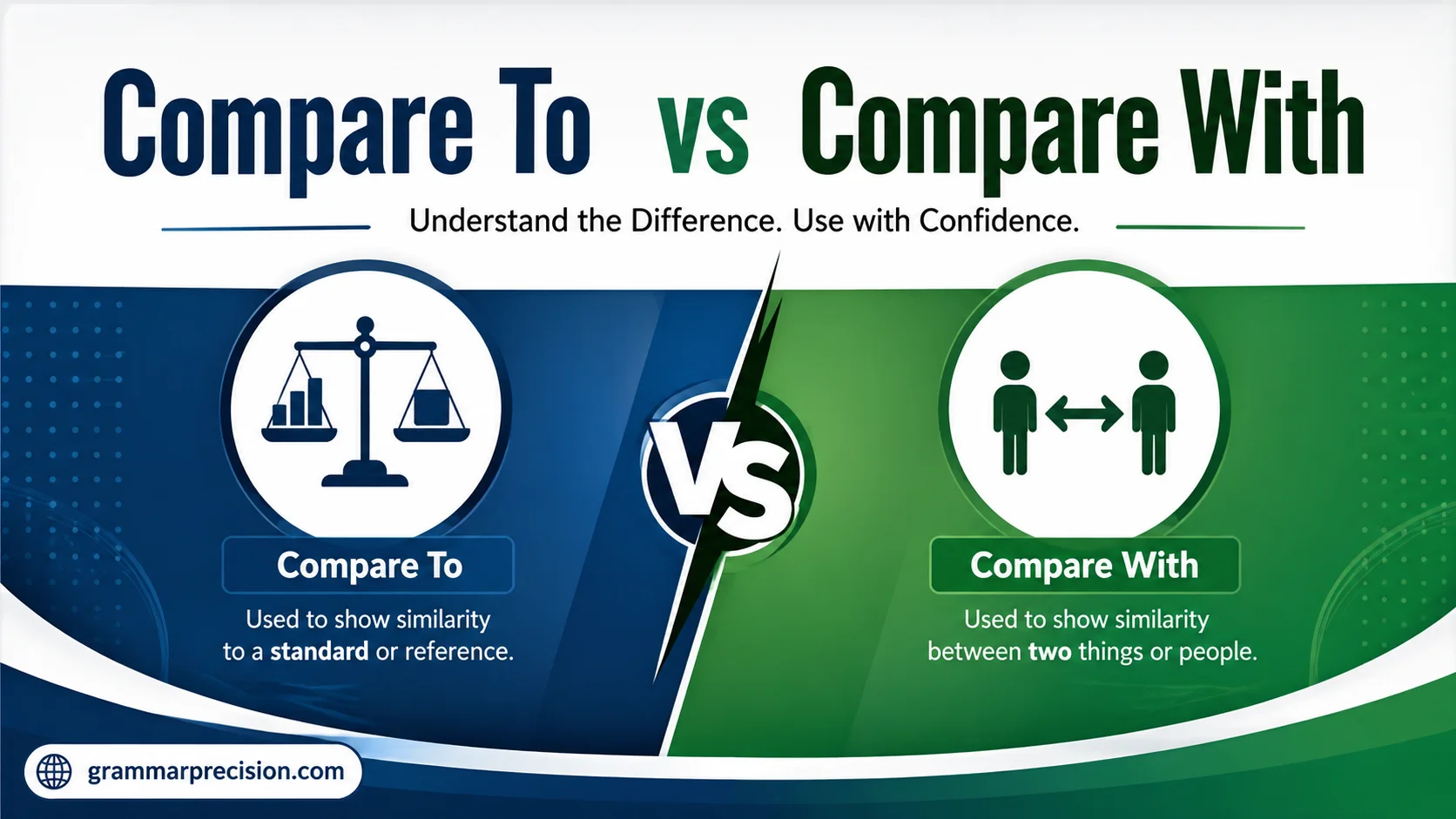
- Compare to usually highlights similarities between two different things. Writers often use it to create analogies or vivid descriptions.
- Compare with usually examines both similarities and differences between two things. It works best when you’re making a careful analysis.
Although modern English allows some flexibility, following this guideline makes your writing more accurate and easier to understand.
Quick Examples
✅ She compared her teacher to a lighthouse because he always guided his students.
✅ The report compared this year’s sales with last year’s sales.
The first sentence creates an analogy.
The second sentence analyzes two sets of data.
What Does “Compare To” Mean?
The phrase compare to is commonly used when you want readers to notice a resemblance between two different things. Instead of examining every detail, you emphasize a shared quality.
Think of it as painting a picture. You’re helping readers visualize one thing by relating it to another.
Definition
Compare to means to point out similarities between two unlike things or to create an analogy.
Simple Formula
Compare To = Show Similarities + Create an Analogy
Examples
- Her voice can be compared to soft rain.
- Many people compare great leaders to captains steering a ship.
- The author compared life to a marathon.
- The coach compared teamwork to the gears inside a clock.
- His determination was compared to that of a mountain climber.
Notice how none of these examples carefully examine differences. Instead, they help readers understand one idea through another.
Why Writers Love “Compare To”
Creative writers often choose compare to because it makes descriptions memorable.
Instead of saying,
The city was busy.
You could write,
The city was compared to a living organism that never sleeps.
That sentence immediately creates a stronger image.
What Does “Compare With” Mean?
Unlike compare to, the phrase compare with focuses on careful evaluation. You’re placing two things side by side to examine how they’re alike and how they differ.
Researchers, teachers, analysts, and business professionals frequently use this expression because it encourages objective analysis.
Definition
Compare with means to examine two or more things by identifying both similarities and differences.
Simple Formula
Compare With = Analyze Similarities + Analyze Differences
Examples
- Compare this smartphone with last year’s model.
- The teacher asked students to compare the novel with the movie adaptation.
- Investors compared Company A with Company B before buying shares.
- Doctors often compare new treatments with existing methods.
- Scientists compare research findings with previous studies.
In every example, the goal is analysis rather than analogy.
Compare To vs Compare With: Side-by-Side Comparison Table
| Feature | Compare To | Compare With |
| Primary Purpose | Show similarities | Analyze similarities and differences |
| Writing Style | Creative | Analytical |
| Common Use | Literature, speeches, storytelling | Essays, reports, research papers |
| Focus | Analogy | Detailed comparison |
| Tone | Descriptive | Objective |
| Best For | Metaphors and imagery | Evaluation and decision-making |
| Example | “Life is compared to a journey.” | “Compare this phone with another model.” |
This simple table highlights the biggest distinction. One phrase inspires imagination. The other supports analysis.
The Main Difference Between Compare To and Compare With
Although both expressions involve comparing things, their purpose changes the meaning.
Imagine you’re shopping for laptops.
If someone says,
“Let’s compare this laptop with another model.”
You expect a detailed discussion about price, battery life, speed, storage, and design.
Now imagine someone says,
“This laptop can be compared to a portable office.”
They’re not evaluating features. They’re creating a comparison that helps you picture how useful the laptop is.
That’s the heart of the difference.
| Goal | Correct Phrase |
| Create an analogy | Compare To |
| Analyze features | Compare With |
| Show resemblance | Compare To |
| Evaluate options | Compare With |
| Discuss differences | Compare With |
| Make figurative language | Compare To |
A Simple Way to Remember the Rule
If you’re trying to decide which phrase to use, ask yourself one question.
Am I creating a picture, or am I analyzing information?
If you’re painting a picture, choose compare to.
If you’re analyzing facts, choose compare with.
Here’s an easy memory trick.
To = Similarity
With = Analysis
This shortcut won’t cover every possible situation, but it works for most everyday writing.
Why This Grammar Rule Matters
Some people assume the choice doesn’t matter because native speakers often use both expressions interchangeably. However, using the more precise phrase improves clarity and strengthens your writing.
Here’s why it matters.
- Readers understand your intention immediately.
- Academic writing becomes more precise.
- Business reports sound more professional.
- Creative writing becomes more vivid.
- You avoid common grammar mistakes in exams and formal documents.
Small grammar choices often create a big difference in how your writing is perceived.
“Good writing isn’t about using bigger words. It’s about choosing the right ones.”
That idea perfectly explains the distinction between compare to and compare with.
Quick Cheat Sheet
| If You Want To… | Use |
| Create a metaphor | Compare To |
| Write a poem | Compare To |
| Analyze two products | Compare With |
| Compare two reports | Compare With |
| Write creatively | Compare To |
| Evaluate options | Compare With |
Keep this table handy whenever you’re unsure. It serves as a quick reference that can save time while improving the accuracy of your writing.
When Should You Use Compare To?
Knowing when to use compare to makes your writing more expressive. This phrase shines when your goal is to highlight a shared quality between two different things rather than examine every detail.
Writers often use compare to in literature, speeches, advertising, and everyday conversations because it creates vivid mental images. Instead of listing facts, it invites readers to see one thing through the lens of another.
Use Compare To for Analogies
An analogy explains one idea by relating it to something familiar. This technique helps readers understand abstract concepts more easily.
Examples:
- Her smile can be compared to sunshine because it brightens every room.
- The internet is often compared to a vast library filled with endless information.
- A skilled teacher can be compared to a gardener who helps students grow.
Each sentence emphasizes a shared characteristic instead of making a detailed comparison.
Use Compare To in Creative Writing
Creative writers rely on imagery to make their stories memorable. That’s why you’ll often find compare to in novels, poems, and speeches.
Example:
The river was compared to a silver ribbon stretching across the valley.
The sentence creates a visual image instead of analyzing the river.
Use Compare To in Motivational Speaking
Public speakers frequently use analogies because they’re easy to remember.
Consider these examples:
- Success can be compared to climbing a mountain.
- Building trust is often compared to planting a tree.
- Time is frequently compared to money.
Each analogy communicates a powerful idea in just a few words.
Common Situations Where “Compare To” Works Best
Use compare to when you’re:
- Creating metaphors or analogies
- Writing poetry
- Giving speeches
- Writing novels
- Describing emotions
- Explaining abstract ideas
- Making inspirational statements
When Should You Use Compare With?
If compare to paints a picture, compare with examines the details.
This expression works best whenever you need to evaluate, measure, or analyze two or more items objectively.
Use Compare With for Detailed Analysis
Suppose you’re buying a new smartphone. Instead of simply saying one phone resembles another, you’ll likely compare features.
For example:
- Compare the iPhone with the latest Android model before making a decision.
- Consumers often compare electric vehicles with gasoline-powered cars.
- Investors compare quarterly earnings with previous reports.
Here, you’re studying differences as well as similarities.
Use Compare With in Academic Writing
Teachers often ask students to compare two ideas, books, or historical events.
Examples include:
- Compare Shakespeare’s Hamlet with Macbeth.
- Compare the American Revolution with the French Revolution.
- Compare renewable energy sources with fossil fuels.
These assignments require thoughtful analysis rather than creative description.
Use Compare With in Business
Businesses compare data constantly.
Marketing teams compare:
- Sales this year with last year.
- Customer satisfaction with competitor benchmarks.
- Advertising costs with revenue.
- Employee performance with company goals.
This type of comparison helps organizations make informed decisions.
Use Compare With in Science
Scientists compare evidence before reaching conclusions.
Examples include:
- Researchers compared the new vaccine with existing treatments.
- Doctors compared patient recovery rates with historical data.
- Engineers compared fuel efficiency with industry standards.
Precision matters in scientific writing, making compare with the better choice.
Compare To vs Compare With in Different Types of Writing
The best phrase often depends on your writing style and purpose.
| Writing Type | Preferred Phrase | Reason |
| Poetry | Compare To | Creates imagery |
| Fiction | Compare To | Builds vivid descriptions |
| Academic Essays | Compare With | Supports analysis |
| Business Reports | Compare With | Evaluates facts |
| Research Papers | Compare With | Encourages objective comparison |
| Speeches | Compare To | Makes ideas memorable |
| Product Reviews | Compare With | Examines features |
| News Reports | Compare With | Focuses on factual analysis |
This guideline isn’t a strict rule, but following it makes your writing more natural.
Compare To vs Compare With in Literature
Many famous authors have used compare to because literature thrives on imagery.
Example
“Shall I compare thee to a summer’s day?”
This famous opening from William Shakespeare doesn’t analyze summer weather. Instead, it creates a beautiful comparison that celebrates the subject’s beauty.
Notice the intention.
The goal isn’t evaluation.
The goal is imagery.
That’s why compare to fits perfectly.
More Literary Examples
- Love is often compared to fire.
- Hope is frequently compared to light.
- Life has been compared to a journey for centuries.
These comparisons help readers connect emotionally with the text.
Compare To vs Compare With in Academic Writing
Academic writing values clarity, evidence, and logical thinking.
When professors ask students to compare two topics, they usually expect an organized analysis.
Example Assignment
Compare online education with traditional classroom learning.
A strong response might examine:
- Cost
- Flexibility
- Student engagement
- Learning outcomes
- Technology requirements
The assignment isn’t asking students to create analogies. It’s asking them to evaluate evidence.
That’s why compare with is the preferred choice.
Academic Writing Tips
When using compare with, remember to:
- Compare similar categories.
- Support claims with evidence.
- Stay objective.
- Discuss both similarities and differences.
- Avoid emotional language unless required.
Compare To vs Compare With in Business English
Business professionals compare numbers every day.
Whether preparing reports or analyzing competitors, choosing the correct phrase improves clarity.
Example
A marketing manager might say:
“Let’s compare this quarter’s revenue with last year’s performance.”
This sentence tells readers that detailed analysis is coming.
Now consider another sentence:
“Our customer service team can be compared to the backbone of the company.”
Here, the speaker isn’t presenting statistics. They’re emphasizing importance through analogy.
Understanding this distinction helps professionals communicate more effectively.
Real-Life Case Study
Imagine two students writing about electric cars.
Student A
Electric vehicles can be compared to smartphones because both transformed the industries they entered.
This sentence uses an analogy.
Student B
This report compares electric vehicles with gasoline-powered cars based on fuel costs, maintenance, charging time, emissions, and performance.
This sentence promises analysis.
Both students used correct grammar.
They simply had different goals.
Common Grammar Rules to Remember
Although English evolves over time, these guidelines remain widely accepted.
Rule One
Use compare to when emphasizing similarities.
Example:
- She compared her mentor to a guiding star.
Rule Two
Use compare with when examining similarities and differences.
Example:
- Compare today’s weather with yesterday’s forecast.
Rule Three
Context matters more than memorizing rules.
Modern English speakers sometimes use both expressions interchangeably. However, choosing the more precise phrase improves readability.
Rule Four
Formal writing usually favors precision.
Academic papers, reports, and research articles often prefer compare with because it signals detailed analysis.
Creative writing often favors compare to because it creates stronger imagery.
Examples That Make the Difference Crystal Clear
| Sentence | Correct? | Why? |
| She compared her child to an angel. | ✅ | Shows similarity |
| Compare this laptop with that one. | ✅ | Evaluates features |
| His determination was compared to steel. | ✅ | Creates imagery |
| Compare the two proposals with each other. | ✅ | Analyzes differences |
| The author compared life to a chess game. | ✅ | Uses analogy |
| Compare these statistics with last year’s report. | ✅ | Examines data |
Reading examples like these helps reinforce the distinction far better than memorizing grammar rules alone.
Also Read This: Did vs. Done: What’s the Difference and When Should You Use Each?
Compare To vs Compare With in American and British English
One reason this grammar topic causes confusion is that American English and British English don’t always follow the same convention.
Traditional grammar guides often distinguish between the two expressions:
- Compare to highlights similarities or creates an analogy.
- Compare with examines similarities and differences.
However, modern English has become more flexible. Many newspapers, websites, and even respected authors occasionally use the phrases interchangeably.
That said, if you’re writing for school, work, or publication, following the traditional distinction makes your writing clearer and more professional.
American English
In American English, you’ll often see both expressions used interchangeably in everyday conversation.
Examples:
- Compare our prices to the competition.
- Compare our prices with the competition.
Both sentences sound natural, although many style guides still recommend compare with when you’re evaluating details.
British English
British English tends to preserve the traditional distinction more consistently.
For example:
- Compare this report with last year’s report. ✅
- The poet compared love to a rose. ✅
If you’re writing for an international audience, using these traditional guidelines is a safe choice.
Compare To vs Compare With vs Compared To vs Compared With
Many writers understand compare to and compare with, but they become confused when the past participle enters the sentence.
Fortunately, the same basic principle applies.
| Expression | Best Use | Example |
| Compare to | Show similarities | Compare success to climbing a mountain. |
| Compare with | Analyze similarities and differences | Compare this phone with another model. |
| Compared to | Indicates resemblance | Her courage is often compared to a lion’s. |
| Compared with | Indicates detailed evaluation | Compared with last year, profits increased by 18%. |
Example
Compared to
The new stadium has been compared to a modern masterpiece.
This sentence emphasizes resemblance.
Compared with
Compared with last season, attendance increased significantly.
This sentence introduces an analysis.
Compare To vs Compare With vs Similar To
These expressions have related meanings, but they aren’t interchangeable.
Similar To
The phrase similar to simply states that two things resemble each other.
Example:
- This design is similar to the original version.
Compare To
This expression actively creates an analogy.
Example:
- The architect compared the building to a sailing ship.
Compare With
This expression examines details.
Example:
- Compare the new design with the original blueprint.
Quick Comparison Table
| Phrase | Purpose |
| Similar To | States resemblance |
| Compare To | Creates analogy |
| Compare With | Evaluates similarities and differences |
Knowing these subtle differences helps you choose the most natural expression.
Common Mistakes People Make
Even advanced English learners make mistakes with these expressions. The good news is that they’re easy to fix once you know what to watch for.
Mistake 1: Using Compare To for Detailed Analysis
❌ Compare this proposal to the previous version.
✅ Compare this proposal with the previous version.
Since you’re evaluating two documents, compare with is more appropriate.
Mistake 2: Using Compare With in a Metaphor
❌ She compared her mother with an angel.
✅ She compared her mother to an angel.
An angel serves as a metaphor, not an object of detailed analysis.
Mistake 3: Assuming Both Expressions Always Mean the Same Thing
Many people believe there’s no difference between the two phrases.
While modern English sometimes treats them as interchangeable, careful writers still choose the expression that best matches their purpose.
Doing so improves clarity and demonstrates strong command of grammar.
Mistake 4: Forgetting Your Audience
A creative blog post and a scientific report have different goals.
Before choosing either phrase, ask yourself:
- Am I telling a story?
- Am I explaining an idea?
- Am I analyzing information?
Your answer usually reveals the correct expression.
Memory Tricks You’ll Never Forget
Grammar becomes easier when you connect rules to memorable images.
Here are several tricks that work surprisingly well.
Memory Trick One
Think of the letter T in To.
T = Twin Quality
You’re focusing on a shared characteristic.
Example:
Hope is compared to light.
Memory Trick Two
Think of the letter W in With.
W = Weigh
You’re weighing two things side by side.
Example:
Compare this proposal with last year’s version.
Memory Trick Three
Ask Yourself One Question
Am I painting a picture or making a comparison?
If you’re painting a picture, use compare to.
If you’re making an evaluation, use compare with.
This single question solves most grammar problems.
Decision Tree: Which Phrase Should You Choose?
Use this quick guide whenever you’re uncertain.
Do you want to compare two things?
│
▼
Are you creating an analogy or metaphor?
Yes —————-► Compare To
│
No
▼
Are you analyzing similarities and differences?
Yes —————-► Compare With
│
No
▼
Are you writing creatively?
Yes —————-► Compare To
No —————–► Compare With
This simple flowchart removes the guesswork.
Compare To vs Compare With in Everyday Conversations
Although grammar books discuss formal rules, everyday speech tends to be more relaxed.
Here are some examples you might hear.
Friends Talking
- Compare this restaurant with the one we visited last week.
- My brother is always comparing me to our father.
- People compare social media to a double-edged sword.
- Compare these vacation packages with each other before booking.
Even in casual conversations, choosing the appropriate expression makes your message clearer.
Compare To vs Compare With in Professional Writing
Professional writing values precision.
Whether you’re writing a proposal, annual report, or product review, the right phrase signals your purpose immediately.
Marketing
- Compare our pricing with the leading competitors.
Finance
- Analysts compared quarterly revenue with projections.
Healthcare
- Researchers compared patient outcomes with national averages.
Technology
- Experts compared the software with earlier versions to identify improvements.
Using compare with in these situations tells readers that your conclusions are based on careful evaluation rather than opinion.
Expert Writing Tips
Professional editors recommend a few simple habits that instantly improve grammar.
- Match the phrase to your purpose.
- Prefer precision over habit.
- Read the sentence aloud.
- Avoid switching between expressions without a reason.
- Use analogies sparingly for greater impact.
- Support analytical comparisons with facts or evidence.
Following these practices will make your writing stronger, whether you’re crafting an academic essay, a business report, or a blog post.
Practice Quiz: Test Your Understanding of Compare To vs Compare With
Now that you’ve learned the rules, it’s time to put them into practice. Try answering each question before checking the solutions.
Choose the Correct Phrase
Fill in the blank with either compare to or compare with.
- The teacher asked students to ________ the two novels.
- Many critics ________ the young athlete ________ a legendary player.
- Before buying a car, you should ________ several models.
- The poet ________ hope ________ a candle in the darkness.
- Scientists often ________ their findings ________ previous research.
Take a moment to answer before scrolling down.
Answers
- compare with
- compared … to
- compare with
- compared … to
- compare … with
If you answered all five correctly, you’ve mastered the core rule.
Practice Exercises With Detailed Explanations
These exercises explain why each answer is correct instead of simply giving the solution.
Exercise One
Sentence
The manager compared this year’s profits ________ last year’s profits.
✅ Answer: with
Why?
The manager is analyzing financial data. The goal is to identify similarities and differences, so compare with is the correct choice.
Exercise Two
Sentence
The speaker compared determination ________ climbing a steep mountain.
✅ Answer: to
Why?
The speaker creates an analogy to inspire the audience. No detailed analysis takes place.
Exercise Three
Sentence
Researchers compared the new treatment ________ the existing treatment.
✅ Answer: with
Why?
Scientific research requires objective comparison, making compare with the preferred expression.
Exercise Four
Sentence
Many people compare the human brain ________ a supercomputer.
✅ Answer: to
Why?
This sentence uses a metaphor to explain the brain’s remarkable abilities.
Exercise Five
Sentence
Please compare the two insurance policies before making your decision.
✅ Answer: with
Why?
The sentence involves evaluating features, costs, and benefits.
Real-World Examples Across Different Contexts
Seeing these expressions in everyday situations makes the distinction easier to remember.
Education
Compare With
- Compare your essay with the grading rubric.
- Compare this experiment with the previous one.
- Compare the causes of the two historical events.
Business
Compare With
- Compare employee productivity with last year’s performance.
- Compare supplier prices with current market rates.
- Compare customer satisfaction with industry averages.
Technology
Compare With
- Compare smartphone processors with competing models.
- Compare laptop battery life with manufacturer claims.
Literature
Compare To
- The novelist compared fear to a shadow.
- The poet compared childhood to spring.
- The playwright compared ambition to wildfire.
Everyday Conversation
- My sister compares our grandfather to a superhero.
- Compare this coffee with the one we tried yesterday.
- People often compare social media to a crowded marketplace.
Quick Reference Cheat Sheet
Bookmark this section whenever you need a fast reminder.
| Situation | Use | Example |
| Creating a metaphor | Compare To | Compare life to a journey. |
| Showing resemblance | Compare To | She compared him to a lion. |
| Evaluating products | Compare With | Compare this phone with another model. |
| Academic essays | Compare With | Compare the two theories with supporting evidence. |
| Business reports | Compare With | Compare quarterly sales with last year’s results. |
| Scientific research | Compare With | Compare the test results with the control group. |
| Creative storytelling | Compare To | Compare hope to a rising sun. |
Frequently Confused Grammar Pairs
If you’re learning compare to vs compare with, you’ll probably encounter these similar grammar questions as well.
Compared To vs Compared With
- Compared to emphasizes resemblance.
- Compared with introduces an analysis.
Examples
- Her courage was compared to a lion’s.
- Compared with last year, revenue increased by 15%.
Similar To vs Compare To
Similar to simply states that two things resemble each other.
Compare to actively creates a comparison or analogy.
Examples
- This painting is similar to the original.
- The artist compared the painting to a dream.
Like vs As
Another common source of confusion involves like and as.
- Use like when making a comparison.
- Use as when describing a role or function.
Examples
- She sings like a professional.
- She works as a professional singer.
Learning these related grammar rules strengthens your overall writing skills.
FAQs:
What is the main difference between compare to and compare with?
The main difference is their purpose. Compare to is generally used to highlight similarities or create an analogy, while compare with is used to examine both similarities and differences between two or more things. Choosing the correct phrase makes your writing clearer and more precise.
Can compare to and compare with be used interchangeably?
In modern English, the two expressions are sometimes used interchangeably, especially in casual conversation. However, in formal, academic, and professional writing, it’s better to follow the traditional rule by using compare to for similarities and compare with for detailed analysis.
Which phrase is better for academic writing?
For most academic papers, compare with is the preferred choice because it signals a careful comparison of facts, ideas, or data. Professors often expect students to analyze both similarities and differences rather than simply point out a resemblance.
Is it grammatically correct to say “compared to” and “compared with”?
Yes, both expressions are grammatically correct when used in the right context. Compared to usually introduces an analogy or highlights a resemblance, while compared with introduces a detailed comparison between two subjects.
How can I easily remember when to use each phrase?
A simple trick is to remember that compare to is for creating a picture or analogy, while compare with is for analyzing information. If you’re describing something creatively, use compare to. If you’re evaluating or examining two things, use compare with.
Conclusion:
Understanding the difference between Compare To vs Compare With helps you communicate more effectively and write with greater clarity, accuracy, and confidence. While compare to is ideal for highlighting similarities and creating analogies, compare with is the better choice for careful analysis and detailed comparisons.
By applying these simple grammar rules and practicing with real-world examples, you’ll make better word choices and produce stronger, more professional, and more engaging writing in every context.