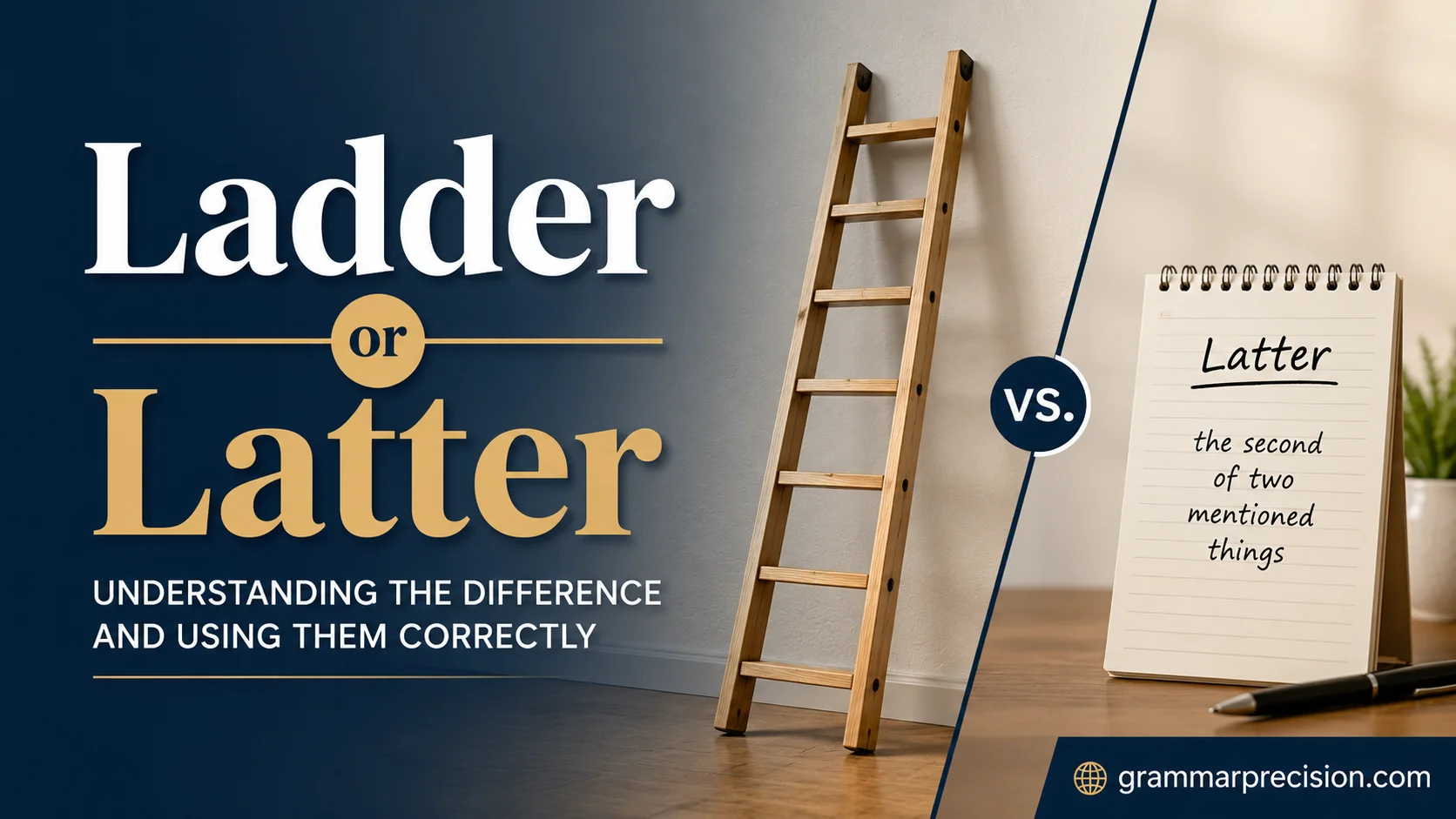
Ladder or Latter often confuses writers because both words sound alike but carry different meanings. Learning their correct usage improves grammar, writing clarity, speaking confidence, and helps avoid embarrassing mistakes in communication daily.
Many learners mix up ladder and latter because their spellings and pronunciation appear similar in conversation. The word latter works as a pronoun or adjective referring to the second of two items, while ladder is a physical object used for climbing and reaching higher places safely during daily tasks and professional work activities.
A ladder can also carry a metaphorical meaning by representing steps, stages, and personal advancement in life or career growth. Understanding these comparisons correctly helps improve grammar, clarity, and overall writing structure while avoiding confusing mistakes in academic, professional, and everyday communication for learners, writers, and public speakers everywhere today.
Ladder or Latter: Quick Meaning Explained
Let’s keep things simple first.
- Ladder = a tool used for climbing up or down
- Latter = the second of two things mentioned
That’s the core difference in one glance.
Example in real life:
- I climbed the ladder to fix the roof.
- I had tea and coffee, but I chose the latter.
Same vibe in spelling. Completely different meaning in use.
Ladder or Latter: Why People Confuse Them So Easily
If you mix these two up, don’t worry. It happens more often than you think.
The confusion comes from a few simple reasons:
- They look similar when typed quickly
- They sound slightly alike in fast speech
- Context gets ignored when people write in a hurry
Your brain also plays a trick here. It doesn’t read every single letter carefully. Instead, it guesses meaning based on patterns.
That shortcut helps you read faster. But it also creates mistakes.
Real-world confusion example:
Someone writes:
I used the latter to climb the roof.
That feels almost right when typing fast. But the meaning is completely wrong.
The correct sentence is:
I used the ladder to climb the roof.
Small slip. Big difference.
Ladder Meaning Explained in Simple Terms
A ladder is a physical tool made for climbing.
You’ve probably seen one many times:
- At home during cleaning
- On construction sites
- In libraries for high shelves
- During rescue operations
It has steps called rungs that help you move upward or downward safely.
Simple definition:
A ladder is a tool you use to go up or down.
Everyday examples:
- I climbed a ladder to paint the ceiling
- The firefighter used a ladder to save the cat
- He slipped off a ladder while fixing the roof
Key idea:
If you can see it and touch it, it’s a ladder.
Latter Meaning Explained in Simple Terms
Now let’s switch gears completely.
Latter is not a physical object. It’s a grammar word used when comparing two things.
It refers to the second option in a pair.
Simple definition:
Latter means the second of two things mentioned.
Example:
- I had pizza and burgers, but I liked the latter more.
Here, “latter” refers to burgers because they were mentioned second.
More examples:
- I could study law or medicine. I chose the latter.
- Between tea and coffee, the latter tastes better.
- She liked dogs and cats, but the latter won her heart.
Key idea:
Whenever you compare two things, “latter” points to the second one.
Ladder or Latter: Side-by-Side Comparison
A direct comparison makes things much clearer.
| Feature | Ladder | Latter |
| Type | Physical object | Grammar reference word |
| Meaning | Tool for climbing | Second option in comparison |
| Usage | Real-world actions | Writing and comparisons |
| Can you touch it? | Yes | No |
| Example | I climbed a ladder | I chose the latter |
Once you see it like this, the confusion drops instantly.
Real-Life Situations Where People Get It Wrong
Let’s look at how this mistake shows up in everyday life.
Workplace emails
Someone writes:
We can choose plan A or plan B. I suggest the ladder.
That changes the meaning completely and confuses the reader.
Academic writing
Students sometimes write:
The latter was used to reach the setup.
This mixes physical action with grammar usage, which breaks clarity.
Social media captions
Fast typing leads to funny mistakes like:
Life feels better with a strong latter.
Now it sounds like philosophy about stairs instead of grammar.
Memory Tricks to Never Confuse Ladder or Latter
Let’s lock this into your memory permanently.
Trick 1: The “D” in Ladder = Direction
Think of movement up or down.
A ladder helps you climb.
So:
- Ladder = direction tool
Trick 2: Double “T” in Latter = Two Choices
Latter always appears when two things are compared.
So:
- Latter = second option in two choices
Trick 3: Visualization Method
Picture this in your mind:
- Ladder → a real object leaning against a wall
- Latter → two boxes and you pick the second one
Images stick better than rules.
Trick 4: Simple Rule You Can Trust
- If you can climb it → ladder
- If you are choosing between two → latter
That’s all you need.
Common Mistakes You Should Avoid
Let’s clean up the usual errors quickly.
Mistake 1: Using “latter” as a physical object
❌ I used the latter to fix the roof
✔ I used the ladder to fix the roof
Mistake 2: Forgetting comparison context
❌ I prefer the latter
✔ I prefer the latter between tea and coffee
Mistake 3: Guessing based on spelling similarity
People assume similar spelling means similar meaning. That’s not true here.
Case Study: How One Word Changes Meaning Completely
Let’s look at a real communication example.
Situation:
A manager writes:
We can hire freelancers or build an in-house team. I suggest the ladder.
What happens:
The team gets confused. Some think it’s a typo. Others think it’s symbolic.
Correct version:
We can hire freelancers or build an in-house team. I suggest the latter.
Result:
- Clear decision
- No confusion
- Professional communication
One small word fixes everything.
Also Read This: Favourite or Favorite
Why Ladder or Latter Confusion Happens More Online
Digital writing makes mistakes more common.
Here’s why:
- People type fast without reviewing
- Mobile keyboards reduce accuracy
- Autocorrect sometimes guesses wrong
- Social media encourages rushed writing
Speed increases errors. Simple as that.
Ladder or Latter in Everyday Communication
Let’s bring it into real life.
Emails
- Ladder → only for physical objects
- Latter → for comparing options
Exams
Teachers often test this confusion directly. It’s an easy trick question.
Conversations
In speech, both sound similar. But writing exposes the difference clearly.
Similar Confusing Word Pairs in English
Ladder vs latter is part of a bigger pattern.
| Word Pair | Meaning Difference |
| Their / There / They’re | Ownership vs location vs contraction |
| Affect / Effect | Action vs result |
| Then / Than | Time vs comparison |
| Accept / Except | Agree vs exclude |
English is full of these traps.
Expert Writing Tip: Context Always Wins
Here’s the golden rule.
Don’t rely on spelling alone. Rely on meaning.
Ask yourself:
- Am I talking about a physical object? → ladder
- Am I comparing two things? → latter
Context always gives the correct answer.
Why Learning Ladder or Latter Actually Matters
This is not just a grammar detail.
It affects:
- Professional emails
- Academic writing
- SEO content accuracy
- Communication clarity
- Personal credibility
Small mistakes can change how people judge your writing skill.
Quick Recap You Can Use Anytime
Let’s make it super simple:
- Ladder = climbing tool
- Latter = second of two options
- One is physical
- One is grammatical
- Context decides everything
FAQs:
What is the difference between ladder and latter?
The word ladder refers to a physical object used for climbing and reaching higher places, while latter is used in comparison to describe the second of two items.
When should I use the word latter?
You should use latter when talking about the second option in a discussion or comparison between two things, especially in formal writing and grammar.
What does ladder mean in simple English?
A ladder is a tool that helps people climb and reach high places safely, such as shelves, roofs, or other elevated areas.
Why do people confuse ladder and latter?
People confuse them because both words have similar spelling and sound alike, but their meanings and uses in grammar are completely different.
Can ladder have a metaphorical meaning?
Yes, ladder can represent progress, steps, or a career path, showing growth and advancement in life or professional development.
Conclusion:
Understanding the difference between ladder and latter is very important for clear and correct communication. The word ladder relates to physical climbing and also metaphorical progress, while latter is used in comparison for the second of two items.
Knowing these differences improves grammar, writing clarity, and confidence in both academic and professional contexts.