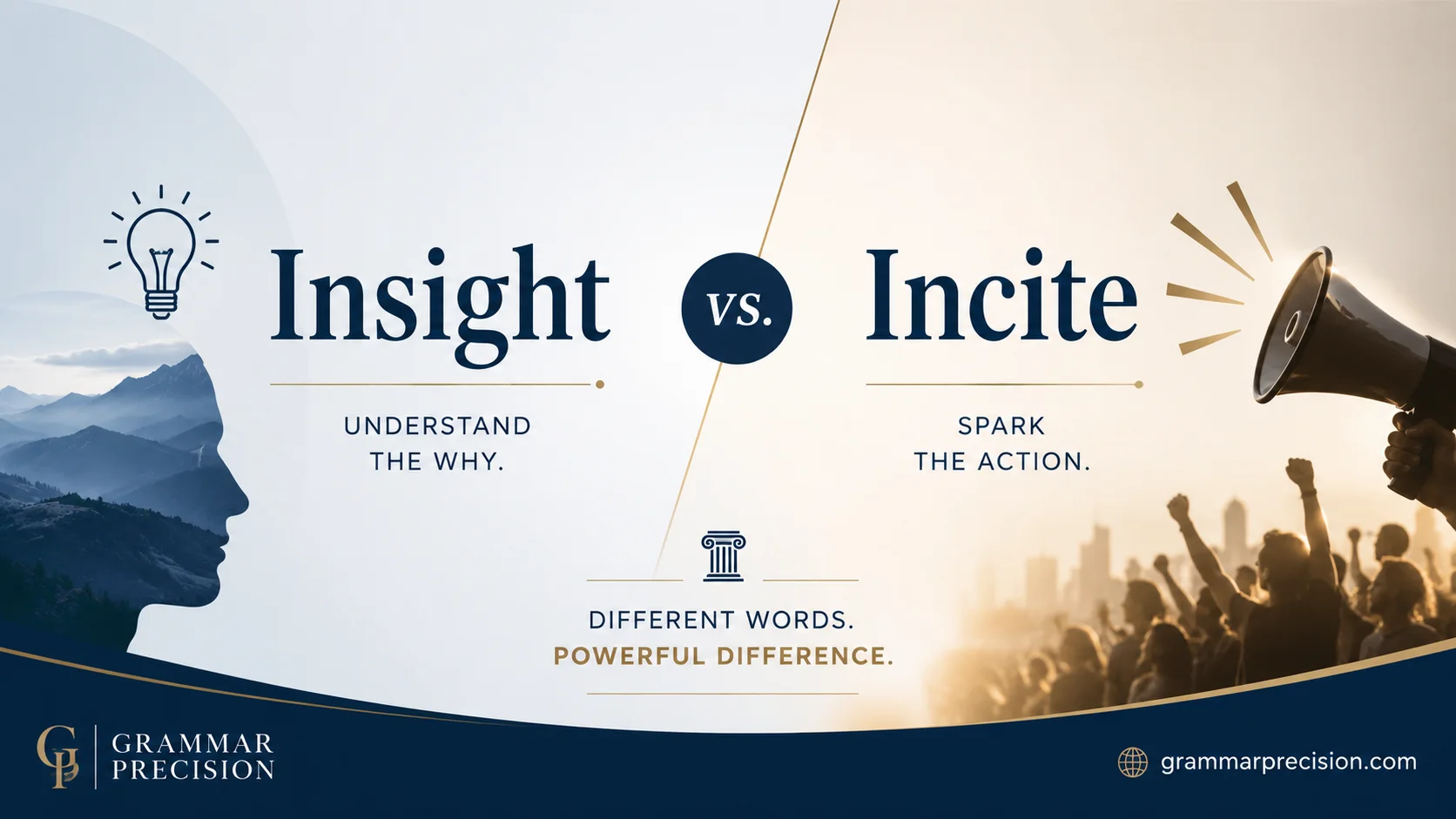
Insight vs. Incite explains how similar words create confusion. Understanding their meaning, usage, and context helps writers choose the correct term and improve clear communication in everyday writing with confidence.
The word insight refers to deep understanding gained through analysis and observation while incite is a verb that means to stimulate action or provoke behavior. These terms have different roles despite similar pronunciation. Learning this distinction improves grammar, vocabulary, and word choice for students, writers, marketers, and professionals who want stronger and more trustworthy writing.
A small mistake between insight and incite can create confusion and change the tone of a message. Using proper usage requires attention to context and purpose. Clear examples help readers understand how insight builds clarity while incite may lead to conflict or action. Regular practice develops language skills and supports effective communication with greater accuracy.
Quick Answer: Insight vs. Incite
If you’re in a hurry, here’s the simplest explanation:
| Word | Meaning | Example |
| Insight | Deep understanding or awareness | Her research provided valuable insight into consumer behavior. |
| Incite | To encourage, provoke, or stir someone to action | The speech incited the crowd to protest. |
The easiest way to remember the distinction is this:
- Insight = Understanding
- Incite = Action
One helps people see clearly. The other pushes people to do something.
Why People Confuse Insight and Incite
Many English learners and native speakers mix up these words because they share several characteristics.
Similar Spelling
Both words begin with “in” and contain similar letter patterns. When reading quickly, it’s easy to overlook the difference.
Compare them carefully:
- Insight
- Incite
Only a few letters differ, yet those small changes create entirely different meanings.
Similar Pronunciation
The words sound somewhat alike when spoken rapidly in conversation.
- Insight: IN-site
- Incite: in-SITE
Although the stress patterns differ slightly, many listeners may not immediately notice the distinction.
Contextual Misunderstanding
Another reason people confuse these words involves context.
Both frequently appear in:
- Academic writing
- Business reports
- Journalism
- Professional communication
As a result, readers sometimes assume they are interchangeable. They are not.
What Does Insight Mean?
The word insight refers to a deep understanding of a person, situation, idea, or problem.
Rather than merely knowing facts, insight involves seeing beneath the surface and recognizing patterns, causes, or hidden meanings.
Definition of Insight
Insight (noun): A clear and often deep understanding of a complex issue or situation.
Examples of Insight
- The scientist gained important insight into climate patterns.
- Customer surveys provided valuable insight into buyer preferences.
- Her years of experience gave her unique insight into the industry.
- The book offers insight into human behavior.
Notice something important.
In every example, insight relates to knowledge, understanding, or awareness.
No action is being encouraged. Instead, a deeper perspective is being gained.
Also Read This: Reckless or Wreckless: Meaning And Difference With Examples
The Power of Insight in Everyday Life
Insight plays a critical role in decision-making.
Successful people rarely rely on guesswork. They gather information, analyze patterns, and develop insight before taking action.
Consider these examples:
Business
Companies use customer data to gain insight into purchasing habits.
Healthcare
Doctors use patient histories to gain insight into medical conditions.
Education
Teachers develop insight into learning styles to improve instruction.
Personal Relationships
People gain insight into others by listening carefully and observing behavior.
In each situation, insight creates clarity.
As the saying goes:
“Knowledge tells you what happened. Insight tells you why it happened.”
That distinction makes insight especially valuable.
Common Collocations With Insight
Certain word combinations frequently appear alongside insight.
Popular Insight Phrases
- Valuable insight
- Deep insight
- Useful insight
- Personal insight
- Strategic insight
- Consumer insight
- Market insight
- Psychological insight
- Cultural insight
- Business insight
Example Sentences
- The report revealed valuable insights about customer loyalty.
- Her analysis offered deep insight into the issue.
- Market insights helped the company improve sales.
Learning these collocations helps your writing sound more natural and professional.
What Does Incite Mean?
Now let’s examine the second word.
Unlike insight, incite functions as a verb.
It means encouraging, provoking, or urging someone toward a particular action.
Sometimes that action may be positive. However, the word often carries a negative tone.
Definition of Incite
Incite (verb): To encourage, provoke, stimulate, or urge someone to take action.
Examples of Incite
- The speech incited the crowd to demonstrate.
- False rumors incited panic among residents.
- The leader’s remarks incited public outrage.
- Extremist messages may incite violence.
Notice the pattern.
Each example involves triggering a response or motivating behavior.
The focus shifts from understanding to action.
The Psychology Behind Incitement
Human beings respond strongly to emotional triggers.
Throughout history, leaders, advertisers, activists, and public speakers have used language to influence behavior.
When language successfully motivates people to act, it may be described as inciting action.
Psychologists often identify several common triggers:
- Fear
- Anger
- Excitement
- Hope
- Urgency
- Social pressure
These emotional drivers can persuade individuals to make decisions they might not otherwise make.
That is why the word incite frequently appears in discussions about politics, protests, social movements, and public communication.
Common Collocations With Incite
Just as insight has common word partners, incite also appears in recurring phrases.
Popular Incite Expressions
- Incite violence
- Incite unrest
- Incite panic
- Incite rebellion
- Incite hatred
- Incite outrage
- Incite action
- Incite conflict
Example Sentences
- The article was criticized for potentially inciting panic.
- Certain messages may incite hostility.
- The campaign aimed to incite public participation.
These phrases appear regularly in news reports and legal discussions.
Insight vs. Incite: Side-by-Side Comparison
The easiest way to understand the difference is through direct comparison.
| Feature | Insight | Incite |
| Part of Speech | Noun | Verb |
| Primary Meaning | Understanding | Encouraging action |
| Emotional Tone | Neutral or positive | Often negative |
| Focus | Knowledge | Behavior |
| Common Context | Research, education, business | Politics, law, activism |
| Example | She gained insight into the problem. | The speech incited the crowd. |
This table highlights the fundamental distinction.
Insight informs. Incite motivates.
A Simple Memory Trick You’ll Never Forget
Many students struggle to remember which word is which.
Fortunately, there’s an easy shortcut.
Insight = Seeing Inside
Think about the word itself:
In + Sight
You are seeing inside a problem.
You understand it more deeply.
Incite = Igniting Action
Notice the letters:
Incite → Ignite
Both involve starting something.
Both involve triggering action.
When someone incites others, they ignite a reaction.
This memory trick works because it connects each word to its core meaning.
Real-Life Examples of Insight vs. Incite
Understanding definitions is helpful.
Seeing real-world usage makes the difference unforgettable.
Example One: Business Meeting
Correct:
“The survey provided insight into customer preferences.”
Incorrect:
“The survey provided incite into customer preferences.”
Why?
A survey delivers understanding, not encouragement.
Example Two: Public Protest
Correct:
“The speech incited the crowd to march.”
Incorrect:
“The speech insighted the crowd to march.”
Why?
The speech encouraged action.
That requires the verb incite.
Example Three: Research Report
Correct:
“The report offers insight into consumer trends.”
Why?
Reports provide knowledge and understanding.
Example Four: Social Media Controversy
Correct:
“The post was accused of inciting hostility.”
Why?
The post allegedly encouraged negative behavior.
That falls under incite.
Insight vs. Incite in Business Communication
Business professionals frequently use the word insight.
Companies collect data every day. However, data alone isn’t enough.
Organizations seek insights that help them make better decisions.
Examples include:
- Customer insights
- Market insights
- Product insights
- Sales insights
- Behavioral insights
A business leader may say:
“Our analytics team uncovered valuable insights about customer retention.”
This statement sounds professional because insight accurately describes understanding derived from information.
By contrast, incite rarely appears in business reports unless discussing controversy, legal matters, or public relations crises.
Insight vs. Incite in Journalism, Education, and Marketing
Context matters when choosing between insight and incite. While both words appear in professional writing, they serve very different purposes.
Journalism
Journalists often use insight when discussing analysis, research, or expert opinions.
Examples:
- The investigation provided fresh insight into the financial scandal.
- Experts shared insight about the economic impact of the policy.
The word incite appears when reporting actions that encourage unrest, violence, or strong reactions.
Examples:
- Authorities claimed the speech could incite unrest.
- The controversial post allegedly incited public anger.
Because journalism values precision, confusing these words can completely alter a story’s meaning.
Education
Teachers and researchers use insight constantly.
Examples include:
- Literary insight
- Historical insight
- Scientific insight
- Student insight
A professor might write:
“The study offers valuable insight into learning behavior.”
Using incite in this context would be incorrect because the goal is understanding rather than motivation.
Marketing
Marketing teams depend heavily on insights.
Common examples include:
- Consumer insights
- Audience insights
- Purchasing insights
- Market insights
These insights help businesses understand customers and create better campaigns.
However, marketers occasionally use incite when discussing campaigns designed to inspire action.
For example:
- The campaign aimed to incite immediate engagement.
- The advertisement sought to incite curiosity among viewers.
Although possible, this usage is less common because “encourage” or “motivate” often sound more natural.
The Origins of Insight and Incite
Understanding where words come from often makes them easier to remember.
Etymology of Insight
The word insight developed from the idea of “seeing within.”
Breaking it apart reveals its meaning:
- In = within
- Sight = vision
Originally, the word referred to seeing deeply into a matter rather than merely observing the surface.
Over time, it evolved into its modern meaning of deep understanding.
Etymology of Incite
The word incite comes from the Latin word incitare, meaning:
- To urge
- To stimulate
- To provoke
Its historical meaning closely matches its current usage.
Both words may look similar today, but their origins reveal completely different concepts.
One centers on understanding.
The other centers on stimulation and action.
The Psychology of Insight: Why It Matters
Insight does more than provide information.
It transforms how people think.
Psychologists often describe insight as the moment when a solution suddenly becomes clear.
Many people call this:
- An “aha moment”
- A breakthrough
- A revelation
Consider a puzzle that seems impossible.
You struggle for hours.
Then suddenly everything clicks.
That’s insight.
Characteristics of Genuine Insight
- Reveals hidden patterns
- Clarifies complex problems
- Improves decision-making
- Creates understanding
- Leads to innovation
Many groundbreaking discoveries began with insight rather than luck.
Scientists, entrepreneurs, and inventors often spend years gathering information before reaching a transformative insight.
The Psychology of Incitement: Why Words Influence Behavior
Words possess tremendous power.
History contains countless examples of language influencing public behavior.
When communication triggers action, it may be considered incitement.
Common Emotional Triggers
| Trigger | Possible Response |
| Fear | Avoidance or panic |
| Hope | Motivation |
| Anger | Protest or resistance |
| Excitement | Participation |
| Urgency | Immediate action |
| Belonging | Group behavior |
Effective communicators understand these triggers.
Advertisers use them.
Political leaders use them.
Activists use them.
Public speakers use them.
This does not automatically make incitement negative. However, the word frequently appears in negative contexts because it often involves provoking strong reactions.
Common Mistakes People Make With Insight vs. Incite
Even experienced writers occasionally confuse these words.
Let’s examine the most common errors.
Mistake: Using Incite When You Mean Understanding
Incorrect:
- The report provided incite into customer behavior.
Correct:
- The report provided insight into customer behavior.
Why?
Reports provide understanding, not encouragement.
Mistake: Using Insight as a Verb
Incorrect:
- The speech insighted the audience to act.
Correct:
- The speech incited the audience to act.
Why?
Insight is primarily a noun.
Incite is a verb.
Mistake: Assuming They Are Interchangeable
Incorrect:
- The article gave readers incite about climate change.
Correct:
- The article gave readers insight about climate change.
The meanings differ too much to substitute one for the other.
Insight vs. Incite in Popular Phrases
Certain expressions frequently appear in books, articles, and professional documents.
Common Insight Phrases
- Gain insight
- Offer insight
- Provide insight
- Deep insight
- Valuable insight
- Personal insight
- Unique insight
- Strategic insight
Common Incite Phrases
- Incite violence
- Incite unrest
- Incite rebellion
- Incite panic
- Incite conflict
- Incite outrage
- Incite action
- Incite hatred
Learning these combinations helps you recognize the correct word instantly.
Insight vs. Incite: Example Sentences
Examples make the distinction crystal clear.
Insight Examples
- Her experience gave her insight into leadership challenges.
- The survey revealed valuable customer insights.
- Researchers gained new insight into memory formation.
- The documentary offered insight into ancient civilizations.
- Good mentors provide insight rather than simple advice.
- The book contains deep psychological insight.
- The discussion generated useful insights for future planning.
- Analysts shared insight regarding market conditions.
- The interview gave readers insight into the athlete’s mindset.
- Years of practice developed his insight into human behavior.
Incite Examples
- The speech incited strong reactions among attendees.
- False information may incite panic.
- Leaders must avoid language that incites hatred.
- The article was accused of inciting unrest.
- Certain messages can incite aggressive behavior.
- The campaign sought to incite public participation.
- Rumors incited concern throughout the community.
- The crowd became louder after the remarks incited excitement.
- The controversial statement incited criticism online.
- The activist hoped to incite meaningful change.
Case Study: One Word, Two Completely Different Meanings
Imagine a newspaper publishing the following headline:
“Research Report Incites New Understanding of Consumer Behavior”
Something feels wrong.
The report didn’t encourage understanding.
It provided understanding.
A better headline would be:
“Research Report Provides New Insight Into Consumer Behavior”
Now consider another headline:
“Political Speech Offers Insight Violence”
Again, the wording sounds strange.
The intended meaning is probably:
“Political Speech Incites Violence”
A single word changes the entire message.
This example highlights why precise language matters.
Related Words Commonly Confused With Insight and Incite
People who confuse insight and incite often struggle with other similar word pairs.
Affect vs. Effect
| Word | Meaning |
| Affect | Usually a verb |
| Effect | Usually a noun |
Advice vs. Advise
| Word | Meaning |
| Advice | Noun |
| Advise | Verb |
Elicit vs. Illicit
| Word | Meaning |
| Elicit | Draw out a response |
| Illicit | Illegal |
Principal vs. Principle
| Word | Meaning |
| Principal | Main or leader |
| Principle | Rule or belief |
Learning these distinctions strengthens your overall writing skills.
Quick Self-Test: Insight or Incite?
Choose the correct word.
Question 1
The report provided valuable ______ into customer satisfaction.
Answer: Insight
Question 2
The speech was criticized for attempting to ______ unrest.
Answer: Incite
Question 3
Years of experience gave her remarkable ______ into negotiations.
Answer: Insight
Question 4
Officials worried the rumors might ______ panic.
Answer: Incite
Question 5
The study offers fresh ______ into workplace productivity.
Answer: Insight
Question 6
The leader’s comments seemed designed to ______ anger.
Answer: Incite
If you answered all six correctly, you’ve mastered the basic distinction.
Expert Tips to Never Mix Up Insight and Incite Again
Remember the Function
- Insight = Thing (noun)
- Incite = Action (verb)
Focus on the Goal
Ask yourself:
Is the sentence about understanding?
Use insight.
Is it about encouraging action?
Use incite.
Use the Memory Formula
- Insight = Seeing inside
- Incite = Ignite action
Check the Context
Business reports, research papers, and educational materials usually involve insight.
Political speeches, protests, controversies, and public reactions often involve incite.
FAQs:
What is the main difference between Insight and Incite?
Insight means a deep understanding, idea, or awareness gained through analysis and observation. Incite means to encourage or provoke action, often related to behavior, conflict, or strong reactions. They sound similar but have completely different meanings and uses.
Is Insight a noun or a verb?
Insight is a noun because it describes an idea, understanding, or clear perspective about something. For example, gaining an insight into a problem means developing better knowledge or awareness of that situation.
Is Incite always negative?
Incite often has a negative meaning because it is commonly connected with violence, conflict, or trouble. However, the word simply means to stimulate action, so the meaning depends on the context in which it is used.
Why do people confuse Insight and Incite?
People confuse Insight and Incite because they have similar pronunciation and sound alike. However, their usage, purpose, and meanings are different. Understanding their distinction helps avoid writing mistakes and improves communication.
How can I remember the difference between Insight and Incite?
A simple rule is that insight is something you have because it represents understanding, while incite is something you do because it means encouraging an action. Remembering this difference makes correct word choice easier.
Conclusion:
Understanding the difference between Insight vs. Incite improves your writing, grammar, and overall communication skills. Although both words sound similar, their meanings, functions, and contexts are completely different. Using insight for understanding and incite for encouraging action helps create clear, accurate, and professional content.