It’s vs. Its is a common confusion in English writing that affects clarity when people use apostrophe incorrectly in sentences about possession and contraction forms every time it appears mistake
its shows possession while it’s is a contraction of it is or it has, and the apostrophe replaces missing letters making meaning different in writing Many learners get confused because both words sound same and come from base pronoun it making mistakes in writing common but easy to fix using substitution trick in daily usage
To avoid common mistakes, always use substitution trick and replace it’s with it is or it has when possible, otherwise choose its for possession and clarity in writing Example sentences help learners understand difference clearly like see its eyes shows ownership while it’s used incorrectly changes meaning entirely in formal writing contexts keep practice to improve usage
The Fastest Explanation of It’s vs. Its
If you only remember one thing from this article, remember this:
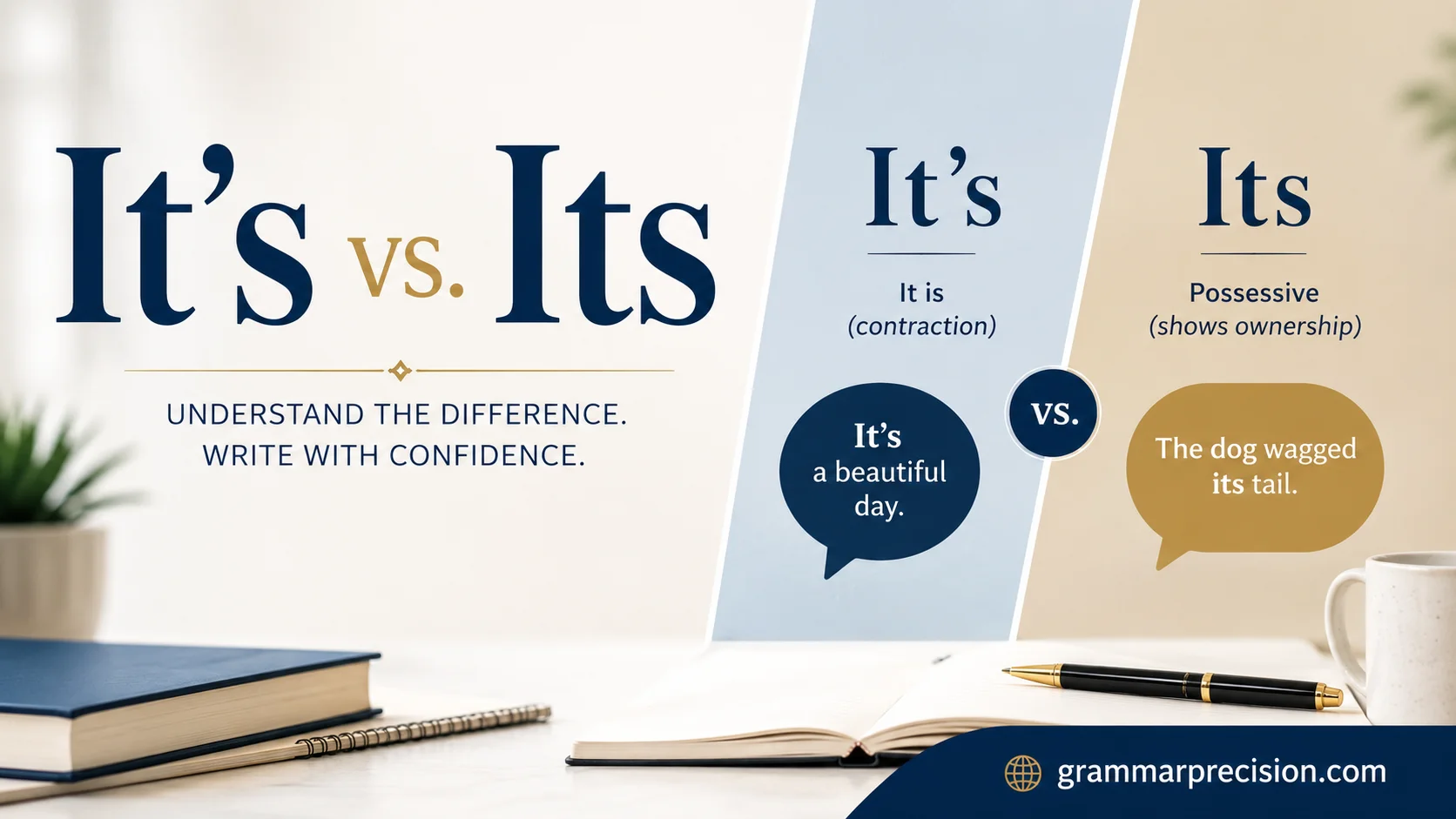
| Word | Meaning | Example |
| It’s | It is / It has | It’s raining outside |
| Its | Shows possession | The dog wagged its tail |
That’s the entire rule.
Seriously.
However, because English likes to keep everyone humble, many people still second guess themselves.
What Does “It’s” Mean?
The word it’s is a contraction.
A contraction combines two words into one shorter form.
“It’s” Can Mean:
- It is
- It has
Examples
- It’s cold today.
→ It is cold today. - It’s been a long week.
→ It has been a long week. - It’s impossible to ignore.
→ It is impossible to ignore.
Here’s the easiest trick in the world:
Replace “it’s” with “it is” or “it has.”
If the sentence still makes sense, you used the correct word.
What Does “Its” Mean?
The word its shows possession.
That means something belongs to something else.
Examples
- The company changed its logo.
- The cat cleaned its paws.
- The phone lost its connection.
In each sentence, something owns or contains something.
No apostrophe needed.
Why This Rule Confuses So Many People
Now comes the sneaky part.
Most possessive words in English use apostrophes.
For example:
| Word | Possessive Form |
| John | John’s |
| Sarah | Sarah’s |
| Dog | Dog’s |
Naturally, people assume it’s must also show possession.
That assumption feels logical.
Unfortunately, English decided to ignore logic here.
Instead:
- It’s = contraction
- Its = possession
That contradiction trips people constantly because the brain expects consistency.
Why “Its” Has No Apostrophe
This rule feels backward until you compare it with other possessive pronouns.
Look closely at this table:
| Pronoun | Possessive Form |
| He | His |
| She | Hers |
| You | Yours |
| It | Its |
Notice something interesting?
None of these possessive pronouns use apostrophes.
That’s why its doesn’t use one either.
The confusion happens because people mentally compare it to nouns instead of pronouns.
The One Memory Trick That Never Fails
Grammar experts love complicated explanations. However, the simplest tricks usually work best.
Here’s the easiest memory shortcut:
The Expansion Test
Replace the word with:
- It is
- It has
If the sentence still works, use it’s.
If it doesn’t, use its.
Example
Sentence:
The laptop lost it’s battery connection.
Now test it:
The laptop lost it is battery connection.
That sounds ridiculous.
Correct version:
The laptop lost its battery connection.
Simple. Fast. Reliable.
Side by Side Examples of It’s vs. Its
Sometimes seeing examples side by side makes everything click instantly.
| Correct Sentence | Why It Works |
| It’s snowing outside | Means “it is” |
| The company changed its policy | Shows possession |
| It’s been a difficult year | Means “it has” |
| The bird spread its wings | Possession |
| It’s obvious what happened | Means “it is” |
| The school updated its website | Possession |
Once you practice a few examples, your brain starts recognizing patterns naturally.
Real Life Examples You’ll Actually See
Grammar rules matter most when they appear in everyday writing.
Let’s look at common situations where people misuse it’s and its.
Workplace Emails
Professional emails often contain apostrophe mistakes because people type quickly.
Incorrect:
The company updated it’s hiring process.
Correct:
The company updated its hiring process.
Tiny mistake. Big difference.
Many hiring managers quietly judge writing quality during recruitment. Fair or unfair, grammar affects perception.
Social Media Posts
Social platforms move fast. Mistakes spread even faster.
Example:
Its finally Friday!
That sentence should use:
It’s finally Friday!
Because:
- It is finally Friday
One missing apostrophe can trigger entire comment sections filled with grammar corrections.
Blog Writing
Bloggers frequently confuse the two words while editing quickly.
Example:
The website improved it’s design.
Correct version:
The website improved its design.
Readers may not consciously analyze grammar. However, awkward wording creates friction subconsciously.
Academic Writing
Professors notice apostrophe mistakes immediately.
In formal writing, repeated errors can:
- Hurt clarity
- Lower grades
- Reduce credibility
- Distract readers
That’s why mastering this tiny rule matters more than people think.
Also Read This: Disoriented vs. Disorientated
Why Grammar Mistakes Affect Credibility
Here’s an uncomfortable truth:
People judge writing almost instantly.
Even small grammar mistakes shape perception.
A reader may unconsciously think:
- Careless
- Unprofessional
- Rushed
- Less trustworthy
That reaction happens within seconds.
A Simple Analogy
Think of grammar like ironing a shirt.
One wrinkle won’t destroy the outfit. However, several wrinkles make the entire presentation feel sloppy.
Writing works the same way.
The Psychology Behind Apostrophe Mistakes
Researchers studying reading behavior discovered something fascinating:
Readers process familiar grammar patterns almost automatically.
When a sentence breaks expected patterns, the brain pauses.
That pause creates friction.
Example
Correct sentence:
The dog wagged its tail.
Incorrect sentence:
The dog wagged it’s tail.
Even if readers understand the meaning, the apostrophe creates a mental speed bump.
Smooth writing feels invisible. Bad grammar pulls readers out of the experience.
Famous Grammar Mistakes From Major Brands
Even billion dollar companies make apostrophe mistakes.
And the internet never forgets.
Example: Restaurant Sign Errors
Restaurants frequently print signs like:
- “Its Delicious!”
- “Burger’s and Fry’s”
People photograph those mistakes constantly.
Then social media does what social media does best:
- Screenshots
- Memes
- Public roasting
Example: News Headlines
Major publications occasionally publish:
“The company announced it’s expansion plans.”
Readers spot those mistakes immediately.
Some articles receive thousands of comments discussing grammar instead of the actual story.
Common Sentences That Trick Smart People
Certain sentence structures create confusion more often than others.
Here are the biggest troublemakers.
“Its Been”
Incorrect:
Its been a stressful week.
Correct:
It’s been a stressful week.
Why?
- It has been
“The Company Changed It’s Policy”
Incorrect:
The company changed it’s policy.
Correct:
The company changed its policy.
Why?
- Ownership
- The policy belongs to the company
“Its Easy”
Incorrect:
Its easy to understand.
Correct:
It’s easy to understand.
Why?
- It is easy
Why Smart Writers Still Make This Mistake
People often assume grammar mistakes happen because someone lacks intelligence.
That’s nonsense.
Even professional writers make these errors because the brain processes familiar words automatically.
Common Causes Include:
- Fast typing
- Mental fatigue
- Autocorrect dependence
- Skimming during proofreading
- Habit patterns
Your brain sometimes sees what it expects instead of what’s actually there.
That’s why proofreading matters so much.
The Hidden Role of Autocorrect
Autocorrect helps. However, it also creates new problems.
Many writing tools:
- Miss context errors
- Suggest incorrect replacements
- Fail to recognize intended meaning
Example
A sentence like:
The company changed it’s logo.
May slip past certain tools because:
- “It’s” is technically a real word
Grammar software struggles with contextual understanding sometimes.
That’s why human proofreading still matters.
How Professional Editors Catch These Mistakes
Experienced editors use surprisingly simple techniques.
Read Backward
Start from the final sentence and move upward.
This breaks your brain’s prediction patterns.
Read Out Loud
Hearing the sentence exposes awkward wording faster.
Slow Down Around Apostrophes
Tiny punctuation marks often hide inside fast moving text.
Use the Expansion Trick
Replace:
- It’s → it is / it has
The sentence instantly reveals the correct answer.
It’s vs. Its in Business Writing
Business communication values clarity more than almost anything else.
Grammar mistakes create unnecessary distractions.
Common Business Examples
| Incorrect | Correct |
| The brand updated it’s image | The brand updated its image |
| Its been a strong quarter | It’s been a strong quarter |
| The app improved it’s security | The app improved its security |
Tiny corrections dramatically improve professionalism.
Why Apostrophe Mistakes Spread Online
The internet moves quickly. Fast writing encourages shortcuts.
People:
- Post without proofreading
- Rely heavily on autocorrect
- Prioritize speed over precision
As a result, grammar mistakes spread everywhere.
Ironically, repeated exposure sometimes makes incorrect forms look normal.
That’s how confusion grows.
The History Behind “It’s” and “Its”
English grammar evolved like a messy garage.
Things got added randomly over centuries.
Early English Variations
Historically, writers experimented with several forms:
- Its
- It’s
- His
- Her
- Of it
Standardized punctuation developed gradually.
By the 18th century:
- “It’s” settled into contraction territory
- “Its” became the accepted possessive form
The system remained confusing ever since.
Why English Grammar Loves Contradictions
English behaves like a patchwork quilt stitched together from different languages.
That’s why rules constantly clash.
For example:
| Rule | Exception |
| Apostrophes show possession | Except “its” |
| I before E | Weird, science, foreign |
| Silent letters are rare | Knight, debt, honest |
The language evolved organically rather than logically.
That’s why memorization sometimes beats analysis.
Easy Memory Hacks for It’s vs. Its
Memory tricks work because they simplify decisions instantly.
Here are the most effective ones.
The “It Is” Test
If “it is” works:
- Use it’s
If it doesn’t:
- Use its
The “His” Comparison
Compare:
- His car
- Its engine
Neither uses an apostrophe.
The Pronunciation Trick
Read the sentence slowly.
If you naturally hear:
- “it is”
- “it has”
Then use:
- it’s
Mini Practice Quiz
Let’s test your instincts.
Choose the Correct Word
Sentence 1
The company updated ___ website.
Answer:
its
Sentence 2
___ going to rain tonight.
Answer:
It’s
Sentence 3
The dog chased ___ tail.
Answer:
its
Sentence 4
___ been a long journey.
Answer:
It’s
See? Once you understand the logic, the pattern becomes surprisingly predictable.
Related Grammar Mistakes You Should Also Avoid
People who confuse it’s vs. its often struggle with similar word pairs.
Common Troublemakers
| Incorrect Pair | Correct Usage |
| Your / You’re | Possession vs contraction |
| Their / There / They’re | Location, possession, contraction |
| Who’s / Whose | Contraction vs possession |
| Affect / Effect | Verb vs noun |
These mistakes happen for similar reasons:
- Sound similarity
- Fast typing
- Grammar shortcuts
Case Study: How One Apostrophe Changed Reader Reactions
A marketing agency once published an ad reading:
“The company expanded it’s services.”
The campaign itself looked polished. The design felt premium. The copy sounded professional.
Then readers noticed the apostrophe.
Comments flooded in:
- “Did nobody proofread this?”
- “Hard to trust a marketing agency with grammar mistakes.”
- “Imagine paying for bad copy.”
One tiny punctuation mark distracted everyone from the actual message.
That’s the power of perception.
The Difference Between Casual and Professional Writing
Casual conversations tolerate mistakes more easily.
Professional environments usually don’t.
Casual Text
its okay lol
Most friends won’t care.
Business Proposal
The company updated it’s financial strategy.
That mistake creates a different impression entirely.
Context changes expectations.
Why Readers Notice Apostrophe Errors So Quickly
Apostrophes stand out visually.
They’re tiny marks. However, they interrupt word shapes.
When punctuation appears unexpectedly, readers notice immediately.
Especially educated readers.
That’s why apostrophe mistakes attract attention faster than many spelling errors.
It’s vs. Its in Modern Digital Communication
Digital writing changed grammar habits dramatically.
People now:
- Type faster
- Edit less
- Publish instantly
As a result, apostrophe confusion appears everywhere:
- Tweets
- YouTube comments
- TikTok captions
- Emails
- LinkedIn posts
However, polished writing still stands out because so much online content feels rushed.
Practical Editing Checklist
Before publishing anything important, check these quickly:
Apostrophe Checklist
- Can “it is” replace “it’s”?
- Does the sentence show possession?
- Did autocorrect change anything?
- Did you proofread slowly?
- Did you read the sentence aloud?
Five seconds of editing prevents embarrassing mistakes later.
FAQs:
What is the difference between its and it’s?
The main difference is that its shows possession, while it’s is a contraction of it is or it has. The apostrophe completely changes the meaning, so correct usage is very important in writing.
Why do people confuse its and it’s?
People confuse them because both words sound the same in spoken English and come from the same base pronoun “it.” This makes them confusing words in written English language, especially for native speakers.
How can I remember when to use its?
You can remember using the substitution trick: if you can replace the word with it is or it has, use it’s. If not, then use its for possession or belonging.
Is it wrong to use it’s for possession?
Yes, using it’s for possession is a common mistake. The correct possessive form is always its, without an apostrophe, to avoid changing the meaning entirely.
What is the easiest way to learn its vs it’s?
The easiest way is regular practice, using examples like “its eyes” for possession and “it’s raining” for contraction. Repetition helps reduce confusion and improves writing accuracy.
Conclusion:
Understanding It’s vs Its is essential for clear and correct writing. The key is remembering that its shows possession, while it’s is a contraction of it is / it has. Many learners make common mistakes because both words sound the same, but with simple rules, practice, and the substitution trick, you can easily avoid confusion.
Mastering this small but important distinction improves overall English grammar accuracy and makes your writing more professional and clear.