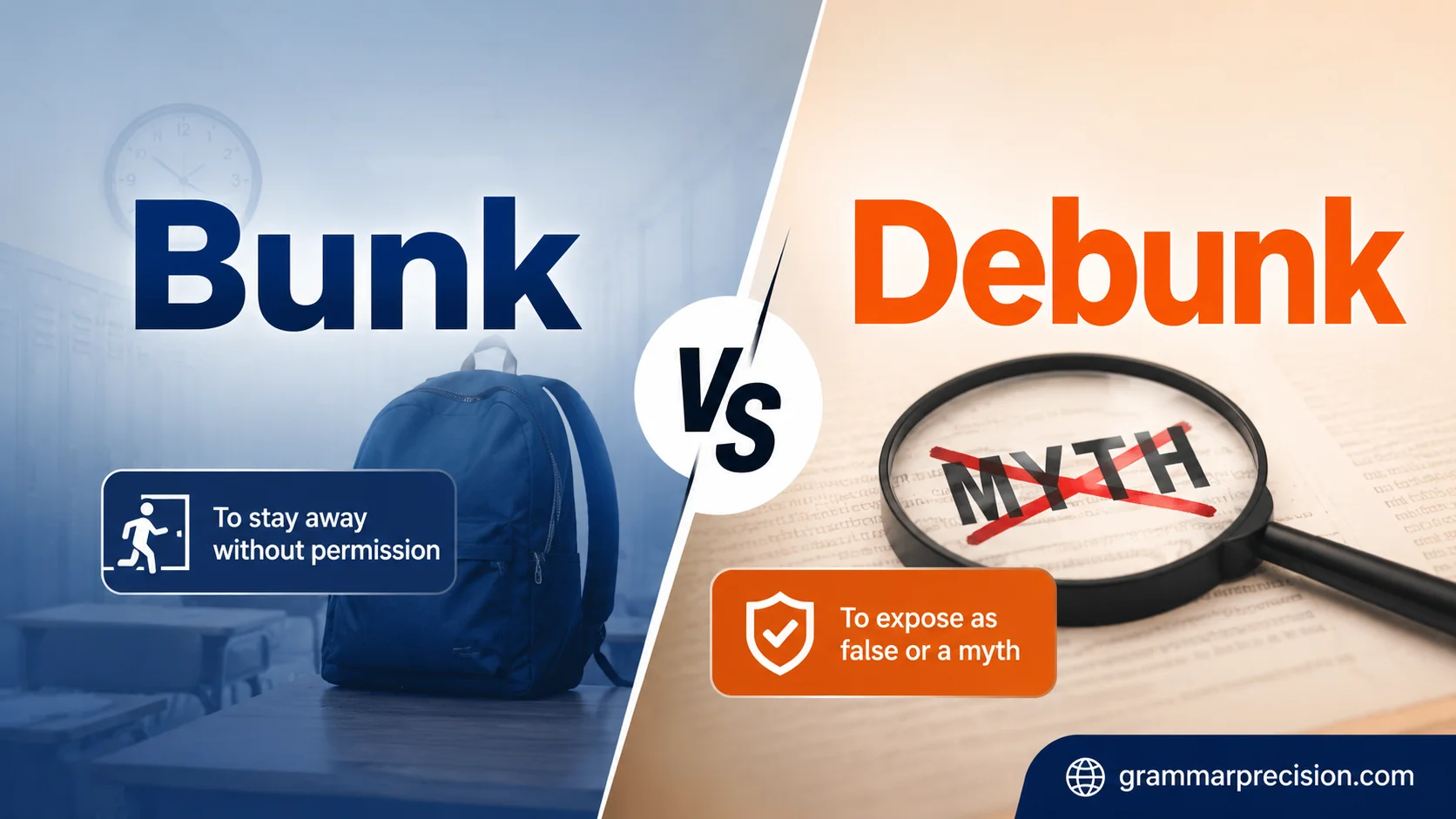
Bunk vs Debunk is a common comparison that helps people understand the difference between false information and the act of proving something false. Knowing these terms improves communication and critical thinking skills.
Understanding Bunk vs Debunk is important in today’s digital world. Bunk refers to misleading information, nonsense, or claims that lack evidence and credibility. In contrast, debunk means using facts, logic, and careful analysis to expose false beliefs and correct misunderstandings effectively.
On social media, misinformation, fake news, and unverified content can spread quickly among users. This is why fact checking, truth verification, and logical reasoning are essential. Journalists, researchers, and educators often work to debunk myths and improve public understanding through accurate information.
Bunk vs Debunk: What’s the Main Difference?
The easiest way to understand the difference is this:
| Word | Meaning | Part of Speech |
| Bunk | Nonsense, foolish talk, or something false | Usually a noun |
| Debunk | To expose a false claim or prove something wrong | Verb |
Here’s the simplest memory rule:
Bunk is the false idea. Debunk is the action of proving it false.
For example:
- “That conspiracy theory is complete bunk.”
- “Scientists debunked the conspiracy theory.”
One word refers to nonsense. The other refers to exposing nonsense.
What Does “Bunk” Mean?
The word bunk has several meanings in English. However, people most commonly use it to describe something false, ridiculous, or meaningless.
Bunk as Nonsense
This is the modern meaning most people recognize.
When someone calls something “bunk,” they mean it’s fake, foolish, dishonest, or absurd.
Examples
- “That miracle cure sounds like bunk.”
- “His explanation was pure bunk.”
- “A lot of internet rumors are complete bunk.”
The word usually sounds casual and dismissive.
The History Behind the Word “Bunk”
The modern meaning comes from the old phrase:
“Talk bunk.”
That expression became popular in American politics during the early twentieth century. Over time, people shortened it to simply “bunk.”
Originally, it referred to empty political speeches and meaningless public statements. Eventually, the word evolved into a general slang term for nonsense.
Language changes constantly. Words stretch and shift like rivers changing direction. “Bunk” is a perfect example of that evolution.
Bunk as a Bed
Interestingly, “bunk” also means a narrow sleeping bed attached to another bed.
You’ll usually hear this meaning in phrases like:
- Bunk beds
- Army bunks
- Train bunks
Example
- “The children slept in bunk beds.”
This definition has nothing to do with nonsense. Context usually makes the intended meaning obvious.
What Does “Debunk” Mean?
The word debunk means:
To expose a false claim, myth, or belief using evidence and reasoning.
Unlike “bunk,” which labels something false, “debunk” describes the process of proving something false.
The Origin of “Debunk”
The word combines two parts:
- De meaning remove
- Bunk meaning nonsense
So “debunk” literally means:
“To remove the nonsense.”
That makes the meaning surprisingly easy to remember.
Examples of Debunk in Sentences
- “Researchers debunked the myth.”
- “Journalists debunked the fake story.”
- “Scientists debunked the internet rumor.”
- “The documentary debunks several conspiracy theories.”
Notice how “debunk” almost always involves proof, evidence, investigation, or explanation.
Bunk vs Debunk: Side by Side Comparison
This comparison table makes the distinction crystal clear.
| Feature | Bunk | Debunk |
| Meaning | Falsehood or nonsense | Expose something false |
| Word Type | Usually noun | Verb |
| Tone | Informal | Analytical |
| Common Usage | Casual speech | Journalism and science |
| Example | “That’s bunk.” | “Experts debunked it.” |
| Focus | The false idea | The action of disproving |
| Emotional Tone | Dismissive | Investigative |
Why People Confuse Bunk and Debunk
The confusion happens for several reasons.
Similar Spelling
Both words look almost identical. Your brain naturally groups them together.
That tiny “de” changes everything.
Shared Connection to False Information
Both words relate to fake claims, misinformation, and myths.
For example:
- Bunk = false information
- Debunk = proving information false
They connect to the same topic from different directions.
Social Media Misuse
The internet spreads grammar mistakes incredibly fast.
People often misuse words online. Others copy those mistakes without realizing it. Soon the incorrect version starts looking normal.
Fast Typing and Autocorrect
Many writers accidentally skip prefixes while typing quickly.
Autocorrect sometimes makes the situation worse instead of better.
How “Debunk” Became Popular Online
The internet changed language dramatically.
As misinformation spread rapidly online, fact checking became more important than ever. That’s when the word “debunk” exploded in popularity.
Today, headlines constantly use it:
- “Doctors Debunk Viral Health Claim”
- “Experts Debunk Alien Theory”
- “Scientists Debunk TikTok Myth”
The word became deeply tied to:
- Journalism
- Scientific research
- Fact checking
- Investigative reporting
- Media analysis
The Psychology Behind Believing Bunk
Humans don’t always believe facts. Emotions often influence belief more than evidence.
That’s why bunk spreads so easily.
Confirmation Bias
People naturally trust information that supports their existing opinions.
Even weak evidence can feel convincing when it matches personal beliefs.
Example
Someone who distrusts medicine may accept false health claims faster than scientific evidence.
Emotional Headlines Spread Faster
Research repeatedly shows that emotional content travels faster online.
Fear. Anger. Shock. Outrage.
These emotions encourage clicks and shares.
Unfortunately, false stories often trigger strong emotional reactions.
Repetition Creates Familiarity
When people hear something repeatedly, they begin accepting it as true.
Even completely false information can start feeling believable after enough repetition.
That’s one reason debunking matters so much.
Also Read This: Ardor or Ardour
How Experts Debunk False Claims
Professional debunking follows a careful process. It’s not random guessing.
Evidence Collection
Researchers gather:
- Scientific studies
- Videos
- Documents
- Data
- Witness statements
Without evidence, debunking becomes opinion instead of proof.
Source Verification
Fact checkers investigate:
- Who published the claim
- Whether sources are reliable
- Original publication dates
- Manipulated media
Many viral stories come from unreliable sources.
Logical Analysis
Experts test whether claims make logical sense.
Sometimes false stories collapse instantly under basic scrutiny.
Public Communication
Debunking only works if people understand the explanation.
Strong communicators simplify complicated information without losing accuracy.
Clear writing matters.
Bunk vs Debunk in Journalism
Journalists use these words differently depending on context.
“Bunk” in Journalism
Reporters occasionally use “bunk” informally when dismissing nonsense.
Example
- “Critics called the theory complete bunk.”
Still, professional journalism often prefers more neutral language.
“Debunk” in Journalism
The word “debunk” appears constantly in investigative reporting.
Example Headlines
- “Scientists Debunk Viral Claim”
- “Experts Debunk Election Rumors”
- “Researchers Debunk Health Myth”
The word signals evidence based analysis.
Bunk vs Debunk in Science
Science depends heavily on debunking.
Researchers constantly test ideas and challenge assumptions. Weak theories collapse under evidence. Strong theories survive repeated examination.
Science isn’t about protecting beliefs. It’s about testing them.
Famous Myths That Scientists Debunked
| Myth | Reality |
| Humans use only 10% of their brains | Brain scans show activity across most regions |
| Sugar makes children hyperactive | Research found weak evidence |
| Vaccines cause autism | Extensive studies disproved this claim |
| Cracking knuckles causes arthritis | No strong scientific proof supports it |
Common Mistakes People Make
Small wording errors create major confusion.
Here are the most common mistakes involving bunk vs debunk.
Incorrect Example
- “Scientists bunked the theory.”
Correct Version
- “Scientists debunked the theory.”
Incorrect Example
- “That article was debunk.”
Correct Version
- “That article was bunk.”
Incorrect Example
- “That’s debunk.”
Correct Version
- “That’s bunk.”
Easy Memory Tricks for Bunk vs Debunk
Simple memory shortcuts make grammar easier.
Think About the Prefix “De ”
The prefix “de ” often means remove.
Examples:
- Defrost = remove frost
- Decode = remove confusion
- Debunk = remove nonsense
That tiny prefix completely changes the meaning.
Bunk Means Bad Information
Both words start with “B.”
That makes this easy:
Bunk = Bad information
Debunk Means Destroy the Bunk
This may be the easiest memory trick of all.
Synonyms for Bunk
Using different vocabulary improves your writing.
| Synonym | Tone |
| Nonsense | Neutral |
| Hogwash | Informal |
| Baloney | Humorous |
| Garbage | Casual |
| Rubbish | British English |
| Foolishness | Formal |
| Claptrap | Old fashioned |
Synonyms for Debunk
Here are useful alternatives for “debunk.”
| Synonym | Best Context |
| Refute | Academic writing |
| Disprove | Scientific writing |
| Expose | Journalism |
| Invalidate | Formal contexts |
| Challenge | General writing |
| Correct | Educational content |
Bunk vs Debunk in Social Media
Social media changed the way people use language.
Platforms reward emotional content, fast reactions, and sensational headlines. Unfortunately, that environment also helps misinformation spread rapidly.
The Rise of Debunking Videos
YouTube and TikTok creators now build entire audiences around debunking myths.
Popular topics include:
- Fake life hacks
- Health misinformation
- Paranormal claims
- Internet rumors
- Viral conspiracy theories
This trend turned “debunk” into a powerful internet buzzword.
Clickbait Problems
Some creators misuse “debunk” for attention.
They may claim something is “debunked” without presenting strong evidence. That creates even more confusion online.
Good debunking requires proof.
Case Study: Viral Health Misinformation
Health misinformation spreads rapidly during times of uncertainty.
False claims often involve:
- Miracle cures
- Fake medical advice
- Conspiracy theories
- Dangerous treatments
Medical experts work constantly to debunk these claims using scientific evidence.
Why Health Misinformation Spreads So Fast
Several psychological factors contribute:
- Fear
- Panic
- Emotional reactions
- Distrust
- Desire for quick solutions
False hope spreads quickly online.
Bunk vs Debunk in Everyday Conversation
People use these words more often than they realize.
Everyday Examples Using “Bunk”
- “That rumor sounds like bunk.”
- “His excuse was total bunk.”
Everyday Examples Using “Debunk”
- “The article debunks common myths.”
- “Experts debunked the fake story immediately.”
Formal vs Informal Usage
Tone matters when choosing words.
| Word | Formality Level |
| Bunk | Informal |
| Debunk | Semi formal to formal |
“Bunk” sounds conversational.
“Debunk” works well in professional writing and journalism.
Can “Bunk” Be a Verb?
Yes, although it’s uncommon.
In British English, people sometimes use phrases like:
- “Bunk off school”
That means skipping school or avoiding responsibilities.
This meaning differs completely from the “nonsense” definition.
English enjoys creating confusion sometimes.
Can “Debunk” Be a Noun?
Usually no.
“Debunk” mainly functions as a verb.
Instead, writers use forms like:
- Debunking
- Debunker
- Debunked myth
Why Accurate Word Choice Matters
Precise language builds credibility.
Using the wrong word weakens your writing instantly.
Imagine reading:
“Researchers bunked the theory.”
The sentence feels awkward and confusing.
Correct language creates authority, clarity, and confidence.
Quick Quiz: Can You Use Them Correctly?
Test your understanding.
Fill in the Blank
The journalist worked hard to ______ the false rumor.
Answer: debunk
That conspiracy theory is complete ______.
Answer: bunk
Scientists successfully ______ the viral myth.
Answer: debunked
His explanation sounded like total ______.
Answer: bunk
FAQs:
What does Bunk mean?
Bunk refers to nonsense, misleading information, or statements that lack evidence and credibility. It can also have other meanings, such as a type of bed, but in language discussions it usually means something untrue or foolish.
What does Debunk mean?
Debunk means to prove that an idea, claim, or belief is false. People use facts, logic, and reliable evidence to debunk myths, rumors, and misunderstandings.
Why do people confuse Bunk and Debunk?
People often confuse these words because they are closely related in spelling and history. However, bunk is the false information itself, while debunk is the action of exposing that information as incorrect.
How is Debunk used in everyday life?
Debunk is commonly used when discussing myths, fake news, and misinformation. Journalists, researchers, and educators frequently debunk false claims to help people understand the truth.
Why is understanding Bunk vs Debunk important?
Understanding Bunk vs Debunk helps improve critical thinking, communication, and decision making. It allows people to identify misleading information and rely on verified facts instead.
Conclusion:
Understanding Bunk vs Debunk is essential for recognizing the difference between false information and the process of proving it wrong. While bunk represents misleading or unsupported claims, debunk involves using facts, evidence, and logic to expose errors.
Learning these terms can strengthen critical thinking, improve information accuracy, and help people make better informed decisions in everyday life.