Much Needed vs Much-Needed: Understanding the difference between these phrases helps improve English grammar, writing clarity, and correct hyphen usage. Learn the proper rule today.
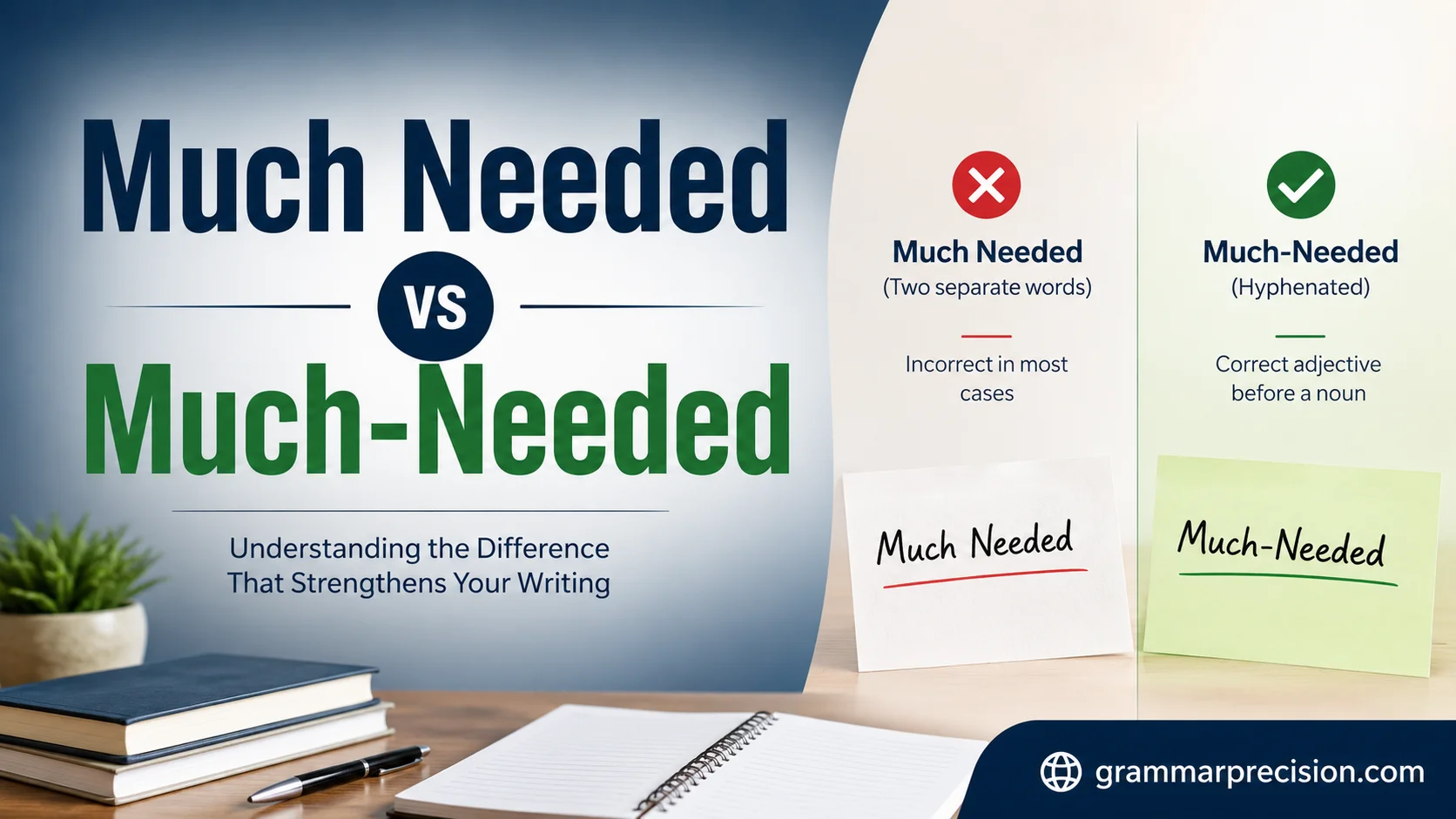
Choosing between much needed and much-needed can confuse many writers and students. The hyphen is used when the phrase comes before a noun as a compound adjective. For example, “a much-needed break” shows correct modifier placement and improves sentence meaning.
When the phrase comes after the noun, you do not need a hyphen. Understanding sentence structure, grammar rules, and punctuation helps create professional writing. Proper usage improves clarity, prevents mistakes, and makes communication more effective.
Why Much Needed vs Much-Needed Confuses So Many Writers
You might think this is a beginner mistake, but it’s not. Even experienced writers, bloggers, and journalists slip up here.
Why?
Because English doesn’t always behave consistently. Some phrases act like normal word groups. Others act like single units. That’s where hyphens step in.
Think of a hyphen like glue. It sticks words together so the reader understands them as one idea instead of separate pieces.
Without that glue, meaning can shift slightly. Not always dramatically—but enough to make writing feel less polished.
For example:
- “a much-needed break” feels tight and structured
- “a much needed break” feels looser and conversational
Both are understandable. But only one looks professionally edited.
Quick Answer: Much Needed or Much-Needed?
Let’s lock the rule in your memory:
- Use much-needed before a noun
- Use much needed after a verb
Examples:
✔ Correct (before noun):
- She took a much-needed break
- The team received much-needed support
- This is a much-needed change
✔ Correct (after verb):
- The break was much needed
- Support is much needed right now
- The change is much needed
Simple, right? Now let’s break down why this happens.
What “Much Needed” Actually Means
When you write “much needed”, you’re describing something that is required or necessary.
It usually appears after verbs like:
- is
- was
- seems
- becomes
- remains
Examples in real writing:
- The help was much needed after the crisis
- His advice is much needed in this situation
- Rest is much needed after a long journey
Here, “much needed” works like a descriptive phrase, not a single unit.
You are not attaching it to a noun directly. You are describing a state.
So no hyphen is required.
What “Much-Needed” Actually Means
Now let’s switch roles.
When you write “much-needed”, you turn the phrase into a compound adjective.
That means it directly describes a noun.
Examples:
- a much-needed vacation
- a much-needed solution
- a much-needed update
Here, the hyphen acts like a bridge. It tells the reader:
“Read these words together as one idea describing the noun.”
Without the hyphen, the reader may pause slightly and mentally separate the words.
That pause is small, but in professional writing, even small friction matters.
The Grammar Rule Behind Much Needed vs Much-Needed
Let’s simplify this rule as much as possible:
Rule:
When a multi-word adjective comes before a noun, hyphenate it.
This rule applies to many phrases, not just “much needed.”
Examples:
- well-known author
- high-quality product
- long-term plan
- much-needed break
But when those same phrases move after the verb, the hyphen disappears:
- The author is well known
- The product is high quality
- The plan is long term
- The break is much needed
This is standard grammar used in style guides like:
- AP Stylebook
- Chicago Manual of Style
- Oxford writing standards
They all agree on this pattern.
Why Hyphens Matter More Than You Think
A hyphen may look small, but it plays a big role in clarity.
Without it, sentences can feel slightly loose or even ambiguous in complex writing.
Let’s compare:
- a small business owner (clear: owner of a small business)
- a small-business owner (even clearer and more structured)
The second version removes any possible confusion.
Now apply that to “much needed”:
- a much-needed change feels precise and intentional
- a much needed change still works but feels less tight
In casual writing, no one will complain.
In professional writing, the hyphen shows attention to detail.
Real-Life Examples of Much Needed vs Much-Needed
Let’s make this practical. Here’s how you’ll actually see it in the real world.
Business Writing
- The company launched a much-needed upgrade
- The upgrade was much needed after customer complaints
Academic Writing
- The study introduced a much-needed correction
- The correction was much needed to improve accuracy
News Writing
- Officials announced a much-needed reform
- The reform is much needed in the current system
Social Media Writing
- Need a much-needed break
- This break is much needed right now
Notice how context decides the form.
Common Mistakes Writers Make with Much Needed vs Much-Needed
Even strong writers make predictable mistakes here.
Mistake 1: Overusing hyphens everywhere
Wrong:
- The break was much-needed
Right:
- The break was much needed
Mistake 2: Forgetting noun position
Wrong:
- a much needed break (formal writing)
Right:
- a much-needed break
Mistake 3: Thinking both versions mean different things
They don’t. Meaning stays the same. Only grammar structure changes.
Quick Comparison Table
| Form | Usage Position | Correct Example | Meaning Style |
| Much needed | After verb | The break is much needed | Descriptive |
| Much-needed | Before noun | A much-needed break | Adjectival phrase |
This table alone can save you from 90% of confusion.
Case Study: How Small Grammar Choices Change Writing Quality
Let’s look at a simple editing scenario.
Original Draft:
The company announced a much needed update. The update was much needed because users complained about speed issues.
At first glance, nothing looks wrong. But it feels slightly unpolished.
Edited Version:
The company announced a much-needed update. The update was much needed because users complained about speed issues.
Now the writing feels cleaner and more professional.
What changed?
Only one thing: hyphen placement.
But the overall tone improved instantly.
This is exactly how editors think when polishing content.
Also Read This: Thank You Very Much vs Thank You So Much: Real Life Differences Explained
Memory Trick to Never Forget the Rule
Here’s a simple trick you can use:
If the phrase sits before a noun, stick it together with a hyphen.
If it sits after a verb, let it breathe without one.
Or even shorter:
- Before noun → glue it
- After verb → separate it
This mental shortcut works better than memorizing grammar rules.
Why Writers Keep Making This Mistake
Let’s be honest. English doesn’t feel logical all the time.
You might write quickly. You might not stop to think about structure. And hyphens often get ignored in casual typing.
But here’s the real reason:
Most people write how they speak. In speech, you don’t hear hyphens. So your brain skips them.
Writing, however, demands structure. That’s where confusion starts.
How to Check Your Own Writing in Seconds
You don’t need a grammar degree. Just use this quick method:
The 10-Second Test
Ask yourself:
- Is the phrase before a noun? → add hyphen
- Is it after a verb? → remove hyphen
That’s it.
Run this test before publishing anything.
Expert Insight: What Style Guides Say
Professional editors follow consistent rules:
- AP Stylebook prefers hyphenation in compound modifiers
- Chicago Manual of Style supports hyphen use before nouns
- Oxford Guide emphasizes clarity over formality
Across all systems, one idea stays consistent:
Hyphens exist to improve readability, not complicate writing.
So the goal isn’t perfection. It’s clarity.
Practical Writing Tips for Better Grammar Flow
Here are simple habits that improve your writing instantly:
- Read sentences out loud
- Look for noun placement
- Break long sentences into smaller ones
- Avoid overthinking single words
- Focus on clarity, not complexity
Good writing feels natural. If it feels forced, revise it.
Commonly Confused Variations of “Much Needed”
You’ll also see similar confusion with phrases like:
- well needed / well-needed
- highly needed / highly-needed
- badly needed / badly-needed
The same rule applies every time.
Before noun → hyphen
After verb → no hyphen
Once you understand this pattern, you unlock dozens of grammar corrections at once.
FAQs:
What is the difference between much needed and much-needed?
The main difference is the hyphen usage. Much-needed is used before a noun as a compound adjective, such as “a much-needed break.” Much needed is used after a noun when it describes the situation, like “The break was much needed.”
When should I use a hyphen in much-needed?
You should use a hyphen when the phrase works together as one modifier before a noun. This makes the meaning clearer and improves sentence structure. Example: “She received a much-needed opportunity.”
Is much needed wrong without a hyphen?
No, much needed is not wrong. It depends on the context and placement in the sentence. When it appears after the noun, the hyphen is usually unnecessary. Example: “The help was much needed.”
Why is understanding much needed vs much-needed important in writing?
Knowing the difference improves writing accuracy, grammar, and clarity. Correct hyphenation helps readers understand your message easily and makes your professional writing look more polished.
Do professional writers need to follow the much-needed rule?
Yes, professional writers, editors, and students should understand this rule. Correct punctuation, modifier placement, and language accuracy help avoid confusion and create clear, effective communication.
Conclusion:
Understanding much needed vs much-needed is a small but important part of English grammar. Using the correct hyphen placement improves clarity, meaning, and overall writing quality. When the phrase comes before a noun, use much-needed as a combined modifier.
When it comes after the noun, much needed is the correct form. Mastering these small details helps create more professional, readable, and accurate sentences.