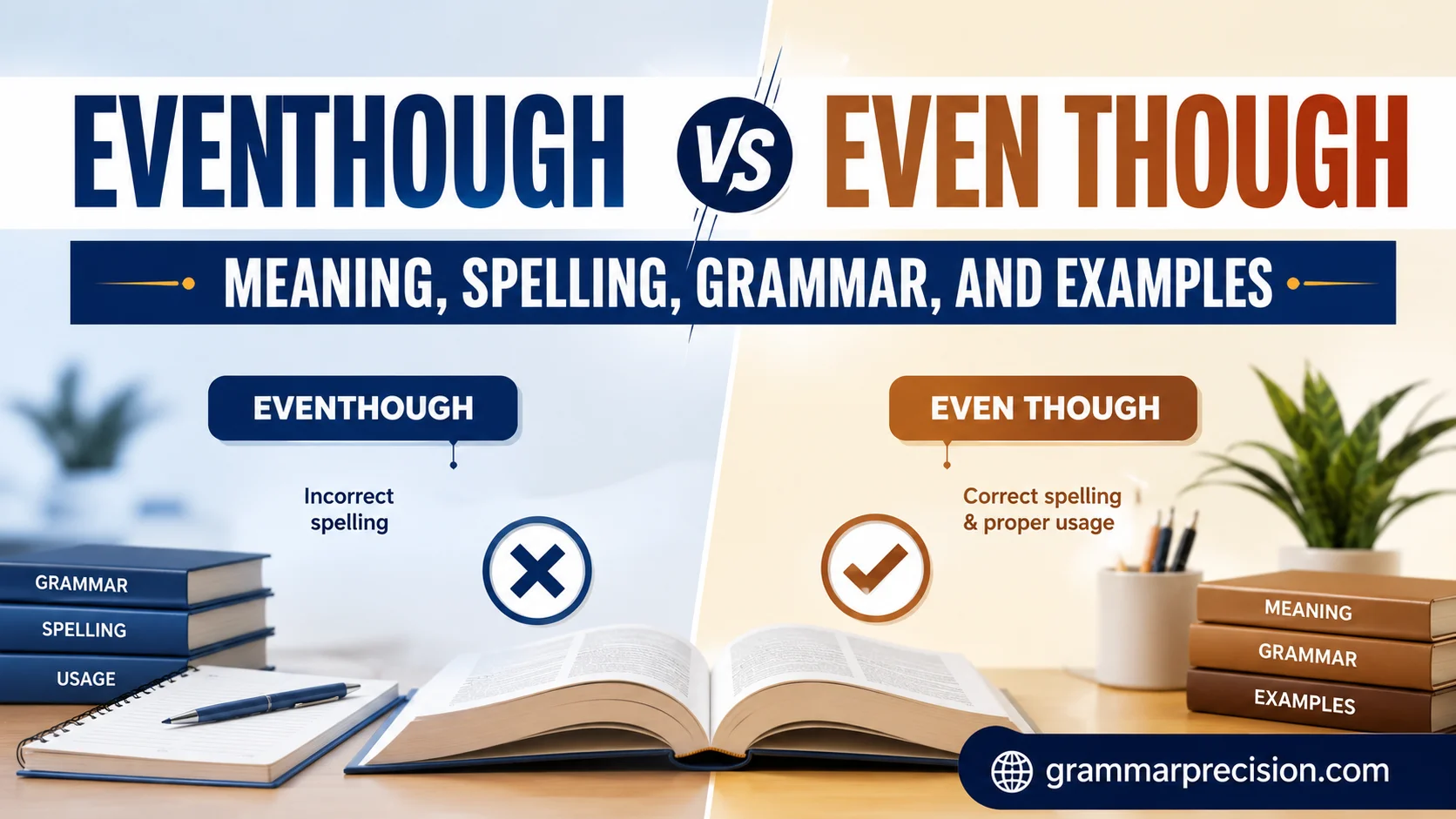
Eventhough vs Even Though often confuses English learners, but Even Though is correct. Knowing this simple difference helps you avoid common spelling mistakes and write with confidence.
Even Though is the grammatically accepted phrase and standard form in English. Eventhough is an incorrect spelling and common misspelling. The correct expression uses separate words, not one word. Even native speakers and fluent speakers sometimes make this subtle error because both forms sound similar in spoken language.
The main grammar rules become easier when you understand Even Though as a conjunction showing contrast or unexpected results. Its proper usage supports clear sentence structure, formal correctness, and effective communication. Using the correct form in emails, exams, college essays, and everyday writing also strengthens your credibility and English writing skills.
Eventhough vs Even Though at a Glance
Here’s the most important point:
| Form | Correct? | Function | Example |
| Even though | Yes | Shows contrast | Even though it was raining, we went outside. |
| Eventhough | No | Nonstandard spelling | Eventhough it was raining, we went outside. |
| Even if | Yes | Expresses a condition or possibility | Even if it rains, we’ll go outside. |
| Although | Yes | Shows contrast | Although it was raining, we went outside. |
| Though | Yes | Shows contrast | Though it was raining, we went outside. |
Both Cambridge Dictionary and Merriam-Webster recognize even though as a standard expression meaning essentially “although” or “despite the fact that.”
So, if you’re writing an email, essay, article, report, or social media post, use even though.
Correct: Even though I was tired, I finished the project.
Incorrect: Eventhough I was tired, I finished the project.
The difference isn’t about meaning. It’s about standard spelling.
Is “Eventhough” a Real Word?
No. Eventhough is not the standard spelling of the conjunction even though.
The expression consists of two separate words:
- even
- though
Together, they form the conjunction even though.
This mistake usually happens because English contains many compound words. Expressions such as however, although, and whenever are written as single words, so learners may naturally assume that even though works the same way.
It doesn’t.
Think of even though like in spite of. You wouldn’t normally turn in spite of into inspiteof. The words work together grammatically while remaining separate in writing.
Why Do People Write “Eventhough”?
Pronunciation plays a major role.
In everyday speech, fluent speakers often connect words. The phrase even though may sound compressed, especially when spoken quickly. Your ear can therefore interpret it as one unit.
Typing habits make the problem worse. Someone who has repeatedly heard the phrase may instinctively reproduce its sound instead of its written form.
Another reason is visual familiarity. Because although is one word, writers sometimes unconsciously treat even though as a similar single-word conjunction.
The safest solution is simple:
Remember that “even though” always has a space between the two words.
What Does “Even Though” Mean?
Even though introduces a fact that contrasts with the main idea of a sentence.
It often means:
- although
- despite the fact that
- in spite of the fact that
The phrase signals that the information in one clause might normally lead you to expect a different result.
For example:
Even though Maya was exhausted, she continued studying.
Being exhausted would normally make you expect Maya to stop studying. Instead, she continued. That unexpected relationship creates the contrast.
Cambridge Dictionary defines even though as an expression equivalent to although and gives examples where one fact does not prevent another situation from being true.
A Simple Way to Understand the Contrast
Consider this pattern:
Unexpected fact → surprising result
Even though the restaurant was crowded, we found a table.
You might expect a crowded restaurant to have no available tables. The second clause surprises you.
Another example:
Even though he had very little experience, he performed well.
The lack of experience creates an expectation of poor performance. The actual result contradicts that expectation.
That’s the heart of even though.
Even Though Grammar Rules You Need to Know
Even though works as a subordinating conjunction. It introduces a dependent clause and connects that clause to a main clause. IDP also describes the expression as a subordinating conjunction used to show contrast between two clauses.
A useful basic structure is:
Even though + dependent clause, independent clause.
For example:
Even though the test was difficult, Lena passed.
The dependent clause is:
Even though the test was difficult
The independent clause is:
Lena passed.
You can reverse the order:
Lena passed even though the test was difficult.
Both versions are grammatical.
Even Though + Complete Clause
After even though, you normally use a clause containing a subject and verb.
Even though she was nervous, she gave the presentation.
Even though the store was closing, we stayed for another few minutes.
Even though they had practiced, they made several mistakes.
Avoid treating even though like a preposition followed directly by a noun.
For example:
❌ Even though the bad weather, we traveled.
A better construction is:
✅ Even though the weather was bad, we traveled.
If you want to follow a noun phrase directly, despite or in spite of may work better:
Despite the bad weather, we traveled.
Even Though at the Beginning of a Sentence
Starting a sentence with even though is completely normal.
When the dependent clause comes first, place a comma between it and the main clause.
Even though I was busy, I answered the phone.
Even though the road was icy, the driver continued carefully.
Even though she disagreed with the decision, she remained respectful.
The comma helps readers recognize where the introductory dependent clause ends.
Even Though in the Middle of a Sentence
When the main clause comes first, you generally don’t need a comma before even though.
I answered the phone even though I was busy.
The driver continued carefully even though the road was icy.
She remained respectful even though she disagreed with the decision.
This distinction is easy to remember:
| Sentence structure | Typical punctuation |
| Even though + dependent clause, main clause | Comma after dependent clause |
| Main clause + even though + dependent clause | Usually no comma |
QuillBot gives the same basic punctuation pattern: a comma follows an introductory even though clause, while a comma generally isn’t needed when that clause follows the main clause.
Comma Rules With Even Though
Comma questions often create more confusion than the spelling itself.
Compare these sentences:
Even though it was late, we kept working.
We kept working even though it was late.
The first sentence places the dependent clause first, so the comma clearly separates it from the main clause.
The second sentence places the dependent clause after the main clause, so no comma is normally required.
However, punctuation can become more flexible when a writer treats a clause as supplemental or parenthetical. In complicated sentences, rewriting the sentence can often make the intended structure clearer.
The practical rule is therefore:
If the “even though” clause comes first, use a comma after it. If it follows the main clause, usually omit the comma.
Eventhough vs Even Though: Side-by-Side Examples
Seeing the mistake repeatedly makes the correct form easier to remember.
| Incorrect | Correct |
| Eventhough I was tired, I kept working. | Even though I was tired, I kept working. |
| She smiled eventhough she was upset. | She smiled even though she was upset. |
| Eventhough it snowed, school remained open. | Even though it snowed, school remained open. |
| We went hiking eventhough it was cold. | We went hiking even though it was cold. |
| Eventhough he apologized, she remained angry. | Even though he apologized, she remained angry. |
The meaning remains understandable when someone writes eventhough, but that doesn’t make the spelling standard.
In polished writing, especially academic, professional, or published work, choose even though.
Also Read This: Super vs Supra: The Ultimate Difference Explained
Even Though vs Although
These expressions are close in meaning. Both can introduce a contrasting clause.
Although the movie was long, I enjoyed it.
Even though the movie was long, I enjoyed it.
The main difference is strength and emphasis.
| Feature | Even Though | Although |
| Meaning | Contrast | Contrast |
| Emphasis | Stronger | More neutral |
| Formality | Neutral | Often slightly more formal |
| Example | Even though it was expensive, I bought it. | Although it was expensive, I bought it. |
If the contrast feels especially surprising, even though can make that relationship more noticeable.
For example:
Even though he had never played tennis before, he won the match.
The phrase emphasizes how unexpected the result was.
Even Though vs Though
Though can also express contrast, but it often sounds more conversational.
Though I was tired, I kept working.
I kept working even though I was tired.
There’s another interesting feature: though can appear at the end of a sentence in informal English.
I didn’t like the movie. The ending was good, though.
You can’t normally replace that final though with even though.
❌ The ending was good, even though.
So, although these expressions overlap, they aren’t interchangeable in every position.
Even Though vs Even If
This is one of the most useful distinctions to learn.
Even though generally introduces a fact or situation that is presented as real.
Even if introduces a condition, possibility, or hypothetical situation.
Compare:
Even though it is raining, we’re going outside.
The rain is presented as a fact.
Now consider:
Even if it rains, we’re going outside.
Here, rain is a possibility. It may happen, but the speaker isn’t presenting it as a current fact.
| Phrase | Main idea | Example |
| Even though | Known or presented fact | Even though she was tired, she kept working. |
| Even if | Condition or possibility | Even if she gets tired, she’ll keep working. |
A quick test helps:
Is the situation presented as a fact? Use even though.
Is it hypothetical or conditional? Use even if.
Even Though vs Despite
The meaning can be similar, but the grammar differs.
Even though normally introduces a clause:
Even though the weather was terrible, we traveled.
Despite normally introduces a noun phrase, pronoun, or gerund:
Despite the terrible weather, we traveled.
You can also say:
Despite the weather being terrible, we traveled.
But this is not normally correct:
❌ Despite the weather was terrible, we traveled.
The same principle applies to in spite of.
In spite of the terrible weather, we traveled.
Even though the weather was terrible, we traveled.
This distinction is especially useful when you’re editing essays or formal writing.
Even Though vs In Spite Of
Both expressions communicate contrast, but their grammatical structures differ.
| Expression | What follows it? | Example |
| Even though | Subject + verb | Even though she was tired, she worked. |
| Despite | Noun / pronoun / gerund | Despite her tiredness, she worked. |
| In spite of | Noun / pronoun / gerund | In spite of being tired, she worked. |
A good editing trick is to identify what comes immediately after the expression.
If you have a complete clause, even though may be appropriate.
If you have a noun phrase or gerund, despite or in spite of may fit better.
Common Mistakes With Even Though
Even though looks simple, several errors appear frequently.
Writing “Eventhough”
This is the central mistake.
❌ Eventhough she was sick, she went to work.
✅ Even though she was sick, she went to work.
Using “Even Though” With a Noun Alone
❌ Even though the rain, we went outside.
✅ Even though it was raining, we went outside.
Or:
✅ Despite the rain, we went outside.
Using “Even Though” and “But” Together
Avoid constructions such as:
❌ Even though I was tired, but I continued working.
The sentence contains two competing ways to mark the same contrast.
Use:
✅ Even though I was tired, I continued working.
Or:
✅ I was tired, but I continued working.
This is a useful general writing principle: don’t stack two conjunctions when one already performs the job.
Forgetting the Comma After an Introductory Clause
❌ Even though I was tired I continued working.
✅ Even though I was tired, I continued working.
The comma isn’t needed simply because even though appears. It is needed because the dependent clause comes before the main clause.
A Quick “Even Though” Editing Checklist
Before publishing or submitting your writing, check these points:
- Is it spelled “even though”?
- Did you keep the two words separate?
- Does it introduce a complete clause?
- Did you use a comma after a front-loaded dependent clause?
- Did you avoid unnecessary “but”?
- Are you describing a fact rather than a hypothetical condition?
- Would “although,” “despite,” or “even if” express your meaning more accurately?
This seven-point check catches most common problems.
A Practical Case Study: Choosing the Right Expression
Imagine you’re describing a student who completed an exam despite feeling nervous.
You could write:
Even though she was nervous, she completed the exam.
This works because she was nervous is a complete clause and the sentence emphasizes the contrast.
You could also write:
Despite her nervousness, she completed the exam.
Here, her nervousness is a noun phrase, so despite fits naturally.
Now imagine the nervousness hasn’t happened yet:
Even if she becomes nervous, she will complete the exam.
The meaning changes. You’re now discussing a possible future condition.
This small comparison demonstrates why choosing the right expression involves more than memorizing spelling.
A Simple Trick to Remember “Even Though”
Use the two-word test.
When you write the phrase, pause after even:
Even | though
If the sentence needs the contrast meaning of although, write even though as two words.
Another useful memory trick is to remember the phrase “even if.” You already recognize that even if contains two words. Even though follows the same visual pattern.
Think:
even if
even though
Not:
❌ evenif
❌ eventhough
The space is small, but it matters.
FAQs:
Is “Eventhough” a correct word?
No, “Eventhough” is incorrect in standard English. The correct form is “Even Though,” written as two separate words. Using the incorrect form can make your writing look careless, especially in formal writing, academic work, and professional communication.
Is “Even Though” always written as two words?
Yes. “Even Though” should always appear as two separate words when used as a conjunction. It introduces contrast or an unexpected result. For example, “Even though it was raining, we went outside.”
What is the difference between “Eventhough” and “Even Though”?
The main difference is correctness. “Even Though” is the standard and grammatically accepted phrase, while “Eventhough” is a common misspelling. The two forms may sound similar, but only the two-word form is correct in standard English.
Can I use “Even Though” in formal writing?
Yes, “Even Though” is completely acceptable in formal writing. You can use it in professional emails, academic essays, reports, and other situations where clear grammar matters. It helps connect two ideas when the second idea contrasts with the first.
Is “Even Though” the same as “Although”?
“Even Though” and “Although” both introduce contrast, so they can sometimes be used similarly. However, “even though” often gives stronger emphasis to the unexpected nature of the result. For example, “Even though she was tired, she continued working.”
Conclusion:
Understanding Eventhough vs Even Though is simple once you remember one rule: Even Though is always written as two words. Eventhough is a misspelling, not a standard English word. Use the correct form in academic, professional, and everyday writing. This small grammar detail can improve your clarity, credibility, and overall writing confidence while helping you avoid a common mistake.