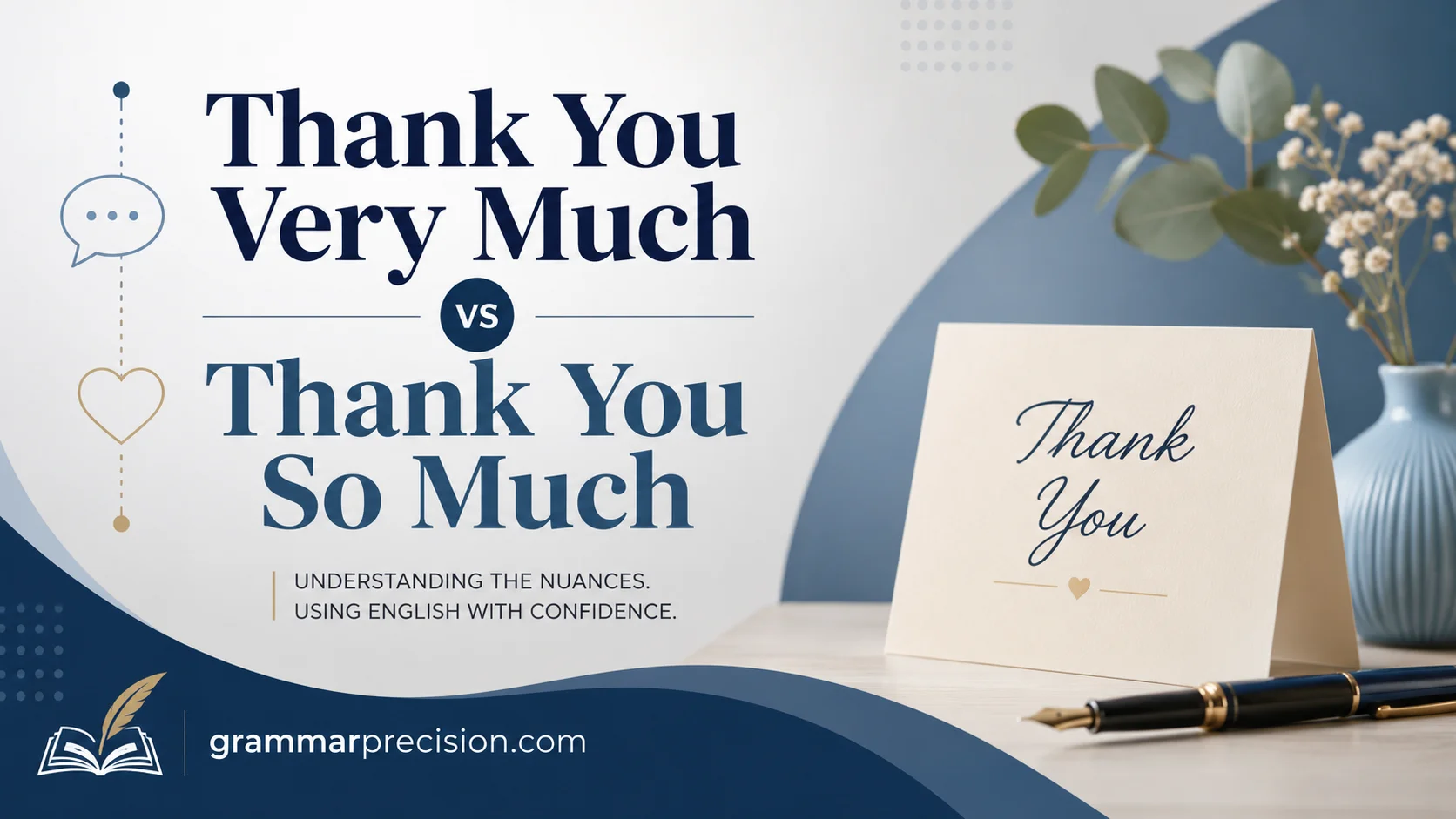
Thank You Very Much vs Thank You So Much explains the difference between two common gratitude expressions. Both show appreciation, but their tone, context, and usage create different meanings in communication.
Many people wonder about these phrases because Thank You Very Much feels more formal and suitable for professional interactions, while Thank You So Much sounds warmer and more personal. Choosing the right phrase depends on audience, social context, and the level of emotional intensity you want to express.
In everyday English, both phrases are correct and show gratitude, but their nuances make them different. Thank You Very Much works well in written communication like emails and notes, while Thank You So Much is better for casual conversations and heartfelt appreciation.
Thank You Very Much vs Thank You So Much Meaning Explained
At their core, both phrases express gratitude. But the emphasis is what changes everything.
“Thank you very much” adds emphasis through formality. It feels structured and traditional. You’ll often hear it in polite conversations, official settings, or professional communication.
“Thank you so much” adds emphasis through emotion. It feels more expressive, more human, and often more personal.
Think of it like this:
- “Very much” = controlled appreciation
- “So much” = emotional appreciation
Neither is wrong. But they carry different emotional weight.
Emotional Tone Differences Between Thank You Very Much vs Thank You So Much
Language is not just grammar. It’s emotion in disguise.
Thank You Very Much
This phrase tends to sound:
- Polite and composed
- Slightly formal
- Neutral in emotion
- Respectful but controlled
It creates a sense of distance, even when the intention is warm.
Thank You So Much
This phrase feels:
- Warmer and more expressive
- Emotionally open
- Friendly and personal
- More spontaneous
It builds emotional closeness faster.
Here’s the subtle truth:
People often don’t remember the exact words you used—they remember how you made them feel.
Real-Life Usage Comparison Table
Let’s make this practical. Here’s how both phrases perform in different real-world situations.
| Situation | Thank You Very Much | Thank You So Much |
| Business email | Perfectly appropriate | Sometimes too casual |
| Talking to a boss | Safe and respectful | Friendly but informal |
| Talking to a friend | Slightly stiff | Natural and warm |
| Customer service | Professional tone | Very positive and engaging |
| Social media | Neutral | Highly common |
| Emotional gratitude | Limited impact | Strong emotional effect |
This is where most learners go wrong. They assume both are interchangeable everywhere. They’re not.
Why People Feel a Difference (Psychology Behind It)
Your brain processes language faster than you think. Even small word changes influence emotional interpretation.
When someone hears “thank you so much,” the word “so” amplifies emotion. It signals intensity. It tells the listener, this matters to me a lot.
On the other hand, “very much” feels like a measured statement. It’s polite, but not emotionally loud.
A simple way to understand it:
- “Very much” = structured gratitude
- “So much” = felt gratitude
In communication psychology, this difference is tied to something called emotional expressiveness—how openly someone shares feelings through language.
Also Read This: Lies Ahead vs Lays Ahead: The Complete Grammar Guide
Case Study: Same Message, Different Impact
Imagine two customer emails:
Email A:
Thank you very much for your assistance with my order.
Email B:
Thank you so much for your help with my order!
Now picture yourself as the support agent reading these.
Email A feels professional. Respectful. Slightly distant.
Email B feels more personal. You sense real appreciation. It feels like the customer genuinely values your effort.
Neither is wrong—but one builds stronger emotional connection.
Cultural Usage Differences in English Communication
English speakers don’t use these phrases randomly. Patterns exist.
British English tendencies
- “Thank you very much” is more commonly heard in formal settings
- Often used with polite restraint
American English tendencies
- “Thank you so much” is widely used in everyday speech
- Feels more natural and conversational
Digital communication trend
In texting, emails, and social media:
- “Thank you so much” dominates
- It aligns better with modern informal tone
Language evolves, and gratitude phrases evolve with it.
When You Should Use Thank You Very Much
This phrase works best when you want to maintain professionalism or polite distance.
Use it in:
- Formal business emails
- Official letters
- Speaking to authority figures
- Academic communication
- Customer service responses (neutral tone)
It keeps things respectful without sounding overly emotional.
Example:
Thank you very much for your time and consideration.
Simple. Clean. Professional.
When You Should Use Thank You So Much
This is your go-to phrase for warmth and connection.
Use it in:
- Conversations with friends
- Casual work chats
- Social media posts
- Personal messages
- Expressing genuine emotional gratitude
Example:
Thank you so much for being there when I needed help.
It feels real. It feels human.
Common Mistakes People Make With These Phrases
Even native speakers misuse tone sometimes.
Overusing “thank you so much”
If every message sounds overly emotional, it can feel less sincere over time.
Using “thank you very much” in casual chats
This can sound stiff or even slightly distant in friendly conversations.
Mixing tone incorrectly
Switching between formal and informal tone in the same conversation can confuse the emotional message.
Better Alternatives for Stronger Expression
Sometimes, you don’t need either phrase. English offers richer options.
Here are stronger alternatives:
- “I really appreciate it” → balanced and natural
- “I can’t thank you enough” → deep emotional gratitude
- “I truly appreciate your help” → formal but warm
- “That means a lot to me” → emotional connection
- “You’ve been a huge help” → conversational and friendly
These expressions often feel more authentic than repeated thank-you phrases.
Real Conversation Examples
Let’s see how both phrases behave naturally.
Workplace scenario
A: I finished the report early.
B: Thank you very much. I’ll review it today.
Friendly scenario
A: I brought you coffee.
B: Thank you so much! That’s really kind of you.
Notice how tone changes the emotional atmosphere instantly.
Expert Insight: Why Tone Matters More Than Words
Communication experts often say that tone carries more meaning than vocabulary.
You can say the same sentence in two ways:
- flat tone → distant
- warm tone → engaging
That’s why “thank you so much” often wins in emotional impact even if “thank you very much” is technically correct.
Quick Usage Guide You Can Remember Easily
Here’s a simple rule that actually works in real life:
- If the situation is formal → use thank you very much
- If the situation is personal → use thank you so much
That’s it. No overthinking needed.
FAQs:
What is the difference between Thank You Very Much and Thank You So Much?
Thank You Very Much and Thank You So Much both express gratitude, but they have different tones. Thank You Very Much sounds more formal and is often used in professional or written situations. Thank You So Much feels more personal, warm, and emotional in casual conversations.
Is Thank You Very Much more formal than Thank You So Much?
Yes, Thank You Very Much is generally considered more formal. People often use it in emails, letters, notes, and professional interactions where courtesy and etiquette are important. However, both phrases are correct and acceptable depending on the situation.
Can I use Thank You So Much in professional communication?
Yes, you can use Thank You So Much in professional communication, especially when you want to show genuine appreciation. It creates a more friendly and personal tone, but for highly formal situations, Thank You Very Much may be a better choice.
Why does Thank You So Much feel more emotional?
Thank You So Much often feels more emotional because it expresses a stronger sense of heartfelt appreciation and deeper gratitude. The word so can suggest a feeling that is difficult to measure or fully express.
Are Thank You Very Much and Thank You So Much grammatically correct?
Yes, both phrases are grammatically correct and have the same basic meaning. The difference comes from context, tone, and communication style. Choosing the right expression helps make your message more clear, natural, and effective.
Conclusion:
Understanding Thank You Very Much vs Thank You So Much helps you choose the right phrase for every situation. Both expressions show gratitude and appreciation, but Thank You Very Much gives a more formal feeling, while Thank You So Much creates a more warm and personal connection.
The best choice depends on your audience, context, and the emotion you want to communicate.