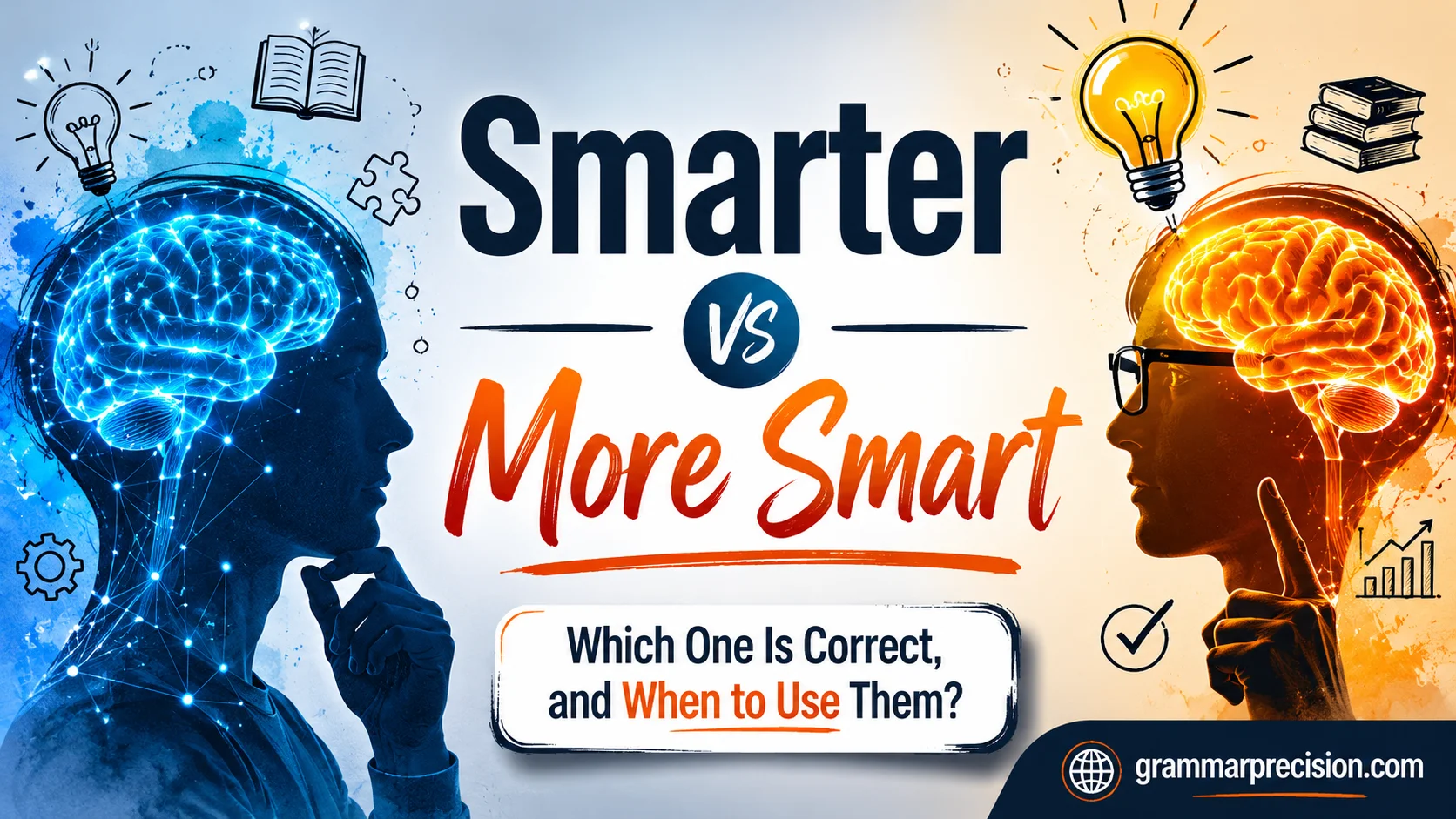
Smarter vs More Smart confusion in English learning affects learners, native speakers, and comparatives, where small grammar differences change meaning, clarity, communication, and everyday usage.
The issue of comparatives in English creates confusion because grammar rules show smarter is the correct choice, while more smart sounds awkward and affects clarity in writing, speaking, and communication. In professional instruction and practical examples, learners improve understanding, build confidence, and create polished sentences with better expression, while applying sentence meaning, correct forms, and grammar awareness in real usage.
Through instructional content, functional grammar, and sentence level guidance, learners gain mastery in comparative forms using practice, lexical semantics, and contextual application. This improves fluency, precision, and accuracy in writing skill, speaking skill, and English proficiency, helping avoid confusion and strengthening polished writing with repeated exposure, examples, and effective usage guidance in daily communication.
With regular learning, practice, and real English usage, learners begin to make the automatic decision between smarter and more smart in classroom, teacher interaction, and real life situations. This improves language awareness, thinking, expression, and comparisons, building stronger speaker credibility, better fluency, and overall language mastery in natural communication.
Why People Search “Smarter vs More Smart” in the First Place
Let’s start with something interesting. People don’t usually search this because they’re confused about intelligence. They search it because English grammar feels inconsistent.
You might notice patterns like:
- big → bigger
- fast → faster
- beautiful → more beautiful
So naturally, learners think:
If “big” becomes “bigger,” why doesn’t “smart” become “smarter” or “more smart”?
That confusion is completely normal. English mixes short and long comparison rules in ways that don’t always feel logical at first.
There’s also another factor: translation. Many languages form comparisons differently, so learners often transfer those patterns directly into English.
What “Smarter” Actually Means in English
Let’s strip it down.
The word smarter is a comparative adjective. It compares two things.
Example:
- “Aisha is smarter than Ali.”
It simply means:
Aisha shows a higher level of intelligence compared to Ali.
In English grammar, most one syllable adjectives form comparatives by adding “ er.”
Here’s a quick breakdown:
| Base Word | Comparative Form | Example Sentence |
| smart | smarter | She is smarter than him |
| fast | faster | This car is faster than that one |
| strong | stronger | He is stronger than me |
So “smart” fits perfectly into this pattern.
Why “More Smart” Sounds Wrong to Native Speakers
Now let’s tackle the awkward version: more smart.
You might see it online or hear it in casual speech from non native speakers. But native speakers rarely use it.
Why?
Because English already assigns “smart” a built in comparative form: smarter.
When you say “more smart,” it creates friction in the listener’s mind. It feels like you’re applying a rule incorrectly, even if the meaning is still understandable.
Think of it like this:
It’s like saying “more fast” instead of “faster.” People will understand you, but it won’t sound natural.
The Core Rule That Solves This Confusion Forever
Here’s the simple grammar rule that clears everything up:
Comparative Adjective Rule in English
- One syllable adjectives → add er
- Two or more syllables → use more + adjective
Now let’s apply it:
| Type | Rule | Example |
| One syllable | add er | smart → smarter |
| Two+ syllables | use “more” | intelligent → more intelligent |
| Special cases | irregular forms | good → better |
So “smart” belongs in the first category.
That’s why “smarter” wins.
When “More + Adjective” Is Actually Correct
Here’s where things get more interesting.
English does use “more + adjective,” but only in certain situations.
Examples:
- more intelligent
- more beautiful
- more careful
- more expensive
Why? Because these words are longer and harder to pronounce with “ er.”
Try saying:
“beautifuller”
It feels wrong instantly. That’s because English avoids awkward sound patterns.
So language efficiency plays a big role here. English prefers smoother speech, not just strict rules.
The Real Difference Between “Smarter” and “More Smart”
Let’s compare them directly.
| Feature | Smarter | More Smart |
| Grammar correctness | Correct | Incorrect in standard English |
| Natural usage | Very common | Rare |
| Native speaker preference | High | Low |
| Formal writing | Acceptable | Not recommended |
| Spoken English | Standard | Awkward |
Even though both expressions technically communicate meaning, only one fits natural English flow.
Why Learners Still Use “More Smart”
This is where real world language learning gets interesting.
There are 4 main reasons people use it:
1. Direct Translation from Native Language
Many languages form comparisons using a separate word like “more.” Learners transfer that structure into English.
2. Overgeneralizing Grammar Rules
Learners remember:
“Use more for comparisons”
But they forget the exceptions.
3. Lack of Exposure to Native English
If you don’t read or hear English often, your brain builds its own version of the rules.
4. Overthinking While Speaking
In real time conversation, people default to simpler constructions, even if they are incorrect.
Real Life Usage: How It Sounds in Context
Let’s see how these phrases behave in real situations.
Workplace Example
❌ “She is more smart than the other candidate.”
✔ “She is smarter than the other candidate.”
Academic Example
❌ “This solution is more smart than the previous one.”
✔ “This solution is smarter than the previous one.”
Casual Speech
❌ “You’re more smart than me!”
✔ “You’re smarter than me!”
You can see the pattern clearly. The correct form always feels smoother and more natural.
Also Read This: Minoot or Minute
Common Mistakes People Make With Comparatives
Here are mistakes that often appear alongside “more smart” confusion:
1. Double Comparatives
❌ “more smarter”
✔ “smarter”
This is one of the most common errors. It combines two comparison systems at once.
2. Overusing “more” for short words
❌ more fast
❌ more tall
✔ faster
✔ taller
3. Incorrect irregular forms
❌ gooder
✔ better
English has irregular patterns that must be memorized.
Case Study: Why Correct Comparatives Improve Communication
Let’s look at a simple real world scenario.
Scenario: Job Interview
Two candidates describe their skills:
Candidate A:
“I am more smart in handling data analysis.”
Candidate B:
“I am smarter in handling data analysis.”
Even though both statements are understandable, Candidate B sounds more fluent, confident, and professional.
In communication, small grammar choices shape perception.
Hiring managers often don’t consciously analyze grammar. Instead, they feel fluency.
Better Alternatives to “Smart” You Can Use
Sometimes, instead of comparing “smart,” you can upgrade your vocabulary entirely.
Here are stronger options:
| Word | Meaning |
| intelligent | general mental ability |
| sharp | quick thinking |
| insightful | deep understanding |
| quick witted | fast responses |
| analytical | structured thinking |
Example:
- “She is more analytical than her teammate.”
- “He is quick witted in discussions.”
These alternatives help you sound more precise and expressive.
Quick Cheat Sheet: Smarter Grammar Choices
Here’s a simple reference you can use anytime:
Correct Usage
- smarter ✔
- faster ✔
- stronger ✔
- better ✔
Incorrect Usage
- more smart ✘
- more fast ✘
- more strong ✘
- gooder ✘
Why “Smarter” Wins in Natural English
English prefers efficiency. That’s the key idea.
Short forms:
- save time
- sound smoother
- reduce effort in speech
- improve rhythm
Think of language like music. “Smarter” fits the rhythm better than “more smart.”
That’s why native speakers choose it instinctively.
How to Train Yourself to Use It Correctly
If you still mix them up, don’t worry. You can fix it with practice.
Try this simple exercise:
Rewrite these sentences correctly:
- She is more smart than her sister.
- This laptop is more fast than mine.
- He is more strong than before.
Answers:
- She is smarter than her sister.
- This laptop is faster than mine.
- He is stronger than before.
Practice like this a few times, and your brain will adapt quickly.
Final Insight: Speak Smarter by Keeping It Simple
Here’s the surprising truth.
You don’t sound smarter by using complicated forms. You sound smarter by using correct, natural ones.
So instead of thinking:
“Should I say more smart or smarter?”
Train yourself to think:
“What would a native speaker naturally say?”
The answer will almost always be: smarter.
Simple wins. Every time.
FAQs:
What is the difference between “Smarter” and “More Smart”?
The correct form is smarter, which follows normal comparative rules in English grammar. More smart is considered awkward and incorrect in standard usage, so it is rarely used in writing or speaking.
Why do learners get confused between these two forms?
Many learners face confusion because of comparative forms and unclear grammar rules. In English learning, this mistake happens when people directly translate from their native tongue, causing wrong form usage in communication.
When should we use “Smarter” in sentences?
We use smarter when comparing abilities or intelligence between two people or things. In real life usage, it sounds more natural, clear, and improves sentence meaning in both speech and writing.
Is “More Smart” ever correct in English?
In standard English, more smart is not correct for one syllable adjectives like smart. It breaks grammar rules and reduces clarity, so it is avoided in professional writing and spoken expression.
How can learners avoid this mistake?
Learners can avoid this issue through regular practice, grammar awareness, and exposure to correct comparative forms. Using instructional content and sentence level examples helps improve fluency, confidence, and English proficiency.
Conclusion:
The difference between smarter and more smart is a simple but important part of English grammar. Using the correct comparative form improves clarity, communication, and overall language mastery.
With proper practice, understanding, and awareness of grammar rules, learners can avoid confusion and build more confident speaking and effective writing skills in everyday real life usage.