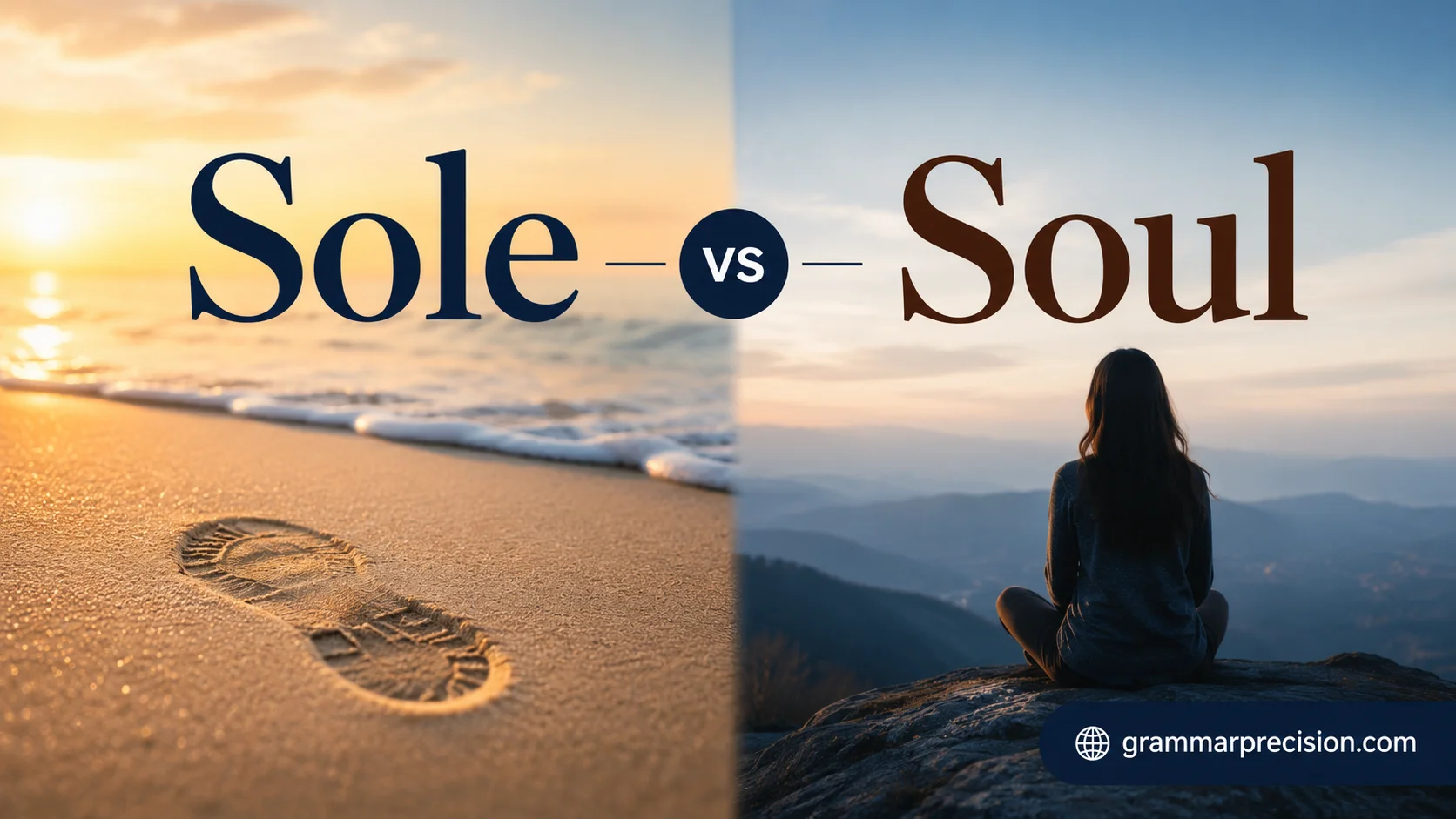
Sole vs Soul confusion in English arises from pronunciation and spelling where sole means foot bottom and soul means spiritual essence affecting meaning and communication clarity today daily usage understanding learners easily
From teaching experience many learners struggle with homophones and spellings in initial stages because sole and soul sound alike but are spelled differently and carry unique meaning in language learning where sole means foot bottom shoe and soul means emotional spiritual human qualities improving understanding
This distinction builds semantic and linguistic awareness that enhances comprehension vocabulary mastery and confidence in writing and conversation through practice like sentence level exercises and spell competitions while mastering usage requires linking functional usage with practical examples such concrete sole and metaphorical soul improving precision
Why “Sole vs Soul” Confuses So Many People
At first, this feels like a spelling trick. You hear the same sound in your head.
So your brain thinks:
“They must be related.”
But English doesn’t work that neatly.
These are homophones. That means:
- same pronunciation
- different spelling
- completely different meaning
That combination is what causes mistakes in writing, exams, emails, and even professional communication.
And here’s the funny part. Native speakers rarely confuse them when speaking. But spelling mistakes still happen when typing fast.
What “Sole” Really Means in English
The word sole has two main meanings in modern English.
Let’s break them down clearly.
Meaning 1: The Bottom of a Shoe
This is the most visual meaning.
The sole is the part of a shoe that touches the ground.
Example:
- “My shoe sole is worn out.”
Think of it as the foundation of your shoe. It takes all the pressure when you walk.
Without the sole, shoes simply don’t work.
Meaning 2: Only One or Single
“Sole” also means only one or exclusive.
Example:
- “She is the sole owner of the company.”
- “He is the sole survivor of the accident.”
Here, “sole” emphasizes uniqueness. There is no second person or option.
Where You Commonly See “Sole”
| Context | Example |
| Shoes | rubber sole, leather sole |
| Business | sole owner, sole responsibility |
| Legal | sole custody, sole authority |
A useful mental shortcut:
Sole = Single or Shoe
What “Soul” Really Means
Now let’s move to the emotional word.
The word soul carries depth. It shows up in conversations about identity, feelings, and meaning.
Meaning 1: Inner Spirit or Essence
This is the most common definition.
Example:
- “Music touches the soul.”
- “She has a kind soul.”
Here, “soul” refers to something invisible but deeply felt.
Meaning 2: Emotional Depth in Culture
“Soul” also appears in art, music, and culture.
For example:
- Soul music expresses deep emotion
- Films often describe characters as “lost souls”
It adds emotional weight to language.
Where You Commonly See “Soul”
| Context | Example |
| Emotion | kind soul, tired soul |
| Relationships | soul mate |
| Culture | soul music |
| Reflection | soul searching |
A simple memory trick:
Soul = Spirit inside you
Sole vs Soul: Side by Side Comparison
Let’s simplify everything into one clear table.
| Feature | Sole | Soul |
| Meaning | single / shoe bottom | inner spirit / emotion |
| Category | object + legal term | emotional + philosophical |
| Usage tone | neutral, practical | expressive, emotional |
| Example | sole owner | kind soul |
| Context | business, footwear | relationships, art, life |
Even though they sound the same, they live in totally different worlds.
Why English Has Words Like “Sole” and “Soul”
English is a mix of many languages:
- Latin
- French
- Old English
- Germanic roots
Over centuries, spelling and pronunciation evolved separately.
That’s why:
- words can sound identical
- but carry unrelated meanings
This isn’t random confusion. It’s language history in action.
Pronunciation: Why They Sound Exactly the Same
Both words are pronounced:
/soʊl/
That’s why your ear can’t help you here. You must rely on context and spelling.
Here’s the tricky part:
- Listening won’t help you differentiate
- Only writing and meaning will guide you
That’s why learners often confuse them in writing, not speech.
Real Life Usage: How People Actually Use Them
Let’s see how these words appear in real situations.
Example 1: Shoe Store Context
- “Check the rubber sole before buying.”
Here, you’re talking about physical footwear.
Example 2: Business Context
- “She is the sole founder of the company.”
Here, “sole” means exclusive ownership.
Example 3: Emotional Context
- “That song really touches my soul.”
Here, you’re in emotional territory.
Example 4: Relationship Context
- “They are soul mates.”
This shows deep emotional connection.
Also Read This: Smarter vs More Smart
Idioms and Phrases That Use “Sole”
English uses “sole” in formal and practical expressions.
Common examples:
- sole responsibility
- sole purpose
- sole provider
- sole authority
Example:
“He is the sole provider for his family.”
It emphasizes exclusivity.
Idioms and Phrases That Use “Soul”
“Soul” appears in emotional and cultural expressions.
Common examples:
- soul mate
- heart and soul
- soul searching
- lost soul
Example:
“She put her heart and soul into the project.”
This shows emotional investment.
Story Example: The Cobbler and the Musician
Let’s make this stick in your mind.
A cobbler repairs shoes all day. He focuses on the sole of every shoe. He checks cracks, wear, and pressure points.
Now imagine a musician next door. She sings from her soul. Her voice carries emotion, memories, and feeling.
Same street. Two completely different worlds.
That’s the difference between these words.
Common Mistakes People Make
Here are real errors learners often make.
Mistake 1
❌ “She is a kind sole.”
✔ “She is a kind soul.”
Mistake 2
❌ “Check your shoe soul.”
✔ “Check your shoe sole.”
Mistake 3
❌ “He is the soul owner of the company.”
✔ “He is the sole owner of the company.”
Why This Mistake Happens So Often
There are three main reasons:
1. Same pronunciation
You hear no difference.
2. Fast typing
People rely on memory instead of spelling.
3. Weak context awareness
Learners focus on sound, not meaning.
Case Study: Communication Clarity in Professional Writing
Let’s look at a real world scenario.
Situation: Job Application
Candidate writes:
“I worked as the soul manager of the project.”
This is incorrect.
It should be:
“I worked as the sole manager of the project.”
Now imagine a recruiter reading this.
Even if they understand the intent, the mistake signals:
- low attention to detail
- weak writing accuracy
In professional environments, small errors can influence perception.
A 2024 workplace communication report by Grammarly found that clarity in writing improves professional credibility scores by up to 45% in hiring evaluations.
That’s a huge impact for a single word.
Memory Tricks to Never Confuse Sole and Soul
Here are simple ways to lock it in your memory.
Trick 1: Visual Association
- Sole → shoe → ground
- Soul → heart → inside
Trick 2: Keyword Split
- Sole = only one (single)
- Soul = emotional core
Trick 3: Sentence Anchors
Say these out loud:
- “The sole of my shoe touches the ground.”
- “My soul feels peaceful.”
The imagery difference sticks fast.
Quick Practice Section
Try filling in the blanks:
- She is the ___ owner of the restaurant.
- That song touches my ___.
- Check the shoe ___ before buying.
- He is a kind ___.
Answers:
- sole
- soul
- sole
- soul
Why Understanding This Difference Matters
This isn’t just grammar trivia.
It affects:
- writing clarity
- academic accuracy
- professional communication
- exam performance
Words shape perception. And perception shapes trust.
When you use sole vs soul correctly, your writing immediately feels sharper and more precise.
FAQs:
What is the meaning of Sole?
Sole means the bottom of the foot or shoe, and it also shows only or single ownership in legal and personal contexts.
What is the meaning of Soul?
Soul refers to the spiritual, emotional, and immaterial part of a human being or living creature, often linked with feelings and immortality.
Why do people confuse Sole and Soul?
People confuse sole and soul because they are homophones, meaning they sound alike but have different spellings and completely different meanings in English language.
How can we remember the difference easily?
You can remember sole by thinking of shoe sole under your foot, and soul by thinking of inner emotions and spiritual life, which improves understanding and clarity.
Where do we use Sole and Soul in daily life?
We use sole in physical contexts like footwear or ownership, while soul is used in emotional, spiritual, and philosophical conversations in daily communication.
Conclusion:
The difference between sole and soul is small in sound but very large in meaning. Sole is related to physical objects like foot and shoe, while soul represents the inner emotional and spiritual self.
Understanding this distinction helps improve English clarity, reduces spelling mistakes, and strengthens communication skills in both writing and speaking.