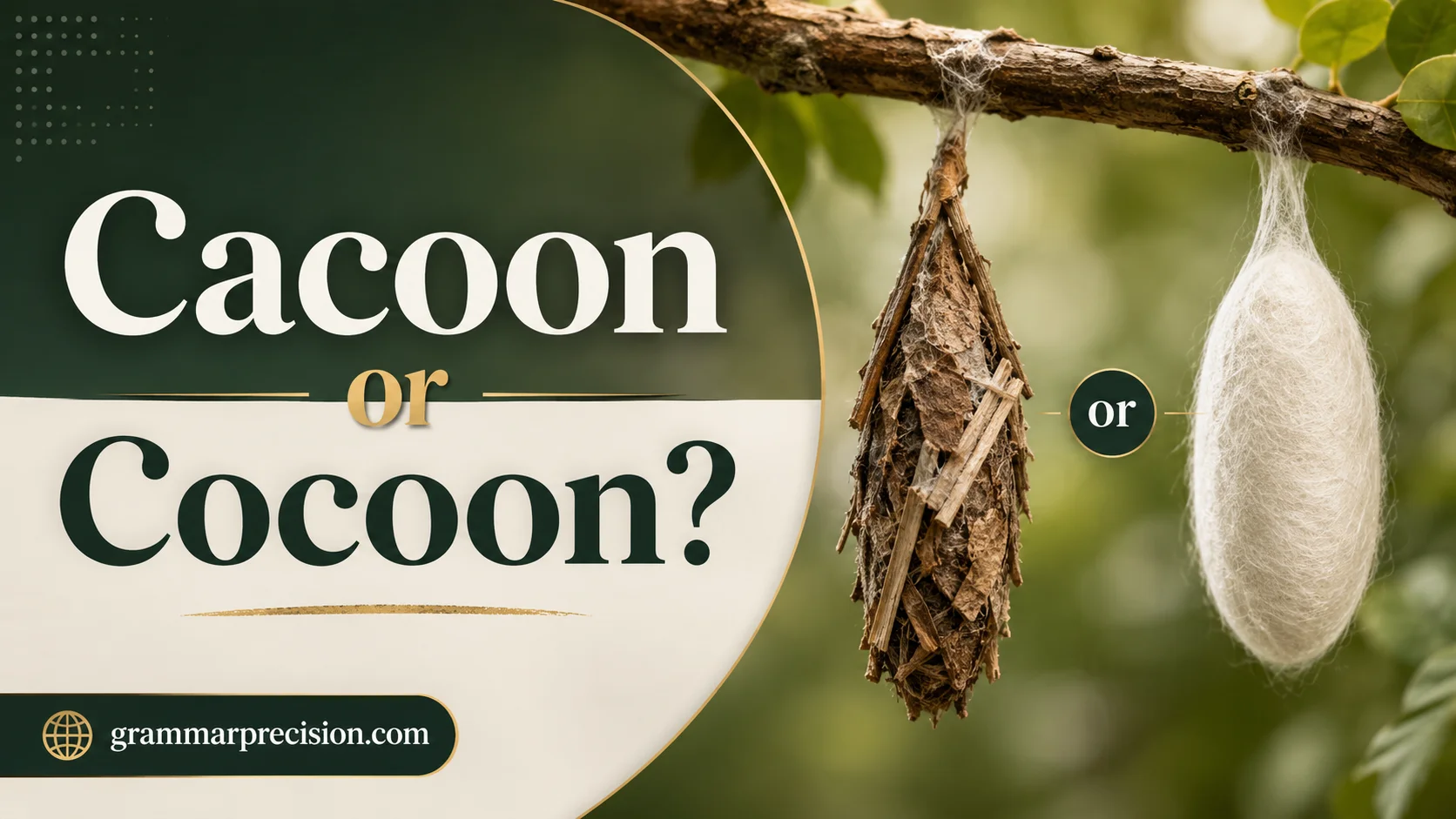
Cacoon or Cocoon? is a common Spelling Confusion in the English Language. Many Writers, Readers, and Learners wonder about the Correct Spelling. Understanding this Comparison helps improve Vocabulary, Confidence, and overall communication skills.
The difference becomes clear when we look at Meaning, Usage, and Correctness. Cocoon is the accepted spelling, while Cacoon is often considered Incorrect Usage. This Frequent Spelling Conundrum affects Native Speakers and learners alike, making Clarity, Accuracy, and proper language understanding important for everyday writing.
In Nature, a Cocoon is a Protective Enclosure made of Silk around Larvae, Caterpillars, Butterflies, and Moths during Metamorphosis and Transformation. Modern Spellcheckers and Online Tools can quickly Flag an Error, helping users Fix mistakes, improve Knowledge, and gain a better understanding of this commonly confused term.
Cacoon or Cocoon What Is the Correct Spelling?
The correct and standard English spelling is:
Cocoon
A cocoon refers to a protective casing spun by insects like moths and butterflies during their transformation stage.
The incorrect version:
Cacoon
This version appears because of typing errors, pronunciation confusion, or brand naming choices. It is not accepted in standard English dictionaries.
Quick Comparison Table
| Term | Correct? | Meaning |
| Cocoon | ✔ Yes | Protective covering for insect transformation |
| Cacoon | ✘ No | Common misspelling or brand variation |
Meaning of Cocoon in Simple Words
A cocoon is basically a “protective shell.”
In nature, insects use it as a safe space while they transform from one stage to another. It acts like a natural shield.
Biological meaning
- Used by moth larvae (caterpillars)
- Protects them during metamorphosis
- Made from silk like material
Simple analogy
Think of it like a sleeping bag for transformation. Inside, everything changes quietly and safely.
The Science Behind a Cocoon (Butterfly Life Cycle Explained)
The word “cocoon” is deeply tied to biology. Let’s walk through the transformation process in a simple way.
Stages of transformation
- Egg stage
- A tiny egg is laid on a leaf
- Larva (caterpillar stage)
- The insect eats constantly and grows fast
- Cocoon formation
- The caterpillar spins silk around itself
- It becomes protected from predators and weather
- Pupa stage inside cocoon
- Major transformation happens
- Body structure changes completely
- Adult insect emerges
- A moth or butterfly comes out
Interesting fact
Inside the cocoon, the caterpillar doesn’t just grow wings—it actually breaks down and rebuilds its body structure. It’s one of nature’s most extreme transformations.
Why Do People Write “Cacoon” Instead of “Cocoon”?
Now let’s understand the real confusion.
1. Pronunciation influence
When people say “cocoon,” it sounds like:
kuh KOON
The “co” sound is soft, so some assume it starts with “ca.”
2. Fast typing habits
On keyboards and phones, errors happen easily:
- One extra “a” becomes “cacoon”
- Muscle memory repeats the mistake
3. Search engine behavior
Google still understands misspellings. So when people search “cacoon,” they still get results for “cocoon.” This keeps the wrong version alive.
4. Brand influence
Some businesses intentionally use alternate spellings like “Cacoon” for:
- Unique branding
- Trademark availability
- Product differentiation
So while it looks wrong in grammar, it can still exist in marketing.
Also Read This: Formerly vs Formally
Is “Cacoon” Ever Correct?
Yes—but only in very specific situations.
Acceptable cases
- Brand names (products, furniture, or companies)
- Stylized marketing names
- Artistic spellings
Not acceptable in
- Academic writing
- Formal English
- Biology or scientific documents
- Exams or grammar usage
So if you’re writing anything formal, stick with cocoon.
The Origin of the Word “Cocoon”
Understanding where the word comes from makes it easier to remember.
The word cocoon comes from:
- French word: cocon
- Latin influence through older Romance languages
Originally, it described a silk covering or shell used by insects.
Over time, English adopted it with slight spelling adaptation.
Interesting linguistic note
Many scientific nature words entered English through French during early biological studies in Europe. “Cocoon” is one of them.
Cocoon in Everyday Language (Beyond Biology)
The word “cocoon” is not just about insects anymore. It has expanded into everyday speech.
Common metaphor meanings
- Emotional cocoon
- A safe mental space
- Example: “She stayed in a cocoon after the breakup.”
- Comfort cocoon
- A cozy environment
- Example: “I stayed in my cocoon of blankets all weekend.”
- Social cocoon
- Avoiding social interaction
- Example: “He’s been in a cocoon lately, avoiding everyone.”
Symbolic Meaning of Cocoon
The cocoon has powerful symbolism in psychology and culture.
It represents:
- Transformation
- Growth
- Protection
- Isolation before change
- Personal development
Real life analogy
Think of your hardest phase in life as a cocoon period. You’re not stuck—you’re transforming.
Case Study: The Cocoon Metaphor in Self Development
Let’s take a simple example.
Scenario
A student struggles with failure in exams and withdraws socially for months.
Interpretation
Instead of seeing this as “wasted time,” psychologists often compare it to a cocoon stage.
- Withdrawal = protection phase
- Reflection = internal restructuring
- Return = improved confidence
Outcome
When the student returns, they often show stronger focus and emotional resilience.
This is why the cocoon metaphor is widely used in motivational writing.
Common Mistakes People Make with Cocoon
Here are frequent errors beyond just spelling:
1. Cocoon vs Cocoons
- Cocoon = singular
- Cocoons = plural
Example:
- Correct: “The cocoon is small.”
- Correct: “The cocoons are scattered on leaves.”
2. Confusing pronunciation
Some pronounce it as:
- “ca cun”
- “co cun”
Correct pronunciation:
kuh KOON
3. Using it too literally
People sometimes assume humans “literally” form cocoons in emotional metaphors. It’s symbolic, not physical.
Why Cocoon Is Important in Science and Culture
This word appears in many fields:
Biology
- Metamorphosis studies
- Entomology research
Psychology
- Isolation behavior studies
- Comfort zone analysis
Pop culture
- Movies and books use it as transformation symbolism
- Represents rebirth or change
Quick Memory Tricks to Remember Cocoon
Here are easy ways to never misspell it again:
1. Double “O” trick
Think:
Cocoon has two eyes looking at transformation (OO)
2. Cocoon = “Cool cover”
Both words start with “co”
3. Butterfly association
Every butterfly comes from a cocoon—not a “cacoon”
Comparison: Cocoon in Nature vs Human Metaphor
| Aspect | Nature | Human Meaning |
| Purpose | Protection during transformation | Emotional or personal growth |
| Duration | Days to weeks | Months or years |
| Outcome | Butterfly or moth | New mindset or behavior |
| Visibility | Physical structure | Psychological state |
Real World Usage Examples
Here are correct sentence examples:
- “The caterpillar spins a cocoon before becoming a moth.”
- “She wrapped herself in a cocoon of silence after the incident.”
- “The company is in a cocoon phase, preparing for a major launch.”
- “He created a cocoon of focus to finish his project.”
FAQs:
Is Cocoon the Correct Spelling?
Yes, Cocoon is the correct spelling in the English language. It refers to a protective enclosure made by certain insects during metamorphosis. The spelling Cacoon is usually considered incorrect when referring to this structure.
What Does the Word Cocoon Mean?
A cocoon is a silky case or protective covering spun by larvae, especially moths and some other insects. It is an important stage in their life cycle, where growth, development, and transformation take place.
Why Do People Confuse Cacoon and Cocoon?
People often confuse these words because they are similar sounding and look almost identical. This spelling confusion is common among writers, readers, and learners, especially when relying on pronunciation rather than correct spelling.
Is Cacoon a Real Word?
Yes, Cacoon can refer to a tropical plant used in some forms of herbal medicine. However, it is not the correct word when talking about the silky structure created by insects during metamorphosis.
How Can I Remember the Difference Between Cacoon and Cocoon?
A simple way to remember is that Cocoon is connected to butterflies, moths, and transformation. Associating the word with nature, science, and insect development can help you avoid this common spelling mistake.
Conclusion:
Understanding the difference between Cacoon and Cocoon improves accuracy, clarity, and overall vocabulary. While Cacoon may refer to a medicinal plant, Cocoon is the correct spelling for the protective structure created by insects.
Knowing this distinction helps prevent common spelling mistakes, strengthens communication skills, and ensures more confident use of the English language in both writing and speaking.