Confused about John and I vs. John and Me vs. Me and John can make grammar choices easier with this simple guide that explains correct usage and common pronoun mistakes.
Understanding John and I and John and Me requires knowing how subject and object pronouns work in English sentences. This guide breaks down the rules with clear examples and practical tips so you can avoid confusing mistakes in writing and speech. Learning these differences helps your communication sound more natural accurate and professionally polished too.
Many speakers struggle with these phrases because they sound similar but have different grammatical roles. By exploring pronoun rules, real-life examples, and helpful tricks, you will quickly understand when to use each expression correctly. This article provides a complete explanation of these confusing phrases with simple strategies designed to improve your everyday English skills confidently.
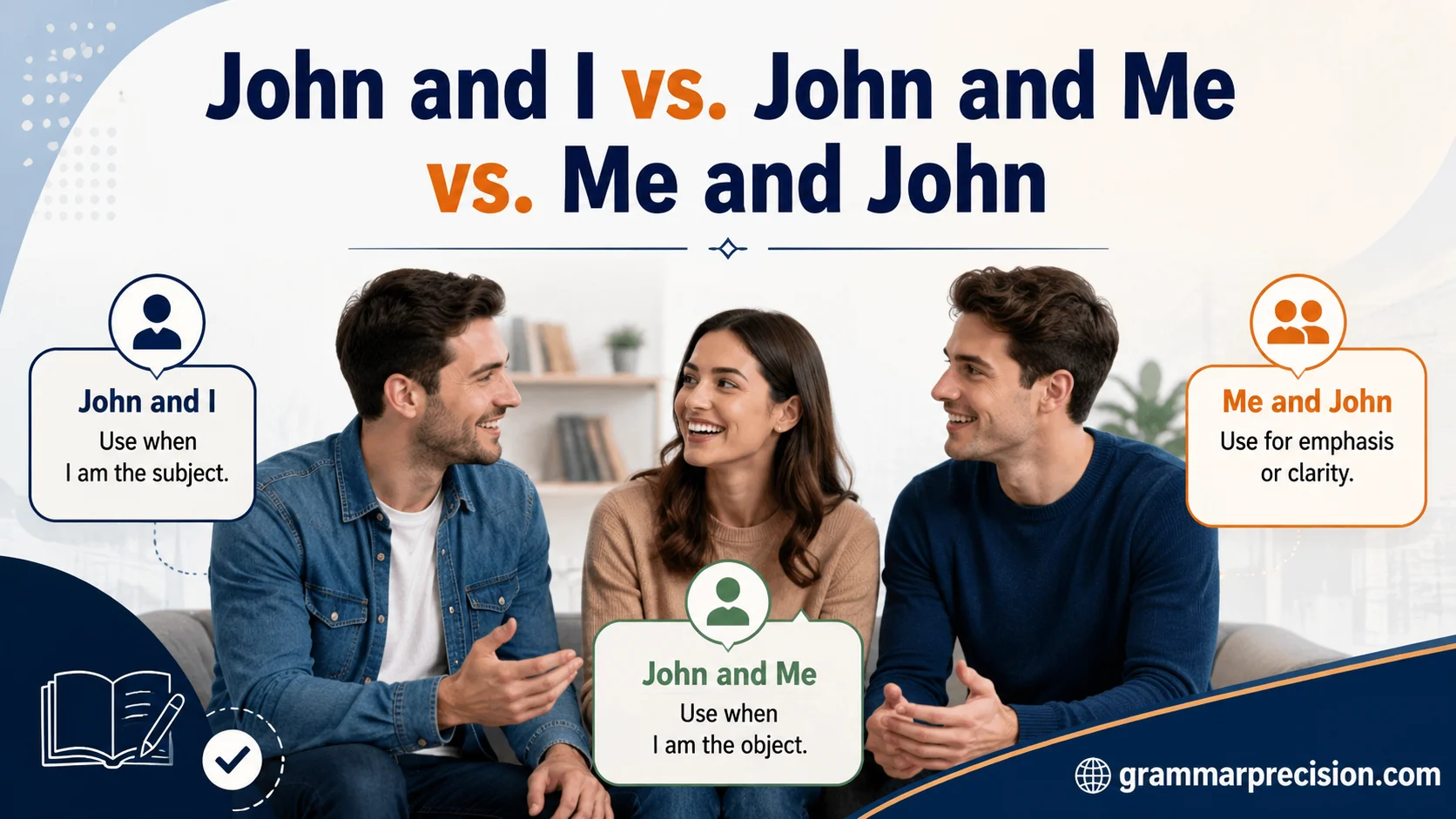
What Is the Difference Between John and I, John and Me, and Me and John?
The main difference between these phrases comes down to one simple idea:
“I” is a subject pronoun, while “me” is an object pronoun.
A subject performs an action. An object receives an action.
Think of a sentence like a movie scene:
- The subject is the person holding the camera and doing something.
- The object is the person affected by what happens.
For example:
- John and I played basketball.
- The coach congratulated John and me.
In the first sentence, John and I perform the action. Therefore, “I” is correct.
In the second sentence, the coach performs the action, and John and me receive it. Therefore, “me” is correct.
Here is a quick comparison:
| Phrase | Grammar Role | Correct Example |
| John and I | Subject | John and I went to the library. |
| John and me | Object | Sarah invited John and me to dinner. |
| Me and John | Informal subject phrase | Me and John went fishing. |
Although “Me and John” appears in everyday speech, it is usually considered informal and less suitable for professional or academic writing.
Understanding John and I: When Should You Use It?
The phrase “John and I” is correct when both people act as the subject of the sentence.
In other words, John and I are doing something together.
Examples of Correct “John and I” Usage
- John and I started a new project last week.
- John and I visited the museum yesterday.
- John and I are planning a vacation.
- John and I completed the assignment before the deadline.
In each example, John and the speaker are the ones performing the action.
Let’s break down one sentence:
John and I finished the report.
Who finished the report?
- John finished it.
- I finished it.
If you remove “John,” the sentence becomes:
I finished the report.
That sounds correct, which proves that “I” is the right choice.
Why Do People Say “John and I” So Often?
Many people overuse “John and I” because they were taught that saying “me” sounds incorrect.
For example:
❌ The manager spoke with John and I.
Many people choose “I” because they think it sounds more professional.
However, the correct sentence is:
✅ The manager spoke with John and me.
Why?
Because “John and me” is receiving the action of the verb spoke with.
Remove John:
- The manager spoke with I. ❌
- The manager spoke with me. ✅
The second sentence works, so “me” is correct.
Understanding John and Me: When Is It Correct?
The phrase “John and me” is correct when it acts as the object of a verb or follows a preposition.
Objects don’t perform the action. They receive it.
Examples of Correct “John and Me” Usage
- My parents gave John and me some advice.
- The teacher helped John and me with the project.
- She invited John and me to her wedding.
- The company offered John and me new positions.
Let’s examine this sentence:
The teacher helped John and me.
Who helped?
The teacher.
Who received the help?
John and me.
Therefore, “me” is correct.
Common Places Where You Need “John and Me”
You will usually use John and me after:
Verbs
Examples:
- called
- helped
- invited
- saw
- thanked
- supported
Sentences:
- Lisa thanked John and me.
- The coach encouraged John and me.
Prepositions
Examples:
- with
- for
- between
- to
- from
Sentences:
- This gift is from John and me.
- The disagreement was between John and me.
- She came with John and me.
A helpful trick is to check what comes before the phrase.
If someone is doing something to you, for you, or with you, you probably need me.
Is Me and John Grammatically Correct?
The phrase “Me and John” is one of the most debated expressions in English.
In everyday conversation, many native speakers say:
Me and John went to the store.
People understand it easily. It sounds natural in casual speech, especially among friends or family.
However, in standard written English, it is better to write:
✅ John and I went to the store.
The reason is not only grammar. English also follows a social rule about name order.
When mentioning yourself and another person, it is generally more polite to place yourself second.
Compare:
- John and I finished the work. ✅
- I and John finished the work. ❌ (sounds unnatural)
- Me and John finished the work. (common in casual speech but not formal)
Putting the other person first shows a small gesture of politeness.
The Easy Trick to Choose Between John and I and John and Me
If you are unsure whether to use I or me, remove the other person’s name.
This simple trick solves most problems.
Example One
Sentence:
John and I went shopping.
Remove John:
I went shopping.
Correct.
Therefore:
✅ John and I went shopping.
Example Two
Sentence:
The teacher called John and me.
Remove John:
The teacher called me.
Correct.
Therefore:
✅ The teacher called John and me.
Example Three
Sentence:
The award was given to John and I.
Remove John:
The award was given to I.
That sounds wrong.
The correct version:
✅ The award was given to John and me.
Also Read This: As Soon as or As Early As? The Complete Guide
Why Do People Make Mistakes With John and I vs. John and Me?
Pronoun mistakes happen for several reasons.
Hypercorrection
One major reason is hypercorrection.
This happens when people try so hard to avoid mistakes that they create new ones.
For example:
Someone learns:
“Never say me when talking about yourself.”
They then write:
❌ The teacher talked to John and I.
But “I” is not correct because it is receiving the action.
The goal is not to avoid “me.” The goal is to use the correct pronoun.
Formal Writing Pressure
Many students and professionals believe “I” always sounds smarter.
However, correct grammar is not about choosing the most formal-looking word.
A simple correct sentence is always better than an impressive-looking incorrect one.
Everyday Speech Influence
People often copy the way others speak.
If you regularly hear:
Me and John went there.
It may start to feel normal.
Language changes through use, but formal writing still follows traditional grammar rules.
The Politeness Rule: Why Do We Say John and I Instead of I and John?
English has an unwritten social habit:
Put others before yourself.
That is why people usually say:
- John and I
- Sarah and me
- My brother and I
Instead of:
- I and John
- Me and Sarah
- I and my brother
This rule is not about grammar alone. It is about sounding considerate.
For example:
My friend and I went hiking.
sounds more natural than:
I and my friend went hiking.
The second sentence is understandable, but it feels less polished.
Common Mistakes With John and I and John and Me
Mistake: Using John and I as an Object
❌ The company hired John and I.
Why is it wrong?
“Hired” affects John and the speaker, so they are objects.
Correct:
✅ The company hired John and me.
Mistake: Using John and Me as a Subject
❌ John and me went to the concert.
Why is it wrong?
John and the speaker perform the action.
Correct:
✅ John and I went to the concert.
Mistake: Starting With Me and John in Formal Writing
❌ Me and John created the presentation.
Better:
✅ John and I created the presentation.
John and I vs. John and Me: A Quick Comparison Table
| Sentence | Correct or Incorrect? | Reason |
| John and I are friends. | ✅ Correct | They are the subjects. |
| The teacher praised John and me. | ✅ Correct | They receive the action. |
| John and me went home. | ❌ Incorrect | “Me” cannot be a subject. |
| The gift belongs to John and me. | ✅ Correct | “Me” follows a preposition. |
| Me and John are classmates. | ⚠️ Informal | Better as “John and I.” |
Real-Life Examples of John and I vs. John and Me
Workplace Example
Incorrect:
My manager asked John and I to join the meeting.
Correct:
My manager asked John and me to join the meeting.
Why?
The manager asked both people. They receive the action.
School Example
Correct:
John and I studied for the exam together.
Incorrect:
The teacher congratulated John and I.
Correct:
The teacher congratulated John and me.
Everyday Conversation Example
Casual:
Me and John watched a movie.
Formal:
John and I watched a movie.
Both communicate the idea, but the second one fits better in professional situations.
A Simple Memory Formula
Remember this:
I = I do something.
Me = Something happens to me.
Examples:
- John and I wrote the article.
- The editor contacted John and me.
If you remember who performs the action, choosing the right pronoun becomes much easier.
FAQs:
What is the difference between John and I and John and Me?
John and I is used when both people are the subjects of a sentence, meaning they perform the action. John and me is used when both people are the objects, meaning they receive the action. For example, “John and I went shopping” is correct, while “The teacher helped John and me” is correct because the action happens to them.
Is John and Me grammatically correct?
Yes, John and me can be completely correct depending on the sentence structure. It works when the phrase receives an action or follows a preposition. For example, “She invited John and me to the party” is correct because the invitation affects both John and the speaker.
Is Me and John wrong in English?
Me and John is common in casual conversations, but it is usually avoided in formal writing. In standard English, it is better to say John and I when both people are doing an action. For example, write “John and I completed the project” instead of “Me and John completed the project.”
How can I quickly decide between John and I and John and Me?
A simple trick is to remove the other person’s name and see what sounds correct. For example, “John and I went home” becomes “I went home,” which is correct. “The manager spoke with John and me” becomes “The manager spoke with me,” which also sounds correct.
Why do people often confuse John and I with John and Me?
Many people confuse these phrases because they think “I” sounds more formal or educated than “me.” However, grammar depends on the role of the pronoun in a sentence, not how formal it sounds. Understanding subject and object pronouns helps you choose the correct phrase every time.
Conclusion:
Knowing when to use John and I, John and me, and me and John makes your English sound clearer and more natural. The key is to remember that “I” performs an action, while “me” receives an action. With simple practice and the right grammar rule, you can avoid common pronoun mistakes in both speaking and writing.