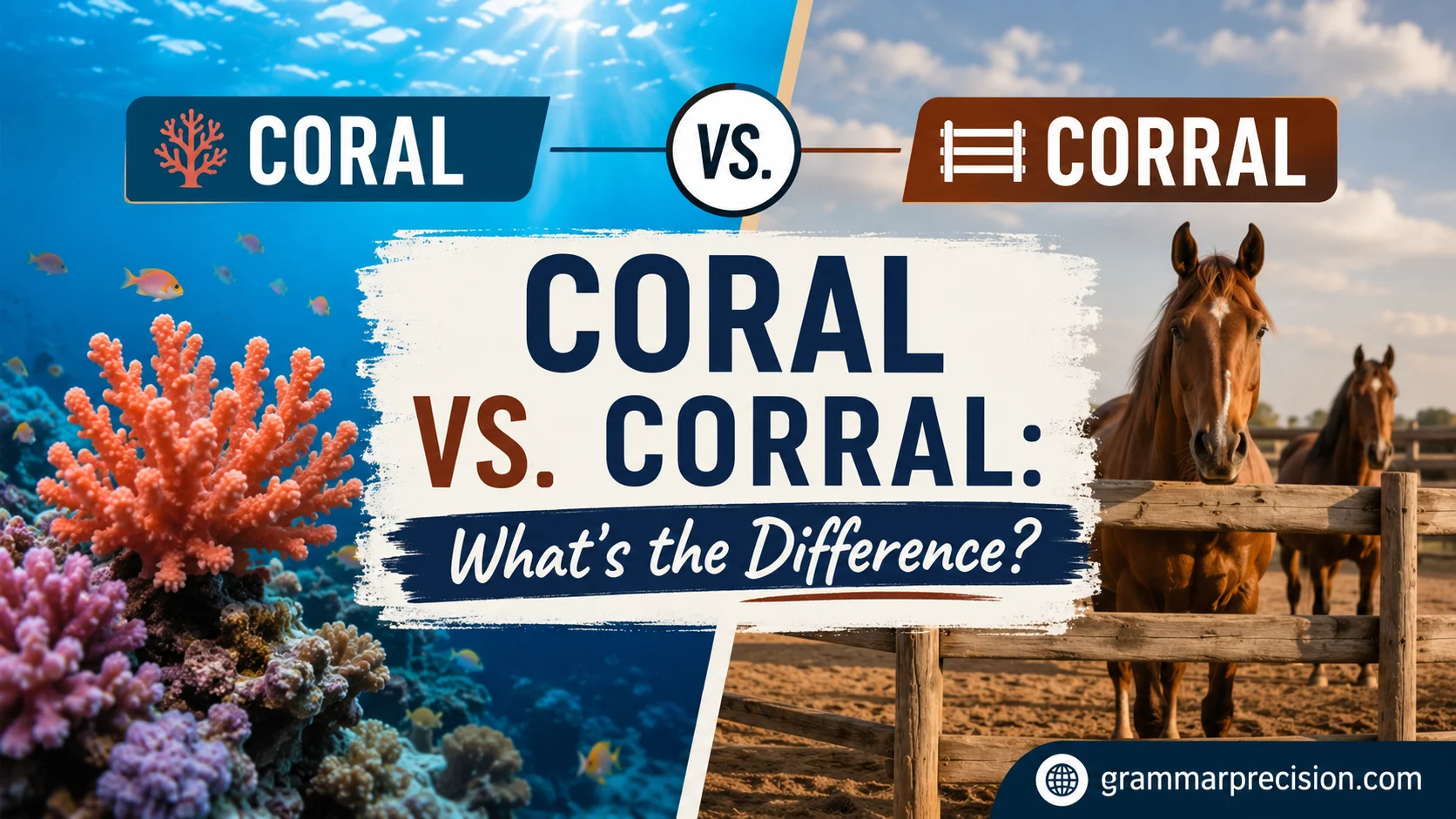
Coral vs. Corral is a commonly confused word pair that can easily lead to writing mistakes. Understanding their meanings helps you choose the correct word with confidence every time.
Although Coral vs. Corral may sound nearly identical, their meanings couldn’t be more different. Coral refers to colorful marine animals that build reefs or a pinkish-orange color, while corral describes a fenced enclosure for livestock or the act of gathering people or animals into one place. Learning this distinction improves both grammar and writing accuracy.
Many English learners and even native speakers confuse these words because of their similar pronunciation. This guide explains Coral vs. Corral with clear definitions, comparison tables, real-world examples, and an easy memory trick that helps you remember the correct spelling and use in any writing situation.
Quick Answer: Coral vs. Corral
If you’re in a hurry, here’s the short answer.
| Word | Meaning | Example |
| Coral | A marine organism that forms reefs, or a pinkish-orange color | The divers admired the colorful coral reef. |
| Corral | A fenced enclosure for animals, or the act of gathering people or animals into one place | The rancher led the horses into the corral. |
The easiest way to remember the difference:
- Coral belongs in the ocean.
- Corral belongs on a ranch or farm.
Although they sound very similar in American English, their meanings have nothing in common.
Coral Meaning
What Does Coral Mean?
Coral refers to tiny marine animals called coral polyps. These small creatures live together in large colonies and build hard limestone skeletons over time. As generations of polyps grow, they create the beautiful underwater structures known as coral reefs.
The word coral can also describe the pinkish-orange color inspired by these marine organisms.
Examples
- We snorkeled above a vibrant coral reef.
- Many fish depend on coral for shelter.
- She painted her bedroom a soft coral color.
- Climate change threatens delicate coral ecosystems.
Coral Pronunciation
Most Americans pronounce coral as:
KOR-uhl
IPA: /ˈkɔrəl/
It has two syllables:
Cor-al
The pronunciation is straightforward, although it closely resembles corral, which often causes confusion.
Where Does the Word Coral Come From?
The word coral has an ancient history.
It entered English through Old French and Latin, eventually tracing back to the Greek word korallion, meaning coral.
People have admired coral for thousands of years. Ancient civilizations used it to create:
- Jewelry
- Decorations
- Religious artifacts
- Protective charms
Today, scientists value coral for a completely different reason. Healthy coral reefs support one of Earth’s richest ecosystems.
Interesting Facts About Coral
Many people think coral is a plant. It isn’t.
Here are a few fascinating facts:
- Corals are animals, not plants.
- More than 6,000 species of coral exist worldwide.
- Coral reefs cover less than 1% of the ocean floor.
- Despite covering such a small area, reefs support about 25% of all marine species.
- Australia’s Great Barrier Reef stretches for over 2,300 kilometers (1,430 miles), making it the world’s largest coral reef system.
These incredible ecosystems protect coastlines, provide food, support tourism, and help millions of people earn a living.
Common Collocations With Coral
You’ll often see coral paired with these words:
- Coral reef
- Coral bleaching
- Coral colony
- Coral ecosystem
- Coral island
- Coral sand
- Coral habitat
- Coral conservation
Using these natural word combinations makes your writing sound more fluent.
Example Sentences Using Coral
Here are several examples that show how coral appears in everyday English.
- Scientists are studying damaged coral reefs.
- Divers photographed colorful coral formations.
- The aquarium displayed rare coral species.
- Pollution can seriously harm coral habitats.
- Her summer dress featured a beautiful coral shade.
Notice that every sentence relates either to the ocean or the color.
Corral Meaning
What Does Corral Mean?
A corral is a fenced area used to keep livestock such as horses, cattle, sheep, or goats.
You’ll often find corrals on:
- Ranches
- Farms
- Rodeos
- Horse-training facilities
Unlike coral, which belongs underwater, a corral exists on land.
Corral as a Verb
Interestingly, corral isn’t only a noun.
It also functions as a verb.
When you corral someone or something, you gather or bring them together into one place.
Examples
- Volunteers corralled visitors before the concert began.
- The ranch hands corralled the cattle.
- Teachers quickly corralled the students after the fire drill.
In modern English, the verb is often used figuratively.
For example:
- She finally corralled all the paperwork.
- The manager corralled everyone into the meeting room.
Corral Pronunciation
Most Americans pronounce corral as:
kuh-RAL
IPA: /kəˈræl/
Unlike coral, the stress falls on the second syllable.
This subtle difference helps distinguish the two words when spoken carefully.
Where Does Corral Come From?
The word corral entered English from Spanish.
The Spanish word corral originally meant an enclosed yard or animal pen.
Spanish influence spread throughout North America during the colonial period, especially in areas known for ranching.
As cattle ranching expanded across the American West, the word became part of everyday English.
Today, it’s closely associated with:
- Cowboys
- Western movies
- Ranches
- Livestock
- Rodeos
Common Collocations With Corral
These word combinations frequently appear together.
- Horse corral
- Cattle corral
- Wooden corral
- Livestock corral
- Corral gate
- Corral fence
- Corral animals
- Corral the crowd
Learning these phrases helps you recognize the correct context immediately.
Example Sentences Using Corral
Here are several examples.
- The horses waited inside the corral.
- Ranch workers repaired the old corral fence.
- Cowboys guided the cattle into the corral.
- Security officers corralled fans before the concert.
- Volunteers corralled children into small groups.
Every example relates to gathering, enclosing, or controlling movement.
Coral vs. Corral at a Glance
Here’s an easy comparison you can revisit whenever you’re unsure.
| Feature | Coral | Corral |
| Meaning | Marine animal or pinkish-orange color | Animal enclosure or gather together |
| Part of Speech | Noun, adjective | Noun, verb |
| Common Location | Ocean | Ranch or farm |
| Related Topics | Marine biology, reefs, conservation | Ranching, livestock, farming |
| Pronunciation | KOR-uhl | kuh-RAL |
| Origin | Greek → Latin → French | Spanish |
| Example | The coral reef attracts divers. | The horses stayed inside the corral. |
This table highlights just how different these words really are.
Why People Confuse Coral and Corral
Even experienced writers occasionally mix up these words. The confusion isn’t surprising because several factors make them easy to mistake.
They Sound Similar
In casual American speech, coral and corral can sound remarkably alike. If you hear the words without context, telling them apart may be difficult.
That’s why many spelling mistakes happen after dictation or conversation.
Only One Letter Changes
At first glance, the spellings seem nearly identical.
- Coral
- Corral
The only visible difference is the extra “r.”
When typing quickly, it’s easy to overlook this small detail.
Spell Check Doesn’t Always Help
Most spelling tools only detect words that don’t exist.
Since coral and corral are both correctly spelled English words, your spell checker usually won’t flag the mistake.
For example:
❌ The rancher repaired the coral.
The sentence is grammatically correct, even though the wrong word changes the meaning completely.
Context Matters More Than Spelling
The easiest way to choose the correct word is to ask yourself one simple question:
Are you talking about the ocean or a ranch?
If the topic involves:
- Fish
- Marine life
- Reefs
- Beaches
- Diving
- Ocean ecosystems
Use coral.
If the topic involves:
- Horses
- Cattle
- Farms
- Ranches
- Cowboys
- Gathering animals
Use corral.
That simple mental check prevents almost every mistake.
Common Writing Mistakes
Writers often make errors like these.
| Incorrect | Correct |
| We visited the beautiful corral reef. | We visited the beautiful coral reef. |
| The cowboy repaired the coral. | The cowboy repaired the corral. |
| Divers photographed the colorful corrals. | Divers photographed the colorful corals. |
| Farmers protect the coral fence. | Farmers protect the corral fence. |
These examples show why understanding the meaning—not just the spelling—is essential.
Memory Trick You’ll Never Forget
One of the easiest ways to remember Coral vs. Corral is to connect each word with something you already know. Instead of memorizing definitions, create a mental picture. Your brain remembers images much better than isolated facts.
The Ocean vs. Ranch Rule
Think of it this way:
- Coral belongs in the ocean.
- Corral belongs on a ranch.
If your sentence mentions fish, reefs, snorkeling, scuba diving, or marine life, coral is almost certainly the right word.
If it mentions horses, cattle, livestock, cowboys, or fences, choose corral.
The Double “R” Trick
Here’s another simple memory aid.
Corral has two Rs.
Imagine those two Rs standing for:
- Ranch
- Round up
Both ideas fit perfectly with the meaning of corral.
By contrast, coral has only one R, just like a single reef beneath the sea.
Picture Association
Visual learners often remember words faster through imagery.
Imagine two scenes:
🌊 Coral
- Bright fish swimming
- Colorful reefs
- Sea turtles
- Crystal-clear water
🤠 Corral
- Wooden fences
- Cowboys
- Horses
- Cattle waiting inside an enclosure
Whenever you’re unsure which spelling to use, picture one of these scenes. The correct word usually becomes obvious.
A Simple Sentence to Remember
Try repeating this sentence a few times:
Coral grows under the sea. A corral stands on the ranch.
It’s short, memorable, and reinforces the difference naturally.
Coral vs. Corral in Everyday Writing
Understanding definitions is helpful. Seeing the words in real situations is even better.
Let’s explore where each word commonly appears.
Coral in Everyday Context
You’ll often encounter coral in articles about nature, travel, science, and environmental conservation.
Travel
- The island is famous for its stunning coral reefs.
- Tourists booked snorkeling trips to see colorful coral.
Marine Biology
- Researchers discovered a new species of coral.
- Healthy coral reefs support thousands of marine animals.
Climate Change
- Rising ocean temperatures threaten fragile coral ecosystems.
- Scientists monitor coral bleaching every year.
Interior Design
Not every use relates to the ocean.
Coral also describes a warm pink-orange color.
Examples:
- She chose coral curtains for the living room.
- The bridesmaids wore elegant coral dresses.
Corral in Everyday Context
You’ll usually see corral in stories about agriculture, ranching, and animal care.
Ranches
- The ranch built a larger horse corral.
- Workers cleaned the corral before sunrise.
Farming
- Farmers guided sheep into the corral.
- The new corral gate made feeding easier.
Sports
At rodeos, you’ll hear the word frequently.
Examples:
- The bull waited inside the corral.
- Riders gathered near the corral entrance.
Figurative Use
Modern English often uses corral metaphorically.
Examples:
- She finally corralled all her receipts.
- The coach corralled the players before practice.
- Volunteers corralled attendees into smaller groups.
In these cases, nobody is fencing animals. Instead, people are gathering or organizing others.
Also Read This: Northeast, North East, or North-East? The Complete Guide to Correct Spelling
Coral vs. Corral in Literature and Pop Culture
These words appear in very different types of writing.
Understanding where you’ll encounter them helps reinforce their meanings.
Coral in Books and Media
Writers often use coral when describing:
- Tropical islands
- Ocean adventures
- Nature documentaries
- Marine conservation
- Underwater photography
- Children’s educational books
Example:
The divers floated above brilliant coral gardens filled with tropical fish.
Travel magazines and wildlife documentaries also use the word frequently.
Corral in Western Stories
Corral appears often in:
- Western novels
- Cowboy movies
- Ranching documentaries
- Historical fiction
- Agricultural magazines
One of the most famous examples is the Gunfight at the O.K. Corral, a legendary event from the American Old West.
Although many people recognize the phrase, they may not realize that a corral simply refers to an enclosed livestock pen.
Common Mistakes to Avoid
Even advanced English speakers occasionally confuse these words.
Let’s correct the most common errors.
Mistake 1: Mixing Up the Context
❌ The horses ran into the coral.
✅ The horses ran into the corral.
Remember:
Horses don’t live underwater.
Mistake 2: Using Corral for Ocean Topics
❌ Australia’s Great Barrier Corral
✅ Australia’s Great Barrier Coral Reef
The Great Barrier Reef contains millions of living coral organisms.
Mistake 3: Forgetting Corral Is Also a Verb
Many people think corral only refers to a fenced area.
Actually, it’s also an action.
Examples:
- Police corralled the crowd.
- Teachers corralled students after recess.
- Organizers corralled volunteers before the event.
Mistake 4: Assuming Coral Is a Plant
This misconception is surprisingly common.
Although coral looks like underwater plants, each structure consists of thousands of tiny animals called polyps.
Knowing this fact helps you better understand articles about marine biology.
Mistake 5: Trusting Spell Check
Spell check won’t catch mistakes like this.
❌ The ranch repaired its coral.
Because coral is a correctly spelled word, your software won’t highlight it.
Always read the sentence carefully.
Ask yourself:
Does this sentence belong in the ocean or on a ranch?
Coral vs. Corral in American and British English
Unlike many confusing English words, coral and corral have the same meanings in both American English and British English.
The spellings remain identical.
The definitions remain identical.
Only pronunciation may vary slightly depending on regional accents.
That consistency makes these words easier to learn than pairs like:
- Color vs. Colour
- Organize vs. Organise
- Center vs. Centre
No matter where English is spoken, coral refers to marine life and corral refers to an enclosure or the act of gathering.
Related Vocabulary You Should Know
Learning nearby vocabulary strengthens your understanding.
Words Related to Coral
| Word | Meaning |
| Reef | A ridge of rock or coral beneath the water |
| Polyp | The tiny animal that builds coral |
| Lagoon | A shallow body of water near reefs |
| Marine | Connected with the sea |
| Bleaching | The loss of color in coral due to stress |
| Ecosystem | A community of living organisms |
Words Related to Corral
| Word | Meaning |
| Ranch | A large farm for raising livestock |
| Livestock | Farm animals raised for agriculture |
| Pasture | Land where animals graze |
| Pen | A fenced enclosure for animals |
| Stable | A building where horses are kept |
| Herd | A group of grazing animals |
Knowing these related terms makes it easier to recognize which word belongs in a sentence.
Coral vs. Corral: Quick Comparison
Here’s another side-by-side overview.
| Feature | Coral | Corral |
| Main Meaning | Marine organism | Animal enclosure |
| Secondary Meaning | Pink-orange color | Gather together |
| Environment | Ocean | Farm or ranch |
| Part of Speech | Noun, adjective | Noun, verb |
| Pronunciation | KOR-uhl | kuh-RAL |
| Common Partners | Reef, bleaching, ecosystem | Horses, cattle, livestock, fence |
| Easy Memory Trick | Ocean | Ranch |
This quick chart makes last-minute proofreading much easier.
Practice Quiz
Test your understanding before moving on.
Choose the correct word.
1. Divers explored a colorful ______ reef.
A. Coral
B. Corral
Answer: A. Coral
2. The rancher repaired the wooden ______.
A. Coral
B. Corral
Answer: B. Corral
3. Scientists are studying ______ bleaching.
A. Coral
B. Corral
Answer: A. Coral
4. Volunteers quickly ______ the visitors into smaller groups.
A. Coraled
B. Corralled
Answer: B. Corralled
5. The horses waited quietly inside the ______.
A. Coral
B. Corral
Answer: B. Corral
6. She painted the walls a soft ______ color.
A. Coral
B. Corral
Answer: A. Coral
If you answered all six correctly, you’ve mastered one of English’s most commonly confused word pairs.
Expert Writing Tips for Using Coral and Corral Correctly
Even skilled writers make mistakes with words that sound alike. The good news is that a few simple habits can help you choose the right word every time.
Think About the Setting
Before you write, ask yourself one question:
Where does this happen?
If the sentence takes place in the ocean, use coral.
If it takes place on a farm, ranch, or rodeo, use corral.
This quick check eliminates most mistakes.
Read the Sentence Aloud
Reading your work aloud helps you catch words that don’t fit the context.
For example:
The divers admired the beautiful corral.
The sentence sounds acceptable because the words are pronounced similarly. However, once you picture divers underwater, you’ll realize coral is the correct choice.
Learn Common Word Partners
Certain words almost always appear together.
Coral
- Coral reef
- Coral bleaching
- Coral ecosystem
- Coral polyps
- Coral conservation
- Coral islands
- Coral habitats
Corral
- Horse corral
- Cattle corral
- Corral gate
- Corral fence
- Corral livestock
- Corral the crowd
- Corral the horses
Recognizing these natural combinations makes your writing more accurate and fluent.
Slow Down During Proofreading
Many spelling errors happen because writers read what they intended to write instead of what actually appears on the page.
During your final edit:
- Look at every homophone carefully.
- Check whether the meaning fits the sentence.
- Don’t rely only on spell-check software.
A few extra seconds can prevent an embarrassing mistake.
Real-Life Case Studies
Let’s see how these words appear in real situations.
Case Study 1: A Student’s Science Report
A middle school student wrote:
The corral reefs protect thousands of fish.
Although the sentence was well written, one spelling mistake changed the meaning completely.
Correct Version
The coral reefs protect thousands of fish.
The correction instantly makes the sentence accurate because coral refers to marine organisms.
Case Study 2: A Ranch Advertisement
A ranch owner posted this online:
We recently built a new coral for our horses.
Potential customers understood the message, but the spelling looked unprofessional.
Correct Version
We recently built a new corral for our horses.
Using the correct word improves both clarity and credibility.
Case Study 3: Event Planning
An event organizer wrote:
Volunteers will corral guests near the entrance before the ceremony begins.
Here, corral is used as a verb, meaning to gather or organize people into one place.
This is a perfect example of figurative usage in modern English.
Similar Word Pairs You Might Also Confuse
If Coral vs. Corral has ever puzzled you, these word pairs may also deserve your attention.
| Word Pair | Difference |
| Desert vs. Dessert | Dry land vs. sweet treat |
| Principal vs. Principle | School leader vs. rule or belief |
| Stationary vs. Stationery | Not moving vs. writing paper |
| Complement vs. Compliment | Complete something vs. praise someone |
| Affect vs. Effect | Usually a verb vs. usually a noun |
| Brake vs. Break | Stop a vehicle vs. separate into pieces |
| Peak vs. Peek vs. Pique | Mountain top vs. quick look vs. stimulate interest |
Learning these commonly confused words will make your writing stronger and more professional.
Key Takeaways
Before you finish, here’s a quick review.
| Coral | Corral |
| Found in the ocean | Found on a ranch |
| Marine animal | Animal enclosure |
| Also a pink-orange color | Also a verb meaning gather together |
| Related to reefs | Related to livestock |
| One R | Two Rs |
Remember This Simple Rule
Coral lives beneath the waves. Corral stands behind the fence.
It’s a short sentence, but it’s easy to remember.
FAQs:
What is the difference between coral and corral?
The main difference is their meaning. Coral refers to marine animals that form reefs or a pinkish-orange color, while corral is a fenced enclosure for livestock or a verb meaning to gather or round up people or animals.
Is coral an animal or a plant?
Coral is an animal, not a plant. It consists of thousands of tiny creatures called polyps that live together in colonies and build the beautiful coral reefs found in oceans around the world.
Can corral be used as both a noun and a verb?
Yes. As a noun, a corral is an enclosed area for animals such as horses or cattle. As a verb, it means to gather, organize, or confine people or animals into one place.
Why do people confuse Coral vs. Corral?
People often confuse Coral vs. Corral because the words have similar spellings and similar pronunciations. However, their meanings are completely different, so paying attention to the context is the best way to choose the correct word.
What is an easy way to remember Coral vs. Corral?
A simple memory trick is to think of the setting. Coral belongs in the ocean with reefs and marine life, while corral belongs on a ranch with horses and cattle. This association makes it much easier to remember the correct spelling.
Conclusion:
Understanding Coral vs. Corral is easier once you focus on the context instead of just the spelling. Coral relates to the ocean, marine life, and even a pinkish-orange color, while corral refers to a livestock enclosure or the action of gathering people or animals. By remembering these key differences and using the simple ocean vs. ranch memory trick, you can avoid common mistakes and write with greater accuracy, confidence, and clarity every time.