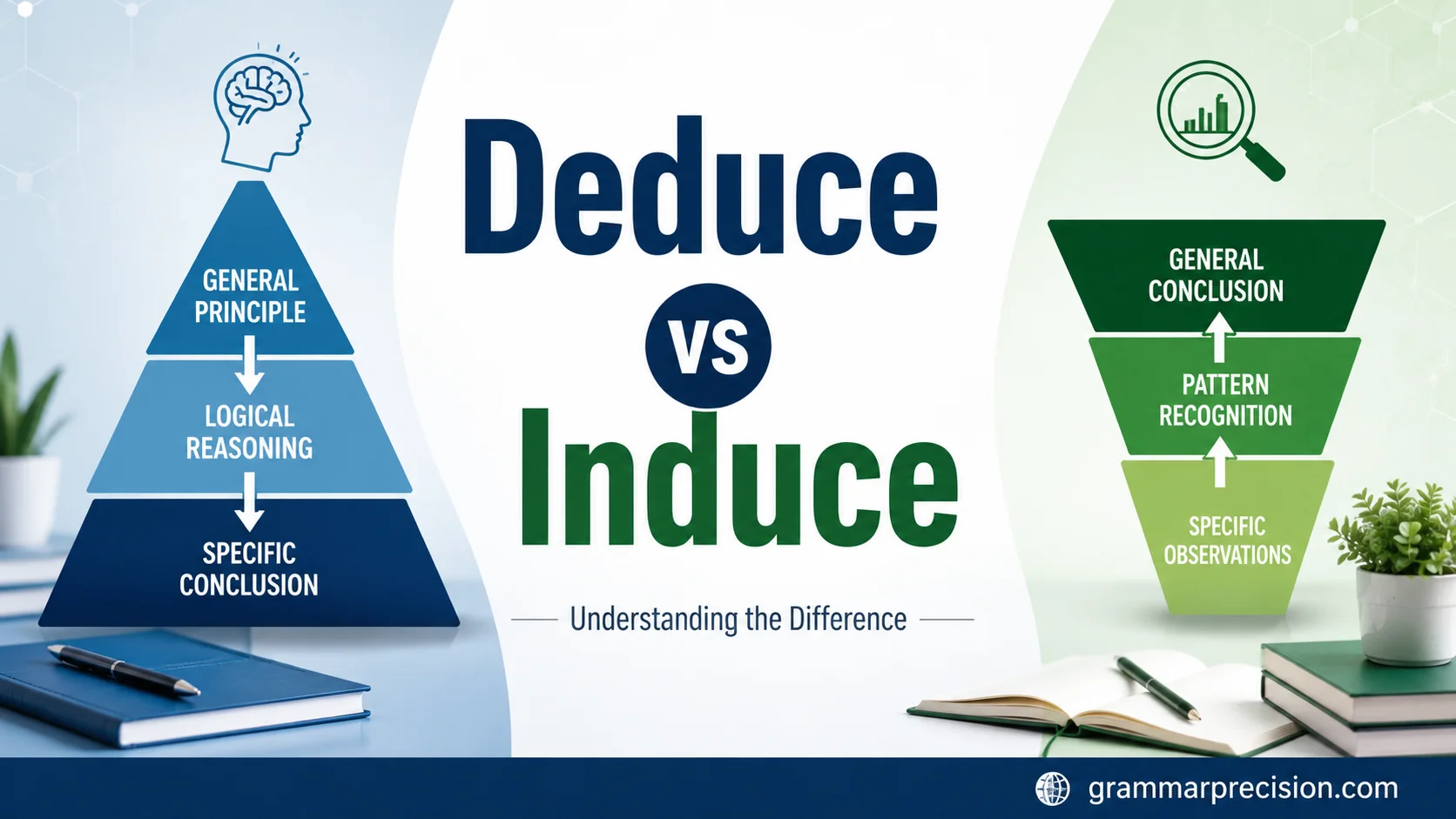
Deduce vs Induce shows inductive reasoning and deductive reasoning in daily life, helping us form conclusions, interpret information, and move from specific observations to general understanding clearly skills across contexts.
In inductive reasoning and deductive reasoning, we shift between deduction and induction, using deducing, deduce, and deduct to reach specific conclusions and form broader generalizations from specific observations.
These processes improve clear thinking and problem solving in real life situations, research, and academic reasoning, where evidence, statements, and claims help navigate confusion, layers of complexity, and meaningful interpretation better.
In daily life, reasoning skills develop through real life observations, evidence, statements, and claims, where practical examples and experiments help move from specific observations to broad generalizations and form general rules and generalizations. confusion, layers of complexity, and meaningful interpretation connect ideas from philosopher, logician, and academic reasoning, improving understanding in structured thinking and analysis clearly.
Deduce vs Induce Meaning: What Are We Really Talking About?
At the core, deduce vs induce describes two different ways of reaching conclusions.
- Deduction moves from general truth to specific certainty
- Induction moves from specific observations to general probability
That difference sounds small. It is not. It changes everything about how conclusions are formed.
Think of it like this:
- Deduction is like following a map.
- Induction is like learning the map by walking the terrain.
Both get you somewhere. But they do it in completely different ways.
What Does Deductive Reasoning Mean?
Deductive reasoning is a logical process where you start with a general rule and apply it to a specific case.
If the rules are true, the conclusion must be true.
That’s the key word: must.
Simple Structure of Deduction
- General rule
- Specific case
- Guaranteed conclusion
Example of Deductive Reasoning
- All humans are mortal
- Socrates is a human
- Therefore, Socrates is mortal
You do not guess here. You do not estimate. You conclude with certainty.
Everyday Deduction Examples
You already use deduction more than you think:
- If all store items are 20% off and a shirt costs $50, you know the final price is $40
- If a traffic light is red, you stop
- If all emails from a sender are spam, you block them
It feels automatic because your brain loves rules.
Key Traits of Deduction
- Starts with known truths
- Produces certain conclusions
- Works like math or formal logic
- Does not rely on probability
But here’s the catch. Deduction is only as strong as its starting point.
If your rule is wrong, your conclusion collapses.
What Does Inductive Reasoning Mean?
Inductive reasoning works in the opposite direction.
You start with specific observations and build a general conclusion.
But unlike deduction, the conclusion is not guaranteed. It is only likely.
Simple Structure of Induction
- Specific observations
- Pattern recognition
- General conclusion
Example of Inductive Reasoning
- The sun has risen every day in recorded history
- Therefore, the sun will rise tomorrow
You do not know it for absolute certainty. You assume it based on repeated experience.
Everyday Induction Examples
You use induction constantly:
- Your friend replies late often, so you assume they are busy
- Dark clouds usually mean rain, so you carry an umbrella
- A restaurant is crowded, so you assume the food is good
Your brain is basically a pattern machine.
Key Traits of Induction
- Starts with evidence
- Builds probable conclusions
- Works on patterns
- Can be wrong, even if evidence feels strong
Induction is powerful, but it is also risky.
One bad assumption can mislead your entire conclusion.
Deduce vs Induce Comparison: Side by Side Breakdown
To make deductive vs inductive reasoning clearer, here’s a direct comparison.
| Feature | Deductive Reasoning | Inductive Reasoning |
| Direction | General → Specific | Specific → General |
| Conclusion Type | Certain | Probable |
| Dependence | Rules or facts | Observations |
| Risk of Error | Low if rules are true | Higher due to uncertainty |
| Use Case | Mathematics, logic, law | Science, predictions, daily life |
| Flexibility | Low | High |
This table shows the real difference in thinking style.
Deduction is rigid. Induction is flexible.
How the Human Brain Uses Deduce vs Induce Thinking
Your brain does not pick one method. It blends both constantly.
The Brain’s Shortcut System
Humans evolved to survive, not to do formal logic exams. So the brain prefers speed over perfection.
That means:
- Induction runs in the background all the time
- Deduction kicks in when rules are clear
Why Induction Dominates Daily Life
Induction is faster.
For example:
If you touch a hot pan once, you learn quickly:
“Hot metal burns.”
You do not need repeated proof. One strong experience is enough.
Where Deduction Takes Over
Deduction becomes useful when rules are stable:
- Math problems
- Legal systems
- Coding logic
- Formal arguments
In those cases, precision matters more than speed.
Real Life Examples of Deductive vs Inductive Reasoning
Let’s ground this in real situations so it actually sticks.
Medical Diagnosis
Doctors use both methods:
- Induction: Symptoms from thousands of patients suggest possible disease
- Deduction: If test results confirm criteria, diagnosis becomes certain
Business Decisions
Companies rely heavily on induction:
- Past sales data → future demand predictions
- Customer behavior → marketing strategy
But they also use deduction:
- If discount = 20% and cost = X, profit = Y
Criminal Investigations
Detective work is a perfect mix:
- Induction: Patterns from past crimes
- Deduction: Applying rules of evidence to a suspect
Think Sherlock Holmes. He often uses deduction after gathering inductive clues.
Weather Forecasting
- Induction: Historical weather patterns
- Probability models → forecast rain
- Deduction: If radar shows storm formation, rain is expected soon
When Deduction Fails
Deduction feels safe. But it breaks easily when assumptions are wrong.
Common Deduction Problems
- Wrong general rule
- Hidden assumptions
- Overconfidence in logic
Example of Failure
- All birds can fly (wrong assumption)
- Penguins are birds
- Therefore, penguins can fly (false conclusion)
The logic is correct. The premise is wrong.
That is the danger.
Also Read This: Relate To vs. Relate With: The Complete Grammar Guide
When Induction Fails
Induction fails in a different way. It looks right until it suddenly isn’t.
Common Induction Problems
- Small sample size
- Bias in observations
- Misreading patterns
Example of Failure
- You meet three rude people from a city
- You conclude everyone from that city is rude
That is a classic overgeneralization.
It feels logical. But it is not reliable.
Why Scientists Use Both Deduction and Induction
Science is the perfect balance of deduce vs induce thinking.
Step 1: Induction
Scientists observe patterns:
- Repeated experiments
- Natural behavior
- Data trends
They form a hypothesis.
Step 2: Deduction
Then they test it:
- If hypothesis is true, what should happen?
- Does the experiment confirm it?
This cycle builds scientific knowledge.
Simple Flow
- Observe → Induce hypothesis
- Test → Deduce outcome
- Repeat → Refine understanding
That is how science progresses.
How Deduce vs Induce Shapes Decision Making
Every major decision you make follows one of these paths.
Inductive Decision Making
You rely on experience:
- “This investment usually performs well”
- “This friend is usually late”
- “This brand feels reliable”
It is fast but not always accurate.
Deductive Decision Making
You rely on rules:
- Budget rules
- Legal constraints
- Mathematical certainty
It is slower but more reliable.
Smart Decision Strategy
The best thinkers combine both:
- Induction to explore possibilities
- Deduction to verify decisions
That balance reduces risk.
Quick Thinking Framework: How to Use Both Methods
Here is a simple mental model you can use:
Step 1: Ask What You Know
- Are there fixed rules? → use deduction
- Are there patterns? → use induction
Step 2: Test Your Assumption
- What if this rule is wrong?
- What if this pattern is coincidence?
Step 3: Cross Check
- Use deduction to verify induction
- Use induction to challenge deduction
This loop improves thinking quality over time.
Common Mistakes People Make With Deduce vs Induce Thinking
Most errors come from confusion between the two.
Mistake 1: Treating Induction as Certainty
People say:
“It happened before, so it must happen again.”
That is not guaranteed.
Mistake 2: Ignoring Evidence in Deduction
People assume rules without checking them.
That leads to false logic chains.
Mistake 3: Mixing Both Without Awareness
This creates confusion:
- Weak assumptions
- Overconfident conclusions
- Poor judgment calls
Awareness fixes most of these problems.
Famous Quote on Reasoning
As philosopher David Hume suggested:
“Reason is, and ought only to be the slave of the passions.”
While debated, it highlights something important.
Humans do not always reason perfectly. Emotion and experience often influence logic.
That is why understanding deductive and inductive reasoning matters so much.
FAQs:
What Is the Main Difference Between Deduce vs Induce?
Deduce vs Induce differs mainly in the direction of reasoning. Deduction starts with a general rule and moves toward a specific conclusion, while induction begins with specific observations and develops a broader generalization. Both methods are important in logic, research, and problem solving.
Can Deduction and Induction Be Used Together?
Yes, deduction and induction often work together. Researchers may use inductive reasoning to create a theory from observations and then apply deductive reasoning to test that theory. Combining both methods can improve critical thinking and produce more reliable conclusions.
Is Deductive Reasoning Always Correct?
Deductive reasoning can be highly reliable when the premises are true and the logic is valid. However, if the starting information is incorrect, the conclusion may also be wrong. The strength of deduction depends on the accuracy of the original assumptions and facts.
Why Is Inductive Reasoning Important?
Inductive reasoning helps people identify patterns, generate hypotheses, and make predictions. It is commonly used in scientific research, business analysis, and everyday decision making. While its conclusions are not guaranteed to be true, they can be very useful when supported by sufficient evidence.
Which Is Better: Deduce or Induce?
Neither method is inherently better. Deduction is best when applying known rules to reach certain conclusions, while induction is useful for discovering new ideas from observations. The choice depends on the situation, the available evidence, and the goal of the analysis.
Conclusion:
Understanding Deduce vs Induce is essential for improving reasoning skills, communication, and decision making.
Deduction moves from a general principle to a specific conclusion, whereas induction moves from specific observations to a general theory. By recognizing when to use each approach, you can analyze information more effectively, build stronger arguments, and make better informed decisions in both academic and everyday situations.