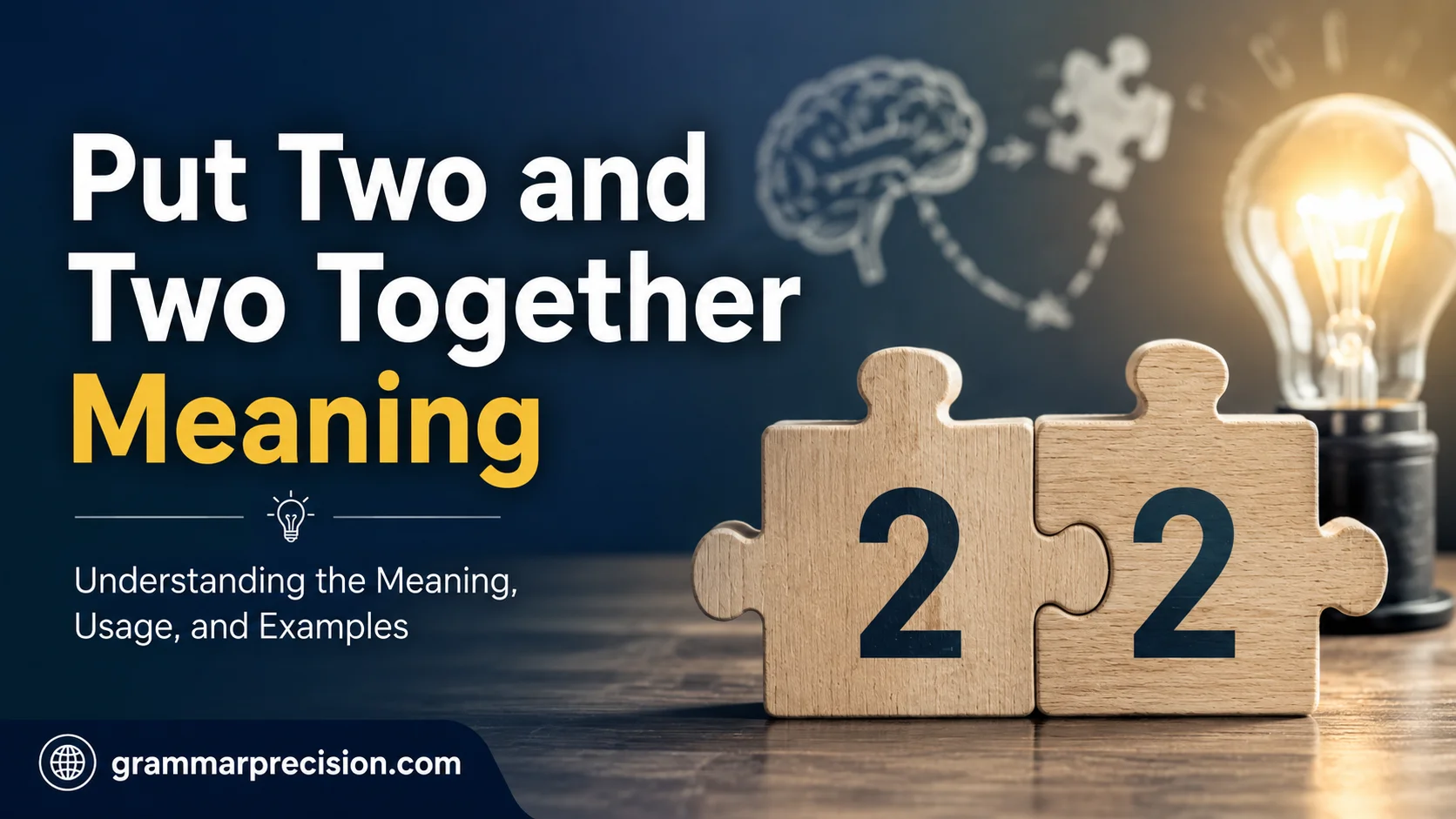
Put Two and Two Together Meaning is a common English idiom used when someone understands the truth by connecting clues or facts. People often use this phrase in daily conversations and writing.
The phrase “Put Two and Two Together Meaning” explains how a person reaches a logical conclusion after noticing small details. It is often used in English conversations, storytelling, and professional communication to describe careful thinking. This idiom highlights the importance of observation, reasoning, and understanding hidden connections between events or information.
People use this expression when they suddenly realize the truth after examining different facts. In both formal and informal language, the idiom represents critical thinking and smart judgment. Learning idioms like this improves your English vocabulary, strengthens communication skills, and helps you understand native speakers more naturally and confidently.
What Does “Put Two and Two Together” Mean?
The idiom “put two and two together” means:
To understand the truth by connecting clues or pieces of information.
In simple words, you notice several details and then reach a logical conclusion.
Here’s a quick example:
“I saw them holding hands at dinner and then leaving together. I put two and two together.”
The speaker never received direct confirmation. Instead, they connected clues and figured out what was happening.
Why This Idiom Makes So Much Sense
The phrase comes from basic arithmetic.
2+2=4
Adding two and two creates an obvious answer. In the same way, connecting obvious clues creates an obvious conclusion.
That’s why native speakers use the idiom when the answer seems fairly clear.
For example:
ClueClueLogical ConclusionEmpty cookie jarChocolate on your child’s faceYour child ate the cookiesPacked suitcaseGoodbye textSomeone is leavingLate-night callsSecret smilesTwo people may be dating
The idiom reflects human pattern recognition. Your brain naturally searches for connections. That mental process sits at the center of the phrase.
Literal Meaning vs Figurative Meaning
This confuses many English learners.
The literal meaning involves math. The figurative meaning involves reasoning.
TypeMeaningLiteralAdding numbers togetherFigurativeConnecting clues to understand something
Native speakers almost always use it figuratively.
Nobody says:
“I put two and two together and got four.”
That sounds overly literal unless someone is joking.
Instead, the phrase usually appears in emotional or social situations.
The Origin of “Put Two and Two Together”
The idiom has existed for centuries.
Language historians trace similar expressions back to the 1600s. Early versions compared obvious truths to the certainty that two plus two equals four.
One early variation resembled this idea:
“As clear as that two and two makes four.”
Over time, English speakers shortened the expression into the idiom we use today.
The phrase became popular because it instantly communicated something important:
- The clues were obvious
- The conclusion required logic
- The answer eventually became clear
That structure still works perfectly in modern English.
Interestingly, some humorous versions later evolved into:
“Put two and two together and make five.”
That version means someone reached the wrong conclusion from the evidence.
Why Native Speakers Love This Idiom
This phrase survives because it sounds natural in almost every kind of conversation.
It works in:
- Casual speech
- Detective stories
- Workplace discussions
- Romantic situations
- Gossip
- TV dialogue
- Family arguments
The idiom also creates suspense.
When someone says:
“Then I put two and two together…”
listeners immediately expect a revelation.
That makes the phrase powerful in storytelling.
Everyday Situations Where People Use “Put Two and Two Together”
Discovering a Secret Relationship
This is one of the most common uses.
Example:
“She kept talking about this ‘friend,’ but after seeing them together every weekend, I put two and two together.”
The speaker figured out the hidden relationship.
Solving a Mystery
Detective shows use this idiom constantly.
Example:
“The detective noticed the muddy shoes, broken lock, and missing keys. He finally put two and two together.”
This use emphasizes logical reasoning.
Understanding Hidden Feelings
Sometimes the idiom relates to emotions.
Example:
“When he stopped texting after the argument, I put two and two together and realized he was hurt.”
The clues reveal emotional truth.
Workplace Realizations
Office conversations often involve indirect communication.
Example:
“The budget cuts and canceled meetings made everyone put two and two together.”
Nobody said layoffs were coming directly. Employees inferred it.
Family Situations
Parents use this phrase all the time.
Example:
“I saw the broken vase and the dog hiding under the table. I put two and two together.”
Children hear this expression early because families constantly interpret clues.
Real-Life Example Sentences
Here are practical examples that sound natural in modern English.
Casual Examples
- “I put two and two together after hearing their conversation.”
- “She eventually put two and two together.”
- “It wasn’t hard to put two and two together.”
- “Everyone put two and two together pretty quickly.”
- “He saw the signs and put two and two together.”
Funny Examples
- “My mom saw the empty pizza boxes and put two and two together.”
- “You dyed your hair blue and expect nobody to put two and two together?”
- “The dog looked guilty enough for me to put two and two together.”
Relationship Examples
- “I noticed they always left parties together, so I put two and two together.”
- “After hearing the voicemail, she put two and two together.”
- “He finally realized why she was acting strange.”
Workplace Examples
- “The canceled contracts helped investors put two and two together.”
- “Management never announced it directly, but staff members figured it out.”
- “People started connecting the clues after the CEO resigned.”
Advanced Native-Level Examples
- “The timeline didn’t add up until she put two and two together.”
- “Viewers quickly put two and two together during the final episode.”
- “The journalist connected several overlooked details.”
How Native Speakers Actually Say It
Textbooks often sound robotic. Real speech feels smoother.
Native speakers commonly say:
- “I kinda put two and two together.”
- “People started putting two and two together.”
- “You can put two and two together.”
- “It doesn’t take a genius to put two and two together.”
Notice the relaxed tone.
The idiom rarely sounds formal or academic.
Is “Put Two and Two Together” Formal or Informal?
The phrase sits in the middle ground.
ContextAppropriate?Casual conversationYesMovies and TVYesWorkplace discussionsUsuallyAcademic essaysRarelyLegal writingNot idealProfessional emailsSometimes
You can absolutely use it in business English. However, highly formal documents usually prefer phrases like:
- “draw a conclusion”
- “infer”
- “deduce”
- “determine”
The Psychology Behind the Idiom
This phrase reveals something fascinating about human behavior.
Humans constantly search for patterns.
Your brain automatically tries to:
- Connect events
- Recognize cause and effect
- Predict outcomes
- Understand motives
That’s exactly why detective stories feel satisfying. Readers slowly gather clues and mentally “put two and two together” before the final reveal.
The idiom mirrors real cognitive behavior.
Common Synonyms and Similar Idioms
Several English expressions share similar meanings. However, each has its own nuance.
ExpressionMeaning DifferenceConnect the dotsMore analyticalFigure it outMore generalRead between the linesUnderstanding hidden meaningCatch onRealizing slowlyPiece it togetherBuilding understanding gradually
Let’s compare them.
“Put Two and Two Together” vs “Connect the Dots”
These phrases overlap heavily.
However:
- Put two and two together sounds conversational
- Connect the dots sounds slightly more analytical
Example:
“The detective connected the dots.”
That sounds investigative.
Meanwhile:
“I put two and two together.”
That sounds casual and personal.
Also Read This: Commensurate With or Commensurate To?
“Put Two and Two Together” vs “Read Between the Lines”
These phrases differ significantly.
IdiomFocusPut two and two togetherConnecting cluesRead between the linesUnderstanding hidden meaning in words
Example:
“She read between the lines and realized he was upset.”
That involves interpreting language.
Meanwhile:
“She put two and two together after seeing the evidence.”
That involves broader clues.
Common Mistakes English Learners Make
Even advanced learners misuse this idiom sometimes.
Here are the biggest problems.
Using It Too Literally
Incorrect:
“I put two and two together equals four.”
Correct:
“I put two and two together and realized the truth.”
Remember, the phrase usually works metaphorically.
Using the Wrong Verb Tense
Incorrect:
“I am put two and two together.”
Correct:
“I put two and two together.”
Or:
“I’m putting two and two together.”
Overusing the Idiom
Native speakers use this expression naturally but not constantly.
If every paragraph contains the phrase, your writing starts sounding repetitive.
Mix it with alternatives like:
- figured it out
- connected the clues
- realized what happened
- caught on
Using It in Extremely Formal Writing
Academic papers rarely use conversational idioms.
Instead of:
“Researchers put two and two together.”
Formal writing prefers:
“Researchers inferred…”
or
“Researchers concluded…”
British vs American Usage
Good news: both American and British English use this idiom frequently.
There’s almost no major difference.
Americans say it naturally. Brits say it naturally. Canadians say it naturally. Australians say it naturally.
That universal usage makes the phrase incredibly useful for English learners.
Pop Culture and Entertainment Examples
Movies and TV helped keep this idiom alive for generations.
Detective dramas especially love it because the phrase creates tension.
Common scenes include:
- Detectives solving crimes
- Friends discovering secrets
- Journalists uncovering scandals
- Parents catching lying children
Crime shows rely heavily on clue-based storytelling. Naturally, this idiom appears everywhere.
Why the Phrase Feels So Satisfying
Humans enjoy revelation.
That sudden moment of understanding creates emotional payoff.
Think about mystery novels.
Readers spend hours collecting clues. Then suddenly everything clicks.
That “aha” moment feels rewarding because the brain loves completed patterns.
The idiom captures that emotional experience perfectly.
The Humorous Version: “Put Two and Two Together and Got Five”
English speakers sometimes modify the idiom humorously.
Example:
“He put two and two together and somehow got five.”
This means someone reached the wrong conclusion despite having evidence.
Native speakers use this variation sarcastically.
It implies:
- faulty reasoning
- bad assumptions
- dramatic overthinking
The humorous twist became popular enough to appear in dictionaries and online discussions.
How to Use the Idiom Naturally Like a Native Speaker
Want your English to sound authentic?
Focus on context and tone.
Use It During Realizations
The idiom works best after discovering something.
Example:
“Then I put two and two together.”
That sounds natural because it introduces realization.
Keep the Tone Conversational
Don’t overexplain.
Natural:
“I just put two and two together.”
Unnatural:
“I logically connected multiple contextual clues.”
One sounds human. The other sounds like a robot detective.
Pair It With Emotional Reactions
Native speakers often combine the idiom with surprise.
Examples:
- “Suddenly I put two and two together.”
- “That’s when she realized the truth.”
- “Everything finally made sense.”
Mini Story Examples
These short stories help the idiom feel real.
The Missing Cake
Jake walked into the kitchen and noticed three things:
- frosting on the dog’s nose
- an empty cake plate
- guilty-looking children
He put two and two together immediately.
The Surprise Proposal
Emma’s boyfriend suddenly started asking strange questions about ring sizes and dream weddings.
Then her best friend disappeared for an entire weekend.
Emma put two and two together.
The Office Mystery
The company canceled hiring plans. Managers held secret meetings. Executives stopped discussing future projects.
Employees quickly put two and two together.
Why English Learners Should Master This Idiom
Learning idioms changes your English dramatically.
Without idioms, speech sounds technically correct but emotionally flat.
Native speakers use expressions like:
- break the ice
- hit the nail on the head
- spill the beans
- put two and two together
These phrases make conversations feel alive.
Mastering this idiom helps you:
- sound more natural
- understand movies better
- follow native conversations
- improve listening skills
- recognize implied meaning
Quick Grammar Guide
Here are the most common grammar patterns.
StructureExamplePast tense“I put two and two together.”Present continuous“I’m putting two and two together.”Future“People will put two and two together.”Question“Did you put two and two together?”
Pronunciation Tips
Native speakers usually stress:
- two
- together
The rhythm often sounds like:
“put TWO and TWO toGETHer”
In fast speech, some sounds blend together naturally.
Common Questions About “Put Two and Two Together”
Is the idiom still popular?
Yes. Extremely popular.
Movies, TV, podcasts, and social media still use it constantly.
Is it old-fashioned?
Not at all.
The phrase sounds timeless.
FAQs
What does “Put Two and Two Together” mean?
The idiom means to understand a situation or discover the truth by connecting different facts or clues. People use it when someone finally reaches a logical conclusion after careful thinking.
Where did the phrase “Put Two and Two Together” come from?
This expression has been used in the English language for many years. It became popular because adding two and two is simple, so the phrase symbolizes using basic reasoning to understand something clearly.
How is “Put Two and Two Together” used in sentences?
People often use this idiom in daily conversations and writing. For example: “After hearing their discussion and seeing the documents, I put two and two together and understood the whole situation.”
Is “Put Two and Two Together” formal or informal?
The phrase can be used in both formal and informal communication. It is common in conversations, books, articles, and even workplace discussions because it expresses logical thinking in a simple way.
Why is learning idioms like “Put Two and Two Together” important?
Learning idioms improves your English vocabulary and helps you understand native speakers more naturally. Idioms also make your speaking and writing more fluent, creative, and engaging.
Conclusion
The idiom “Put Two and Two Together” is widely used to describe understanding something through logic, observation, and careful thinking. It is an important part of English communication and helps learners sound more natural. Understanding such idioms can improve both speaking skills and overall language confidence.