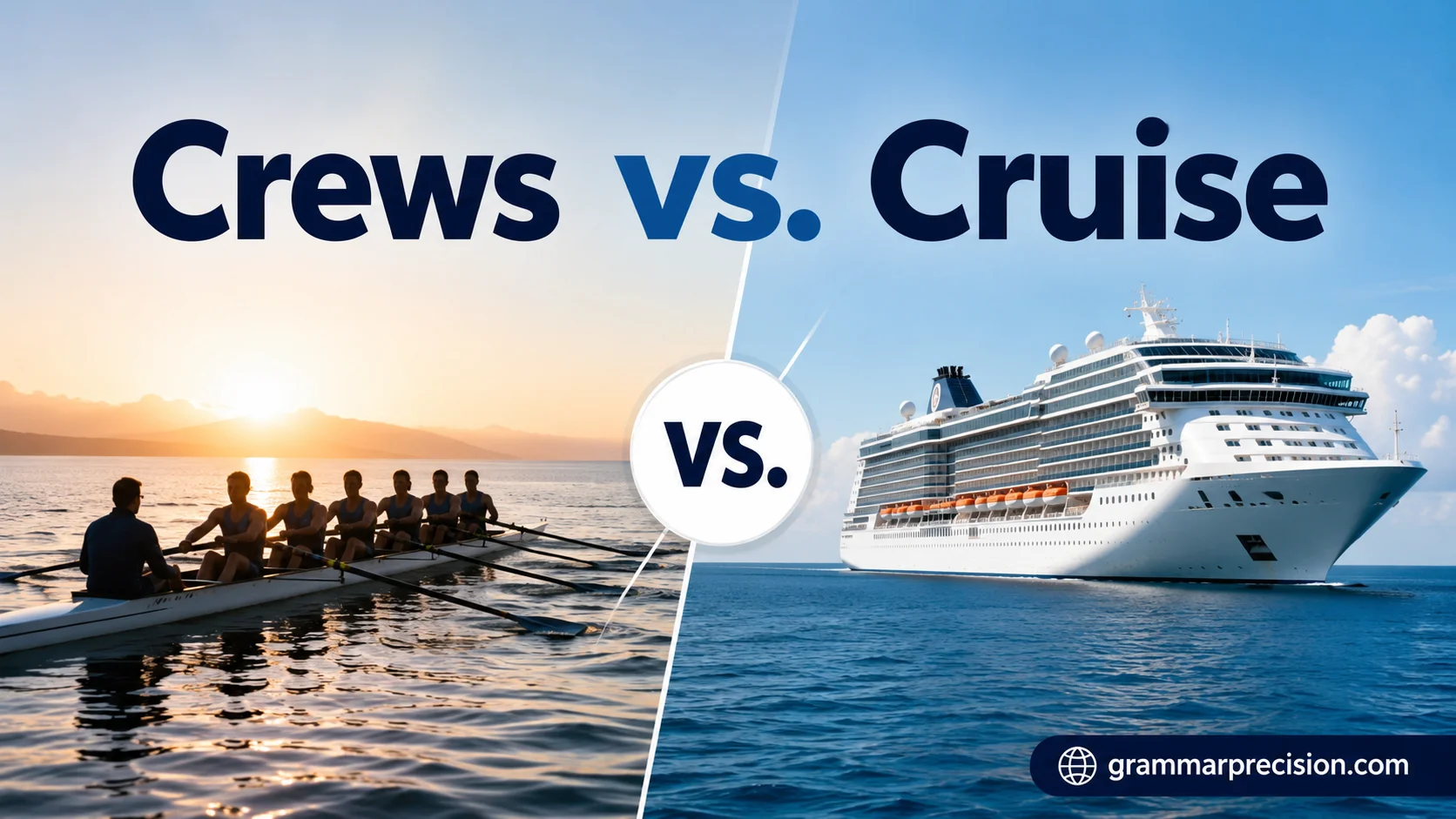
Crews vs. Cruise: What’s the Difference and When Should You Use Each? explains the difference between these two commonly confused words. Understanding their meaning, usage, and context helps improve your English writing and communication skills.
The word crews refers to a group of people who work together, especially on ships, aircraft, or projects. It is the plural form of crew and describes a team with shared responsibilities. For example, a ship’s crew manages operations, while a film crew creates movies.
The word cruise means a journey or trip, usually by ship, taken for relaxation or travel. It can also be used as a verb meaning to move smoothly or travel easily. Knowing when to use crews and cruise prevents confusion and makes your sentences more accurate.
Crews vs. Cruise at a Glance
Before diving deeper, here’s a quick overview.
| Word | Meaning | Part of Speech | Example |
| Crews | Groups of workers or team members | Noun (plural) | The construction crews finished the project early. |
| Cruise | A journey on a ship or traveling smoothly | Noun or Verb | We plan to cruise around the Caribbean next summer. |
Quick Answer
- Crews refers to groups of people working together.
- Cruise refers to traveling, especially for leisure, often by ship, car, or plane.
If you’re talking about workers, teams, or staff members, use crews.
If you’re talking about a vacation, traveling smoothly, or sailing, use cruise.
What Does “Crews” Mean?
The word crews is the plural form of crew.
A crew is a group of people who work together to perform a specific task. When there is more than one group, the correct word becomes crews.
Definition of Crews
Crews means multiple teams of workers, operators, staff members, or specialists assigned to a particular job.
Common Industries That Use the Word Crews
You will often hear the word in:
- Construction
- Aviation
- Film production
- Shipping
- Emergency response
- Transportation
- Maintenance services
- Sports broadcasting
Examples of Crews in Sentences
- Several construction crews repaired the highway after the storm.
- Emergency crews arrived within minutes.
- Airline crews prepared passengers for departure.
- The movie required multiple filming crews.
- Utility crews restored electricity throughout the city.
Notice that every example refers to groups of people working together.
Real-World Example
Imagine a major highway expansion project.
You may have:
- Survey crews
- Engineering crews
- Construction crews
- Safety crews
- Inspection crews
Each team has a unique responsibility. Together, they complete the project efficiently.
The Origin of the Word “Crew”
The word crew has a long history.
It originated from Middle English and traces its roots to older Germanic languages. Historically, it referred to groups of soldiers or sailors working together.
Over time, its meaning expanded to include nearly any organized team.
Today, businesses, governments, transportation companies, and media organizations regularly use the word.
Common Collocations with Crews
Certain words frequently appear alongside crews.
Examples include:
- Construction crews
- Flight crews
- Ground crews
- Emergency crews
- Maintenance crews
- Cleaning crews
- Film crews
- Rescue crews
These pairings appear often in newspapers, business reports, and everyday conversations.
What Does “Cruise” Mean?
Unlike crews, cruise focuses on movement, travel, and leisure.
The word can function as both a noun and a verb.
Cruise as a Noun
As a noun, a cruise refers to a pleasure trip, usually on a large passenger ship.
Examples:
- We booked a seven-day cruise to Alaska.
- The cruise included meals and entertainment.
- Their anniversary cruise exceeded expectations.
Cruise as a Verb
As a verb, cruise means traveling smoothly or moving at a relaxed pace.
Examples:
- We cruised along the coastline.
- The car cruised down the highway.
- The pilot cruised at an altitude of 35,000 feet.
Multiple Meanings of Cruise
The versatility of the word makes it interesting.
It can describe:
- Ocean travel
- River travel
- Driving leisurely
- Flying steadily
- Moving effortlessly
- Casual browsing
Examples of Cruise in Different Contexts
Travel
- The family enjoyed a Mediterranean cruise.
Driving
- They cruised through the countryside all afternoon.
Aviation
- The aircraft cruised above the clouds.
Informal Usage
- He cruised through the exam without difficulty.
In this case, cruise means completing something easily.
The History of the Word “Cruise”
The word cruise originated from Dutch and Spanish maritime terminology.
Historically, it referred to ships sailing around a region while patrolling or searching.
Over centuries, the meaning evolved.
Today, most people associate cruises with luxury vacations, entertainment, and tourism.
The modern cruise industry carries millions of passengers annually across destinations worldwide.
Crews vs. Cruise: Side-by-Side Comparison
Although the words sound alike, their meanings couldn’t be more different.
| Feature | Crews | Cruise |
| Meaning | Groups of workers | Leisure travel or smooth movement |
| Part of Speech | Noun | Noun and Verb |
| Refers To | People | Travel or movement |
| Workplace Usage | Common | Rare |
| Travel Usage | Rare | Very Common |
| Example | Emergency crews arrived. | We took a cruise. |
The Main Difference
Think of it this way:
Crews = People
Cruise = Travel
That simple distinction solves most confusion.
Also Read This: Work Alongside You or. Work Alongside With You: Correct Usage With Examples
Why People Confuse Crews and Cruise
Several factors contribute to the mix-up.
Similar Pronunciation
Both words sound almost identical in casual speech.
Their pronunciation differs only slightly.
Fast Typing
Many mistakes happen when people type quickly.
Autocorrect sometimes fails to catch the error because both words are legitimate English terms.
Context Confusion
Writers occasionally focus on sound rather than meaning.
As a result, they choose the wrong spelling.
Example
Incorrect:
The emergency cruise arrived after the accident.
Correct:
The emergency crews arrived after the accident.
The first sentence sounds strange because cruises are journeys, not rescue teams.
Common Mistakes People Make
Understanding typical errors helps prevent them.
Mistake: Using Cruise Instead of Crews
Incorrect:
- Road cruise repaired the bridge.
Correct:
- Road crews repaired the bridge.
Mistake: Using Crews Instead of Cruise
Incorrect:
- We booked a Caribbean crews.
Correct:
- We booked a Caribbean cruise.
Mistake: Ignoring Context
Incorrect:
- The airline cruise welcomed passengers aboard.
Correct:
- The airline crew welcomed passengers aboard.
Or:
- The airline crews prepared the aircraft.
Context determines the correct choice.
Memory Trick to Remember the Difference
A simple mnemonic can save you from future mistakes.
The Letter “S” in Crews
The word crews ends with s, which can remind you of staff.
Both refer to groups of people.
Cruise Contains “U”
Think of U as standing for vacationing you.
When you’re taking a trip, you choose cruise.
Visual Memory Aid
CREWS
↓
Groups of Workers
Staff
Teams
CRUISE
↓
Vacation
Travel
Journey
Many students find visual associations easier than memorizing definitions.
Real-Life Examples of Crews
Let’s examine how the word appears in everyday situations.
Construction Industry
Construction crews perform tasks such as:
- Excavation
- Framing
- Electrical work
- Roofing
- Inspection
Large projects often require multiple specialized crews.
Aviation Industry
Flight crews include:
- Pilots
- Co-pilots
- Flight attendants
Ground crews support operations before takeoff and after landing.
Emergency Services
Emergency crews may include:
- Firefighters
- Police officers
- Medical responders
- Rescue personnel
These teams coordinate during disasters and emergencies.
Real-Life Examples of Cruise
The word cruise appears in many travel and transportation settings.
Ocean Cruises
Popular cruise activities include:
- Fine dining
- Live entertainment
- Excursions
- Swimming
- Sightseeing
Road Trips
People often cruise scenic highways for relaxation.
Air Travel
Pilots frequently refer to the cruising phase of flight.
This phase occurs after ascent and before descent.
Figurative Use
People sometimes say:
She cruised through the interview.
This means she completed it confidently and easily.
FAQs:
What is the main difference between crews and cruise?
Crews refers to a group of people working together, while cruise refers to a journey or trip, usually by ship. Crews are people, but a cruise is an experience or travel activity.
Is crews the plural form of crew?
Yes, crews is the plural form of the word crew. It describes multiple teams or groups of people working together, such as airline crews, ship crews, or movie crews.
Can cruise be used as a verb?
Yes, cruise can be used as a verb. It means to travel smoothly or move easily. For example, “The car cruised along the highway,” means the car moved comfortably without difficulty.
Are crews and cruise pronounced the same?
No, crews and cruise are pronounced similarly but have different meanings. They are homophones, meaning they sound alike but have different spellings and uses.
How can I remember the difference between crews and cruise?
A simple way to remember is that crews contains an “s” sound connected to people or teams, while cruise is connected to travel and journeys. Think “crew = workers” and “cruise = trip.”
Conclusion:
Understanding the difference between crews vs. cruise helps you use these words correctly in English. Crews refers to groups of people working together, while cruise describes a travel experience or smooth movement. Although they sound similar, their meanings and uses are completely different. Using the right word improves your grammar, writing accuracy, and communication skills.