The words Breath and breathe are often confused because spelling looks similar but meaning differs clearly in English usage grammar rules and communication.
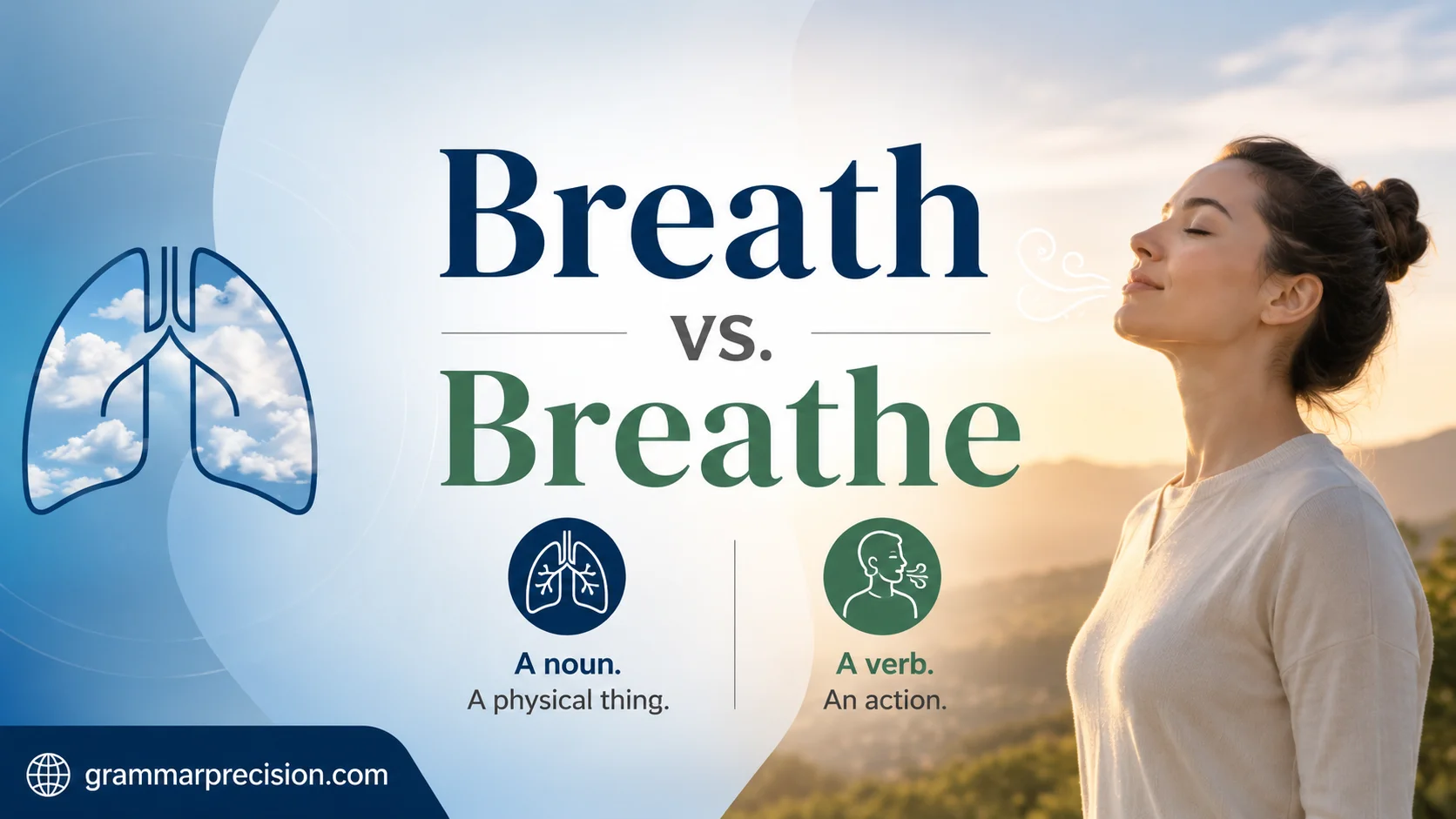
Breath is noun while breathe is verb describing action and air flow from lungs in daily speaking writing context usage rules important.
Understanding Breath vs. breathe helps distinguish noun and verb classification in English language learning context. remember verb has e ending while noun does not and context decides correct usage in speaking and writing practice for clear communication avoids confusion in real life usage every time.
Breath vs. Breathe: Why This Confusion Happens So Often
Let’s be honest. English isn’t always kind to learners or even native speakers. “Breath” and “breathe” look almost identical, but they behave completely differently.
That’s where most of the trouble starts.
Here’s the core issue:
- One is a noun
- The other is a verb
But because they sound similar when spoken quickly, people often mix them up in writing.
A simple breakdown
| Word | Type | Meaning | Example |
| Breath | Noun | Air you take in or release | “Take a deep breath.” |
| Breathe | Verb | The action of taking air in/out | “Breathe slowly.” |
That one extra “e” is doing a lot of heavy lifting.
Breath vs. Breathe Explained in the Simplest Way Possible
Let’s strip it down.
Breath = Thing (noun)
Think of “breath” as something you have or take.
- You take a breath
- You lose your breath
- Your breath is cold in winter air
It’s a thing, even though you can’t touch it.
Breathe = Action (verb)
Now think of “breathe” as something you do.
- You breathe in
- You breathe out
- You breathe deeply when stressed
It always shows action.
Quick memory trick
- Breath = thing = no extra action
- Breathe = do it = extra “e” for effort
That extra “e” can remind you the word is active.
Why Your Brain Keeps Mixing Them Up
This isn’t just carelessness. There’s a psychological reason behind it.
Your brain prefers shortcuts. When two words look almost identical, it stores them as “same category,” especially under time pressure like texting or exams.
Common triggers for mistakes
- Fast typing on mobile
- Autocorrect interference
- Speaking in your head while writing
- Lack of grammar awareness in casual writing
Real world confusion example
❌ “I need to breathe before I speak.” (wrong if used as noun)
✔ “I need a breath before I speak.”
❌ “Take a deep breathe.”
✔ “Take a deep breath.”
Small error. Big difference in clarity.
The Silent Grammar Rule Behind Breath vs. Breathe
English has a sneaky pattern: many verbs ending in “e” often describe action, while shorter forms tend to act as nouns.
But here’s where it gets interesting.
Pattern insight
- Bath → Bathe
- Breath → Breathe
- Sheath → Sheathe
The extra “e” often signals movement or action.
So instead of memorizing blindly, you can recognize a pattern:
If it’s something you do, it often stretches into a longer form.
Real Life Sentence Fixes (Before vs After)
Let’s make this practical. You’ll learn faster by seeing mistakes corrected.
Everyday communication
| Wrong | Correct |
| I can’t breathe fresh air. | I can’t catch my breath. |
| Take a deep breathe. | Take a deep breath. |
| My breath is hard to control. | I find it hard to breathe. |
Emotional writing examples
- ❌ “She forgot to breathe when she saw him.”
- ✔ “She lost her breath when she saw him.”
- ❌ “He took a breath of relief after the exam.”
- ✔ “He breathed a sigh of relief after the exam.”
Notice how switching one word completely changes the structure and meaning.
Also Read This: Someday vs. Some Day
Breath vs. Breathe in Everyday Life (You Already Use Both)
Even if you’ve been confused about the spelling, you’ve been using both words naturally in speech your entire life.
Situations where you use “breath”
- After running: “I’m out of breath.”
- During relaxation: “Take a breath and calm down.”
- In fear: “She held her breath.”
Situations where you use “breathe”
- Stress control: “Just breathe.”
- Exercise: “Breathe in through your nose.”
- Meditation: “Breathe slowly and evenly.”
Your brain already knows the difference. Writing just needs to catch up.
Memory Hacks That Actually Stick
Let’s make this effortless.
The “E = Energy” trick
- Breath = static thing
- Breathe = action, energy, movement
The extra “e” represents motion.
The “pause test”
Ask yourself:
- Am I describing a thing? → breath
- Am I describing an action? → breathe
The substitution test
Replace the word:
- If you can replace it with “air,” use breath
- If you can replace it with “inhale/exhale,” use breathe
Common Mistakes People Keep Making
Even advanced writers slip up sometimes.
Mistake patterns
- Forgetting the “e” in verbs
- Over correcting and adding unnecessary letters
- Mixing forms in fast writing
Social media errors
You’ll often see:
- “Just breathe…”
- “I need to breath”
Both show up frequently, especially in emotional posts where typing is rushed.
Breath vs. Breathe and Similar Confusing Word Pairs
Once you understand this pattern, you’ll start noticing others like it.
| Word Pair | Common Confusion |
| Advice / Advise | noun vs verb |
| Practice / Practise | US vs UK usage |
| Affect / Effect | verb vs noun |
| Lose / Loose | spelling similarity |
| Then / Than | grammar vs comparison |
Why this matters
These small differences affect:
- Academic writing scores
- Professional communication clarity
- Email tone and credibility
A Mini Quiz: Test Your Understanding
Let’s see how well this sticks.
Fill in the blanks
- I need to take a deep ___ before speaking.
- Just ___ and relax.
- She held her ___ underwater.
- He couldn’t ___ after running fast.
Answers
- breath
- breathe
- breath
- breathe
If you got all four right, you’ve already mastered it.
Real Case Study: Why Small Grammar Mistakes Matter
A survey of professional email communication (based on writing behavior studies in workplace linguistics) found something interesting:
- Messages with grammar errors reduced perceived credibility by up to 30%
- Small errors like “breath vs breathe” were among the most noticed
What this means for you
Even tiny spelling differences can influence:
- Job applications
- Academic essays
- Business communication
It’s not about perfection. It’s about clarity and confidence.
Quick Reference Cheat Sheet
Keep this in your back pocket.
Breath
- Noun
- Something you take
- No action involved
Examples:
- Take a breath
- Out of breath
- Hold your breath
Breathe
- Verb
- Action of inhaling/exhaling
- Movement based
Examples:
- Breathe deeply
- Breathe slowly
- Just breathe
How to Never Confuse Them Again
Here’s a simple system you can rely on every time:
Step 1: Identify meaning
Ask: thing or action?
Step 2: Match structure
- Thing → breath
- Action → breathe
Step 3: Double check with sound
Say it out loud. If it feels like an action, it probably needs “breathe.”
Why Mastering Small Grammar Details Actually Matters
You might wonder, “Is this really important?”
Yes and not because grammar is strict, but because clarity builds trust.
When your writing is clean:
- People understand you faster
- You sound more confident
- Your ideas come through clearly
Think of grammar like traffic signals. You can still drive without them, but everything becomes chaotic.
FAQs:
What is the difference between Breath and Breathe?
The main difference is that breath is a noun meaning air in and out of lungs, while breathe is a verb meaning the action of taking air in and out. This makes them different in grammar usage.
Why do people confuse Breath and Breathe?
People confuse them because of similar spelling, pronunciation, and English writing patterns. Both words are closely related, which leads to common mistakes in speaking and writing.
Is Breath a noun or verb?
Breath is always a noun. It refers to the air that is inhaled or exhaled from the lungs, not the action itself.
Is Breathe a noun or verb?
Breathe is always a verb. It describes the action of taking air in and out of the lungs to stay alive and maintain oxygen flow.
How can I remember the difference easily?
A simple trick is that breathe has an extra “e”, which stands for action. While breath without “e” is the thing (noun) itself.
Conclusion:
Understanding Breath vs Breathe is important for correct English grammar and clear communication. The key rule is simple: breath = noun (air) and breathe = verb (action). Learning this difference helps improve writing accuracy, speaking clarity, and reduces common mistakes in everyday English usage.