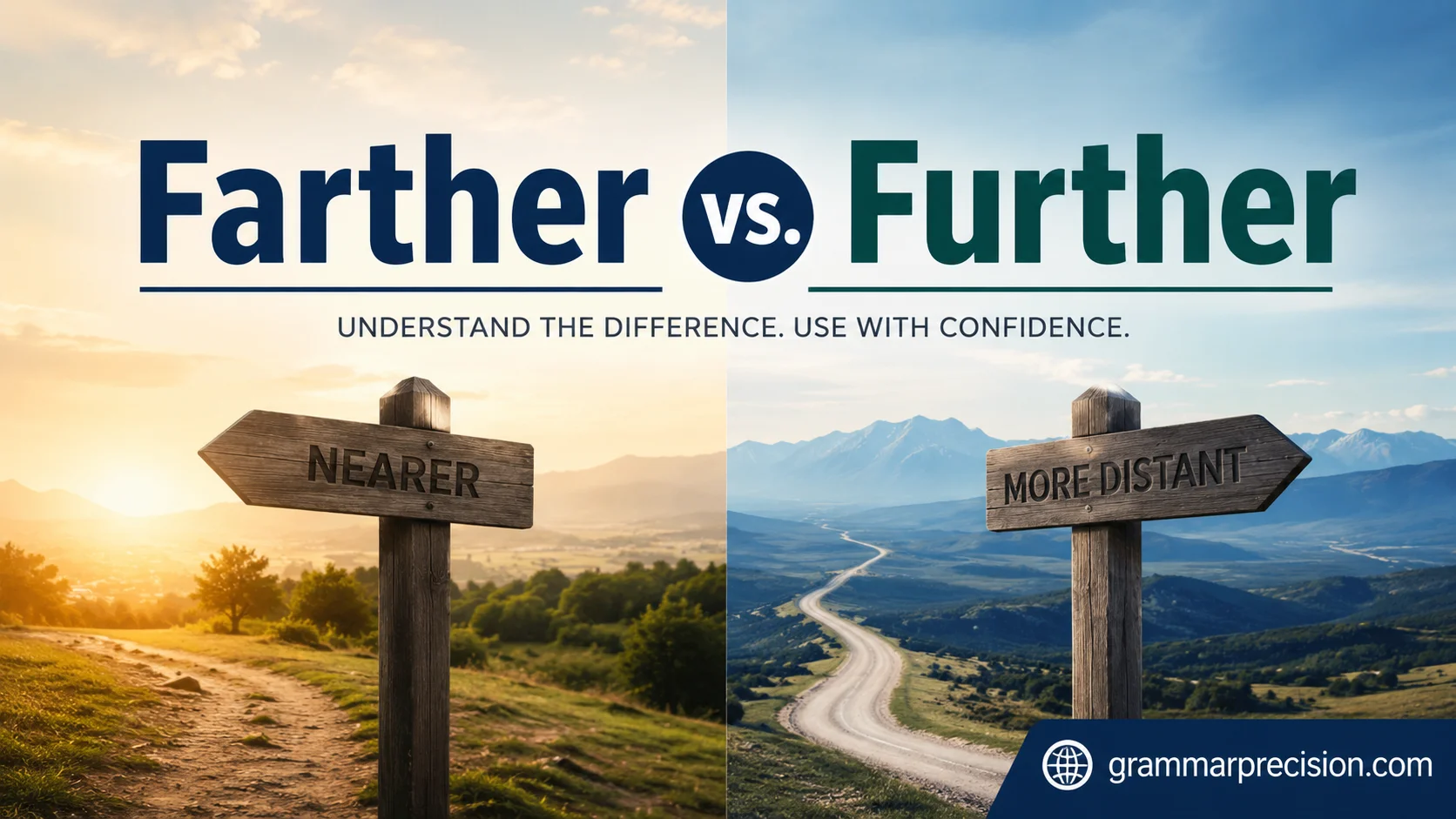
Understanding Farther vs. Further can improve your writing accuracy and help you communicate more clearly. Although these words seem similar, they have different uses that every English learner should know.
Many writers struggle with Farther vs. Further because both words relate to distance in some way. However, farther usually refers to physical distance, while further often describes additional information, progress, or figurative distance. Learning this distinction can make your writing more professional, precise, and easier for readers to understand.
Whether you’re writing an email, academic paper, or blog post, choosing the correct word matters. By mastering Farther vs. Further, you’ll avoid common grammar mistakes and gain a better understanding of English usage rules. This guide provides clear explanations, practical examples, and simple memory tricks to help you use both words with confidence.
The Quick Answer
Here’s the simplest rule:
- Farther refers to physical distance.
- Further refers to figurative distance, additional information, or advancement.
Examples
✅ The gas station is farther down the road.
✅ We need to discuss this matter further.
✅ She ran farther than anyone else in the race.
✅ Further investigation revealed new evidence.
If you’re talking about measurable distance, choose farther. If you’re discussing ideas, progress, time, or additional details, choose further.
Why People Confuse Farther and Further
At first glance, the words appear interchangeable. In many conversations, people use them without noticing a difference.
Several factors contribute to the confusion:
Shared Origins
Both words evolved from Old English and were originally variations of the same concept. For centuries, writers often used them interchangeably.
Similar Pronunciation
In everyday speech, many people pronounce the words almost identically. Because listeners rarely notice the distinction, speakers often don’t either.
Overlapping Usage
Modern dictionaries recognize that further sometimes appears in physical-distance contexts. This overlap causes uncertainty among writers trying to follow traditional grammar rules.
Style Guide Differences
Some style guides strictly separate the two words. Others allow more flexibility. As a result, writers receive mixed advice.
Farther vs. Further: Side-by-Side Comparison
| Feature | Farther | Further |
| Primary Meaning | Physical distance | Figurative distance or additional amount |
| Measurement Possible | Yes | Usually no |
| Refers to Location | Yes | Sometimes |
| Refers to Progress | Rarely | Yes |
| Refers to Additional Information | No | Yes |
| Common in Formal Writing | Less common | More common |
| Easy Memory Trick | Far = distance | Further = additional |
This table provides a quick reference whenever you’re unsure.
What Does “Farther” Mean?
Farther specifically relates to measurable physical distance.
You can often replace it with phrases such as:
- More distant
- At a greater distance
- Beyond a certain point
Examples of Farther
- The school is farther from my house than the library.
- We drove farther than expected.
- The hikers traveled farther into the mountains.
- Can you throw the ball farther?
- The beach lies farther south.
Notice that each sentence involves a real, measurable distance.
Physical Distance Rule
A useful question to ask yourself is:
Can I measure the distance with miles, feet, kilometers, or meters?
If the answer is yes, farther is usually the correct choice.
Travel Examples
Consider these examples:
| Sentence | Correct Word |
| The hotel is _____ from the airport. | Farther |
| We walked _____ than yesterday. | Farther |
| Their campsite was _____ up the trail. | Farther |
Every example refers to an actual location.
What Does “Further” Mean?
Further usually refers to abstract distance, progression, advancement, or additional information.
Think of it as moving an idea, project, discussion, or situation forward.
Common Meanings of Further
Additional
- Further details will be provided tomorrow.
- We need further evidence before making a decision.
Advancement
- The program helps students further their careers.
- New technology continues to further scientific research.
Deeper Discussion
- Let’s discuss the issue further.
- The committee reviewed the proposal further.
Unlike farther, these examples cannot be measured with a ruler or map.
The Easy Memory Trick You’ll Never Forget
One of the most effective memory tricks focuses on the first three letters of each word.
Farther = Far
The word farther begins with far.
Since “far” relates to distance, use farther when discussing physical space.
Example:
- Chicago is farther from New York than Cleveland.
Further = Further Discussion
Many phrases containing further involve ideas rather than locations.
Examples:
- Further analysis
- Further research
- Further consideration
- Further discussion
- Further education
Whenever you’re talking about concepts instead of locations, further usually works best.
Real-Life Examples in Everyday Conversations
Grammar rules become easier when you see them in action.
Travel Examples
Correct:
- The museum is farther than I expected.
- We drove farther into the countryside.
- Their cabin sits farther north.
Incorrect:
- The museum is further than I expected.
Although some modern writers accept this usage, traditional grammar prefers farther.
School Examples
Correct:
- Further study improved her grades.
- The professor provided further explanations.
- Students requested further clarification.
In these examples, no physical distance exists.
Workplace Examples
Business professionals frequently use further.
Examples:
- Further review is necessary.
- Further action may be required.
- We need further information before approval.
- The company plans to further expand operations.
Notice how all examples involve development, information, or progress.
Academic Writing Examples
Academic writing heavily favors further because research often involves abstract concepts.
Examples:
- Further research is recommended.
- Further investigation may reveal additional patterns.
- The study contributes to further understanding of the topic.
These phrases appear regularly in journals, dissertations, and research papers.
Can Further Replace Farther?
This question sparks ongoing debate among grammar experts.
Traditional View
Traditional grammar follows a clear distinction:
- Farther = physical distance
- Further = figurative distance
Under this rule:
✅ The store is farther away.
❌ The store is further away.
Modern Usage
Many modern dictionaries acknowledge that further sometimes functions as a distance word.
For example:
- The store is further away.
Most readers understand the meaning perfectly.
Which Approach Is Best?
For maximum clarity and professionalism:
- Use farther for physical distance.
- Use further for everything else.
This approach satisfies grammar experts and eliminates ambiguity.
Common Mistakes and How to Avoid Them
Mistake: Using Further for Measurable Distance
Incorrect:
- The mountain is further away.
Preferred:
- The mountain is farther away.
Mistake: Using Farther for Additional Information
Incorrect:
- We need farther details.
Correct:
- We need further details.
Mistake: Ignoring Context
Before choosing a word, determine whether you’re discussing:
- Physical distance
- Abstract progress
- Additional information
- Advancement
The answer usually reveals the correct choice immediately.
Quick Decision Tree
Use this simple guide:
Are you talking about measurable physical distance?
→ Yes → Use Farther
→ No → Use Further
Examples:
- The airport is farther away.
- We need further discussion.
- She ran farther.
- Further investigation is needed.
- The village lies farther north.
- Further training improved performance.
Following this decision tree eliminates most errors instantly.
British English vs. American English Usage
One question many learners ask is whether British English and American English treat farther vs. further differently.
The short answer is yes—though not dramatically.
American English Preference
In American English, writers typically maintain a clearer distinction:
- Farther = physical distance
- Further = figurative distance or additional information
Examples:
- New York is farther from Los Angeles than Chicago is.
- Further details will be announced next week.
Many American editors, teachers, and style guides prefer this separation because it creates clarity.
British English Preference
British English tends to use further more frequently.
You might see sentences such as:
- The station is further down the road.
- We walked further than expected.
While these examples are common in the UK, many professional writers still follow the traditional distinction.
Which Style Should You Follow?
For international audiences, the safest choice remains:
| Situation | Recommended Word |
| Physical distance | Farther |
| Additional information | Further |
| Advancement | Further |
| Abstract concepts | Further |
This approach works well regardless of your audience.
Origins of Farther and Further
Understanding where these words came from makes their relationship easier to understand.
Old English Roots
Both words trace their origins to Old English.
Historically, English speakers used several related forms that expressed the idea of moving beyond a point. Over time, these forms evolved into the modern words farther and further.
Because they developed from similar linguistic roots, writers often used them interchangeably for centuries.
How the Meanings Diverged
As English evolved, grammar experts attempted to establish clearer distinctions.
They gradually encouraged writers to use:
- Farther for measurable distance.
- Further for metaphorical distance and additional concepts.
This distinction gained popularity because it improved precision.
Modern Language Evolution
Languages rarely remain fixed.
Today, many dictionaries acknowledge overlapping usage. However, most professional writers still follow the traditional rule because readers instantly understand the intended meaning.
How Their Meanings Changed Over Time
Language behaves much like a river. It keeps flowing and adapting.
Centuries ago, these words shared nearly identical meanings. Writers selected one or the other based largely on preference.
Over time, editors and educators promoted a distinction:
| Earlier Usage | Modern Preference |
| Interchangeable | More specialized |
| Similar meanings | Separate functions |
| Writer preference | Context-based choice |
As a result, modern English now treats the words as related but distinct.
Common Expressions Using Further
Many fixed expressions use further rather than farther.
Learning these phrases helps you sound natural and fluent.
Further Investigation
Example:
- Police conducted further investigation before making an arrest.
Further Information
Example:
- Contact us for further information.
Further Education
Example:
- She pursued further education after graduation.
Further Development
Example:
- The software requires further development.
Further Consideration
Example:
- The proposal deserves further consideration.
Further Discussion
Example:
- Let’s schedule a meeting for further discussion.
Further Action
Example:
- Further action may be necessary.
Further Research
Example:
- Scientists recommend further research.
These expressions appear frequently in professional, academic, and business writing.
Also Read This: Result In or Result To: The Complete Guide to Using These Phrases Correctly
Common Expressions Using Farther
Although farther appears less often, several common expressions rely on it.
Farther Away
Example:
- Their new house is farther away.
Farther Down the Road
Example:
- The restaurant is farther down the road.
Farther North
Example:
- Alaska lies farther north than any other state.
Farther Along
Example:
- The hikers moved farther along the trail.
Farther From Home
Example:
- He traveled farther from home than ever before.
Notice that every phrase relates directly to physical distance.
Real-World Examples: Farther vs. Further
The best way to master usage is through repetition.
Examples with Farther
- The lake is farther than it appears.
- We traveled farther than planned.
- She threw the javelin farther than anyone else.
- Their campsite was farther up the hill.
- The nearest town was farther away than expected.
- The train station is farther from downtown.
- He ran farther this year.
- They ventured farther into the forest.
- The island sits farther offshore.
- Our destination lies farther west.
Examples with Further
- Further analysis revealed several mistakes.
- We need further clarification.
- Further study improved results.
- The company plans further expansion.
- Further discussion is required.
- Scientists conducted further experiments.
- The project needs further funding.
- Further investigation uncovered new facts.
- The policy requires further review.
- Further education increased her opportunities.
Farther vs. Further in Professional Writing
Professional writers rarely leave word choice to chance.
Business Writing
Business communication frequently uses further.
Examples include:
- Further details
- Further review
- Further action
- Further assistance
Sample sentence:
Please contact us if you require further assistance.
Academic Writing
Researchers use further extensively.
Examples:
- Further analysis
- Further research
- Further evaluation
- Further examination
Sample sentence:
Further research may strengthen these findings.
Journalism
Journalists use both words depending on context.
Examples:
- The storm moved farther inland.
- Further developments are expected tomorrow.
Precision remains essential because readers depend on clear communication.
Common Grammar Myths
Several misconceptions continue circulating online.
Myth: Farther and Further Mean Exactly the Same Thing
Reality:
They overlap occasionally but modern usage usually distinguishes between physical and figurative distance.
Myth: Further Is Always Wrong for Distance
Reality:
Many dictionaries accept this usage.
However, professional writers often prefer farther for physical distance.
Myth: Farther Sounds More Formal
Reality:
Neither word is inherently more formal.
The correct choice depends entirely on context.
Myth: Nobody Notices the Difference
Reality:
Editors, teachers, and experienced readers often notice immediately.
Using the appropriate word strengthens credibility.
Similar Word Pairs You Might Also Confuse
People who struggle with farther vs. further often confuse other word pairs as well.
Affect vs. Effect
| Word | Meaning |
| Affect | Usually a verb |
| Effect | Usually a noun |
Example:
- The weather affected attendance.
- The effect was noticeable.
Then vs. Than
| Word | Meaning |
| Then | Time sequence |
| Than | Comparison |
Example:
- We ate dinner then watched a movie.
- She is taller than her brother.
Fewer vs. Less
| Word | Meaning |
| Fewer | Countable items |
| Less | Uncountable amounts |
Example:
- Fewer students attended.
- There was less traffic.
Learning these distinctions improves overall writing accuracy.
Editor’s Checklist Before Publishing
Before submitting any document, ask yourself:
Distance Check
- Is the sentence discussing physical space?
If yes, use farther.
Information Check
- Is the sentence discussing additional details?
If yes, use further.
Progress Check
- Is the sentence discussing advancement?
If yes, use further.
Clarity Check
- Would readers immediately understand your meaning?
If not, revise the sentence.
Professional editing often comes down to small decisions like these.
Practice Exercise
Choose the correct word.
Questions
- The nearest gas station is _____ away.
- We need _____ evidence.
- She walked _____ than her friends.
- Further research may reveal new patterns.
- The hikers moved _____ into the valley.
- We require _____ clarification.
- The cabin sits _____ north.
- The company plans _____ expansion.
- He threw the ball _____.
- Further discussion is necessary.
Answers
- Farther
- Further
- Farther
- Further
- Farther
- Further
- Farther
- Further
- Farther
- Further
Quick Reference Cheat Sheet
| If You’re Talking About… | Use |
| Miles | Farther |
| Kilometers | Farther |
| Roads | Farther |
| Travel | Farther |
| Additional Information | Further |
| Research | Further |
| Progress | Further |
| Development | Further |
| Discussion | Further |
| Education | Further |
Bookmark this table for future reference.
Advanced Usage Rules for Farther vs. Further
Once you’ve mastered the basic distinction, it’s helpful to understand a few advanced situations where writers often hesitate.
When Both Words May Be Accepted
In modern English, some dictionaries and style guides acknowledge that further can sometimes refer to physical distance.
Example:
- The village is further down the road.
- The village is farther down the road.
Both versions may appear in published writing.
However, many editors still prefer farther because it removes any ambiguity. If your goal is precision, especially in academic or professional writing, choosing farther for physical distance remains the safest option.
Further as a Verb
One unique feature of further is that it can function as a verb.
Farther cannot.
Examples:
- The scholarship helped further her education.
- New funding will further the project.
- Technology continues to further scientific advancement.
In these sentences, further means to advance, promote, or help progress.
Further in Formal Communication
Business professionals frequently use further because much of their communication involves ideas rather than measurable distance.
Examples include:
- Further review
- Further consideration
- Further updates
- Further guidance
- Further assistance
These phrases sound natural because they refer to additional information or progress.
Case Studies: Real-Life Usage
Let’s examine how these words work in practical situations.
Case Study: Travel Blog
Sentence:
We drove farther into the Rocky Mountains before stopping for the night.
Why it works:
The sentence describes a measurable location. Distance can be mapped and calculated.
Correct choice: Farther
Case Study: Research Paper
Sentence:
Further investigation revealed a previously overlooked pattern.
Why it works:
The sentence discusses additional analysis rather than physical movement.
Correct choice: Further
Case Study: Business Email
Sentence:
Please let us know if you require further assistance.
Why it works:
The message refers to extra help or support.
Correct choice: Further
Case Study: Sports Commentary
Sentence:
The athlete jumped farther than any competitor in the event.
Why it works:
The jump can be measured physically.
Correct choice: Farther
Expert Writing Tips
Professional writers often rely on simple habits rather than memorizing dozens of grammar rules.
Think About Measurement
Ask yourself:
Can I measure this with a ruler, tape measure, miles, or kilometers?
If yes, choose farther.
Think About Ideas
If the sentence involves:
- Information
- Progress
- Growth
- Analysis
- Research
- Discussion
Choose further.
Focus on Reader Clarity
Good writing isn’t about showing off grammar knowledge.
It’s about helping readers understand your meaning instantly.
Using farther for distance and further for abstract concepts creates immediate clarity.
Learn Common Phrases
Many phrases automatically use further.
Examples include:
- Further notice
- Further instructions
- Further evidence
- Further review
- Further development
- Further education
Memorizing these combinations makes writing easier.
The Ultimate Farther vs. Further Quiz
Test your understanding.
Choose the correct word.
Questions
- The hikers traveled _____ into the wilderness.
- We need _____ information.
- The airport is _____ away than I thought.
- Scientists conducted _____ experiments.
- The runners went _____ than expected.
- Further discussion may solve the problem.
- The trail extends _____ north.
- The company seeks _____ investment.
- She swam _____ than her teammates.
- We require _____ clarification.
- The campsite was _____ up the mountain.
- Further review revealed several errors.
- The delivery truck traveled _____ today.
- We need _____ evidence before deciding.
- Their cabin sits _____ from town.
- The project requires _____ development.
- He kicked the ball _____ than before.
- Further analysis improved understanding.
- The road stretches _____ into the desert.
- We will discuss the issue _____ tomorrow.
Answer Key
- Farther
- Further
- Farther
- Further
- Farther
- Further
- Farther
- Further
- Farther
- Further
- Farther
- Further
- Farther
- Further
- Farther
- Further
- Farther
- Further
- Farther
- Further
Scoring Guide
| Score | Interpretation |
| 18–20 | Excellent mastery |
| 15–17 | Strong understanding |
| 10–14 | Good foundation |
| Below 10 | Review key rules again |
Quick Comparison Summary
| Question | Farther | Further |
| Physical distance? | ✓ | Sometimes |
| Additional information? | ✗ | ✓ |
| Progress or advancement? | ✗ | ✓ |
| Formal business writing? | Rarely | Frequently |
| Research papers? | Rarely | Frequently |
| Can be used as a verb? | No | Yes |
FAQs:
What is the main difference between farther and further?
The main difference is that farther usually refers to physical distance, while further refers to additional information, progress, or figurative distance. For example, you can drive farther down a road, but you can discuss a topic further.
Can further be used instead of farther?
In modern English, some writers use further for physical distance. However, many grammar experts still recommend using farther for measurable distances and further for abstract or non-physical meanings to maintain clarity and accuracy.
Which word is more common in professional writing?
Further is more common in business, academic, and formal writing because it frequently appears in phrases such as “further research,” “further information,” and “further discussion.” These expressions relate to ideas rather than physical locations.
Is farther always related to distance?
Yes, farther is generally associated with measurable physical distance. If you can calculate the distance in miles, kilometers, feet, or meters, farther is usually the correct choice.
How can I easily remember the difference between farther and further?
A simple memory trick is to remember that farther contains the word “far,” which relates to physical distance. Use further when talking about extra information, development, or advancement.
Conclusion:
Understanding Farther vs. Further can significantly improve your grammar skills and make your writing more clear, professional, and effective. While farther is best used for physical distance, further is the preferred choice for additional information, progress, and abstract concepts.
By applying this simple rule and practicing with real-world examples, you can avoid common mistakes and communicate with greater confidence. Mastering this distinction may seem small, but it plays an important role in producing accurate and polished English writing.