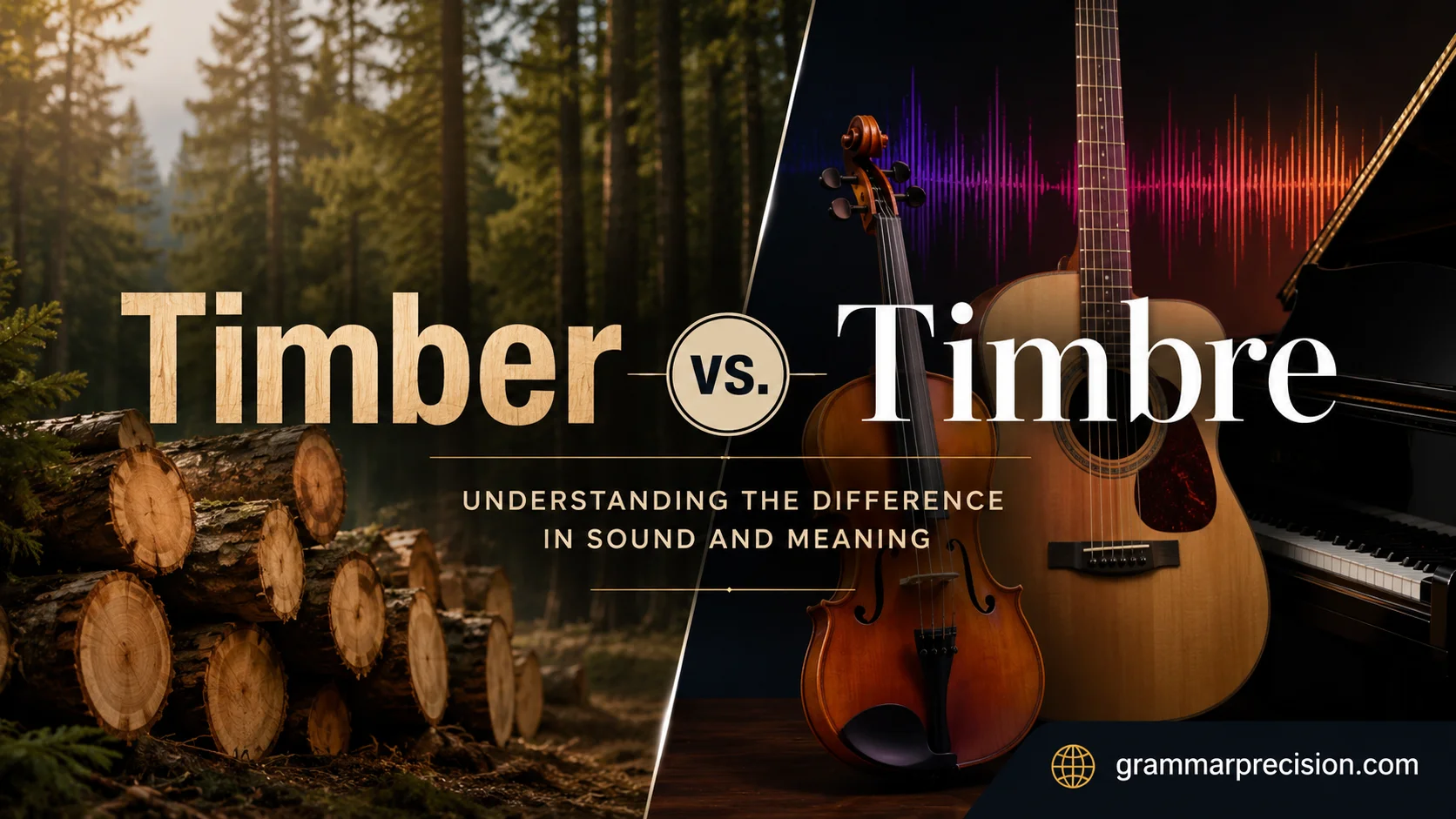
Understanding Timber vs. Timbre can be challenging because these words sound alike but have completely different meanings. Knowing the distinction helps you communicate clearly and avoid common writing mistakes.
Many writers, students, and English learners confuse these terms because of their similar pronunciation. Timber relates to wood, construction, and forestry, while timbre describes the unique sound quality of a voice or musical instrument. Learning the difference improves both your vocabulary and writing accuracy in everyday communication and professional contexts.
Although the words may sound nearly identical, their meanings belong to entirely separate fields. One appears in discussions about building materials and woodworking, while the other is common in music, acoustics, and audio engineering. This guide explores their definitions, examples, key differences, and practical memory tricks to help you use each word with complete confidence.
Timber vs. Timbre: Quick Comparison
Before diving deeper, let’s look at a simple overview.
| Feature | Timber | Timbre |
| Meaning | Wood prepared for building or carpentry | The unique quality of a sound |
| Industry | Forestry, construction, woodworking | Music, acoustics, audio engineering |
| Part of Speech | Noun | Noun |
| Pronunciation | TIM-ber | TAM-ber (often similar to timber) |
| Example | The cabin was built from pine timber. | Her voice has a warm timbre. |
Quick Rule
If you’re talking about trees, wood, lumber, or construction, use timber.
If you’re talking about music, voices, instruments, or sound quality, use timbre.
What Is Timber?
The word timber refers to wood that people use for construction, furniture making, and various industrial purposes.
When trees are cut down, processed, and prepared for practical use, the resulting material is often called timber.
Simple Definition
Timber is wood that is suitable for building, manufacturing, or carpentry.
Many countries use the term “timber” interchangeably with “lumber,” although subtle differences may exist depending on the region.
The Origin of Timber
The word traces its roots back to Old English and Germanic languages. Historically, timber referred not only to wood but also to materials used for building structures.
For centuries, timber has been one of humanity’s most important resources.
Ancient civilizations used timber to construct:
- Houses
- Ships
- Bridges
- Fortifications
- Furniture
Even today, timber remains one of the most widely used building materials worldwide.
Common Types of Timber
Different tree species produce different kinds of timber.
Softwood Timber
Softwoods come from coniferous trees.
Examples include:
- Pine
- Cedar
- Spruce
- Fir
Characteristics:
- Lightweight
- Easier to cut
- Faster-growing trees
- Often less expensive
Hardwood Timber
Hardwoods come from deciduous trees.
Examples include:
- Oak
- Maple
- Walnut
- Mahogany
Characteristics:
- Dense structure
- Greater durability
- Attractive grain patterns
- Premium furniture applications
Why Timber Matters in Construction
Walk into almost any building site and you’ll find timber playing a major role.
Builders value timber because it offers:
- Strength
- Flexibility
- Sustainability
- Natural insulation
- Aesthetic appeal
Uses of Timber
Timber appears in countless applications:
- House framing
- Roofing
- Flooring
- Doors
- Windows
- Cabinets
- Decking
- Furniture
In modern green construction, sustainably sourced timber has become increasingly popular because it stores carbon and has a lower environmental impact than many synthetic materials.
Examples of Timber in Sentences
Understanding context makes learning easier.
Here are several examples:
- The carpenter selected oak timber for the dining table.
- Timber prices increased after the storm damaged forests.
- The cabin was built entirely from locally sourced timber.
- Pine timber remains popular for residential construction.
- The company exports timber to international markets.
Notice that every example involves wood or building materials.
What Is Timbre?
Now let’s switch from forests to music halls.
The word timbre refers to the unique character or quality of a sound.
It explains why two instruments can play the same note at the same volume and still sound completely different.
Simple Definition
Timbre is the distinctive tone color or sound quality that makes one voice or instrument recognizable from another.
Without timbre, every instrument would sound identical.
Thankfully, that isn’t the case.
The Origin of Timbre
The word comes from French origins and entered English through discussions of music and acoustics.
Musicians, composers, and sound engineers use the term regularly because it describes something that pitch and volume alone cannot explain.
Think of timbre as a sound’s personality.
Pitch tells you how high or low a note is.
Volume tells you how loud it is.
Timbre tells you what makes that sound unique.
Why Timbre Matters in Music
Imagine a piano and a violin both playing middle C.
The pitch remains identical.
The volume may also be identical.
Yet you instantly know which instrument is playing.
Why?
The answer is timbre.
Each instrument produces a unique combination of harmonics and overtones that create its distinctive sonic fingerprint.
Characteristics That Shape Timbre
Several factors influence timbre:
Harmonics
Extra frequencies accompany the main note.
Sound Envelope
How quickly a sound starts, sustains, and fades.
Resonance
The physical structure of an instrument shapes the sound.
Material
Wood, brass, strings, and electronic components all affect tone quality.
Examples of Timbre in Everyday Life
Timbre isn’t limited to orchestras.
You encounter it daily.
Examples include:
- Recognizing a friend’s voice on the phone.
- Distinguishing a guitar from a piano.
- Identifying a singer after hearing only a few notes.
- Hearing the difference between a trumpet and a saxophone.
In each situation, timbre helps your brain identify the source of the sound.
Examples of Timbre in Sentences
Here are some practical examples:
- Her voice has a rich and soothing timbre.
- The violin’s timbre adds emotion to the performance.
- Jazz musicians often experiment with timbre.
- The singer’s distinctive timbre made her instantly recognizable.
- Audio engineers adjusted the recording to improve its timbre.
Notice that every example relates to sound quality.
Timber vs. Timbre: Key Differences at a Glance
Many people confuse these words because they sound alike.
However, their meanings couldn’t be more different.
| Category | Timber | Timbre |
| Related To | Wood | Sound |
| Field | Forestry | Music |
| Physical or Abstract | Physical Material | Sound Characteristic |
| Can You Touch It? | Yes | No |
| Common Users | Builders, carpenters, foresters | Musicians, singers, audio engineers |
| Example | Cedar timber | Warm timbre |
A simple way to remember this:
Timber belongs in the forest. Timbre belongs in the concert hall.
Why Do People Confuse Timber and Timbre?
Several factors contribute to the confusion.
Similar Pronunciation
In many English accents, the words sound nearly identical.
This makes mistakes common in writing.
Different Spellings
Their spellings differ by only one letter sequence.
At first glance, they appear closely related.
Rare Use of Timbre
Most people encounter timber more often than timbre.
Construction, furniture, and woodworking appear regularly in daily life.
Music terminology tends to be more specialized.
As a result, writers often default to the more familiar word.
Real-World Scenario: Construction vs. Music
Imagine two professionals.
A builder says:
“We need more timber for the roof structure.”
A music teacher says:
“Listen carefully to the timbre of the cello.”
Although the words sound similar, the subjects are entirely different.
The builder discusses materials.
The teacher discusses sound quality.
That single distinction eliminates most confusion.
Also Read This: Your Sincerely or Yours Sincerely: Examples, and Professional Writing Tips
The Science Behind Timbre
Timbre may seem like a simple musical concept, but fascinating science lies behind it.
When an instrument produces a note, it doesn’t generate just one frequency. Instead, it creates a complex blend of frequencies known as harmonics or overtones.
These additional frequencies give each sound its unique character.
For example:
- A flute produces a smooth and airy timbre.
- A trumpet creates a bright and powerful timbre.
- A cello generates a warm and rich timbre.
Even when these instruments play the exact same note, your ears can immediately tell them apart.
How Humans Perceive Timbre
The human brain processes timbre remarkably fast.
Researchers have found that people can often identify familiar voices or instruments within milliseconds.
When you hear a loved one’s voice over the phone, timbre helps you recognize them before they even finish speaking.
Several elements influence perception:
- Harmonic content
- Resonance
- Attack and decay
- Vibrato
- Acoustic environment
Together, these factors create a sound’s unique fingerprint.
Timbre vs. Pitch vs. Volume
Many beginners confuse these terms.
Here’s a simple breakdown.
| Element | Definition | Example |
| Pitch | How high or low a sound is | High whistle vs. low drum |
| Volume | How loud or soft a sound is | Whisper vs. shout |
| Timbre | The unique quality of the sound | Piano vs. violin |
Think of it this way:
- Pitch tells you the note.
- Volume tells you the loudness.
- Timbre tells you who’s making the sound.
This distinction is essential for musicians, producers, and audio engineers.
The Economics of Timber
While timbre belongs to music, timber plays a major role in the global economy.
The timber industry supports millions of jobs worldwide.
These include:
- Foresters
- Loggers
- Carpenters
- Furniture manufacturers
- Construction workers
- Export businesses
Many countries depend heavily on timber production as a source of revenue.
Timber as a Renewable Resource
One reason timber remains valuable is its renewable nature.
Unlike steel or concrete, timber can be replenished through responsible forest management.
Sustainable forestry practices include:
- Replanting harvested trees
- Protecting biodiversity
- Preventing illegal logging
- Maintaining healthy ecosystems
When managed correctly, forests can provide timber for generations.
Common Commercial Uses of Timber
Timber serves countless industries.
Construction
Used in:
- Residential housing
- Commercial buildings
- Bridges
- Roof structures
Furniture Manufacturing
Popular products include:
- Tables
- Chairs
- Cabinets
- Bed frames
Paper Production
Many paper products begin as timber resources.
Decorative Applications
Architects often use timber because of its natural beauty and warmth.
Timber vs. Lumber: Are They the Same?
People often use these terms interchangeably.
However, subtle differences exist.
| Feature | Timber | Lumber |
| Meaning | Wood prepared for construction | Processed wood ready for use |
| Usage | Common internationally | Common in North America |
| Industry Context | Forestry and construction | Retail and manufacturing |
In American English, lumber appears more frequently.
In British English and many other regions, timber remains the preferred term.
Both terms generally refer to wood used for building purposes.
Timbre vs. Tone: What’s the Difference?
Another common source of confusion involves timbre and tone.
Although related, they are not identical.
What Is Tone?
Tone often describes the overall quality or character of a sound.
For example:
- Warm tone
- Bright tone
- Harsh tone
What Is Timbre?
Timbre refers to the unique sonic characteristics that distinguish one sound source from another.
Example
Two singers may produce a warm tone.
However, each singer still possesses a different timbre.
Their voices remain recognizable because their sound fingerprints differ.
Everyday Scenarios That Show the Difference
Learning becomes easier when connected to real life.
Scenario: Building a Cabin
A contractor says:
“We’ll need high-quality timber for the frame.”
The discussion focuses on wood.
Therefore, timber is correct.
Scenario: Attending a Concert
A music critic writes:
“The singer’s timbre added emotional depth to every song.”
The discussion focuses on sound quality.
Therefore, timbre is correct.
Scenario: Furniture Workshop
A craftsman explains:
“This oak timber offers excellent durability.”
Again, the subject is wood.
The correct word is timber.
Scenario: Recording Studio
An engineer says:
“Let’s adjust the microphone settings to capture the guitar’s natural timbre.”
The subject is sound.
The correct word is timbre.
Common Mistakes Writers Make
Because the words sound alike, mistakes happen frequently.
Let’s examine some examples.
Incorrect Example
❌ The violin’s timber sounded beautiful.
Correct Version
✅ The violin’s timbre sounded beautiful.
A violin produces sound, not wood.
Incorrect Example
❌ The house was built from premium timbre.
Correct Version
✅ The house was built from premium timber.
Houses use wood, not sound qualities.
Incorrect Example
❌ The singer had a unique timber.
Correct Version
✅ The singer had a unique timbre.
The sentence refers to vocal characteristics.
Memory Techniques That Actually Work
The easiest way to remember the difference is through association.
The Tree Trick
Notice the word timber.
Think:
Timber = Trees = Wood
Since timber comes from trees, the connection becomes easy to remember.
The Music Trick
Notice the letters bre in timbre.
Think:
Timbre = Breath = Voice = Sound
This mental shortcut helps many students remember the correct term.
The Visual Method
Imagine two pictures.
Picture One
A forest full of tall trees.
Label it:
TIMBER
Picture Two
A concert stage filled with musicians.
Label it:
TIMBRE
Visual learning often strengthens memory.
Practice Exercise
Test your understanding.
Choose the correct word.
Question 1
The carpenter ordered more ______ for the project.
Answer: Timber
Question 2
The flute’s ______ sounded light and airy.
Answer: Timbre
Question 3
Oak ______ remains popular for furniture making.
Answer: Timber
Question 4
Her unique vocal ______ impressed the judges.
Answer: Timbre
Question 5
The company exports hardwood ______ worldwide.
Answer: Timber
Quick Reference Chart
Keep this chart handy whenever confusion arises.
| If You’re Talking About… | Use This Word |
| Trees | Timber |
| Wood | Timber |
| Lumber | Timber |
| Construction | Timber |
| Furniture | Timber |
| Singing | Timbre |
| Instruments | Timbre |
| Music | Timbre |
| Sound Quality | Timbre |
| Voice Characteristics | Timbre |
Why Understanding Timber vs. Timbre Matters
At first glance, this distinction may seem minor.
However, using the wrong word can affect clarity and credibility.
Students encounter these terms in exams.
Writers use them in articles.
Musicians discuss timbre regularly.
Construction professionals rely on the term timber every day.
Choosing the correct word demonstrates strong language skills and precise communication.
FAQs:
What is the main difference between timber and timbre?
The main difference is that timber refers to wood used for construction, furniture, and other practical purposes, while timbre refers to the unique quality of sound that distinguishes one voice or musical instrument from another. Although they sound similar, they belong to completely different fields.
Is timber the same as lumber?
In many cases, timber and lumber are used interchangeably. However, timber often refers to wood prepared for construction, while lumber commonly describes processed wood ready for manufacturing or building projects. Usage can vary depending on the region and industry.
Why do people confuse timber and timbre?
People often confuse these words because they have a very similar pronunciation. However, their meanings are entirely different. Timber is associated with trees, wood, and building materials, whereas timbre is associated with music, voices, and sound characteristics.
What does timbre mean in music?
In music, timbre is the distinctive quality or tone color of a sound. It allows listeners to tell the difference between instruments or voices even when they produce the same note at the same volume. A guitar, piano, and violin each have their own unique timbre.
How can I remember the difference between timber and timbre?
A simple memory trick is to connect timber with trees and wood because timber comes from forests. Connect timbre with tone and music because it relates to sound quality. This association makes it much easier to choose the correct word.
Conclusion:
Understanding Timber vs. Timbre is essential for clear and accurate communication. While timber refers to wood, forestry, and construction materials, timbre describes the unique sound quality of voices and musical instruments. Despite their similar pronunciation, these words have completely different meanings and applications.
By remembering that timber belongs to the forest and timbre belongs to sound, you can avoid common mistakes and use both terms with confidence in writing and conversation.