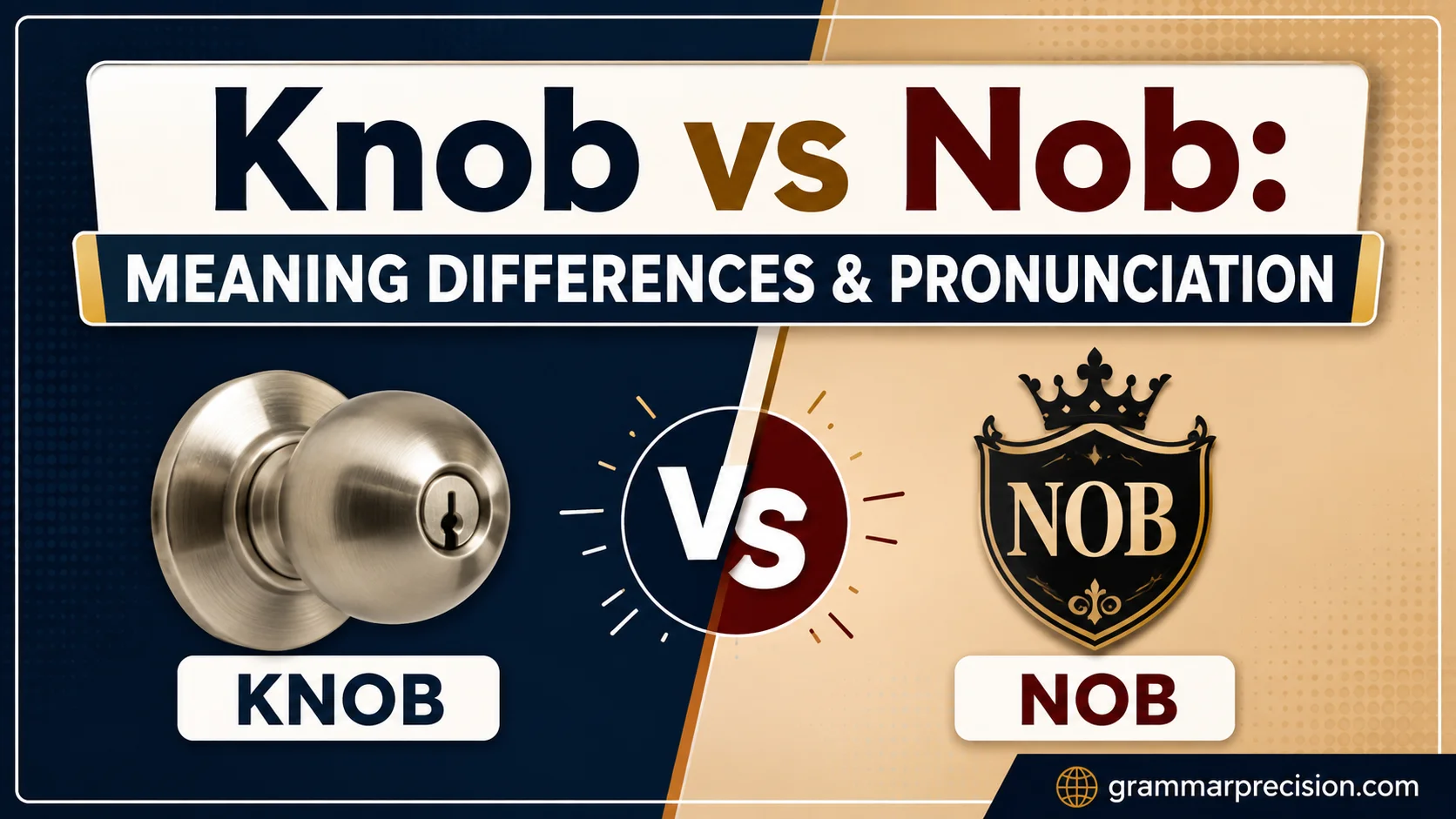
Knob vs Nob can confuse English learners because these homophones sound alike but have different meanings. A knob is an object, while a nob describes a person.
A knob usually means a rounded handle on a door, drawer, or piece of equipment. It can also act as a control or switch for a device, such as a radio or television. The word may also describe a small rounded protuberance or a small hill.
A nob is mainly a British English term for a person with wealth or high social position. It may refer to someone in the aristocratic class, a superior, or a person of status. Unlike knob, this word relates to people and social rank rather than physical objects or controls.
Knob vs Nob at a Glance
The easiest way to separate these words is to focus on meaning rather than sound.
| Word | Main meaning | Common context | Pronunciation |
| Knob | A rounded handle, control, projection, or feature | Doors, cabinets, machines, objects | Usually sounds like “nob” |
| Nob | A British informal term for an important or socially prominent person | British informal speech | Usually sounds like “nob” |
So, if you write, “Turn the nob to open the door,” the spelling is wrong in standard English. The correct sentence is “Turn the knob to open the door.”
On the other hand, if a British speaker says someone is “a bit of a nob,” they aren’t talking about a door handle. They’re using an informal term for a person, often with a mocking or insulting tone.
That distinction gives you a reliable rule:
- Knob usually names a thing, feature, or control.
- Nob usually describes a person in British informal usage.
- Both words are commonly pronounced the same.
What Does “Knob” Mean?
The word knob has several established meanings. Its most familiar meaning describes a small, rounded object that you can hold, turn, push, or adjust.
Think about a bedroom door. The rounded piece you grip to open it is a door knob. A cabinet may have a smaller knob that you pull. A stove, radio, amplifier, or other device can also have a knob that you turn to control a setting.
Knob as a Handle
The most common everyday use refers to a rounded handle or grip.
Examples include:
- a door knob
- a drawer knob
- a cabinet knob
- a furniture knob
- a decorative knob
Consider this sentence:
She turned the brass knob and opened the old wooden door.
Here, knob identifies a physical object. There’s no reason to use nob.
Knob as a Control
A knob can also control a machine or electronic device. Instead of opening something, you may turn it to change a setting.
For example:
- Turn the volume knob clockwise.
- The oven has a separate temperature knob.
- Adjust the brightness knob until the screen looks comfortable.
- He turned the radio knob slowly.
This meaning has become especially familiar in technical and household contexts. A knob can control volume, temperature, pressure, speed, frequency, intensity, or another variable.
Knob as a Rounded Projection
The word can describe something that sticks out in a rounded or lump-like shape. In this sense, the object doesn’t necessarily function as a handle.
For instance, a surface may have a small knob or rounded projection. The term can also describe a rounded anatomical feature in some technical contexts.
Knob as a Hill or Elevated Feature
In some varieties of English, particularly American regional usage, knob can describe a rounded hill or mountain-like elevation.
You may encounter names such as Knob Hill in geographic contexts. Here, the word has nothing to do with a handle. It describes the shape of the land.
That broader meaning explains why knob can appear in place names and geographic descriptions.
What Does “Nob” Mean?
Nob is a real English word, but it has a much narrower everyday role than knob. It’s chiefly associated with British informal English.
A nob can refer to a person who is wealthy, socially important, influential, or regarded as part of a higher social class. The word often carries a sarcastic or dismissive flavor.
For example:
He acted like a nob who expected everyone to serve him.
The sentence isn’t praising the person. It suggests arrogance, entitlement, or an exaggerated sense of status.
Nob as British Slang
In modern British usage, nob can function as informal slang. Its tone depends heavily on the sentence and speaker.
You might see it used humorously among friends, in fiction, or in informal commentary. In a formal business letter, academic paper, or professional report, however, it would usually be out of place.
That makes register important. Knowing what a word means isn’t enough. You also need to know where and how people normally use it.
Nob as an Insult
In some contexts, nob is used as a mild insult for someone considered unpleasant, pretentious, foolish, or arrogant. The exact force varies with dialect and situation.
For example:
Don’t be such a nob.
That sentence clearly isn’t describing someone’s social position neutrally. It’s an insult.
Because slang changes quickly, the safest approach is to treat nob as informal and context-sensitive. If you’re writing formal American English, you’ll rarely have a reason to use it.
Are Knob and Nob Homophones?
In most common pronunciations, knob and nob are homophones. That means they have the same pronunciation but different spellings and meanings.
The word knob contains a silent k. You don’t pronounce the first letter.
So:
- knob → sounds like nob
- nob → sounds like nob
This is one reason the pair causes spelling mistakes. When you hear the word, your ears can’t tell you which spelling the writer intended. You have to use the context.
English contains many similar examples:
- knee / nee in contexts where the latter might occur as a name or abbreviation
- know / no
- knight / night
- knife / nife as a spelling contrast, although nife isn’t a standard word
The important lesson is simple: pronunciation doesn’t always reveal spelling in English.
Why Does “Knob” Have a Silent K?
The silent k in knob reflects an older English spelling pattern. English once pronounced the initial consonant cluster in words beginning with kn- more fully than modern English does.
Over time, pronunciation changed. The k disappeared from ordinary speech, but the spelling remained.
That pattern appears in several familiar words:
| Word | Modern pronunciation | Silent letter |
| knob | nob | K |
| knee | nee | K |
| knife | nife | K |
| knight | nite | K |
| know | no | K |
This history is useful because it gives you a memory trick. When you see a physical knob, remember that it belongs to the same old spelling family as knee and knife.
The spelling may look old-fashioned, but it’s completely standard.
Also Read This: Renumeration vs Remuneration: Meaning Spelling & Pronunciation
Knob vs Nob in American and British English
Regional English matters here.
Knob is a normal word in both American and British English. You can use it for doors, cabinets, controls, rounded features, and other established meanings.
Nob, however, is much more strongly associated with British English. American readers may recognize it from British books, television, films, or online discussions, but it isn’t a common everyday American term.
This creates an important practical difference.
| Situation | Best choice |
| Door handle | Knob |
| Cabinet handle | Knob |
| Machine control | Knob |
| Rounded projection | Knob |
| Rounded hill in some geographic usage | Knob |
| British informal term for a socially important person | Nob |
| British insult | Nob, depending on context |
If your audience primarily uses US English, knob will almost always be the relevant spelling when discussing an object.
The History Behind “Knob”
The history of knob helps explain why the word has such a broad range of meanings.
English dictionaries trace knob to older Germanic forms associated with a rounded protuberance, lump, or projection. Over centuries, the word developed into the familiar senses involving rounded objects and handles.
That semantic connection is easy to see. A door knob is essentially a rounded projection designed for the hand. A knob on a machine is a raised control. A rounded hill can resemble a large natural knob rising from the surrounding landscape.
In other words, the different meanings aren’t random. They share the underlying idea of something rounded or projecting outward.
Where Did “Nob” Come From?
The history of nob is more specialized. The word has long been connected with British informal language and ideas of social prominence or rank.
Historical dictionary sources record nob as a term associated with a person of wealth or social standing. Its modern informal use can be neutral, humorous, sarcastic, or insulting depending on context.
That evolution illustrates an important feature of English slang: words can develop social meanings that aren’t obvious from their spelling.
Knob vs Nob: Real-World Examples
Context makes this spelling difference much easier to remember.
Examples With Knob
The brass knob on the cabinet came loose.
Turn the knob gently to increase the volume.
The old door has a heavy wooden knob.
A small knob controls the oven temperature.
The hikers climbed the rounded knob of land before sunset.
Every example refers to an object, control, or physical feature.
Examples With Nob
He sounded like a nob when he complained about the service.
The character is portrayed as a wealthy nob with little patience.
Stop acting like a nob and apologize.
These examples use nob in informal British-style contexts involving a person.
A Simple Contrast
She turned the knob.
He acted like a nob.
One letter changes the spelling, while the context changes the meaning completely.
Common Mistakes With Knob and Nob
These mistakes usually happen because people write what they hear.
Mistake: Writing “Nob” for a Door Handle
Incorrect:
Turn the nob.
Correct:
Turn the knob.
The silent k belongs in the standard spelling.
Mistake: Assuming “Knob” Is Always the Answer
Although knob is far more common, you shouldn’t automatically replace every instance of nob.
If a British text uses nob to describe a person, changing it to knob could change the intended meaning.
Mistake: Using British Slang in Formal Writing
Even when nob is understood, its informal tone can make professional writing sound careless.
Instead, choose a precise description such as:
- wealthy person
- socialite
- aristocrat
- influential person
- arrogant person
The best alternative depends on the intended meaning.
A Quick Memory Trick for Knob vs Nob
Here’s an easy way to keep the two words straight:
K = Knob = Keep turning it.
Picture a door. Your hand reaches for the knob, and you turn it.
For nob, think:
Nob = Name for a person in British informal usage.
It isn’t a perfect historical rule, but it works as a practical spelling reminder.
You can also remember the sentence:
You turn a knob, but you might call an arrogant person a nob.
That single contrast covers the most important difference.
Knob vs Nob: Quick Practice Quiz
Choose knob or nob in each sentence.
- Please turn the ___ to lower the volume.
- The old cabinet has a beautiful brass ___.
- He was acting like a complete ___.
- The oven temperature ___ is broken.
- She grabbed the door ___ and pulled.
Answers
- knob
- knob
- nob
- knob
- knob
Notice the pattern. Four examples describe physical objects or controls. Only one describes a person in an informal British context.
A Real-World Case Study: Why Context Wins
Imagine proofreading a home-improvement guide that says:
“Grip the nob firmly and rotate it clockwise.”
The pronunciation won’t help you spot the error. Context will. The sentence describes a physical control, so knob is the correct spelling.
Now imagine a British comedy script containing:
“Don’t be such a nob.”
Changing nob to knob would make the sentence look completely different. Here, the writer is using an informal term for a person.
This gives you a useful proofreading method. When two words sound alike, ask:
- What does the word refer to?
- Is the context formal or informal?
- Does it describe an object or a person?
Those three questions usually reveal the correct spelling immediately.
Related Words and Precise Usage
When you mean a door fixture, related words include handle, latch, lock, hinge, and doorknob. These terms aren’t interchangeable because each names a different part.
When nob refers to a person, nearby words include aristocrat, elite, socialite, and snob. However, these aren’t exact synonyms. A snob, for example, is someone who behaves as though they’re socially or culturally superior.
That small distinction matters. Good writing doesn’t merely find a similar word. It finds the word that fits the meaning, tone, and context.
FAQs:
What is the difference between knob and nob?
Knob usually refers to a rounded handle, control, or small protrusion, while nob is mainly a British English term for a person of high social position. Although they sound identical, they have completely different meanings and uses.
Are knob and nob homophones?
Yes. Knob and nob are homophones because they are pronounced the same way but have different spellings and meanings. Their pronunciation can cause confusion, so you need to consider the context to choose the correct word.
What does knob mean in English?
A knob is commonly a handle on a door or drawer. It can also be a control or switch on a device, such as a radio or television. The word may also describe a small rounded protuberance or hill.
What does nob mean?
Nob is primarily a British English word describing someone with wealth, high social position, or an aristocratic background. It can also refer to a superior or person of status and may sometimes be used as an insult.
How can I remember knob vs nob?
Remember knob with the k for a physical object you can grip or turn, such as a door knob. Nob without the k relates to a person of status. Thinking about the meaning rather than pronunciation makes the distinction easier.
Conclusion:
Understanding knob vs nob becomes simple when you focus on their meanings. Knob refers to a handle, control, or physical object, while nob describes a person with status, wealth, or social rank. Although these words are homophones, their spelling and usage differ. Remembering their contexts will help you choose the correct word confidently in everyday English writing and speech.